
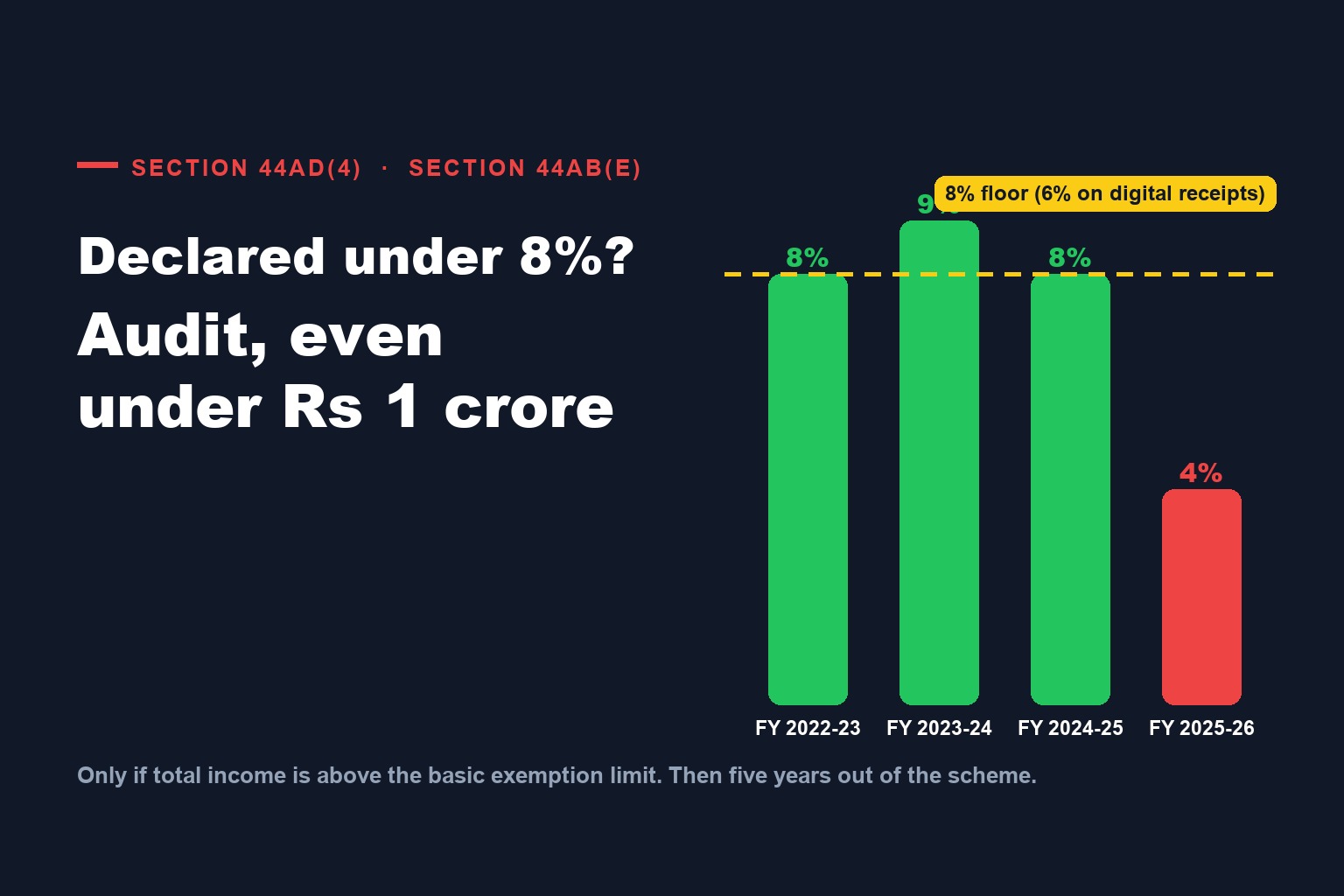

TL;DR: A business with turnover under Rs 1 crore is outside the turnover test in Section 44AB(a), but it is not automatically outside tax audit. Section 44AB(e) requires an audit where Section 44AD(4) applies and total income exceeds the basic exemption limit. Section 44AD(4) applies when you declared profit under the presumptive scheme in an earlier year and, in any of the next five assessment years, declare profit not in accordance with Section 44AD(1), that is, below 8 per cent of turnover (6 per cent on the part received digitally by the return due date). So for AY 2026-27: used 44AD in any year from AY 2021-22 onwards, declaring below the presumptive rate now, total income above Rs 4 lakh (new regime) or Rs 2.5 lakh (old): audit by 30 September 2026, books of account, and five years out of the scheme. Two people this does not catch, despite what they are often told: the business that never used Section 44AD and is declaring a low profit on regular books, and the one whose total income is below the exemption limit.
1. The two conditions, in the statute’s words
Section 44AB(e) brings into audit a person “carrying on the business” if “the provisions of sub-section (4) of section 44AD are applicable in his case and his income exceeds the maximum amount which is not chargeable to income-tax in any previous year”. Section 44AD(5) says the same from the other side: an eligible assessee to whom sub-section (4) applies, whose total income exceeds that amount, must keep books under Section 44AA(2) and get them audited under Section 44AB. Both conditions have to hold.
Condition 1: Section 44AD(4) applies. Sub-section (4) reads: where an eligible assessee declares profit for any previous year in accordance with the provisions of this section, and declares profit for any of the five assessment years relevant to the previous year succeeding that year not in accordance with sub-section (1), he is not eligible for the scheme for the five assessment years after the year of the low declaration. It has a starting point (a year in which you did declare under 44AD) and a trigger (a later year, within five, in which you declare below the sub-section (1) rate). Without the starting point there is no sub-section (4) to apply.
Condition 2: total income above the basic exemption limit. Total income from all heads, after deductions, for the year of the low declaration. For AY 2026-27 the limit is Rs 4,00,000 under the new regime and Rs 2,50,000 under the old (Rs 3,00,000 for a resident aged 60 or more, Rs 5,00,000 for 80 or more). A business declaring 4 per cent on Rs 60 lakh (Rs 2,40,000) with nothing else is below both limits and is not in audit under clause (e); add Rs 2 lakh of income from house property (that is, rent after the 30 per cent deduction) and it is.
2. What “in accordance with sub-section (1)” means
Section 44AD(1) deems profit at 8 per cent of turnover or gross receipts, or a higher amount if you claim one. The proviso substitutes 6 per cent for the part of turnover received by account-payee cheque, account-payee draft, ECS or a prescribed electronic mode, during the year or before the Section 139(1) due date. The two rates apply to two slices of the same turnover, so the “floor” for a business that collects half in cash and half through those modes by the due date is 7 per cent of the whole. Declaring at or above that blended floor is in accordance with sub-section (1); anything below it is not, and is what sub-section (4) calls declaring profit not in accordance with the provisions.
Two consequences people miss. First, a trader who declares more than 8 per cent because that is the real profit is still in accordance with sub-section (1), and is still on the presumptive scheme with no books and no audit. Second, the rate is on turnover, not on income from all sources: a business with a 3 per cent margin that also has large interest income has a Section 44AD problem regardless of the interest.
3. Who is not caught
- The business that never opted in. A person who has always declared on regular books and now shows a 4 per cent profit on Rs 80 lakh turnover is not in Section 44AD(4), because there is no earlier year of presumptive declaration to start the clock. Section 44AB(a) does not apply below Rs 1 crore. There is no audit. What may apply is Section 44AA(2): books of account must be kept where income exceeded Rs 1,20,000 or turnover exceeded Rs 10,00,000 in any of the three immediately preceding years (Rs 2,50,000 and Rs 25,00,000 for an individual or HUF), with a separate test for a newly set-up business; at Rs 80 lakh of turnover an existing business will usually be over it. A low profit on regular books can be questioned in assessment, and the books are what answer the question; that is a different risk from an audit obligation, and conflating the two is how small businesses get told to pay for an audit they do not need.
- Total income below the limit. Section 44AD(4) still applies, and the five-year exclusion still runs, but Section 44AB(e) and the Section 44AD(5) books requirement do not.
- Turnover above the scheme. A business with turnover above Rs 2 crore (Rs 3 crore where cash receipts are within 5 per cent) is not carrying on an eligible business for the year; it is in Section 44AB(a) territory on the Rs 1 crore / Rs 10 crore tests, and the 8 per cent question does not arise.
- More than five years ago. If the last presumptive year was AY 2020-21 or earlier, the five assessment years relevant to the succeeding previous years have run out by AY 2026-27, and a low declaration now does not attract sub-section (4).
4. Professionals: Section 44ADA is different
The five-year clock is a Section 44AD device. Section 44ADA has no equivalent of sub-section (4). A professional who declared 50 per cent last year and declares 35 per cent this year is dealt with by Section 44AB(d): audit if the profit claimed is lower than the deemed 50 per cent and income exceeds the basic exemption limit. No lock-out follows; next year the professional may declare 50 per cent again. The same two-condition structure, without the five-year tail. Najma’s guide for freelancers filing under Section 44ADA covers the choice of form.
5. Worked cases for AY 2026-27
A. The trap, fully sprung. Suresh, turnover Rs 80 lakh in FY 2025-26, used Section 44AD for AY 2024-25. This year the real margin is 4 per cent, Rs 3,20,000, and he declares it. He also has Rs 3,00,000 of income from house property, after the 30 per cent deduction. Sub-section (4) applies (presumptive in AY 2024-25, low declaration within five years); total income Rs 6,20,000 exceeds Rs 4,00,000 (new regime). Result: books under Section 44AA(2), tax audit under Section 44AB(e) by 30 September 2026, return by 31 October, and no Section 44AD for AY 2027-28 to AY 2031-32.
B. Same facts, no rent, new regime. Total income Rs 3,20,000 is below the Rs 4,00,000 limit. No audit, no books under Section 44AD(5). The five-year exclusion still applies from AY 2027-28. Under the old regime the limit is Rs 2,50,000, Rs 3,20,000 exceeds it, and the audit applies: the regime changes the answer.
C. Never opted in. Meena has filed on regular books since she started in 2019. Turnover Rs 80 lakh, profit 4 per cent, plus Rs 3,00,000 of income from house property. Section 44AD(4) does not apply; Section 44AB(a) is not met. No audit. Books under Section 44AA(2), yes, on her preceding-year figures.
D. The choice, before it is made. Ravi, turnover Rs 90 lakh, used Section 44AD for the last three years, and this year’s real margin is 5 per cent. He can declare 8 per cent (6 per cent on the digital slice) and pay tax on income he did not earn, with no books and no audit; or declare 5 per cent, keep books, get audited if his total income is above Rs 4 lakh, and lose the scheme for five years. The arithmetic is the tax on the 3 per cent gap versus the audit fee and five years of book-keeping; for a Rs 90 lakh business at the lower slabs, the gap is often the cheaper option, but not always, and it is a decision to make on numbers rather than by default.
E. Above Rs 1 crore. Turnover Rs 1.5 crore, declares 8 per cent: no audit, because the proviso to Section 44AB (as substituted from 1 April 2024) takes a person declaring under Section 44AD(1) or 44ADA(1) out of the section, and Rs 1.5 crore is within the Rs 2 crore eligible-business ceiling in Section 44AD. Declares 5 per cent: clause (e) if sub-section (4) applies, and in any case Section 44AB(a) at Rs 1.5 crore unless cash receipts and cash payments are each within 5 per cent, in which case the Rs 10 crore test applies instead. The tax audit limit hub works through the cash tests.
6. What the audit involves, and what it costs to skip
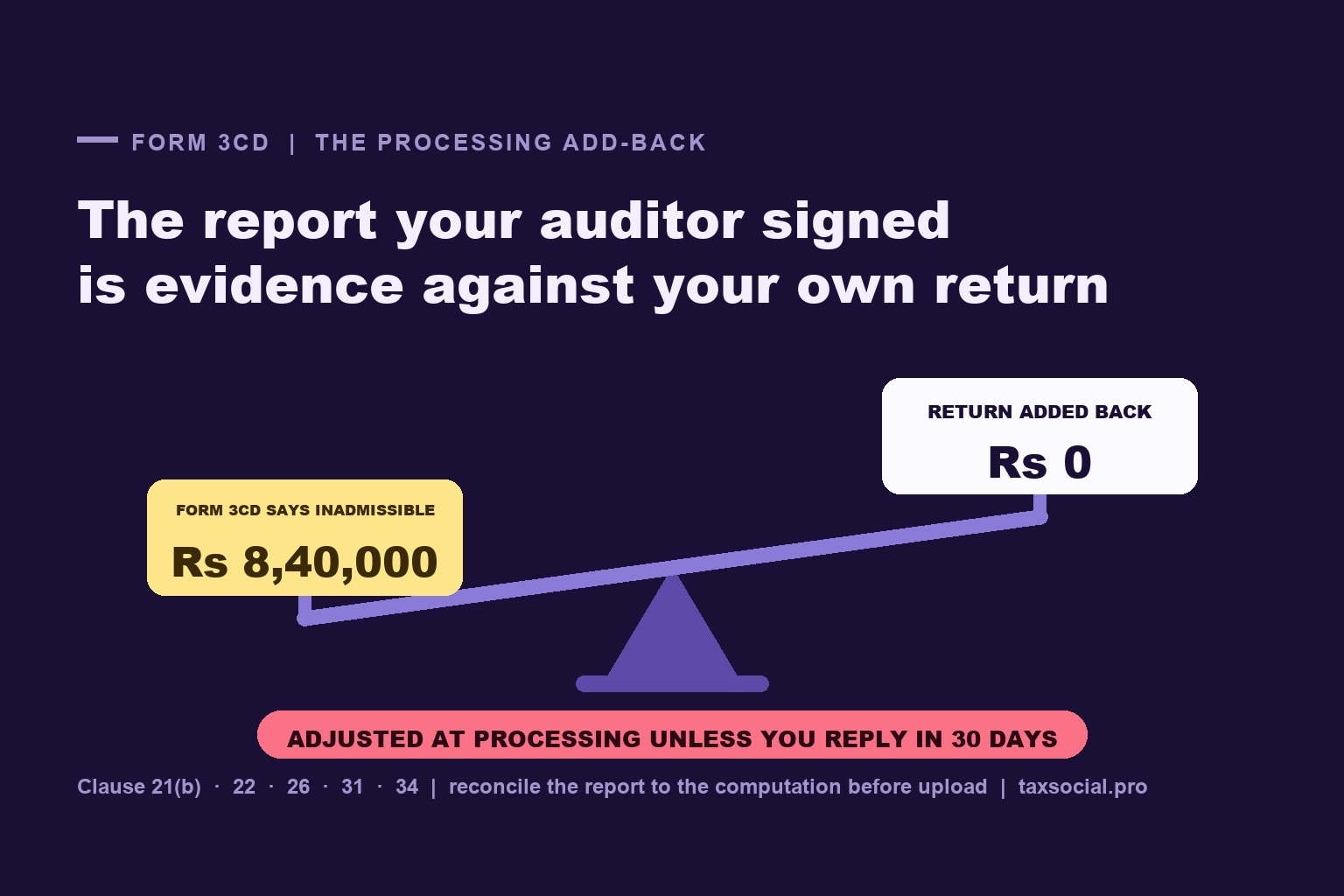
The audit is under Section 44AB like any other: Form 3CB and Form 3CD (Form 3CA where the accounts are already audited under another law), furnished by the specified date, 30 September 2026 for AY 2026-27, with the return by 31 October. Vijay’s Form 3CD checklist has the clauses that matter for a small business (Section 43B, MSME dues, cash transactions). Skipping it attracts Section 271B: one-half per cent of turnover, up to Rs 1,50,000, at the Assessing Officer’s discretion, with a reasonable-cause defence under Section 273B; Vijay’s Section 271B penalty explainer prices it. On Rs 80 lakh that is Rs 40,000.
7. Next year, under the 2025 Act
Tax year 2026-27 is governed by the Income-tax Act, 2025, where the presumptive scheme is Section 58 and the audit provision is Section 63. The design carries over: a five-year exclusion for the business row (Section 58(7)) and an audit where a lower profit is declared and total income exceeds the exemption limit. The section numbers change; the trap does not. Vijay’s explainer on presumptive taxation under Section 58 covers the new numbering, and Harsh’s page on Form 26, the audit report under the 2025 Act covers next September’s form.
8. Quick answers
Turnover Rs 70 lakh, profit 5 per cent, used 44AD last year, total income Rs 6 lakh. Audit under Section 44AB(e); books; out of the scheme for five years.
Same, but I have never used 44AD. No audit. Keep books under Section 44AA(2) if your preceding-year figures cross its thresholds.
Same, total income Rs 3.5 lakh, new regime. No audit (below Rs 4 lakh); the five-year exclusion still applies. On the old regime (limit Rs 2.5 lakh) the audit would apply.
I declared 9 per cent. Am I “not in accordance”? No. Declaring more than the deemed rate is in accordance with sub-section (1).
I collect entirely by UPI and declared 6 per cent. In accordance with the proviso, if the receipts came in by the return due date. No audit.
I am a doctor on 44ADA and declared 40 per cent. Section 44AB(d): audit if your income exceeds the exemption limit. No five-year lock.
Can I go back to 44AD after the five years? Yes, if you are otherwise eligible in that year.
Sources
- Income-tax Act, 1961 — Section 44AD(1), proviso, (4), (5), (6) and Explanation; Section 44ADA; Section 44AA(2); Section 44AB(a), (d), (e), the proviso on Rs 2 crore and Explanation (ii); Section 271B; Section 273B.
- Finance Act, 2025 — basic exemption limit of Rs 4,00,000 under the new regime for AY 2026-27.
- Income-tax Act, 2025 — Section 58(7) and Section 63 (tax year 2026-27 onwards).
Written as at 10 September 2026 for AY 2026-27 (FY 2025-26) under the Income-tax Act, 1961. Take advice from a Chartered Accountant on a specific case; the decision in section 5D is a numbers decision.


Comments (0)
No comments yet. Be the first to comment!