
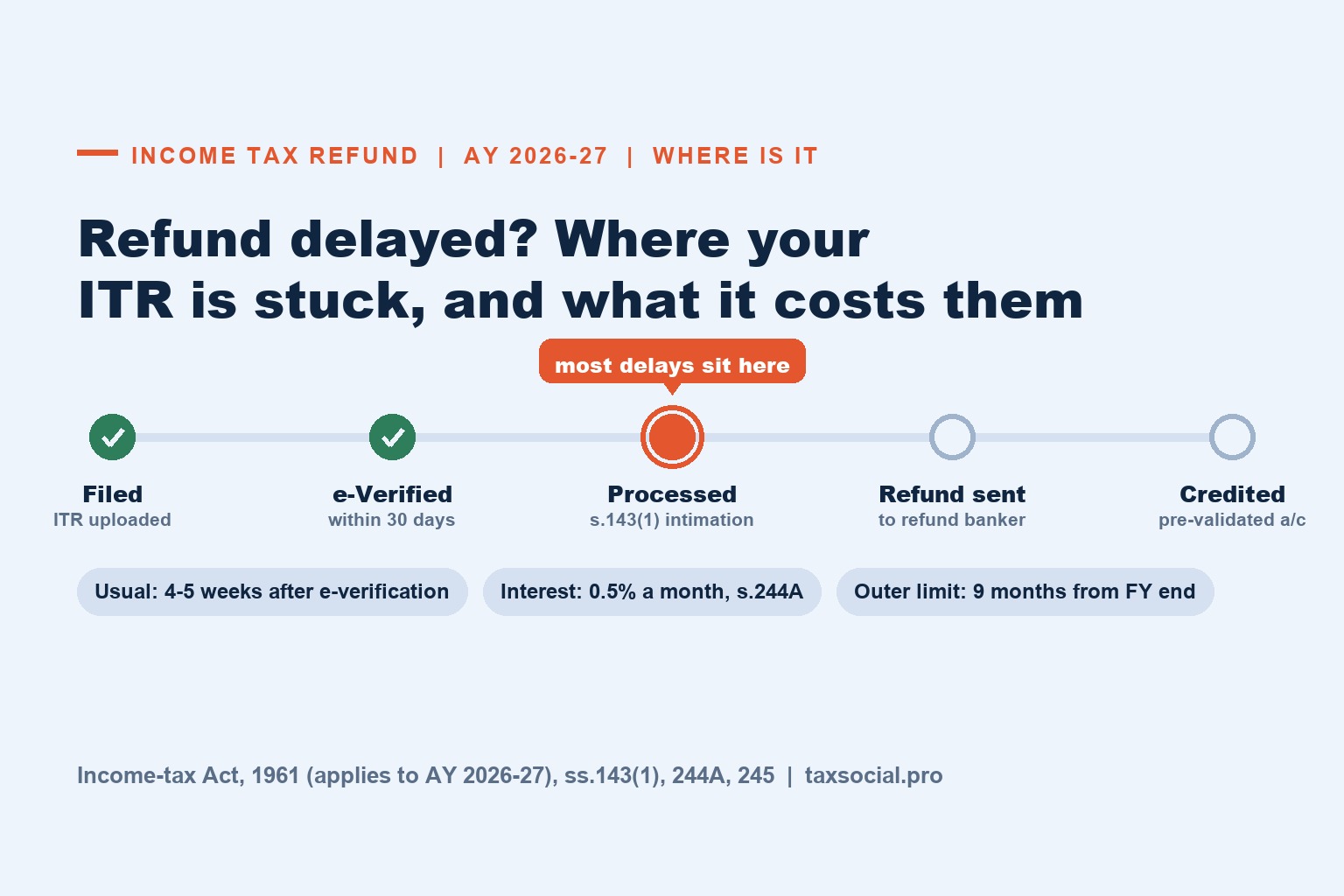

Four to five weeks after you e-verify is the department’s own figure; nine months from the end of the financial year you filed in is the law’s outer limit. A return for AY 2026-27 filed in July 2026 and e-verified the same day will, in the ordinary course, be processed under Section 143(1) and the refund credited within about five weeks. The Centralised Processing Centre has until 31 December 2027 to send the intimation for any AY 2026-27 return filed by 31 March 2027. Between those two dates a refund is “delayed” only in the everyday sense, and the delay is almost always one of eight things: not e-verified, bank account not validated, PAN inoperative, a mismatch the system wants you to explain, a defective return, an old demand being set off, a refund withheld because an assessment is open, or a return picked for a data-driven review. While you wait, the department owes you simple interest at one-half per cent a month under Section 244A, unless the refund is less than ten per cent of your tax or the delay was yours. AY 2026-27 is governed by the Income-tax Act, 1961; the section numbers below are the ones that apply to it.
1. How long it actually takes
The e-filing portal’s Refund Status manual says that refund processing starts only after the return is e-verified and that “it takes 4-5 weeks for the refund to be credited to the account”. That is the norm for a clean return: figures that match the Annual Information Statement and Form 26AS, a pre-validated bank account, an operative PAN. Two public numbers put the norm in context. Up to 10 August 2026 the department had issued Rs 1.43 lakh crore of refunds in the current financial year, about four per cent more than in the same period of 2025. And in a Rajya Sabha reply in February 2026 the Minister of State for Finance said that of the 8.8 crore returns filed for AY 2025-26, about 24.64 lakh, or 2.8 per cent, had been pending processing for more than 90 days. Most refunds arrive on time. A meaningful minority do not, and the reasons are knowable.
The statutory limit is different from the norm. Under the second proviso to Section 143(1), no intimation can be sent after nine months from the end of the financial year in which the return is made. A return for AY 2026-27 furnished at any time in FY 2026-27, whether on 25 July 2026 or as a belated return on 31 December 2026, can be processed up to 31 December 2027. Nothing obliges the CPC to use that time, and it rarely does for straightforward returns, but a refund that is six weeks late is not a refund the department has failed to pay within the law.
2. The pipeline, and what each status means
A return moves through five points, and the portal shows you which one it has reached under e-File, Income Tax Returns, View Filed Returns, View Details.
- Filed. The return is uploaded. Nothing happens until it is verified.
- e-Verified. Verification has to be completed within 30 days of uploading or by the statutory filing due date, whichever is later, under the Directorate of Systems’ notification of 2022 as amended in 2024. Where a verification after the 30 days is accepted, its date is treated as the date of furnishing the return, which can turn an on-time return into a belated one, with the Section 234F fee and a later start date for refund interest under Section 244A(1)(a)(ii). A return not verified by the applicable deadline is invalid unless the delay is condoned. Until this point the CPC has not started.
- Processed. The CPC has run the return under Section 143(1) and sent an intimation to your registered e-mail: refund, demand, or nil. If the system proposes an adjustment, you first get a proposal under Section 143(1)(a) with 30 days to respond, and processing pauses until you do or the window closes.
- Refund sent. The portal shows “Refund Issued” with the date it went to the refund banker and the last four digits of the account. Two variants at this point are “Refund Partially Adjusted” and “Refund Fully Adjusted”, which mean an outstanding demand was set off under Section 245, and “Refund Failed”, which means the banker could not credit it.
- Credited. Usually a few working days after “Refund Issued”.
Two things about checking. The pre-login “Know your refund status” service on the portal takes a PAN and an assessment year and returns the same information without logging in. And the TIN-NSDL refund tracker that older guides point to is not where AY 2026-27 refunds are tracked; use the e-filing portal.
3. The eight reasons a refund is stuck
1. You have not e-verified. The single most common reason. Check the return’s status; if it says “Submitted and pending for e-Verification”, nothing else on this page matters until you fix it.
2. Bank account not pre-validated, or details wrong. The refund manual lists the failure causes in order: bank account not pre-validated, name on the account not matching the PAN, invalid IFSC, closed account. Go to My Profile, My Bank Account, validate the right account and nominate it for refund, then raise a reissue request (section 6).
3. PAN inoperative. If your PAN is inoperative for want of Aadhaar linkage, Rule 114AAA(3) and CBDT Circular 3/2023 are blunt: for a PAN made inoperative because Aadhaar was not intimated, no refund is made, and no interest accrues for the period the PAN stays inoperative. The portal shows a warning to link. Link, pay the Rs 1,000 fee, wait for the PAN to become operative, then check the refund status or raise a reissue request; the interest for the inoperative months is lost. Persons exempt from Aadhaar linking are not affected.
4. A mismatch the system wants explained. TDS claimed that is not in Form 26AS, income in the AIS that is not in the return, a deduction that does not fit the schedule. The CPC sends a Section 143(1)(a) proposal; you have 30 days to agree or disagree with reasons. Ignore it and the adjustment is made and the refund shrinks or becomes a demand.
5. Defective return. A notice under Section 139(9) with a time limit, usually 15 days, to correct the defect. Miss it and the return is treated as invalid, which is worse than a delay.
6. Set-off against an old demand. Section 245(1) lets the department adjust a refund against any tax you still owe for another year, after giving you an intimation in writing of the proposed adjustment. That intimation lands on the portal under Pending Actions, Response to Outstanding Demand, and if the demand is wrong, that is the place and the time to say so. If you do not respond, the adjustment goes through and the status reads “Partially” or “Fully Adjusted”.
7. Refund withheld because an assessment is open. Since 1 April 2023, Section 245(2) allows the Assessing Officer, where an assessment or reassessment is pending and he is of the opinion that granting the refund would adversely affect the revenue, to withhold it up to the date of that assessment, for reasons recorded in writing and with the prior approval of the Principal Commissioner or Commissioner. It needs four things: a pending assessment or reassessment, the officer’s opinion that the refund would hurt the revenue, reasons recorded in writing, and the Commissioner’s prior approval. If your refund is sitting on it, ask the portal or the jurisdictional officer for the Section 245(2) basis and take advice on the remedy; it is a reasoned order, not a silence.
8. A data-driven review. The February 2026 reply to the Rajya Sabha says the NUDGE communications asked taxpayers whose returns were selected by risk analysis, for undisclosed foreign assets or income, or for deductions under Sections 80G, 80GGC and 80E that did not fit the data, to review and revise or update their returns. It does not say that every selected refund was formally withheld pending an answer, but if you received such a communication and have not acted on it, that is the first place to look.
4. The interest the department owes you
Section 244A(1)(a) gives simple interest at one-half per cent for every month or part of a month on a refund of TDS, TCS or advance tax, from 1 April of the assessment year to the date the refund is granted. Three qualifications. No interest is payable under clauses (a) and (aa) if the refund is less than ten per cent of the tax as determined under Section 143(1) or on regular assessment. Where the return is filed after the due date, Section 244A(1)(a)(ii) starts the clock from the date of furnishing the return instead of 1 April; a refund of self-assessment tax paid under Section 140A runs under clause (aa) from the later of the return date and the payment date. And Section 244A(2) excludes any period of delay attributable to you, with the Principal Chief Commissioner, Chief Commissioner, Principal Commissioner or Commissioner deciding a dispute about which period that is, which is why an unverified return can cost you interest as well as time. One addition for appeal cases: where a refund arises from giving effect to an appellate or revision order and is delayed beyond the time Section 153(5) allows, Section 244A(1A) adds three per cent a year for the delay.
| Case | Facts | Interest under Section 244A |
|---|---|---|
| On-time return | Refund Rs 60,000; return filed 25 July 2026; refund granted 20 November 2026 | April to November 2026 = 8 months (a part month counts) × 0.5% = 4% → Rs 2,400 |
| Belated return | Same refund; return filed 15 September 2026; refund granted 20 November 2026 | September to November = 3 months × 0.5% = 1.5% → Rs 900 |
| Small refund | Refund Rs 4,000 against tax determined of Rs 50,000 (8%) | Below ten per cent → nil |
| Inoperative PAN | PAN inoperative from 1 April to 31 August 2026 | No interest for those five months |
The interest is paid with the refund and shown on the intimation. It is taxable: it is income from other sources in the year you receive it, and it appears in your AIS for that year, so it goes into next year’s return.
5. What to do, in order
- Confirm the return is e-verified. If not, verify now and read section 2, point 2, for what the late verification costs.
- Open View Filed Returns, View Details, and read the status. If it is “Processed” with a refund and no “Refund Issued” date after two weeks, check the bank account validation.
- Check Pending Actions for a Section 143(1)(a) proposal, a Section 139(9) defect notice, or a Section 245 intimation. Respond within the window.
- Check that the PAN is operative under My Profile.
- If the status is “Refund Failed”, raise a reissue request (section 6).
- If the intimation has a mistake apparent from the record, file a rectification request under Section 154 from the portal rather than a grievance.
- If none of that applies and five weeks have passed since e-verification, raise a grievance on the portal under e-Nivaran, or call the CPC helpline. Keep the acknowledgment number.
6. Refund reissue in five steps
Log in; go to Services, Refund Reissue; click Create Refund Reissue Request; select the return whose refund failed; choose a validated bank account (validate one first under My Bank Account if none shows); e-verify the request with Aadhaar OTP, a digital signature or an EVC. A transaction ID is e-mailed and texted. After a successful reissue request, the department’s refund-failure communications say the credit may take 7 to 10 days; check the request status if it does not arrive.
7. If the nine months pass with no intimation
The Section 143(1) time limit is a bar on sending an intimation after it, not a rule that a refund claimed in the return stands determined. The acknowledgment is deemed to be the intimation only where nothing is payable or refundable and no adjustment has been made, so it does not cover a refund case. If a refund return is still unresolved once the limit has passed, raise a grievance on the portal with the acknowledgment and the supporting records, and take case-specific advice before considering a writ petition. In practice the CPC processes far inside the limit, and the cases that reach the end of it are the ones under review in section 3, point 7 or 8.
FAQ
In how many days does an income tax refund come? Four to five weeks after e-verification for a clean return, by the department’s own manual. The legal limit is nine months from the end of the financial year the return was filed in.
How do I check the refund status? Log in to the e-filing portal, e-File, Income Tax Returns, View Filed Returns, View Details; or use the pre-login refund status service with your PAN and assessment year.
What does “Refund Failed” mean? The refund banker could not credit your account: not pre-validated, name mismatch, wrong IFSC, closed account, or inoperative PAN. Fix the cause and raise a reissue request.
What does “Refund Adjusted” mean? An outstanding demand for another year was set off under Section 245 after an intimation to you.
Do I get interest on a late refund? Yes, 0.5 per cent for every month or part of a month under Section 244A from 1 April 2026 (or from the date of filing if the return was late), unless the refund is under ten per cent of your tax determined or the delay was attributable to you.
Is the interest taxable? Yes, as income from other sources in the year received.
Can the department hold my refund because I have a scrutiny notice? Only under Section 245(2), while an assessment or reassessment is pending, for reasons recorded in writing and with the Commissioner’s prior approval.
Which Act applies? The Income-tax Act, 1961, for AY 2026-27. The 2025 Act applies from tax year 2026-27.
Sources
- Income-tax Act, 1961, ss.139(9), 143(1) and its proviso, 143(1)(a), 154, 234F, 244A, 245(1) and (2).
- Income-tax Rules, 1962, Rule 114AAA; CBDT Circular No. 3/2023 dated 28 March 2023.
- Directorate of Income-tax (Systems) Notification No. 05/2022 dated 29 July 2022 (30-day verification).
- e-Filing portal, Refund Status User Manual and Refund Reissue User Manual, as read on 15 September 2026.
- Government data on direct tax collections and refunds as on 10 August 2026 (reported 11 August 2026).
- Rajya Sabha, unstarred question on income-tax refunds, reply of the Minister of State for Finance, February 2026 (data as at 4 February 2026).



Comments (0)
No comments yet. Be the first to comment!