
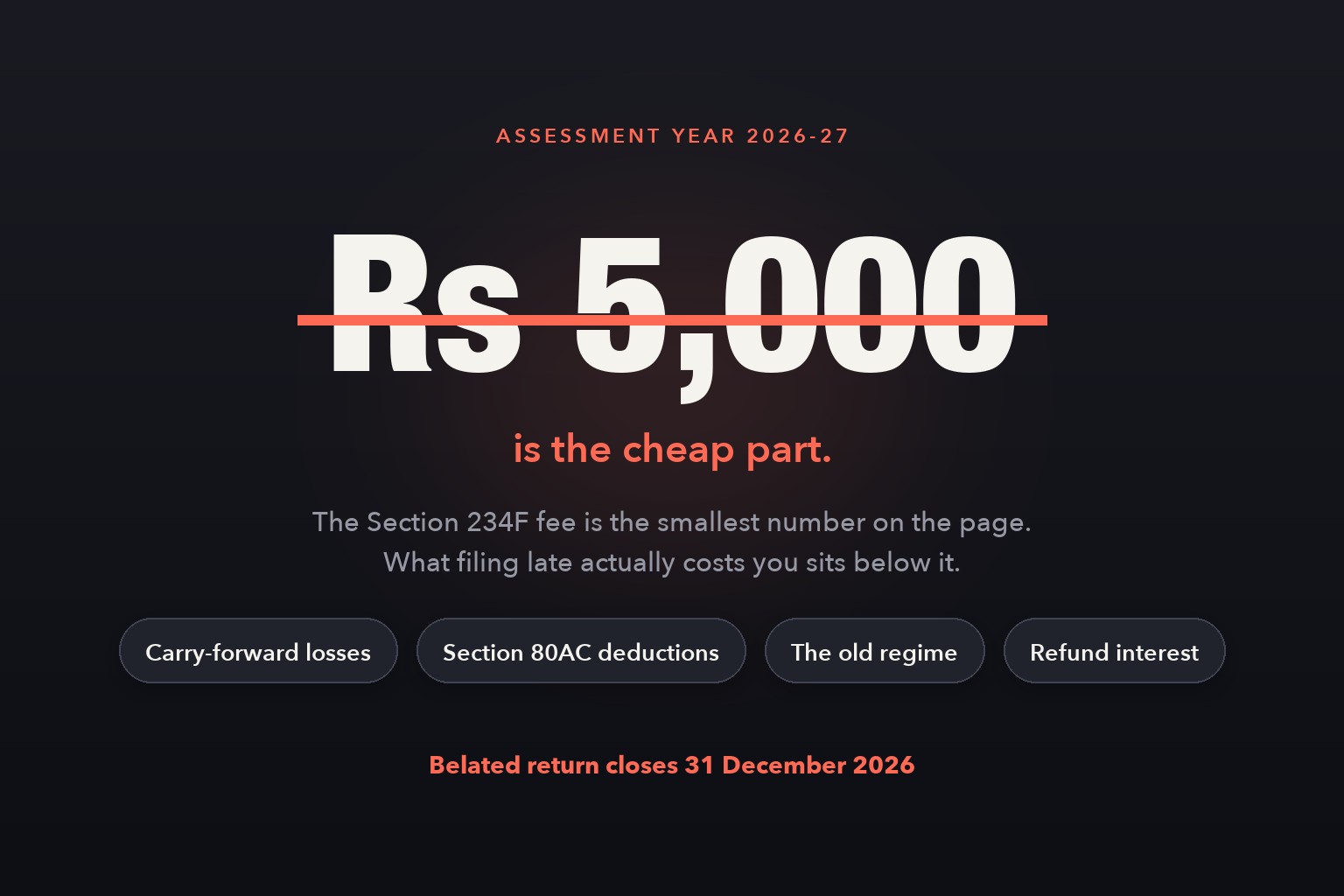

TL;DR: If you missed your due date for AY 2026-27, you can still file a belated return under Section 139(4) up to 31 December 2026. The late fee under Section 234F is Rs 5,000, or Rs 1,000 if your total income does not exceed Rs 5 lakh. That fee is the part everyone talks about, and it is almost always the cheapest thing about being late. The expensive part is silent: business and capital losses you can no longer carry forward, the entire class of deductions Section 80AC shuts off, the old regime you are no longer allowed to choose, and refund interest that now starts from the day you file instead of from 1 April. For some filers those four together cost nothing. For a trader, a start-up or a co-operative society they can run into lakhs.
1. First, work out which due date was actually yours
This matters more this year than it used to, because the Finance Act, 2026 split the old common 31 July date. For AY 2026-27 there is no longer one answer for everyone who is not under audit.
| Who you are | Due date under Section 139(1) for AY 2026-27 |
|---|---|
| Salaried, pension, house property, capital gains — typically ITR-1 or ITR-2 | 31 July 2026 |
| Income from business or profession, accounts not required to be audited — in practice ITR-3 or ITR-4 | 31 August 2026 — new this year |
| Accounts required to be audited under the Act | 31 October 2026 |
| Cases requiring a transfer pricing report in Form 3CEB | 30 November 2026 |
The 31 August date is genuinely new, and it is permanent — the Finance Act, 2026 substituted Explanation 2 to Section 139(1) rather than granting a one-off extension. It is also the row people misdescribe most often. The statutory test is whether you have income from business or profession and your accounts are not required to be audited. It is not "you filed ITR-3 or ITR-4". The two usually land in the same place, but the law keys off the nature of your income, not the form you picked. Someone with only salary and capital gains had 31 July whichever form they used.
So check which row is yours before concluding anything about your own position, because everything that follows keys off the 139(1) date for you. A freelancer who assumed 31 July spent a month worrying early. One who has not filed yet is, as of today, a day late rather than a month late.
One clarification worth making early: being late is not the same as being barred. The belated window under Section 139(4) runs to 31 December 2026, or until your assessment is completed, whichever happens first. That second limb is not decorative — if the department completes assessment in November, your window closes in November.
2. The visible cost: the fee and the interest
Section 234F — the flat fee
Rs 1,000 where total income does not exceed Rs 5,00,000; Rs 5,000 in every other case. The portal computes it and will not let the return through without it, so there is nothing to plan around.
Two things people get wrong about it. First, the fee attaches to being required to file and filing late. If you were not required to furnish a return under Section 139 at all and you file voluntarily, there is no 234F fee. But do not read that as "my income was under the basic exemption limit, so I am safe" — income alone is not the test. The provisos to Section 139(1) can require a return regardless of income, on triggers such as large current-account deposits, foreign travel spending, high electricity expenditure, and holding foreign assets or signing authority over a foreign account. Check whether one of those catches you before concluding the fee does not apply. Second, it is a fee, not a penalty: there is no discretion in it, no waiver application, and no argument about reasonable cause.
Section 234A — interest on what you still owe
One per cent per month, or part of a month, from the day after your due date until you furnish the return. Critically, it runs only on tax that is still unpaid after credit for TDS, TCS, advance tax and reliefs. If your employer deducted enough and nothing further is due, 234A can be nil no matter how late you are.
"Part of a month" is the sting. Filing on the 1st and filing on the 28th of the same month cost exactly the same, so once you have crossed into a month there is no interest reason to rush — but there is every reason not to cross into the next one.
3. The four costs nobody puts on the poster
3.1 The losses you can no longer carry forward
This is usually the largest number on the page. Section 80, read with Section 139(3), says that losses are not carried forward to future years unless the return was filed within the Section 139(1) time. File late and the following are simply gone for the future:
- Business loss under Section 72
- Speculation loss under Section 73
- Specified business loss under Section 73A
- Capital loss under Section 74 — both short-term and long-term
- Loss from owning and maintaining race horses under Section 74A
Two things survive a belated return, and they are worth knowing because people write off more than they need to:
- Loss from house property under Section 71B. It sits outside the Section 80 bar and can still be carried forward for up to eight assessment years. For anyone with a let-out property and a large home loan, this is the single most valuable exception.
- Unabsorbed depreciation under Section 32(2). It is not treated as a loss carried forward under the Chapter VI provisions at all, so the Section 80 bar does not reach it. It continues indefinitely.
And one clarification that saves a lot of unnecessary alarm: Section 80 restricts carry forward, not set-off within the same year. Setting a current-year loss against current-year income under Sections 70 and 71 is unaffected by filing late. What you lose is the ability to take the unabsorbed part into future years.
3.2 Section 80AC — deductions that vanish entirely
Section 80AC says no deduction shall be allowed under the heading "C.—Deductions in respect of certain incomes" in Chapter VI-A unless the return is furnished on or before the 139(1) due date. Not reduced. Not deferred. Not allowed.
That heading covers, among others, Sections 80-IA, 80-IAB, 80-IAC, 80-IB, 80-IBA, 80-IC, 80-ID, 80-IE, 80JJA, 80JJAA, 80LA, 80P, 80QQB and 80RRB. The consequence is brutal and it lands hardest on entities rather than individuals:
- A start-up claiming Section 80-IAC in one of its three eligible years loses the whole deduction for that year. There is no second chance at it.
- A co-operative society claiming Section 80P loses it. This has been litigated repeatedly and the courts have treated the condition as mandatory, not procedural.
- A business claiming Section 80JJAA for additional employee cost loses that year's claim, and 80JJAA is one of the few heading-C deductions that is still available under the new regime, so this bites even where the regime question below does not.
Note what Section 80AC does not cover: the familiar personal deductions such as 80C, 80D and 80TTA sit under a different heading and are outside its bar. For an individual filing belated, though, that is cold comfort — as the next point explains, they have usually already gone for a different reason.
3.3 The old regime is off the table
The new regime is the default. Choosing the old one is an opt-out under Section 115BAC(6), and the timing of that opt-out is tied to the return under Section 139(1):
- If you have business or professional income, the option is exercised in Form 10-IEA on or before the 139(1) due date.
- If you do not have business or professional income, it is exercised in the return furnished under Section 139(1).
A belated return is furnished under Section 139(4), not 139(1). So a belated return goes in under the new regime, and the utility will not let you do otherwise. The trap that catches people hardest: filing Form 10-IEA on time does not save you if the return itself is late. The form is a condition, not the exercise of the option in isolation.
Whether this costs you anything depends entirely on your own numbers. If the new regime was better for you — and for a great many salaried filers with modest deductions it now is — you lose nothing at all here. If you were carrying a large home loan interest claim, a full 80C, HRA and a health insurance premium, and the old regime was materially cheaper for you, then this one line can dwarf the Rs 5,000 fee several times over.
3.4 Refund interest starts months later
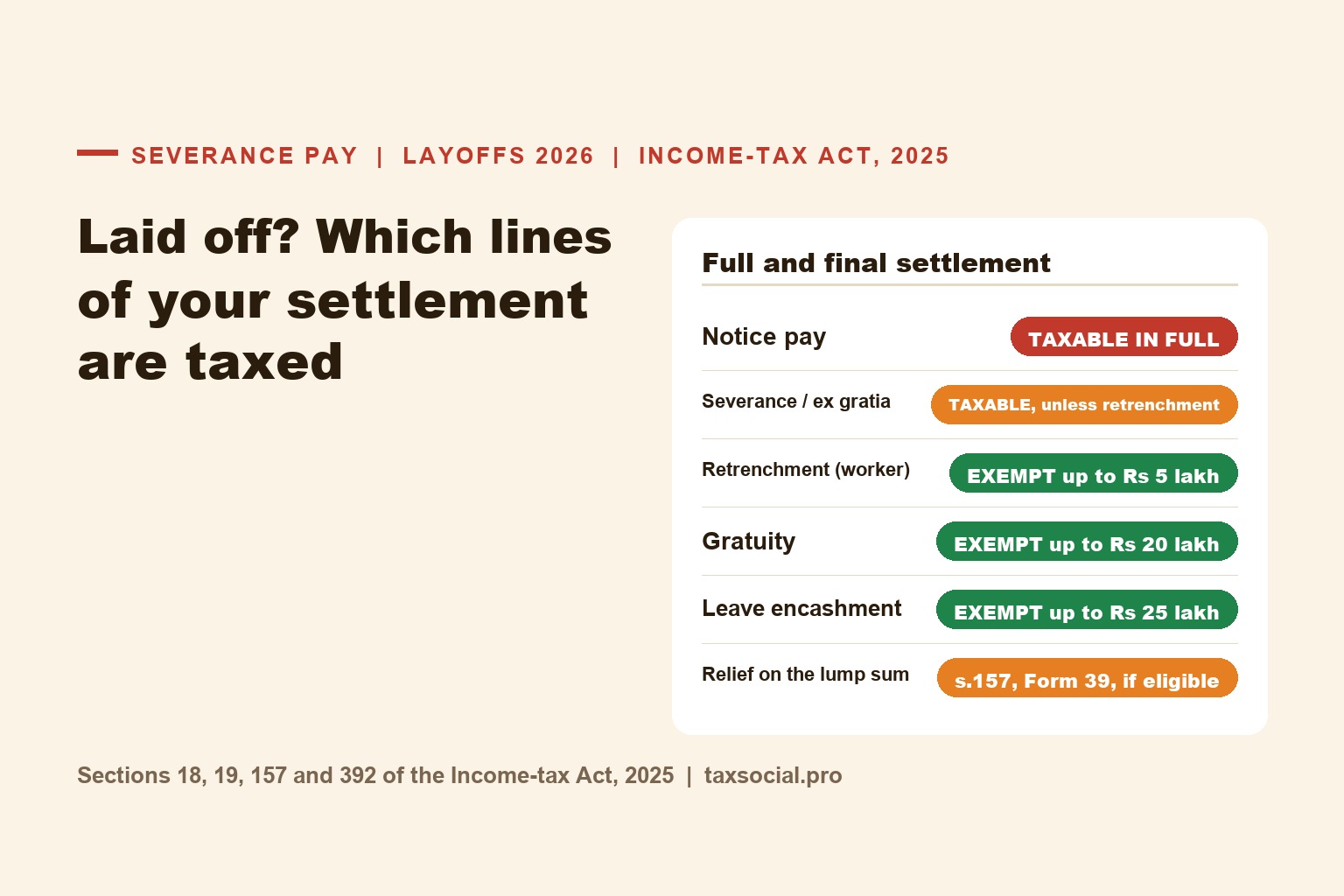
Where a refund is due out of TDS, TCS, advance tax or tax treated as paid under Section 199 — which is the ordinary salaried case — Section 244A(1)(a) pays simple interest at half a per cent per month or part of a month. The period it runs for depends on when you filed:
- Return furnished by the due date: interest runs from 1 April of the assessment year to the date the refund is granted.
- Return furnished in any other case: interest runs only from the date of furnishing the return.
So a filer with a Rs 60,000 refund who files on 15 December 2026 rather than in July has given up roughly eight months of interest on that money — around Rs 2,400 — on top of everything else. It is rarely the biggest number in this article, but it is the one that is purely self-inflicted, because a refund case has no tax to fund and therefore no cash-flow excuse for the delay.
Two qualifications on this one. Clause (a) carries its own threshold — no interest is payable where the refund is less than ten per cent of the tax determined on summary processing or regular assessment. And a refund of self-assessment tax is not governed by clause (a) at all: it falls under Section 244A(1)(aa), which has its own start date. If your refund arises because you overpaid self-assessment tax rather than because too much was deducted at source, work from that clause instead.
4. Putting numbers on it
Case A — salaried, refund due, old regime was better
Total income Rs 9,80,000, TDS fully deducted by the employer, refund of Rs 60,000 expected. Due date 31 July 2026; files 15 December 2026. Suppose that on her own numbers — home loan interest, 80C, 80D — the old regime would have produced a liability Rs 34,000 lower than the new regime.
| Section 234F fee | Rs 5,000 |
| Section 234A interest | Nil — no tax outstanding |
| Regime differential now unavailable | Rs 34,000 |
| Refund interest forgone (approx. 8 months on Rs 60,000) | Rs 2,400 |
| Total cost of being late | Rs 41,400 |
The fee is twelve per cent of the bill.
Case B — F&O trader with a loss year
Non-speculative business loss of Rs 4,20,000 for FY 2025-26, ITR-3, due date 31 August 2026, files in November. He expects a profitable FY 2026-27 and had intended to set the loss off against it.
The Rs 4,20,000 cannot be carried forward at all. If it would have sheltered income otherwise taxed at the 30% slab plus 4% cess, the value destroyed is Rs 4,20,000 × 31.2% = Rs 1,31,040 — a little over twenty-six times the Rs 5,000 fee. And unlike the fee, there is no way to pay it and move on; the loss is simply not there in future years.
Case C — start-up in an 80-IAC year
An eligible start-up with a Rs 40,00,000 deduction claim under Section 80-IAC files after the due date. Section 80AC denies the deduction outright for that year. Assume for illustration that the company is taxed at the 25% base corporate rate: with the 4% cess that is Rs 40,00,000 × 26% = Rs 10,40,000 of tax on income that should not have been taxed at all, before any surcharge. The actual figure depends on the rate and regime that apply to the company. And because the deduction can be claimed in only three years out of ten, one of those three years has been spent for nothing.
5. What you have not lost
Filing late is expensive. Not filing is worse, and the difference between the two is large enough that nobody should read this article and conclude the door has shut.
- The belated return itself is still open until 31 December 2026, or completion of assessment if that comes first.
- A belated return can be revised. This has been the position for several years now — filing late does not cost you the ability to correct what you filed.
- Revision runs to 31 March 2027. The Finance Act, 2026 substituted Section 139(5) and extended the revised-return window to the end of the assessment year. It also introduced a fee under the new Section 234-I for revisions filed after 31 December, so it is a paid extension — but it is there.
- House property loss and unabsorbed depreciation still carry forward, as set out above.
- If 31 December passes with nothing filed, the updated return under Section 139(8A) remains, at a materially higher cost in additional tax.
- TDS credit is not forfeited by filing late. Your refund is delayed and its interest curtailed, not cancelled.
6. The mistakes that turn a small problem into a large one
- Assuming your due date was 31 July. For non-audit ITR-3 and ITR-4 filers it was 31 August this year. Getting this wrong in the other direction — assuming you have until 31 August when you file ITR-2 — costs you everything in section 3.
- Filing Form 10-IEA in time and then filing the return late. The form does not carry the old regime across on its own.
- Deciding not to file because the loss is gone anyway. The carry-forward is lost either way; not filing adds the fee, the interest, and a non-filer flag against a PAN with reported transactions behind it.
- Waiting to fund the tax before filing. Section 234A runs on unpaid tax until the return is furnished. Filing and then paying does not stop that clock, but it does stop the 234F position getting worse and preserves the 31 December window.
- Reading last year's article. AY 2026-27 is still an Income-tax Act, 1961 year — the Income-tax Act, 2025 and its "tax year" language apply to income earned from 1 April 2026 onward, not to this return. Section numbers written for the new Act do not describe this filing.
7. Sources
- Income-tax Act, 1961 — Sections 139(1), 139(3), 139(4), 139(5), 80, 80AC, 71B, 32(2), 70, 71, 72, 73, 73A, 74, 74A, 115BAC(6), 234A, 234F and 244A(1)(a).
- Finance Act, 2026 — amendment to Section 139(1) giving non-audit ITR-3 / ITR-4 filers a 31 August due date from AY 2026-27; substitution of Section 139(5); insertion of Section 234-I.
- Income Tax Department, e-filing portal help — "Income Tax Returns": belated return for AY 2026-27 on or before 31 December 2026 or before completion of assessment, whichever is earlier; Section 234F fee of Rs 1,000 where total income does not exceed Rs 5,00,000 and Rs 5,000 in all other cases.
- Rule 21AGA and Form 10-IEA — mechanism for exercising the Section 115BAC(6) option.
Figures in the worked examples are illustrative and assume the marginal rates stated in each case; your own numbers will differ. Confirm your applicable due date and the current position on the e-filing portal before acting, and take advice from a practising Chartered Accountant on a specific return.



Comments (0)
No comments yet. Be the first to comment!