
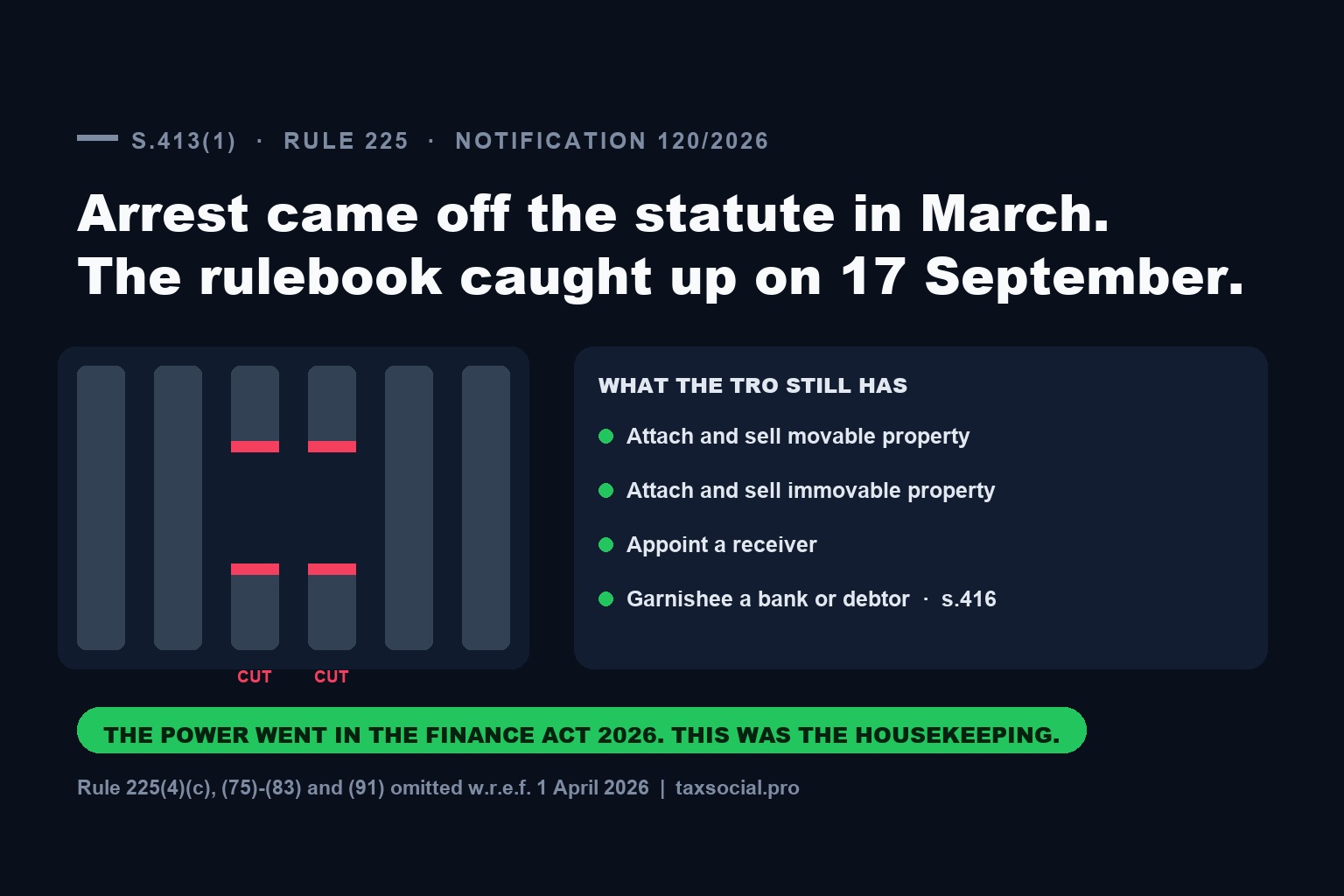

The Tax Recovery Officer can no longer have a defaulter arrested and detained in civil prison. That is real, and under the law as it stands it is settled. But the CBDT did not do it — Parliament did, in the Finance Act, 2026, which received assent on 30 March 2026. Section 413(1) of the Income-tax Act, 2025 lost its arrest clause with effect from 1 April 2026, and the Second Schedule to the old 1961 Act lost the whole of its arrest Part with effect from 30 March 2026. What Notification No. 120/2026 dated 17 September 2026 did was delete the machinery that had been left stranded in Rule 225 of the Income-tax Rules, 2026 — sub-rule (4)(c), sub-rules (75) to (83) and sub-rule (91) — and it backdated the omission to 1 April 2026 so that the rules are treated as never having carried it. Everything else the Tax Recovery Officer had, he still has: attachment and sale of movable and immovable property, appointment of a receiver, and the garnishee and salary-deduction powers in Section 416. And prosecution is untouched in principle — Section 475 still punishes anyone who makes property disappear to defeat a recovery certificate, and Section 478 still punishes a wilful attempt to evade payment. Both are lighter than they were on 31 March 2026, because the same Finance Act converted rigorous imprisonment to simple and removed the mandatory minimums. "No arrest" does not mean "no jail".
1. What the notification actually says
Notification No. 120/2026, G.S.R. 822(E), dated 17 September 2026, is titled the Income-tax (Fourth Amendment) Rules, 2026. It is made under Section 533 read with Sections 262, 273, 413, 514 and 515 of the Income-tax Act, 2025, and it runs to eight rules across five gazette pages, most of which are the two substituted forms at the end.
The commencement clause matters as much as the substance:
"(a) rules 2 to 4 shall be deemed to have come into force on the 1st day of April, 2026; and (b) rules 5 to 8 shall come into force on the date of their publication in the Official Gazette."
Rules 2 to 4 are the ones that carry the recovery changes, and they are deemed to have come into force on 1 April 2026 — that is, retrospectively, by five and a half months. Hold on to that; it is the point of Section 4 below.
The eight rules do the following.
- Rule 2 corrects a cross-reference in Rule 160, sub-rules (3) and (4): for the brackets and figure "(i)", the brackets and letter "(a)" are substituted.
- Rule 3 amends Rule 176(3)(a)(ii): for the words "by affixing digital signature", the words "by way of an electronic communication" are substituted.
- Rule 4 is the one the headlines are about. In Rule 225: sub-rule (4), clause (c) is omitted; in sub-rule (19), "or to arrest" is replaced by "of"; in sub-rule (56) a mangled cross-reference, "sub-rule 53(iv).S", becomes "sub-rule 53(d)"; sub-rules (75), (76), (77), (78), (79), (80), (81), (82), (83) and (91) are omitted; and in sub-rule (87), the brackets and words "(except arrest and detention)" are omitted.
- Rules 5 and 6 extend the deadline in Rule 246(4) and Rule 256(4) — registration of valuers and of authorised income-tax practitioners respectively — from 30 September 2026 to 31 March 2027. This has nothing to do with recovery and everything to do with a deadline nobody was going to meet, and if you have a valuer registration or a practitioner registration pending, this is the operative line of the notification for you.
- Rules 7 and 8 substitute FORM NO. 169 and FORM NO. 171, the application forms for those two registrations.
2. Rule 225 is the recovery machinery, and Rule 225(4) is its menu
Rule 225 of the Income-tax Rules, 2026 is titled "Procedure for recovery of tax for the purposes of sections 413 and 475". If you worked with the 1961 Act, it is the Second Schedule — the same ninety-odd numbered provisions on certificates, notices, attachment, sale, proclamation, objections and appeals — relocated from a Schedule of the Act into a rule made under it. That relocation is itself the reason this story has two halves.
Sub-rule (4), headed "Mode of recovery", is the menu. As it stands today, after the amendment, it reads:
"(a) by attachment and sale of movable property of the defaulter; (b) by attachment and sale of immovable property of the defaulter; (c) [omitted]; (d) by appointing a receiver for the management of the movable and immovable properties of the defaulter."
Clause (c) — "by arrest of the defaulter and his detention in prison" — is gone, and note that the rules were not renumbered. Clause (c) is now an empty slot and the receiver remains at (d). That is a small drafting detail with a practical use: if you are reading a notice, an order or a precedent that cites "Rule 225(4)(d)", it means the receiver both before and after 17 September, so the citation has not shifted under you.
3. What the headlines missed: Parliament did this in March
Almost every report on this notification is framed as the CBDT removing the power of arrest. The CBDT did not remove it, and as a matter of law could not have. Rule 225 is subordinate legislation made under Section 533 of the Income-tax Act, 2025. The modes of recovery are fixed by the Act itself, in Section 413(1), which opens by saying that the Tax Recovery Officer shall proceed to recover the certified amount "by one or more of the modes mentioned below, as per the rules prescribed in this regard". The rules supply the procedure. The Act supplies the list.
Section 413(1) today reads:
"(a) attachment and sale of movable property of the assessee;
(b) attachment and sale of immovable property of the assessee;
(c) appointing a receiver for the management of movable and immovable properties of the assessee."
Three clauses, not four. The department's own footnote to the section records why:
"Clause (c) sub. for clauses (c) and (d) by Act No. 4 of 2026, w.e.f. 1-4-2026. Prior to their substitution, clauses (c) and (d) read as under: '(c) arrest of the assessee and his detention in prison; (d) appointing a receiver for the management of movable and immovable properties of the assessee.'"
Act No. 4 of 2026 is the Finance Act, 2026. It received the President's assent on 30 March 2026. Section 92 of that Act substituted a single clause (c) — the receiver — for the old clauses (c) and (d), which is the drafting device by which the arrest clause was deleted and the receiver moved up to fill the gap. Section 1(2)(a) of the Finance Act brought Sections 2 to 129 into force on 1 April 2026, and Section 92 sits inside that range.
So the statutory power of arrest for recovery of income-tax arrears ceased to exist on 1 April 2026. Not on 17 September.
The reasoning was brief and, for once, candid. The explanatory material accompanying the amendment to the Finance Bill put it as doing away with the power because the other modes of recovery were considered sufficient. That is the memorandum speaking, not the enacted section, but it is the only stated rationale on the record.
4. So what was Rule 225 doing between April and September?
This is the uncomfortable part, and it is the reason the notification is backdated.
The Income-tax Rules, 2026 were notified in March 2026, before the Finance Bill became the Finance Act. Rule 225 was drafted to mirror the Second Schedule as it then stood, arrest machinery included. When Section 413(1)(c) was deleted with effect from 1 April 2026, nobody went back and took the corresponding sub-rules out. From 1 April to 17 September 2026, the Rules therefore carried a full apparatus for arresting and detaining a defaulter — show-cause notice, warrant, custody, detention, subsistence allowance — resting on a parent provision that no longer authorised any of it.
Subordinate legislation cannot confer a power the Act has withdrawn. So the better view is that those sub-rules were inoperative from the day the Act changed, whatever the rulebook said. The notification's retrospective commencement is consistent with exactly that: by deeming rules 2 to 4 to have come into force on 1 April 2026, the CBDT has put the rulebook into the state it should have been in all along, rather than removing a power on 17 September.
Two practical consequences follow, and the second is the one to be careful about.
- For anyone reading the rules today, the gap is closed and there is nothing to argue about. A TRO who threatened arrest after 1 April 2026 was relying on a provision with no statutory foundation, and after 17 September there is not even a provision to point at.
- For a matter that was actually live in that window, do not take your position from a summary — this one included. Neither the notification nor anything the department has published says what happens to a warrant issued, or a detention ordered, before the omission. A retrospective omission ordinarily means the provision is treated as never having been there for the period covered, but the consequences for a completed or part-completed proceeding are a question for the file and, if it comes to it, for a court. If you have a client who was arrested, detained or served with a show-cause notice under the old sub-rule (75) at any point since 1 April 2026, that is a matter to take advice on, not to settle from an article.
5. And the 1961 Act? Closed too — a day earlier
The first question any practitioner will actually be asked is about old arrears. Most demands under recovery today relate to assessment years governed by the Income-tax Act, 1961, and the 2025 Act's savings provisions keep pre-1 April 2026 tax years with the old Act. If the 1961 Act's Second Schedule still permitted arrest, none of the above would help the people most likely to be facing a TRO.
It does not. The same Finance Act, 2026 dealt with the 1961 Act in its Section 34, and it is worth setting out because the correspondence with Notification 120/2026 is exact:
| Finance Act 2026, s.34 — Second Schedule, Income-tax Act 1961 (w.e.f. 30 March 2026) | Notification 120/2026 — Rule 225, Income-tax Rules 2026 (w.r.e.f. 1 April 2026) |
|---|---|
| rule 4, clause (c) omitted | sub-rule (4), clause (c) omitted |
| rule 19: "or to arrest" replaced by "of" | sub-rule (19): "or to arrest" replaced by "of" |
| Part V omitted — the arrest and detention Part | sub-rules (75) to (83) omitted |
| rule 85: "(except arrest and detention)" omitted | sub-rule (87): "(except arrest and detention)" omitted |
| rule 90 omitted — subsistence allowance | sub-rule (91) omitted — subsistence allowance |
Five changes, five changes, in the same order, doing the same thing to the same machinery under two different statutes. That mapping is the clearest available evidence that the September notification is consequential housekeeping and not a fresh policy decision — the policy decision was taken once, in the Finance Act, and applied to both Acts.
Note also the language Parliament used for the 1961 Act. Each limb of Section 34 says the provision "shall be omitted and shall be deemed to have been omitted", and the section is expressed to take effect from 30 March 2026 — the date of assent itself. So for old arrears the door shut a day before the new Act even commenced.
6. What exactly has been deleted
It is worth knowing what the machinery was, both because it tells you what a client can no longer be threatened with and because some of it was more restrained than people assume. The department's own footnotes to Rule 225 preserve the omitted text, and it ran as follows.
- Sub-rule (75) — notice to show cause. No order of arrest and detention could be made unless the TRO had served a notice to appear and show cause, and had recorded in writing his satisfaction either that the defaulter had dishonestly transferred, concealed or removed property after the certificate was drawn up, or that he had the means to pay and had refused or neglected to. A warrant could be issued without that notice only where the TRO was satisfied that, with the object or effect of delaying execution of the certificate, the defaulter was likely to abscond or to leave the local limits of the TRO's jurisdiction — the second limb is the one usually forgotten, and it was the wider of the two. Anyone arrested had to be produced before the TRO "within twenty-four hours of his arrest".
- Sub-rules (76) to (78) — hearing, custody and order. A hearing, a discretion to hold the defaulter in custody or release him on security pending the inquiry, and on conclusion an order of detention — with power to hold off for up to fifteen days to let him satisfy the arrears.
- Sub-rule (79) — how long. These were maximum periods of detention, not fixed terms: six months where the certificate was for more than two hundred and fifty rupees, six weeks otherwise. Release did not discharge the arrears, but a person released could not be re-arrested under the same certificate.
- Sub-rules (80) and (81) — release. On full disclosure of property in good faith, and on serious illness or infectious disease.
- Sub-rule (82) — entry. No dwelling house to be entered after sunset and before sunrise.
- Sub-rule (83) — who could never be arrested. A woman; any person who in the TRO's opinion was a minor or of unsound mind.
- Sub-rule (91) — subsistence allowance, borne by the TRO on the scale the State Government fixed for judgment-debtors.
Sub-rule (87), on death of a defaulter, is a useful marker of how thoroughly this has been swept out. It provides that proceedings may be continued against the legal representative — and it used to say "the proceedings in this rule (except arrest and detention) may be continued". The carve-out has been deleted not because anything changed about legal representatives, but because there is no longer an arrest to carve out.
7. What the Tax Recovery Officer still has
Nothing in this notification softens recovery itself. The certificate procedure is intact and so is everything that follows from it.
- Attachment and sale of movable property, Section 413(1)(a) and the Rule 225 machinery for it.
- Attachment and sale of immovable property, Section 413(1)(b).
- Appointment of a receiver to manage the defaulter's movable and immovable property, now Section 413(1)(c).
- Section 416, other modes of recovery, which is available to the Assessing Officer where no certificate has been drawn up and to the TRO in addition to the certificate modes where one has. It carries the two that clients feel fastest: a requisition to an employer to deduct arrears from salary, under Section 416(3); and the garnishee notice under Section 416(5)(a), by which the officer can require any person from whom money is due to the assessee, or who holds money for him, to pay it over — expressly including money held jointly with someone else. That is the bank-account power, and it has not been touched.
- Section 413(5), which pulls into the defaulter's property anything transferred without adequate consideration to a spouse, minor child, son's wife or son's minor child on or after 1 June 1973 — and keeps a minor's property in the net even after the minor attains majority, for arrears of the earlier period.
- Interest under Section 411(3) and penalty under Section 412, the latter capped at the amount of the arrears and subject to a good-and-sufficient-reasons defence.
Put plainly: what has gone is the power to coerce payment by taking away a person's liberty. What remains is the power to take the money and the property. For most defaulters the second was always the real exposure.
8. The part that has not gone: prosecution
This is the section to read twice, because "no more arrest for tax" is one short step from "no more jail for tax", and that step is wrong.
Detention under old Rule 225 was a civil coercive measure, ordered by a revenue officer, with no conviction and no criminal court involved. It has been abolished. Criminal prosecution is a different thing entirely, it is brought before a court, and it survives — including one offence written specifically to protect the recovery process.
Section 475 of the Income-tax Act, 2025 punishes a person who "fraudulently removes, conceals, transfers or delivers to any person, any property or any interest therein, with the intent to prevent such property or interest therein from being taken in execution of a certificate drawn under section 413". That is the same certificate the TRO draws up. Move assets to defeat recovery and the route is a criminal court, not a civil prison.
Section 478 punishes a wilful attempt to evade tax, penalty or interest, and — separately, in sub-section (2) — a wilful attempt to evade the payment of tax, penalty or interest. Sub-section (2) is precisely the mischief that arrest and detention used to address.
But both provisions were themselves rewritten by the same Finance Act, 2026 with effect from 1 April 2026, and materially in the taxpayer's favour. The comparison below is against the Income-tax Act, 2025 as originally enacted — that is, the text that would have applied from 1 April 2026 had the Finance Act not intervened. It is deliberately not a comparison with the law as actually in force in March 2026, because the 1961 Act's equivalent prosecution provisions were eased by the same Finance Act on their own timetable, deemed effective from 1 March 2026. The direction of travel across the whole package is consistent, and this is where most of the commentary stops too early.
| Income-tax Act, 2025 as originally enacted | As amended, from 1 April 2026 | |
|---|---|---|
| s.475 — defeating a recovery certificate | Rigorous imprisonment up to 2 years, and liable to fine | Simple imprisonment up to 2 years, and with fine |
| s.478(1) — evading tax / under-reporting, above the higher threshold | Rigorous imprisonment, not less than 6 months, up to 7 years, and fine — where the amount exceeded Rs 25 lakh | Simple imprisonment up to 2 years, or fine, or both — where the amount exceeds Rs 50 lakh |
| s.478(1) — middle band | No middle band | Simple imprisonment up to 6 months, or fine, or both — above Rs 10 lakh and up to Rs 50 lakh |
| s.478(1) — everything else | Rigorous imprisonment, not less than 3 months, up to 2 years, and fine | With fine only |
| s.478(2) — evading payment | Rigorous imprisonment, not less than 3 months, up to 2 years, and fine at the court's discretion | Same three-tier structure as s.478(1): above Rs 50 lakh, up to 2 years simple, or fine, or both; Rs 10-50 lakh, up to 6 months, or fine, or both; otherwise fine only |
Four changes are doing the work there, and each one matters on its own.
- Rigorous imprisonment has become simple imprisonment in both sections.
- The mandatory minimum sentences are gone. A court that convicts is no longer obliged to send anyone to prison for three or six months; the sentence starts at nothing.
- Imprisonment and fine are now alternatives in Section 478 — "or with fine, or with both" — where the old provision made fine an addition to a custodial term.
- Monetary thresholds now gate the custodial exposure — not the offence itself. Below Rs 10 lakh a wilful attempt to evade tax, or to evade payment of it, remains an offence; what changes is that it is punishable with fine only, with no imprisonment available. And the higher threshold has moved up from Rs 25 lakh to Rs 50 lakh.
Section 478(3) is unchanged and worth remembering: the punishment is "without prejudice to any penalty that may be imposable under any other provision of this Act". Prosecution and penalty run in parallel; nothing here touches Section 270A, Section 412 or interest.
One honest caveat. It would be easy to write that the department, having lost its coercive detention power, will now reach for prosecution more often. That is a reasonable thing to watch for, particularly in the larger-arrears cases where the Rs 50 lakh threshold is met. It is not a fact, and nothing in the notification or the Finance Act says it. Treat it as a question, not a conclusion.
9. What to tell a client sitting on arrears
Nothing in this changes the arithmetic of a demand, and it is worth being blunt with anyone who reads the headline and relaxes.
- The demand still stands, and interest still runs on it.
- The bank account is still reachable — Section 416(5) was never in issue and is, in practice, the power used first.
- Property can still be attached and sold, and a receiver can still be appointed over a running business.
- Section 412 penalty still applies, up to the amount of the arrears, unless good and sufficient reasons are shown.
- Moving assets to stay ahead of the TRO is now the worst available move, because it is the one thing that converts a recovery problem into a Section 475 prosecution.
- The real work is still upstream — getting the demand right, or getting it stayed while it is disputed, rather than managing the recovery. If that is where you are, the mechanics of a stay application and the twenty-per-cent question are a separate subject and we have covered them separately.
The right way to describe 17 September to a client is this: an obsolete threat has been taken off the page, six months after Parliament took it out of the law. It was worth doing, and it is a genuine improvement in how the State collects tax. It changes nothing about whether the money is owed.
Sources
- Notification No. 120/2026, G.S.R. 822(E), dated 17 September 2026 — Income-tax (Fourth Amendment) Rules, 2026, Gazette of India, Part II, Section 3(i).
- The Finance Act, 2026 (No. 4 of 2026), assented 30 March 2026 — Sections 1(2), 34, 92, 110 and 113. (Section 110 amends Section 475 of the Income-tax Act, 2025; Section 113 substitutes sub-sections (1) and (2) of Section 478.)
- Income-tax Act, 2025 — Sections 411, 412, 413, 416, 475 and 478, as they stand for 2026.
- Income-tax Rules, 2026 — Rule 225, with the department's footnotes preserving the omitted sub-rules (75) to (83), (87) and (91).
This article states the position as at 19 September 2026. It is general commentary on a change in the law, not advice on any particular recovery proceeding. If a warrant, detention or show-cause notice under the old Rule 225 machinery was issued in your matter at any time on or after 1 April 2026, take advice on the file rather than relying on the general position described here.



Comments (0)
No comments yet. Be the first to comment!