
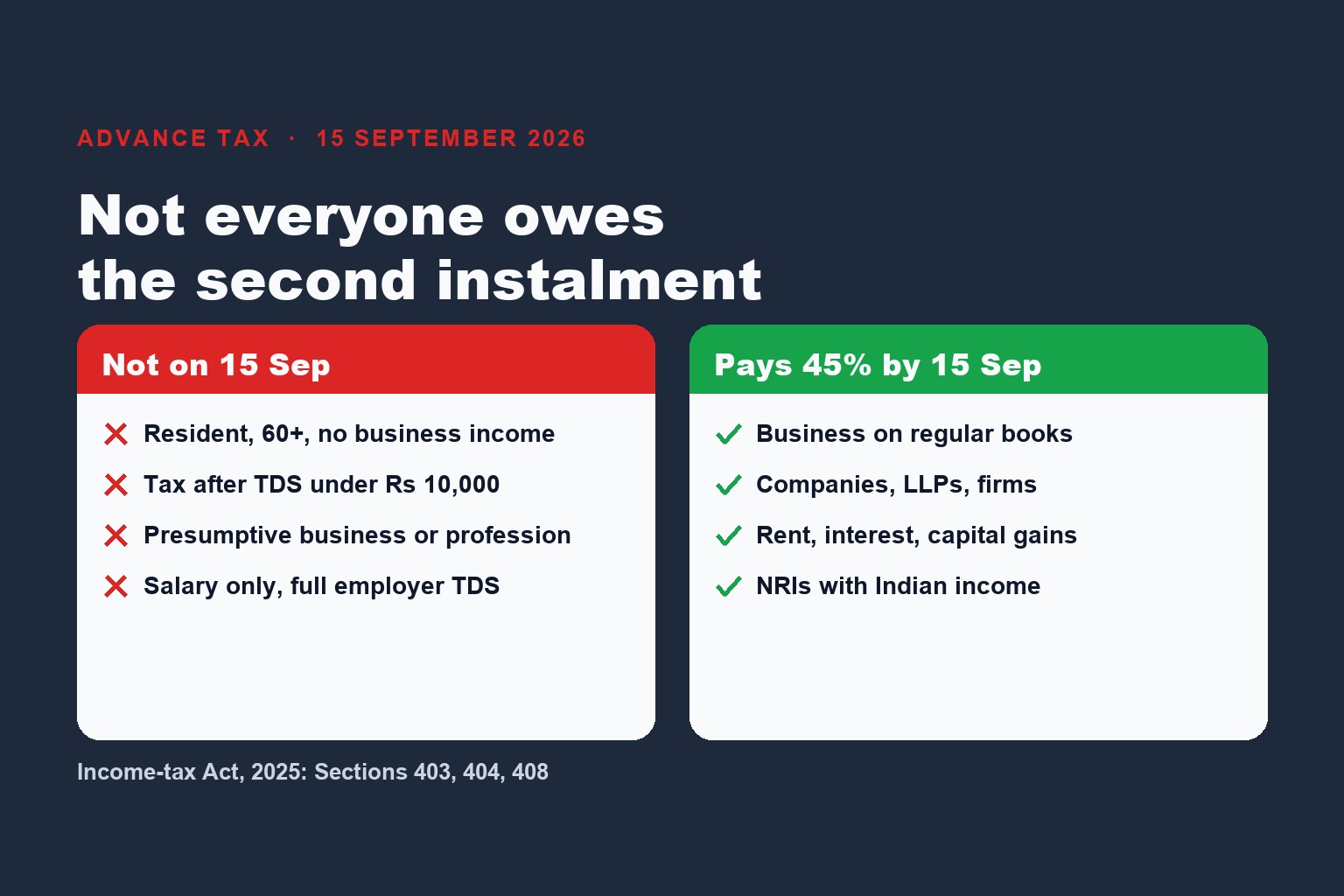

TL;DR: The advance-tax instalment due on 15 September 2026 is not a universal deadline. Under the Income-tax Act, 2025 it applies to you only if three things are true together: you are not a resident senior citizen without business or professional income (Section 403(3)); the tax you would still owe for tax year 2026-27 after TDS and TCS is Rs 10,000 or more (Section 404); and you are not declaring profits under the business or profession rows of Section 58(2), Sl. Nos. 1 or 3, whose advance tax is one instalment on 15 March (Section 408(2)). If all three are true, 45 per cent of the year’s advance tax has to be in by 15 September. Most salaried people whose employer deducts on everything are out. Landlords, investors with gains, professionals whose clients do not deduct, NRIs, firms and companies are usually in. The rest of this article takes each category in turn.
1. The three tests, in the order to apply them
| Test | Section | If yes |
|---|---|---|
| Are you an individual, resident in India, 60 or older at any time in tax year 2026-27, with no income under the head profits and gains of business or profession? | 403(3) | Advance tax does not apply to you at all. Stop here. |
| Is the tax on your estimated total income for the year, less the TDS and TCS you expect on that income, below Rs 10,000? | 404 read with 405 | Advance tax does not apply to you this year. Stop here. |
| Are you declaring profits under Sl. No. 1 (business) or Sl. No. 3 (profession) of the Section 58(2) table, the presumptive scheme? | 408(2) | Advance tax applies, but in one instalment on 15 March. Nothing is due on 15 September. The goods-carriage row, Sl. No. 2, is not covered. |
| None of the above | 408(1) | 45 per cent of the year’s advance tax by 15 September, less whatever you paid by 15 June. |
Section 403(1) makes advance tax payable during the financial year on current income, which Section 403(2) defines as the total income that would be chargeable for the tax year. The year in question is tax year 2026-27, 1 April 2026 to 31 March 2027, under the new Act. It is not the year you filed a return for in July or August. Deep Jasani’s 15 September piece covers that which-year point, the full schedule and the interest arithmetic; this article stays on the question of whether the schedule is yours to follow.
2. Who is out: the Section 403(3) senior-citizen exclusion
Section 403(3) is a complete exclusion, not a threshold. An individual who is resident in India, who is 60 or more at any time during the tax year, and who has no income chargeable under the head profits and gains of business or profession, is outside Section 403(1). No advance tax is payable, however large the tax. The whole liability is settled as self-assessment tax with the return, and because there was never an obligation to pay in advance, the interest provisions for short or late advance tax do not bite.
Three things people get wrong with it.
- The age test is “at any time during the tax year”. Someone who turns 60 on 20 March 2027 is a senior citizen for the whole of tax year 2026-27, and the exclusion applies to the entire year, including the 15 September instalment that fell before the birthday.
- Pension, interest, rent, dividend and capital gains do not disturb it. None of those is income under the business-or-profession head. A retired person living on pension and deposits, or selling a flat this year, has no advance tax to pay.
- A consultancy fee does disturb it. Income from a retainer, a directorship that is professional in character, a small trading activity, or freelance work is business-or-professional income. One rupee of it and the exclusion is gone for the year; the Rs 10,000 test in section 3 then decides.
The exclusion is for residents only. A non-resident who is 60 or older gets no relief from it and goes straight to the Rs 10,000 test.
3. Who is out: the Rs 10,000 test under Section 404
Section 404 says advance tax is payable where the amount computed under this Part is Rs 10,000 or more for the financial year. The computation is Section 405: A = B minus C, where B is the income-tax on your estimated total income at the rates in force and C is the tax that will be deducted or collected at source on income you have included in that estimate. The Rs 10,000 test is applied to A, for the whole year, once. It is not a per-instalment test, and it is not applied to gross tax before TDS.
Two consequences follow for anyone doing the arithmetic in September.
First, C is the TDS and TCS you will actually suffer. If the payer is not required to deduct, or will not, the tax on that income is yours to pay in advance. A tenant paying rent below the threshold at which a tenant must deduct, an individual client who has no obligation to deduct on a professional fee, a foreign platform paying an Indian creator: none of these puts anything into C.
Second, the rates in force are the ones you will actually be taxed at. For a resident individual on the new regime, total income up to Rs 12 lakh attracts the Section 156 rebate and the slab-rate tax is nil, so for most such people B is nil and there is nothing to pay in advance. Section 198(7) allows the rebate from the income-tax on total income as reduced by the tax payable on long-term gains on listed equity, so those gains stay taxable: an investor with Rs 8 lakh of salary and Rs 4 lakh of long-term gains on shares cannot assume a nil B.
Worked test: salaried with bank interest. Salary Rs 14,00,000, standard deduction Rs 75,000, fixed-deposit interest Rs 2,50,000, new regime. Total income Rs 15,75,000; tax Rs 1,16,250 plus 4 per cent cess, Rs 1,20,900. The employer deducts on salary alone: tax on Rs 13,25,000 is Rs 78,750 plus cess, Rs 81,900. The bank deducts 10 per cent on the interest, Rs 25,000. A = 1,20,900 − 81,900 − 25,000 = Rs 14,000. That is Rs 10,000 or more, so advance tax applies, and 45 per cent of it, Rs 6,300, has to be in by 15 September. Reduce the interest to Rs 1,50,000 and the same arithmetic gives A of Rs 8,400: below the threshold, no advance tax for the year, and the balance goes with the return.
The example also shows why the threshold is crossed so easily. The bank deducts at 10 per cent; this taxpayer’s marginal rate on the interest is 15 per cent plus cess. The 5-point gap on Rs 2,50,000 is most of the Rs 14,000.
4. Who pays, but not on 15 September: Section 58(2) presumptive declarants
Section 408(2) takes an assessee who declares profits under Sl. No. 1 or Sl. No. 3 of the Section 58(2) table, the presumptive scheme for a business or a profession, out of the four-instalment schedule and gives one date: the whole of the advance tax on or before 15 March. A small business declaring 8 per cent or 6 per cent of turnover, or a professional declaring 50 per cent of receipts, has nothing due on 15 June, 15 September or 15 December.
Two cautions. The single-instalment rule follows the declaration, not the size of the business. A trader who is eligible for the scheme but keeps regular books and declares actual profit is on the four-instalment schedule like everyone else. And the sub-section names Sl. Nos. 1 and 3 only, so it does not extend to the goods-carriage row, Sl. No. 2: an operator declaring the fixed per-vehicle amount for trucks is on the ordinary schedule and owes 45 per cent by 15 September. Our Section 58 guide sets out the rows and who is eligible.
Worked test: a professional on the presumptive scheme. Receipts Rs 40,00,000, deemed profit 50 per cent, Rs 20,00,000. Tax on the new regime Rs 2,00,000 plus cess, Rs 2,08,000. If the clients are companies deducting 10 per cent, C is Rs 4,00,000 and A is negative: no advance tax, and a refund at the return. If the clients are individuals with no obligation to deduct, C is nil, A is Rs 2,08,000, and the whole of it is due by 15 March 2027. Nothing on 15 September in either case.
5. Who is in on 15 September
| Who | Why the schedule applies | What to check now |
|---|---|---|
| Business or profession on regular books (not declaring under Section 58(2)) | Business income removes the senior exclusion; regular books remove the single-instalment rule | Estimate the year’s profit from the first five months; 45 per cent of A by 15 September, less the June payment |
| Companies, LLPs, partnership firms, AOPs | Section 403(3) is for individuals only; there is no other exclusion | The Rs 10,000 test is the only way out, and it rarely helps an entity |
| Landlords | Rent from an individual tenant is usually paid without TDS, or with TDS at a rate below the landlord’s slab | Tax on net annual value after the 30 per cent deduction and interest, less any tenant TDS, against the Rs 10,000 line |
| Investors with capital gains, dividend or interest | Dividend and interest carry 10 per cent TDS at most; gains on listed shares and mutual funds carry no TDS for a resident; a property sale of Rs 50 lakh or more carries buyer TDS of 1 per cent of the consideration, and a crypto transfer 1 per cent, both far below the tax on the gain | Gains already booked go into this instalment; gains not yet made are handled by the Section 425 rule in section 6 |
| Salaried with other income | Employer TDS covers salary; it covers rent, interest or gains only if you declared them to the employer under the salary-TDS rules | Run the Section 405 arithmetic in section 3; if A is Rs 10,000 or more, 45 per cent by 15 September |
| Non-residents with Indian income | No senior exclusion for a non-resident. Whether the TDS on NRO interest, rent or gains covers the tax depends on the income, the treaty rate claimed, surcharge and cess, and the deductions available against the income; rent TDS on the gross can over-cover, interest at a treaty rate can under-cover | Same Rs 10,000 test, worked on the actual TDS the payers will deduct; the treaty rate, where claimed, is the rate in force for B |
| Pensioners under 60, and senior citizens with any business income | The exclusion needs both conditions; failing either puts you on the Rs 10,000 test | Pension is salary and usually carries TDS; interest and rent usually create the gap |
Worked test: a trader on regular books. Estimated tax for the year after TDS, A, is Rs 3,00,000. The schedule under Section 408(1) is cumulative: 15 per cent, Rs 45,000, by 15 June; 45 per cent, Rs 1,35,000, by 15 September, which after the June payment is Rs 90,000 now; 75 per cent by 15 December; the whole by 15 March. If the June instalment was missed, the 15 September payment is the full Rs 1,35,000, and three months of interest at 3 per cent under Section 425 runs on the June shortfall.
6. Who is in, but for whom a September miss costs nothing: the Section 425 exception
Section 425 charges interest of 3 per cent on the shortfall at each of the June, September and December instalments and 1 per cent at March. It then carves out shortfalls that come from income you could not have estimated: capital gains, winnings, dividend, and business or professional income arising for the first time. Where the shortfall at an instalment is because of such income and the tax on it is paid in the remaining instalments, or by 31 March where there is no instalment left, no interest is charged for the earlier instalment.
In practice that means a flat sold in October, a lottery prize in November or a large dividend in February does not turn the June and September instalments into interest-bearing shortfalls. But the exception is for the instalment before the income arose. A flat sold in July has to be in the 15 September instalment. And the exception is to Section 425 only: Section 424, which charges interest where less than 90 per cent of the year’s tax has been paid as advance tax by 31 March, still applies if the gain is left to the return.
Section 425 also carries a tolerance for the first two instalments: no interest for June if 12 per cent of the tax due on the returned income was paid by 15 June, and none for September if 36 per cent was paid by 15 September. In the salaried example above, Rs 5,040 by 15 September avoids interest even though the instalment is Rs 6,300.
7. A checklist for the week
- Apply Section 403(3) first. Resident, 60 or more in the year, no business or professional income: you are done.
- Estimate the year. Five months of actuals are in; annualise, and add anything already booked, including gains.
- Compute A under Section 405 at the rates you will actually pay, after the rebate if your income is within it, and after only the TDS and TCS that will actually be deducted.
- Below Rs 10,000: nothing to pay in advance. Rs 10,000 or more: on to the schedule.
- Declaring under Section 58(2), business or profession row: one instalment on 15 March. Goods-carriage row, or regular books: 45 per cent by 15 September.
- Pay under the 2025 Act for the year ending 31 March 2027, not for the year you have just filed. Deep’s article has the challan and the year-selection steps.
FAQ
Is advance tax on 15 September compulsory for everyone? No. It does not apply to resident senior citizens without business or professional income, to anyone whose tax after TDS and TCS for the year is under Rs 10,000, or on that date to presumptive declarants under Section 58(2), who pay once on 15 March.
I am salaried. Do I pay advance tax? Only if the tax on your income other than salary, after the TDS on it, reaches Rs 10,000 for the year, or if your employer is not deducting enough. Salary alone with full employer TDS gives A of nil.
I am 62, retired, and sold a flat in August. Advance tax? No, if you are resident and have no business or professional income. Section 403(3) excludes you entirely; the tax goes with the return, without advance-tax interest.
I am 62 and take a monthly retainer from my old firm. That is professional income. The exclusion is lost for the year and the Rs 10,000 test decides.
I declare 50 per cent of receipts under the presumptive scheme. One instalment, 15 March 2027. Nothing on 15 September.
I run three trucks under the presumptive scheme. The single-instalment rule does not extend to the goods-carriage row. 45 per cent by 15 September.
My advance tax is Rs 9,800. Below Rs 10,000: no advance tax for the year. Pay it with the return.
I am an NRI with rent and NRO interest in India. No senior exclusion for a non-resident. If the tax after TDS is Rs 10,000 or more, the schedule applies.
Sources
- Income-tax Act, 2025 — Section 403(1) to (3), Section 404, Section 405, Section 408(1) to (3), Section 424, Section 425, Section 58(2), Section 156, Section 198(7), Section 202, Section 393.
- Finance Act, 2025 (rates in force for tax year 2026-27; Budget 2026 made no change to the individual slabs).
Written as at 7 September 2026 for tax year 2026-27 under the Income-tax Act, 2025. The examples use the new regime with 4 per cent cess and no surcharge, and are shown before rounding. Take advice from a Chartered Accountant on a specific computation.



Comments (0)
No comments yet. Be the first to comment!