
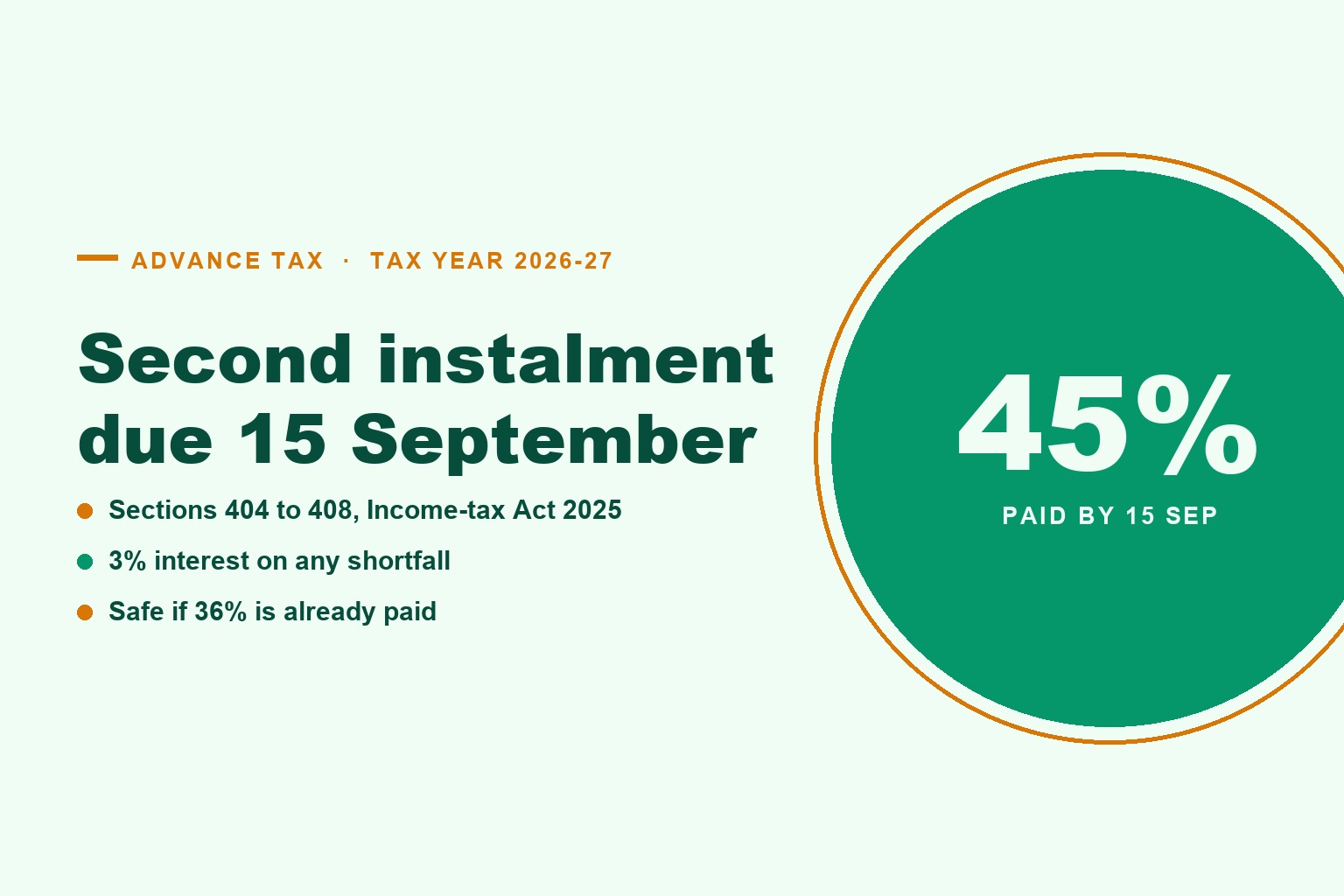

TL;DR: The second advance tax instalment for the year that began on 1 April 2026 falls due on Tuesday, 15 September 2026. It is the first September instalment under the Income-tax Act, 2025, so the section numbers on every reference sheet have changed: liability is in Sections 403 and 404, the instalment table is Section 408, interest for a short instalment is Section 425 and interest for paying less than 90% overall is Section 424. The arithmetic has not changed — by 15 September you must have paid 45% of the year’s advance tax, counting what you paid in June — but the interest clause has been redrafted as a flat 3% of the shortfall, and the two safe harbours (12% by June, 36% by September) survive. Presumptive taxpayers on the business and profession rows of section 58 owe nothing until 15 March; the goods-carriage row does not get that concession. If you sell shares or receive a large dividend after the 15th, you can still avoid interest by paying the tax on it in a later instalment.
1. Which year this is, and which Act
Two different years are live at once this September, and mixing them up is the most common advance-tax error of 2026. The return most people filed in July or August was for FY 2025-26, called assessment year 2026-27 in the old vocabulary and governed by the Income-tax Act, 1961. The advance tax you pay on 15 September is for the year running 1 April 2026 to 31 March 2027, which the new Act calls tax year 2026-27, and which is governed entirely by the Income-tax Act, 2025. Our explainer on the tax-year concept covers why the vocabulary changed; for today the practical point is that when you pay, you select the year that ends on 31 March 2027, not the one you have just filed for.
The FY 2025-26 advance-tax schedule remains on this site for anyone reconciling last year’s Section 234B and 234C interest. Everything below is about the new Act.
2. Who has to pay: Sections 403 and 404
Section 403(1) makes advance tax payable during the financial year on the assessee’s current income, which sub-section (2) defines as the total income that would be chargeable for the tax year. Section 404 then sets the threshold: advance tax is payable only where the tax for the year, computed under this Part, is Rs 10,000 or more. That figure is after the reductions in Section 405, so it is the tax you would still owe after TDS and TCS, not your gross liability.
Section 403(3) carries over the senior-citizen carve-out: a resident individual who is 60 or older at any time during the tax year and who has no income under the head profits and gains of business or profession is outside advance tax altogether. Pension, interest, rent and capital gains do not disturb that exemption; a consultancy fee does.
Section 405 is the computation, written as a formula: A = B − C, where B is the income-tax on your estimated total income at the rates in force for the year and C is the tax deductible or collectible at source on income that you have included in that estimate. Two things follow. First, the rates in force for tax year 2026-27 are the ones enacted by the Finance Act, 2025 and left untouched by Budget 2026: the new regime under Section 202 with its Rs 4 lakh exemption, slabs stepping to 30% above Rs 24 lakh, Rs 75,000 standard deduction and the Section 156 rebate up to Rs 12 lakh of income. Second, C is the TDS and TCS you actually expect to suffer or bear. If a payer will not deduct — a tenant paying rent below the TDS threshold, a client who is not required to deduct, a foreign platform — the tax on that income is yours to pay in advance.
3. The schedule: Section 408
Section 408(1) puts the four instalments in a table. The percentages are cumulative and each later instalment is expressed “as reduced by the amount, if any, paid in the earlier instalment”:
| On or before | Cumulative amount paid must be |
|---|---|
| 15 June 2026 | Not less than 15% of the year’s advance tax |
| 15 September 2026 | Not less than 45%, less what was paid in June |
| 15 December 2026 | Not less than 75%, less earlier payments |
| 15 March 2027 | The whole amount, less earlier payments |
So the September cheque is not 45% of the year’s tax; it is whatever brings the running total to 45%. Someone who paid the full 15% in June pays a further 30% now. Someone who paid nothing in June pays 45% now and has already incurred interest on the June shortfall, which section 4 below quantifies.
Section 408(2) is the presumptive exception. An assessee who declares profits under section 58(2), table entries Sl. No. 1 (small business) or Sl. No. 3 (specified profession) pays the whole of the year’s advance tax in one instalment by 15 March 2027. Nothing is due from them on 15 September. Note that the concession is written for rows 1 and 3 only — a goods-carriage operator under row 2 is on the ordinary four-instalment schedule. Our section 58 guide goes through the eligibility rows.
Section 408(3) is the small mercy: anything paid as advance tax on or before 31 March counts as advance tax for the year, even if it missed every instalment date. That matters for Section 424, which tests whether advance tax paid reached 90% of the assessed tax — a March payment counts towards that 90%, and if it gets you there, no Section 424 interest runs from April. It does not undo Section 425 interest on the instalments already missed.
4. Section 425: interest for a short instalment, now a flat 3%
The 1961 Act charged 1% per month for three months on a September shortfall. The 2025 Act reaches the same number by a shorter route. Section 425(1) is a table: for each of the June, September and December instalments the interest is 3% of the shortfall, and for the March instalment it is 1%. The “shortfall” is the instalment target (15%, 45%, 75% or 100% of the tax due on returned income) less the advance tax actually paid by that date. It is a one-off charge per instalment, not a running rate.
Tax due on returned income is defined in the section itself: the tax on the total income you declare in your return for the year, reduced by TDS and TCS on income included in that total, relief under sections 157, 159 and 160 and the tax credits under section 206. In plain terms it is the year’s tax net of everything deducted at source and every credit — the same base as Section 405, but measured on the return you eventually file rather than your estimate today. That is why an honest estimate in September can still produce interest in July 2027 if the year turns out better than expected.
The two safe harbours, Section 425(2): no interest is charged on the June instalment if the advance tax paid by 15 June is 12% or more of the tax due on returned income, and none on the September instalment if the amount paid by 15 September is 36% or more. These are floors, not targets: paying 36% avoids the interest but leaves you 9% behind for December’s 75% test.
The 15 March test, Section 425(3): anyone liable to advance tax — the section 58 row 1 or row 3 assessee with their single instalment, and equally the ordinary four-instalment taxpayer — who has paid less than the tax due on returned income by 15 March pays simple interest of 1% on that shortfall. For the presumptive taxpayer it is the only instalment and the only interest; for everyone else it sits on top of whatever the first three rows of the table produced.
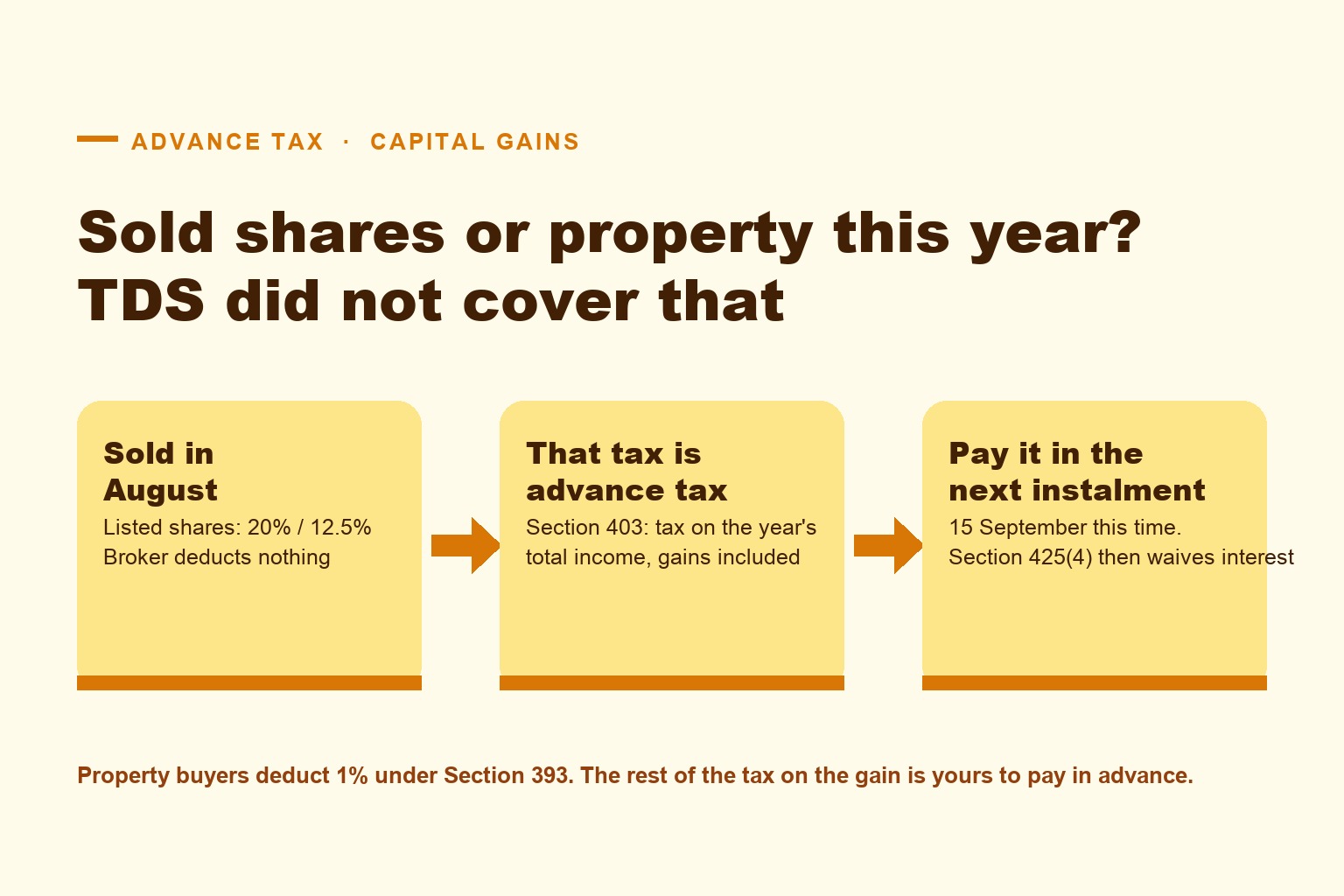
The carve-outs, Section 425(4): no interest is payable on a shortfall that arises from under-estimating, or failing to estimate, any of the following — capital gains; winnings from lotteries, races, card games and the like, being the income referred to in section 2(49)(n); income from a business or profession that accrues for the first time during the year; and dividend income (other than deemed dividend under section 2(40)(e)) — provided the tax on that income is paid in full in any remaining instalment, or by 31 March. The carve-out protects the earlier instalments only. If shares are sold in November, the tax on the gain must be in the December or March payment; leave it for the return and the carve-out is lost.
5. Section 424: interest for paying less than 90% overall
Section 425 looks at each instalment. Section 424 looks at the year. Where the advance tax paid is less than 90% of the assessed tax — or where none was paid at all — simple interest runs at 1% per month or part of a month from 1 April 2027 until the intimation under section 270(1) or the completion of assessment, on the whole shortfall. Assessed tax is defined the same way as tax due on returned income: tax on total income net of TDS, TCS, foreign-tax relief and section 206 credits. Paying self-assessment tax before the intimation stops the clock from that date, under Section 424(4).
The practical reading: Section 425 is the price of being late during the year, and it is capped by design at 3% per missed instalment. Section 424 is the price of being short at the end of it, and it is open-ended. A taxpayer who cannot fund the September instalment should still get to 90% by 31 March, because the second charge is the one that compounds through the filing season.
6. Worked examples
All three use the new regime, health and education cess at 4%, no surcharge, and figures before any rounding.
Example A: salaried, with interest income the employer does not know about
Salary Rs 18,00,000; FD interest Rs 4,00,000 on which the bank deducts 10%. After the Rs 75,000 standard deduction, total income is Rs 21,25,000 and the tax is Rs 2,40,500. The employer, deducting on salary alone unless the interest was declared, withholds Rs 1,50,800. The bank withholds Rs 40,000. Advance tax under Section 405 is therefore Rs 49,700 — above the Rs 10,000 threshold, so Section 404 applies.
| Date | Cumulative target | Amount |
|---|---|---|
| 15 June 2026 | 15% | Rs 7,455 |
| 15 September 2026 | 45% | Rs 22,365 |
| 15 December 2026 | 75% | Rs 37,275 |
| 15 March 2027 | 100% | Rs 49,700 |
If nothing was paid in June and nothing is paid now, the Section 425 interest is 3% of Rs 7,455 for June (Rs 224) and 3% of Rs 22,365 for September (Rs 671). If Rs 15,000 has been paid by 15 September, it is below the 36% safe harbour of Rs 17,892, so interest is charged on the shortfall against 45%: Rs 7,365 at 3% = Rs 221. Paying Rs 17,892 or more by the 15th brings the September interest to zero. The amounts are small because the base is small; scale the salary to Rs 40 lakh and rental income into the picture and they are not.
Example C: shares sold in November
A listed-equity long-term gain of Rs 6,00,000 realised on 20 November 2026 carries tax of Rs 61,750 (12.5% on the amount above the Rs 1,25,000 exemption, plus cess). None of it was in the June or September estimate, and under Section 425(4) none of it needs to have been: as long as the Rs 61,750 is included in the 15 December or 15 March payment, no interest attaches to the June or September instalments for having left it out. Miss both and pay it with the return instead, and the carve-out falls away for every instalment.
Example D: professional, not on presumptive
Advance tax for the year of Rs 3,00,000. Rs 60,000 was paid in June, comfortably above the 15% target of Rs 45,000. The September target is Rs 1,35,000 cumulative, so Rs 75,000 is due on the 15th. If only Rs 40,000 more is paid, taking the total to Rs 1,00,000, that is below the 36% harbour of Rs 1,08,000, and interest is 3% of the Rs 35,000 shortfall: Rs 1,050. Pay Rs 48,000 instead of Rs 40,000 — reaching Rs 1,08,000 — and the interest is nil, though Rs 27,000 is still owed towards the December target.
7. Mistakes worth avoiding this month
- Paying against the wrong Act or year. Select the Income-tax Act, 2025 and the year running 1 April 2026 to 31 March 2027, so that the challan generated is ITNS 280N. A payment made on the old ITNS 280 against the year just filed sits as excess self-assessment tax on that return and does nothing for Section 425.
- Assuming salary TDS covers everything. It covers salary. Interest, rent, freelance fees and gains are yours unless you declared them to your employer for deduction.
- Treating 36% as the target. It is the floor that avoids interest on this instalment. December’s test is 75%.
- Applying the single-instalment rule too widely. It is for section 58 rows 1 and 3. A goods-carriage operator on row 2, a partner drawing remuneration, or a professional who has opted out of section 58 is on four instalments.
- Paying on the 16th. The 15th is a Tuesday. A payment that clears on the 16th is a September shortfall for Section 425 purposes, and the 3% is charged on the whole of it.
- Forgetting the March backstop. Section 408(3) counts any payment made by 31 March as advance tax. If the year has gone badly, getting to 90% by then is what keeps Section 424 off the file.
8. How to pay
Use the e-Pay Tax service on the income-tax portal (e-File → e-Pay Tax), or an authorised bank. The portal now asks you to select the applicable Act first. For this instalment that is the Income-tax Act, 2025, which brings up challan ITNS 280N — the 2025-Act counterpart of the familiar ITNS 280 — with the minor head 100 (Advance Tax) and the year ending 31 March 2027. ITNS 280 under the 1961 Act is still on the portal for payments relating to earlier years, which is exactly how a September payment ends up against the wrong year. Net banking, UPI, cards and NEFT/RTGS are all accepted; check that the receipt shows the 2025 Act and the correct year before you close the window. Keep the BSR code and challan serial number — they are what the return will ask for in July 2027.
9. Sources
- Income-tax Act, 2025, as amended by the Finance Act, 2026 (Income Tax Department consolidated text) — Sections 403 (liability; senior-citizen carve-out in sub-section (3)), 404 (Rs 10,000 threshold), 405 (computation), 408 (instalments and due dates), 424 (interest for default in payment of advance tax), 425 (interest for deferment of advance tax) and the definition of income in section 2(49).
- Income-tax Act, 2025 — Section 58 (presumptive income), Section 156 (rebate) and Section 202 (new-regime rates), as they apply to tax year 2026-27.
- Finance Act, 2025 (rates in force for tax year 2026-27; Budget 2026 made no change to individual slab rates, standard deduction or rebate).
- Income Tax Department e-filing portal — e-Pay Tax service and challan ITNS 280.
The examples are illustrative and computed on stated assumptions. Your own advance tax depends on your estimate of the full year’s income and the TDS you will actually suffer; recompute before each instalment. Take advice from a Chartered Accountant on a specific position.



Comments (0)
No comments yet. Be the first to comment!