
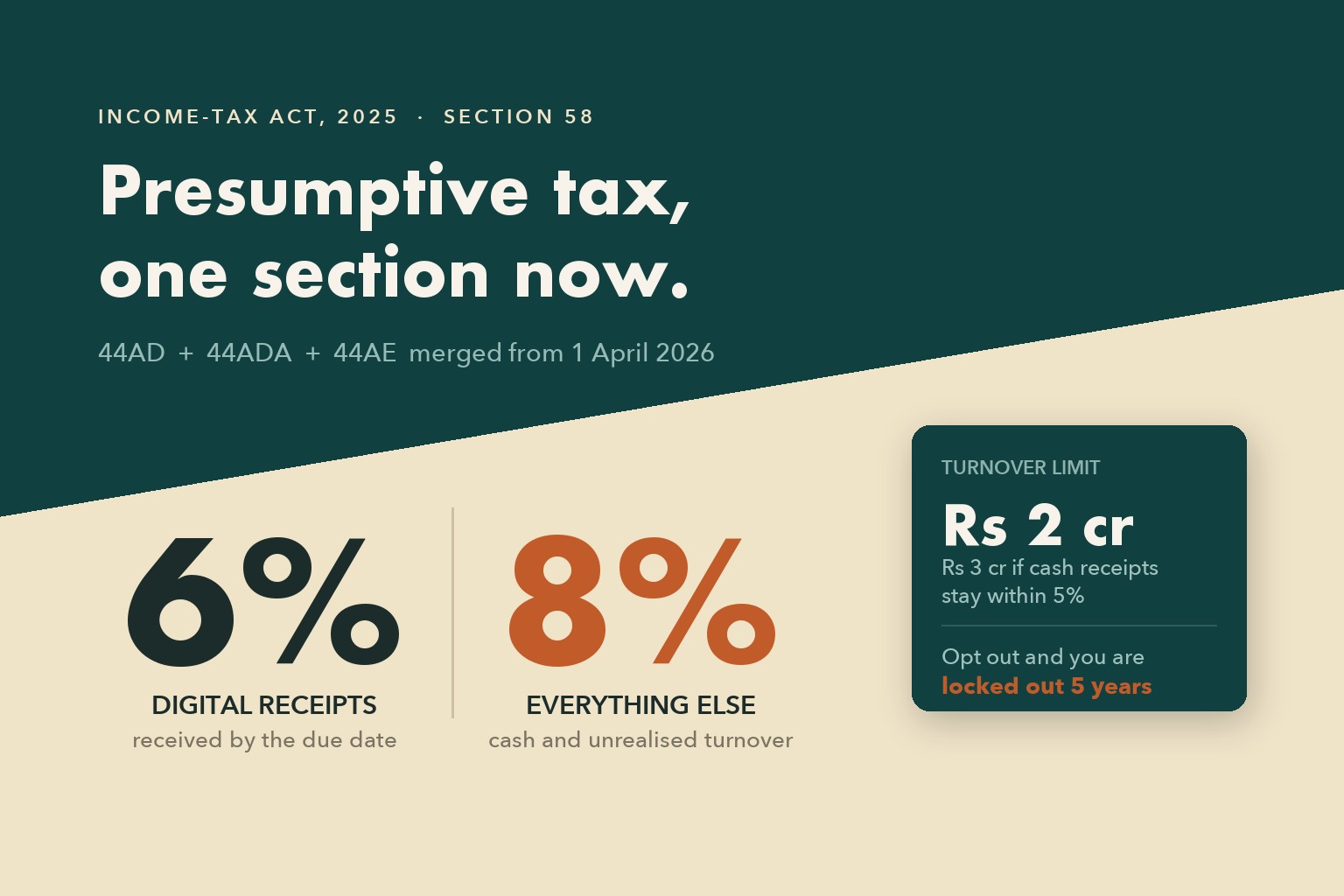

TL;DR: From 1 April 2026 the Income-tax Act, 2025 replaced the 1961 Act, and the three separate presumptive schemes small businesses knew as 44AD, 44ADA and 44AE are now a single provision — section 58. Tax year 2026-27 is the first year you actually compute under it. The limits and rates are broadly what they were: ₹2 crore of turnover for a business, stretching to ₹3 crore if cash receipts stay within 5%, taxed at 6% of digital receipts and 8% of the rest. What deserves attention is not the arithmetic but the three things attached to it — the deductions you forfeit, the depreciation you are deemed to have claimed whether you claimed it or not, and the five-year lock-out that follows if you opt in and then walk away.
1. What changed on 1 April 2026
Nothing about the underlying policy changed much. The drafting changed completely. Three provisions that lived in different corners of the 1961 Act are now three rows of one table inside section 58.
| What you used to call it (1961 Act) | Where it lives now (2025 Act) |
|---|---|
| Section 44AD — small business | Section 58, table entry Sl. No. 1 |
| Section 44AE — goods carriage | Section 58, table entry Sl. No. 2 |
| Section 44ADA — specified profession | Section 58, table entry Sl. No. 3 |
| Section 44AA — books of account | Section 62 |
| Section 44AB — audit | Section 63 |
| Section 139(1) — due date for the return | Section 263(1) |
| Section 40(b) — partner salary and interest limits | Section 35(e) |
This matters more than a renumbering exercise normally would, because for the next year or two almost everything written about presumptive taxation online still cites the 1961 numbers. If a note, a software help page or an adviser's email refers you to "44AD" for tax year 2026-27, it is describing repealed law. The substance may still be right; the citation is not.
One more piece of vocabulary. The 2025 Act drops "previous year" and "assessment year" and uses a single tax year. The year running from 1 April 2026 to 31 March 2027 is tax year 2026-27, and that is the year you are deciding about now.
2. Who can use it
The general-business scheme is available to an eligible assessee, which means a resident:
- individual;
- Hindu undivided family; or
- firm — but not a limited liability partnership.
A company cannot use it. A non-resident cannot use it. An LLP cannot use it, which surprises people every year and is the single most common eligibility error: converting a partnership firm into an LLP for limited-liability reasons quietly removes the presumptive option.
Four categories are excluded even where the person is otherwise eligible:
- a specified profession — professions have their own row in the table, at 50%;
- agency business;
- income by way of commission or brokerage; and
- anyone claiming a deduction under Chapter VIII-C for the year.
The commission-and-brokerage exclusion is worth pausing on, because it is drawn by the nature of the income, not by what the business calls itself. An insurance agent, a commission agent in a mandi, a freight broker earning a commission on arranged loads — none of them can put that income under the general-business row, whatever the turnover.
3. The three rows and what they produce
| Who | Ceiling | Deemed income | |
|---|---|---|---|
| Sl. 1 — business | Eligible assessee, any business other than goods carriage | Turnover up to ₹2 crore, extended to ₹3 crore where cash receipts do not exceed 5% of total turnover or gross receipts | 6% of receipts received through prescribed banking or online modes by the section 263(1) due date, plus 8% of everything else — or a higher amount if you actually claim one |
| Sl. 2 — goods carriage | Owner of not more than 10 goods carriages at any time during the year | No turnover ceiling | ₹1,000 per ton of gross vehicle weight, per month or part of a month, for a heavy goods vehicle; ₹7,500 per month or part of a month for any other vehicle — or a higher amount actually claimed |
| Sl. 3 — profession | Specified profession | Gross receipts up to ₹50 lakh, extended to ₹75 lakh on the same 5% cash test | 50% of gross receipts — or a higher amount actually claimed |
Two points on the goods carriage row. "Heavy goods vehicle" is a defined term keyed to gross vehicle weight, so the split between the ₹1,000-per-ton rate and the flat ₹7,500 is settled by the weight recorded on the registration certificate, not by what the vehicle is used for — check each vehicle before you compute. And the ten-vehicle test is applied at any time during the year: buying an eleventh truck in February takes you outside the scheme for that whole tax year, not from February onwards.
The 6% / 8% split is not automatic
The lower 6% rate applies only to the part of turnover received through prescribed banking or online modes, and received by the due date for filing the return under section 263(1). Two consequences follow, and both are missed regularly:
- A sale invoiced in March 2027 and collected by bank transfer in May 2027 still gets 6% treatment, because it was received before the due date. A sale collected in December 2027 does not — it is taxed at 8% even though the customer eventually paid by bank transfer.
- The split decides the rate, not the base. The base is the whole of turnover or gross receipts for the year. A business that invoices ₹1.8 crore and still has ₹40 lakh outstanding at the return due date does not compute on ₹1.4 crore — it applies 6% to the ₹1.4 crore actually received in a qualifying mode and 8% to the ₹40 lakh that was not. Unrealised turnover does not drop out of the computation; it lands in the more expensive half of it.
A worked example
A trading firm — a partnership, not an LLP — has turnover of ₹1.9 crore in tax year 2026-27. ₹1.7 crore is received by bank transfer and UPI before the return due date; ₹20 lakh is received in cash.
| Component | Amount | Rate | Deemed income |
|---|---|---|---|
| Digital receipts | ₹1,70,00,000 | 6% | ₹10,20,000 |
| Other receipts | ₹20,00,000 | 8% | ₹1,60,000 |
| Total presumptive income | ₹11,80,000 |
Note also that ₹20 lakh of cash on ₹1.9 crore is about 10.5% — well over the 5% test — so this firm could not have used the higher ₹3 crore ceiling had its turnover been larger. The 5% test and the presumptive rate are two separate things: cash receipts above 5% do not disqualify you at ₹1.9 crore of turnover, they only close off the ₹2 crore to ₹3 crore band.
4. What you give up
This is where the section earns its complexity, and where a decision that looks obviously good on the rate can turn out badly.
No deductions against presumptive income — section 58(4)
Any loss, allowance or deduction otherwise allowable under the Act is not allowed against income computed under the presumptive table. The deemed figure is the business income, full stop. Rent, salaries, interest on a business loan, professional fees — all of it is treated as already absorbed.
Depreciation you never claimed is deemed to have been allowed — section 58(6)
The written down value of an asset used in the business is computed as if depreciation had been claimed and actually allowed for every relevant tax year. Read that carefully, because it is a one-way street. You get no depreciation deduction while you are in the scheme, but the asset's WDV falls every year regardless.
The consequence lands later. A business that spends four years in the presumptive scheme, buys a ₹40 lakh machine in year one, and then moves back to normal computation in year five does not pick up depreciation from ₹40 lakh. It picks up from a WDV reduced by four years of depreciation it never got the benefit of. And if the asset is sold, the capital-gains computation runs off that reduced WDV too. For an asset-light service business this is immaterial. For a manufacturer or a transport operator buying vehicles, it can be the single biggest number in the decision.
Partner salary and interest — section 58(5)
Where the assessee is a firm, salary and interest paid to partners are deductible from the presumptive income subject to the limits in section 35(e) — but this is available only for the goods carriage row. A firm in the general-business row or the professional row gets no deduction for what it pays its own partners. For a two-partner consultancy or trading firm, that is often the fact that decides the whole question, because partner remuneration is usually the largest single item in the profit and loss account.
5. Declaring less than the presumptive figure
Section 58(3) permits you to declare income lower than the table produces. It is not free. Where you declare lower and your total income exceeds the maximum amount not chargeable to tax, you must:
- maintain books of account under section 62; and
- get them audited under section 63, and furnish the report.
Both limbs have to be satisfied before the obligation bites. A business with a genuinely bad year whose total income falls below the exemption limit can declare its real, lower income without triggering books and audit. A business with a bad trading year but substantial other income cannot.
6. The five-year lock-out — section 58(7)
This is the provision that turns a one-year convenience into a multi-year commitment, and it applies to the general-business row only — not to goods carriage, not to professions.
If an eligible assessee declares profit on the presumptive basis for a tax year, and then in any of the five following tax years declares profit otherwise than in accordance with the scheme, that person is not eligible to claim the benefit of section 58 for the five tax years subsequent to the year in which the profit was not declared presumptively.
Worked through on a calendar:
| Tax year | What happens |
|---|---|
| 2026-27 | Declares presumptively under section 58. Clock starts. |
| 2027-28 | Declares presumptively. |
| 2028-29 | Opts out — declares actual profit under normal computation. |
| 2029-30 to 2033-34 | Locked out. Section 58 is unavailable for these five tax years, whatever the turnover. |
And through the lock-out period, the ordinary books and audit requirements apply on their own terms. So the real question to ask before opting in is not "is 6% lower than my actual margin this year?" It is "am I willing to be in this for six years, and what does my asset profile look like over that horizon?" A business planning significant capital expenditure, or one whose margins are volatile enough that a loss year is realistic, should think hard before starting the clock.
7. Advance tax: one instalment, not four
Advance tax is payable where the tax for the year is ₹10,000 or more after reducing expected TDS, TCS and available credits — section 404. The ordinary schedule is four instalments at 15%, 45%, 75% and 100% by 15 June, 15 September, 15 December and 15 March.
Taxpayers computing under section 58 get a simplification: section 408(2) lets the entire advance tax liability be discharged in a single instalment on or before 15 March of the tax year. For tax year 2026-27, that date is 15 March 2027.
Three cautions. First, the concession is written for the business and specified profession rows — it does not extend to the goods carriage scheme, which stays on the ordinary four-instalment schedule. That was the position under the 1961 Act and it carries forward; if you are a transport operator, do not assume 15 March covers you. Second, it is one instalment, not an exemption — miss 15 March and the interest provisions apply as they would to anyone else. Third, the concession follows the scheme: a business that decides in February that it will declare actual profits instead has been on the four-instalment schedule all along, and has already missed three dates.
8. A short decision checklist
- Are you eligible at all? Resident individual, HUF or firm — and not an LLP, not a company, not agency income, not commission or brokerage.
- Which row? Business, goods carriage or specified profession. They have different ceilings, different rates and different attached rules.
- Where do the receipts land? Compute the 6% and 8% split on actual receipts by the return due date, not on invoiced turnover.
- What is your real margin? If it is comfortably below the presumptive rate, the scheme is costing you tax to save you compliance.
- What is on your balance sheet? Deemed depreciation under section 58(6) is the cost most often left out of the comparison.
- If you are a firm, what do the partners draw? Outside the goods carriage row, partner salary and interest are simply not deductible.
- Can you commit for six years? Section 58(7) is the reason this is not a year-by-year choice.
- Diarise 15 March 2027 for the single advance tax instalment.
Sources
- Income-tax Act, 2025, section 58 — special provision for computing profits and gains of business or profession on a presumptive basis in the case of certain residents: sub-section (2) and its table, sub-section (3) (books and audit where lower profits are declared), sub-section (4) (no loss, allowance or deduction), sub-section (5) (partner salary and interest, goods carriage row), sub-section (6) (written down value deemed reduced by depreciation), sub-section (7) (five-year ineligibility).
- Income-tax Act, 2025, sections 62 and 63 — maintenance of books of account, and audit.
- Income-tax Act, 2025, section 263(1) — due date for furnishing the return of income, which fixes the cut-off for the 6% treatment of digital receipts.
- Income-tax Act, 2025, section 35(e) — limits on deductible partner salary and interest.
- Income-tax Act, 2025, sections 404 and 408 — advance tax liability threshold, and the single-instalment date of 15 March for presumptive taxpayers.
- Income-tax Act, 1961, sections 44AD, 44ADA and 44AE — the predecessor provisions, for the mapping table only. They do not apply to tax year 2026-27.
This article states the position under the Income-tax Act, 2025 as in force on 31 August 2026, the first tax year of the new Act. The Income-tax Rules, 2026 and CBDT circulars will continue to fill in detail, and the basic exemption limit and other figures referred to descriptively here should be confirmed against the current text before you rely on them. Nothing here is advice on your particular facts — the choice to enter or leave section 58 has multi-year consequences, and it is worth putting your own numbers in front of a qualified practitioner before you make it.



Comments (0)
No comments yet. Be the first to comment!