
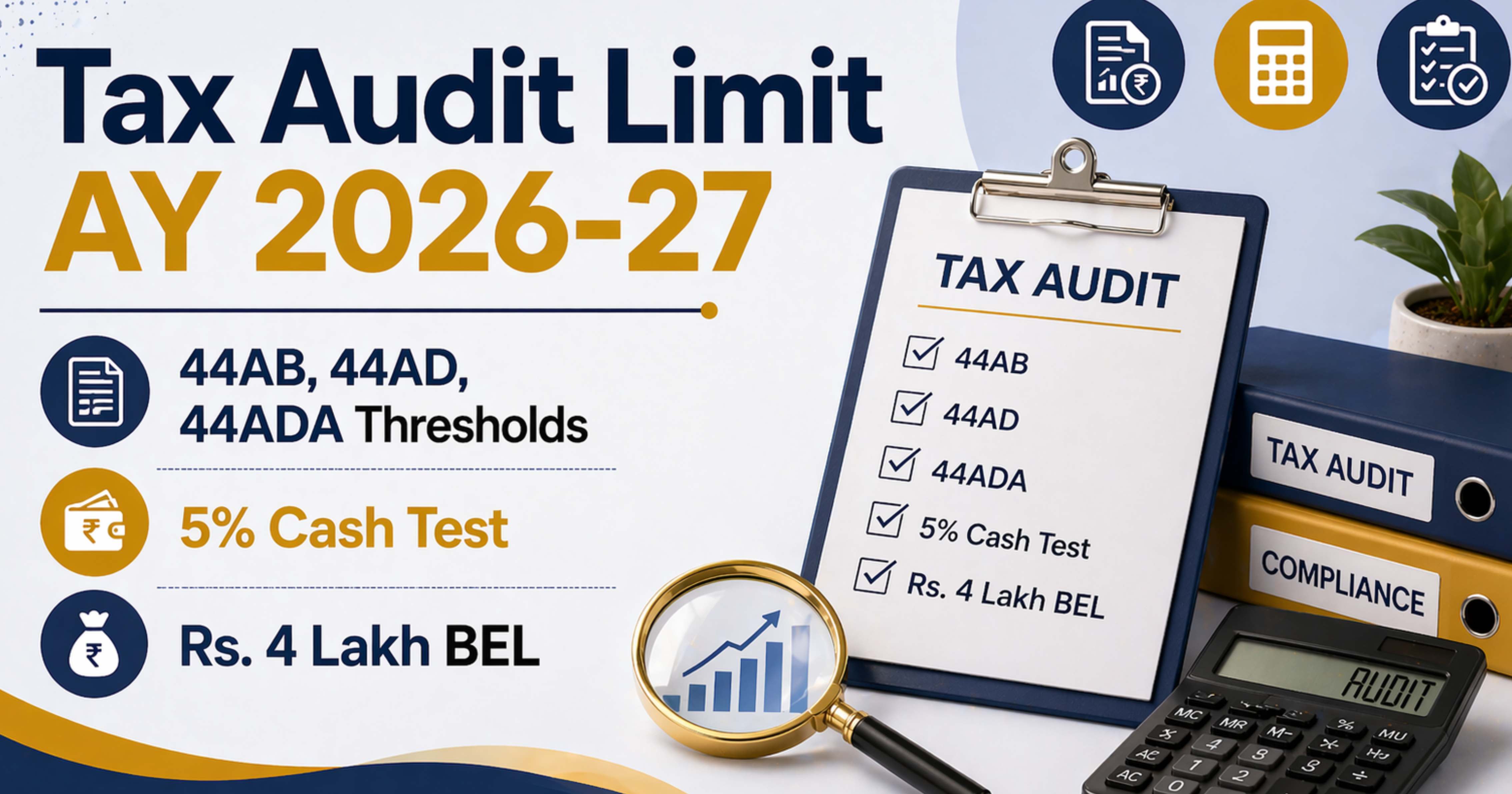

Tax audit applicability for Assessment Year 2026-27 (Financial Year 2025-26) is where three distinct limbs of the Income-tax Act, 1961 meet — the Section 44AB tax-audit threshold, the Section 44AD / 44ADA presumptive regimes, and the Section 115BAC new-regime basic exemption limit. Get any one of these wrong and you either file an audit you didn’t need, or miss one you did — both carry consequences.
This article works through every threshold, every proviso, and every trigger that decides whether your business or profession must get its books audited under Section 44AB for AY 2026-27. It also unpacks a common but subtly wrong shorthand floating around infographics — the “digital business” label used for enhanced turnover thresholds — and replaces it with what the statute actually says.
Updated: April 2026. Reflects the Finance Act 2025 revision of the new-regime basic exemption limit to Rs. 4,00,000 and the enhanced rebate under Section 87A (up to Rs. 60,000 for total income up to Rs. 12 lakh), alongside the Section 44AD / 44ADA enhanced thresholds that were introduced by the Finance Act 2023.
1. Quick Reference — Tax Audit Thresholds AY 2026-27
Section Applies to Standard threshold Enhanced threshold Condition for enhanced threshold 44AB(a) Business — tax audit Turnover > Rs. 1 crore Turnover > Rs. 10 crore Cash receipts ≤ 5% of total receipts AND cash payments ≤ 5% of total payments (both conditions) 44AB(b) Profession — tax audit Gross receipts > Rs. 50 lakh No enhanced threshold. Rs. 50 lakh applies uniformly. 44AD Small-business presumptive Turnover ≤ Rs. 2 crore Turnover ≤ Rs. 3 crore Cash receipts ≤ 5% of total turnover/gross receipts (receipts only — not payments) 44ADA Specified-profession presumptive Gross receipts ≤ Rs. 50 lakh Gross receipts ≤ Rs. 75 lakh Cash receipts ≤ 5% of total gross receipts (receipts only — not payments) 44AB(d) Profession declaring profit lower than 44ADA Audit if assessee declares profit lower than 44ADA presumptive (50%) and total income exceeds the basic exemption limit 44AB(e) Business in the 44AD(4) lock-in Audit if 44AD(4) applies and total income exceeds the basic exemption limitNote the asymmetry that infographics often flatten out:
- Section 44AB(a) — enhanced Rs. 10 crore threshold requires both cash receipts and cash payments ≤ 5%. Two cumulative conditions.
- Section 44AD and 44ADA — enhanced threshold requires only the cash receipts test ≤ 5%. One condition.
Non-account-payee cheques and non-account-payee bank drafts are deemed to be cash for the 44AB(a) proviso. Plan your banking flow accordingly if you’re close to the Rs. 10 crore line.
2. “Digital Business” Is Not a Statutory Term — Clarifying the Label
Many online flowcharts and tax-audit summaries label the enhanced thresholds (Rs. 10 crore for business, Rs. 3 crore for 44AD, Rs. 75 lakh for 44ADA) as applicable to “digital business”. The Income-tax Act uses no such phrase. What the statute actually prescribes is a cash-receipt (and for 44AB, cash-payment) test of 5% or less.
The practical difference matters:
- A predominantly offline business that happens to bank almost all its receipts and make almost all its payments by account-payee banking instruments does qualify for the enhanced Rs. 10 crore threshold — there is no requirement that it be “digital” in any other sense.
- A predominantly online business that still receives 10% of its revenue in cash does not qualify — being “digital” in business model is irrelevant; the cash test is what counts.
Read the statutory proviso, not the marketing label. The enhanced threshold is tied to how you receive and pay money, not to what industry you operate in.
3. Section 44AB — Who Must Get Books Audited
Section 44AB of the Income-tax Act, 1961 lists the categories of assessees required to get their accounts audited by a chartered accountant and furnish the tax audit report (Form 3CA / 3CB with 3CD). For AY 2026-27:
3.1 Clause (a) — Business
Any person carrying on business whose total sales, turnover, or gross receipts in the previous year exceed Rs. 1 crore. The first proviso substitutes this with Rs. 10 crore where both:
- aggregate cash receipts during the previous year do not exceed 5% of the aggregate of all receipts; and
- aggregate cash payments during the previous year do not exceed 5% of the aggregate of all payments.
Where either test fails, the threshold reverts to Rs. 1 crore.
3.2 Clause (b) — Profession
Any person carrying on a profession whose gross receipts in the previous year exceed Rs. 50 lakh. There is no enhanced threshold under 44AB(b) for professions — the Rs. 50 lakh number is the uniform audit line.
3.3 Clause (c) — Section 44AE / 44BB / 44BBB Opt-outs
Assessees claiming income lower than the presumptive rate prescribed under Section 44AE (goods carriages), 44BB (non-resident oil service providers), or 44BBB (foreign company in specified power projects) are required to maintain books of account and get them audited.
3.4 Clause (d) — 44ADA Opt-out
An assessee carrying on a profession eligible for 44ADA who declares profit lower than 50% of gross receipts and whose total income exceeds the basic exemption limit — audit applies.
3.5 Clause (e) — 44AD Lock-in Trigger
An assessee to whom Section 44AD(4) applies, whose total income exceeds the basic exemption limit — audit applies. This is the clause that catches businesses that opted into the 44AD presumptive regime and then tried to exit by declaring lower profits within the lock-in window.
4. Section 44AD — Presumptive Taxation for Small Businesses
4.1 Eligibility
Section 44AD applies to an eligible assessee carrying on an eligible business. Definitions:
Eligible assessee (Explanation (a) to Section 44AD): a resident individual, resident Hindu Undivided Family, or resident partnership firm (not a limited liability partnership). An LLP cannot opt into 44AD.
Eligible business (Explanation (b) to Section 44AD): any business except:
- Business of plying, hiring, or leasing goods carriages referred to in Section 44AE.
- Any business whose total turnover / gross receipts in the previous year exceed Rs. 2 crore (or Rs. 3 crore under the 5% cash-receipts proviso).
Persons specifically excluded by Section 44AD(6):
- A person carrying on a profession referred to in Section 44AA(1) — they must use 44ADA, not 44AD.
- A person earning income in the nature of commission or brokerage.
- A person carrying on any agency business.
4.2 Turnover Threshold — Rs. 2 Crore vs Rs. 3 Crore
The proviso to Section 44AD(1), inserted by the Finance Act 2023 with effect from AY 2024-25 and carried forward to AY 2026-27, raises the turnover ceiling from Rs. 2 crore to Rs. 3 crore where the aggregate cash receipts during the previous year do not exceed 5% of the total turnover / gross receipts.
Only the cash-receipts limb applies for 44AD. Unlike Section 44AB(a), there is no additional cash-payments test for 44AD. A business can have substantial cash payments (for example, to small suppliers) and still claim the Rs. 3 crore threshold provided its cash receipts are within 5%.
4.3 Presumptive Profit Rate
- 8% of turnover or gross receipts received in cash.
- 6% of turnover or gross receipts received through account-payee cheque, account-payee bank draft, ECS, or other prescribed electronic mode — provided the amount is received on or before the due date under Section 139(1).
An assessee is free to declare a higher profit than 8% / 6%; the statute sets the floor, not the ceiling.
4.4 The Section 44AD(4) Five-Year Lock-in
This is where the flowchart labels “any PY” tend to oversimplify. The statute is precise:
Where an eligible assessee declares profit for any previous year in accordance with the provisions of Section 44AD(1), and he declares profit for any of the five assessment years relevant to the previous year succeeding such previous year not in accordance with Section 44AD(1), he shall not be eligible to claim the benefit of 44AD for five assessment years subsequent to the assessment year relevant to the previous year in which the profit was not declared in accordance with 44AD(1).
Translated:
- You opt into 44AD in PY1.
- In any of the next five PYs, you declare lower profit (i.e., profit not in accordance with 44AD(1)).
- From that opt-out year, you are locked out of 44AD for the next five AYs.
- Additionally, if 44AD(4) applies to you and your total income exceeds the basic exemption limit in that AY, Section 44AB(e) requires a tax audit.
“Any PY” framing is overbroad — the lock-in is the specific five-AY window following the opt-out, not a perpetual bar.
4.5 Consequences of Being Covered by 44AD(4)
- Must maintain books of account under Section 44AA(2) (the general books-of-account provision still applies based on income/turnover thresholds).
- Tax audit under Section 44AB(e) if total income > basic exemption limit for the relevant AY.
- Cannot switch back to 44AD until the five-AY lock-out completes.
5. Section 44ADA — Presumptive Taxation for Specified Professionals
5.1 Who Can Opt In
Section 44ADA applies to a resident individual or resident partnership firm (not LLP) carrying on a profession referred to in Section 44AA(1). The Section 44AA(1) list, read with CBDT notifications, is broader than most flowcharts show:
- Legal profession
- Medical profession
- Engineering profession
- Architectural profession
- Accountancy profession (including Chartered Accountants)
- Technical consultancy
- Interior decoration
- Any other profession notified by the CBDT — which currently includes authorised representatives, film artists, company secretaries, and information technology professionals
If your profession is not on this list, you cannot use 44ADA. Common examples of professions that are not 44AA(1) specified professions include insurance agents, teachers running their own tutorials, fashion designers (not classified as technical consultancy or interior decoration), and freelance writers — these would typically fall back to Section 44AD (subject to the exclusions in Section 44AD(6)) or to regular computation.
5.2 Gross Receipts Threshold — Rs. 50 Lakh vs Rs. 75 Lakh
The proviso to Section 44ADA(1), inserted by the Finance Act 2023, raises the gross-receipts ceiling from Rs. 50 lakh to Rs. 75 lakh where aggregate cash receipts during the previous year do not exceed 5% of total gross receipts.
As with 44AD, only the cash-receipts limb applies. The cash-payments test does not extend to 44ADA.
5.3 Presumptive Profit Rate
A flat 50% of gross receipts is deemed to be the professional’s profits and gains from the profession. The assessee may declare a higher percentage; they cannot declare a lower percentage without triggering Section 44AB(d) audit.
5.4 Section 44AB(d) Trigger
A professional who is eligible for 44ADA but declares profit lower than 50% of gross receipts, and whose total income exceeds the basic exemption limit, must get books audited under Section 44AB(d). The audit trigger requires both conditions together:
- Declared profit < 50%; AND
- Total income > basic exemption limit for the relevant AY.
6. Basic Exemption Limit for AY 2026-27
6.1 New Regime — Section 115BAC (Default)
The Finance Act 2025 revised the new-regime slab structure with effect from AY 2026-27 (FY 2025-26). The new slabs:
Total Income (Rs.) Tax Rate 0 – 4,00,000 Nil (basic exemption) 4,00,001 – 8,00,000 5% 8,00,001 – 12,00,000 10% 12,00,001 – 16,00,000 15% 16,00,001 – 20,00,000 20% 20,00,001 – 24,00,000 25% Above 24,00,000 30%Basic exemption limit under the new regime for AY 2026-27 is Rs. 4,00,000 (Rs. 4 lakh). This is the figure to use when testing whether “income exceeds the basic exemption limit” under Sections 44AB(d) and 44AB(e) for assessees who remain on (or default to) the new regime.
The Section 87A rebate under the new regime has been enhanced to a maximum of Rs. 60,000 where total income does not exceed Rs. 12,00,000. The rebate reduces tax liability to nil within that income band, but the basic exemption limit itself for Section 44AB purposes remains Rs. 4 lakh.
6.2 Old Regime — Opt-in
Section 115BAC(1A) makes the new regime the default. The old regime remains available as an opt-in for AY 2026-27, with its historical slab structure:
- Rs. 2,50,000 — individuals below 60 years, Hindu Undivided Families, Association of Persons, Body of Individuals.
- Rs. 3,00,000 — resident individuals aged 60 years or more but less than 80 years (senior citizens).
- Rs. 5,00,000 — resident individuals aged 80 years or more (super senior citizens).
Mechanics of opting in:
- Non-business/non-profession assessees: exercise the option in the return of income under Section 115BAC(6) for each assessment year.
- Business/profession assessees: file Form 10-IEA on or before the due date under Section 139(1) for the first AY in which the old regime is opted. The option, once exercised, can be withdrawn only once and thereafter the assessee reverts to the new regime.
6.3 Which BEL Applies for the Section 44AB(d) / (e) Test
Use the BEL applicable to the assessee under the regime they have opted for in that AY. For a business assessee who has defaulted to the new regime, that is Rs. 4 lakh. For an old-regime senior citizen professional, it is Rs. 3 lakh. The audit-trigger language in Sections 44AB(d) and (e) — “maximum amount which is not chargeable to income-tax” — is regime-sensitive.
7. Decision Tree — Will Your AY 2026-27 Return Attract Tax Audit?
7.1 For a Business
- Is turnover > Rs. 1 crore?
- No — go to step 2.
- Yes, but cash receipts AND cash payments are each ≤ 5% — enhanced Rs. 10 crore threshold applies. Audit only if turnover > Rs. 10 crore. Go to step 2 if within Rs. 10 crore.
- Yes, and either cash test fails (receipts > 5% OR payments > 5%) — audit required under 44AB(a).
- Have you opted into Section 44AD in the current or any of the preceding five PYs?
- No, and turnover is within the eligible-business limits — no Section 44AB(a) audit on turnover alone. Books of account under Section 44AA(2) still apply if your income or turnover exceeds the s. 44AA(2) thresholds (Rs. 1.2 lakh income / Rs. 10 lakh turnover for non-individuals/HUFs; Rs. 2.5 lakh income / Rs. 25 lakh turnover for individuals and HUFs) in any of the three preceding previous years.
- Yes, and you declared profit as per 44AD(1) in the current PY — no audit. 44AD opt-in protects you.
- Yes, but you have declared profit lower than 8% / 6% in the current PY, triggering 44AD(4), and your total income exceeds the BEL applicable for your regime — audit required under 44AB(e).
7.2 For a Profession
- Is the profession one of the specified professions under Section 44AA(1)?
- No — 44ADA is not available. Audit test runs under 44AB(b): audit if gross receipts > Rs. 50 lakh.
- Yes — go to step 2.
- Are gross receipts > Rs. 50 lakh?
- Yes — audit required under 44AB(b). 44ADA is not available above Rs. 50 lakh (or Rs. 75 lakh with cash receipts ≤ 5%).
- No — go to step 3.
- Have you opted into Section 44ADA?
- Yes, and declared profit is 50% or more of gross receipts — no audit.
- Yes, but declared profit is lower than 50%, AND total income > BEL applicable for your regime — audit required under 44AB(d). You also have to maintain books under 44AA.
- No — books and audit positions are governed by 44AA(2) and 44AB(b) on the gross-receipts limit.
8. Three Corrections to the Typical “Tax Audit Limit AY 2026-27” Flowchart
Popular tax-audit flowcharts circulating online generally get the numbers right but carry a few legal-precision errors. The three that matter most:
Correction 1 — “Digital Business” Is the Wrong Label
The statute uses a cash-receipts test (and for 44AB, an additional cash-payments test), not a business-type classification. A brick-and-mortar wholesaler that receives nearly everything by account-payee banking is entitled to the enhanced threshold; an e-commerce seller who still takes 10% cash on delivery is not. Use “enhanced threshold under the 5% cash-receipts proviso,” not “digital business.”
Correction 2 — Single-Test vs Two-Test Provisos
Section 44AB(a) requires both cash receipts AND cash payments to be within 5%. Section 44AD and Section 44ADA require only cash receipts to be within 5%. A flowchart that lumps all three thresholds under a single “cash receipt/payment 5%” label obscures this asymmetry and can mislead taxpayers into thinking the 44AD Rs. 3 crore threshold requires a cash-payments test it does not.
Correction 3 — “Never Opted for 44AD” Does Not Mean “No Books Required”
Even where Section 44AB audit is not triggered, Section 44AA(2) still requires books of account to be maintained if income or turnover thresholds are crossed. Conflating “audit not required” with “books not required” is a common misreading that can leave an assessee without basic books when an assessment notice arrives.
Correction 4 (bonus) — The Lock-in Runs Five AYs, Not “Any PY”
The Section 44AD(4) lock-in applies for the five assessment years immediately succeeding the AY in which the profit was declared not in accordance with 44AD(1). It is not a perpetual “any previous year” bar. Similarly, the Section 44AB(e) audit trigger tests BEL in the relevant AY — not in any previous year.
9. Worked Examples
Example 1 — Business on the Enhanced Threshold
Ramesh runs a small trading firm. FY 2025-26 turnover: Rs. 4.2 crore. Of the total receipts (including GST), cash receipts are Rs. 18 lakh (approximately 4.1% of receipts). Of the total payments, cash payments are Rs. 28 lakh (approximately 6% of payments).
Does the enhanced Rs. 10 crore threshold apply? No. Although cash receipts are within 5%, cash payments exceed 5%. Both conditions must be satisfied. Turnover Rs. 4.2 crore > Rs. 1 crore → tax audit under 44AB(a) is required.
Example 2 — 44AD Presumptive with Declared Profit
Priya runs an e-commerce apparel business as a sole proprietor. FY 2025-26 turnover Rs. 2.7 crore, of which Rs. 3.2 lakh (approx. 1.2%) was received in cash. She declares profit at 6% of banking turnover and 8% of cash turnover under Section 44AD.
Is 44AD available? Yes. Cash receipts ≤ 5% → enhanced Rs. 3 crore threshold applies. Turnover Rs. 2.7 crore is within Rs. 3 crore. She is an eligible assessee (resident individual) in an eligible business (retail trade, not commission / agency / specified profession). No tax audit required.
Example 3 — 44ADA Opt-Out
Arjun, a practising chartered accountant (resident individual), has gross receipts of Rs. 42 lakh for FY 2025-26. His actual net profit after expenses is Rs. 16 lakh (approximately 38%). He intends to declare the actual Rs. 16 lakh, not the 50% presumptive amount (which would be Rs. 21 lakh).
Does audit apply? Arjun’s profit of Rs. 16 lakh is lower than 50% of gross receipts. His total income of Rs. 16 lakh exceeds the new-regime basic exemption limit of Rs. 4 lakh. Both conditions of Section 44AB(d) are satisfied → tax audit required under 44AB(d). He must maintain books under Section 44AA(1).
Example 4 — 44AD Lock-in Trigger
Suresh, a resident individual, opted into 44AD for FY 2022-23 and declared presumptive profit. For FY 2025-26 his turnover is Rs. 80 lakh but his actual profit works out to Rs. 3 lakh (approximately 3.75%), well below the 8% / 6% presumptive floor.
Since FY 2025-26 falls within the five-AY window after his initial 44AD opt-in, declaring profit at 3.75% triggers Section 44AD(4). His total income (assuming Rs. 3 lakh is his only income) is below the new-regime BEL of Rs. 4 lakh. Audit under 44AB(e) is not triggered (because the BEL test fails) — but he is nonetheless locked out of 44AD for the next five AYs from AY 2026-27 onwards, and must maintain books under Section 44AA(2).
Tweak the facts: if Suresh also has Rs. 2 lakh rental income, total income becomes Rs. 5 lakh > Rs. 4 lakh BEL → Section 44AB(e) audit is triggered. The BEL test is on total income from all heads, not just business income.
10. Tax Audit Due Dates for AY 2026-27
- Tax audit report (Form 3CA/3CB + 3CD): on or before 30 September 2026 — the “specified date” under Section 44AB is one month prior to the Section 139(1) return due date for audit cases.
- Return of income for audit cases: on or before 31 October 2026 under Section 139(1).
- Transfer-pricing audit report (Form 3CEB) under Section 92E: on or before 31 October 2026 — one month before the return due date for transfer-pricing assessees.
- Return of income for transfer-pricing assessees: on or before 30 November 2026 under Section 139(1).
The government has historically extended these dates by CBDT circular in certain years. Confirm the final date applicable to your return from the CBDT circulars in force in September / October 2026.
Penalty for failure to get accounts audited — Section 271B: one-half of one percent of total sales, turnover, or gross receipts, or Rs. 1,50,000, whichever is less. The penalty is not leviable where the assessee proves reasonable cause under Section 273B.
11. Books of Account — Section 44AA Still Applies
Even when Section 44AB audit is not triggered, an assessee may still be required to maintain books of account under Section 44AA:
- Section 44AA(1): professions specified under this subsection (the 44AA(1) list above) must maintain prescribed books regardless of income level — with the limited relief that if the gross receipts do not exceed Rs. 1,50,000 in any of the three preceding PYs (or, for a newly set-up profession, if the receipts are likely not to exceed Rs. 1,50,000 in the current year), only such books as enable computation of total income are required.
- Section 44AA(2): other businesses and professions must maintain books if income from business / profession exceeds Rs. 1,20,000 (Rs. 2,50,000 for individuals and HUFs) or turnover / gross receipts exceed Rs. 10 lakh (Rs. 25 lakh for individuals and HUFs) in any of the three preceding PYs.
- Presumptive regimes override the books requirement only while the assessee continues to comply with the presumptive scheme. On opt-out (or where 44AD(4) / 44AB(d) is triggered), books under 44AA apply.
12. Frequently Asked Questions
Q1. I run an e-commerce store with Rs. 1.8 crore turnover, of which Rs. 4 lakh is COD (cash on delivery). Is tax audit applicable?
Cash receipts are approximately 2.2% of total receipts — within 5%. If cash payments are also within 5%, the enhanced Rs. 10 crore threshold under Section 44AB(a) applies, so turnover Rs. 1.8 crore is below it → no audit under 44AB(a). You may still opt into 44AD (subject to eligibility) and declare presumptive profit; if you declare normal profits without 44AD opt-in, maintain books under Section 44AA(2) based on the relevant income / turnover thresholds.
Q2. I am an advocate with gross receipts of Rs. 68 lakh. Can I use 44ADA?
If cash receipts are within 5% of gross receipts, 44ADA with the enhanced Rs. 75 lakh threshold is available. You would declare profit at 50% of gross receipts (Rs. 34 lakh) or higher. If cash receipts exceed 5%, only the standard Rs. 50 lakh limit applies — you cannot use 44ADA at Rs. 68 lakh and must either maintain full books or face audit under Section 44AB(b) if you cross Rs. 50 lakh gross receipts.
Q3. Can a partnership firm use 44AD?
A resident partnership firm (not a limited liability partnership) can use 44AD, subject to the eligible-business test. An LLP cannot. This is because the definition of “eligible assessee” in Explanation (a) to Section 44AD explicitly excludes LLPs.
Q4. I have only interest and dividend income of Rs. 6 lakh — do I need tax audit?
No. Section 44AB applies only to business and profession income. Interest and dividend are taxed under “Income from Other Sources” and do not trigger 44AB on turnover alone. Your return obligation and books obligation are governed by the normal return-filing thresholds, not by 44AB.
Q5. I exited 44AD two years ago by declaring lower profit. Can I go back to 44AD now?
No. Once Section 44AD(4) is triggered, you are locked out of 44AD for the next five assessment years starting from the AY in which you declared profit not in accordance with 44AD(1). Re-entry is only permitted after that five-AY lock-out period.
Q6. Does the Rs. 4 lakh basic exemption limit apply to senior citizens too?
Under the new regime, the Rs. 4 lakh BEL applies uniformly to all individuals regardless of age — the new regime does not differentiate by age. Under the old regime, the age-based slabs (Rs. 2.5 / 3 / 5 lakh) continue to apply. For Section 44AB(d) / (e) purposes, the BEL you compare against is the one under the regime you have opted for in that AY.
Q7. What happens if cash receipts are exactly 5%? Is the enhanced threshold available?
The statutory language is “not more than 5%” / “does not exceed five per cent” — so exactly 5% satisfies the proviso. Only receipts strictly exceeding 5% take you out of the enhanced threshold.
Q8. My turnover is Rs. 95 lakh and I have never opted for 44AD. My actual profit is 4%. Do I need tax audit?
Turnover Rs. 95 lakh is below the Section 44AB(a) Rs. 1 crore threshold — no audit on turnover alone. If you have never opted into 44AD, Section 44AD(4) does not apply to you, and Section 44AB(e) is not triggered. However, you must maintain books under Section 44AA(2) based on the income/turnover thresholds in the three preceding PYs, and file the return with your actual profit of 4% under the regular profit-and-loss route. The audit position only changes if (a) you had earlier opted into 44AD and are now in the lock-in window, or (b) turnover crosses Rs. 1 crore / Rs. 10 crore without meeting the cash-receipts proviso.
13. Legal References
- Section 44AB, Income-tax Act, 1961 — audit of accounts of certain persons carrying on business or profession.
- Section 44AD, Income-tax Act, 1961 — presumptive basis for small businesses; see Explanation (a) and (b), subsections (4), (5), (6).
- Section 44ADA, Income-tax Act, 1961 — presumptive basis for specified professions.
- Section 44AA, Income-tax Act, 1961 — maintenance of books of account; Rule 6F of the Income-tax Rules, 1962 prescribes the books for 44AA(1) professionals.
- Section 115BAC, Income-tax Act, 1961 — new tax regime; Section 115BAC(1A) on default applicability; Section 115BAC(6) on exercise of option; Form 10-IEA.
- Section 139(1), Section 271B, Section 273B — return due date, penalty for failure to get audit done, reasonable-cause safety valve.
- Finance Act 2023 — provisos to Section 44AD(1) and Section 44ADA(1) introducing Rs. 3 crore / Rs. 75 lakh enhanced thresholds under the 5% cash-receipts test.
- Finance Act 2025 — revised slab rates under Section 115BAC(1A) with Rs. 4 lakh basic exemption and enhanced Section 87A rebate of up to Rs. 60,000 for total income up to Rs. 12 lakh.
- CBDT Notifications under Section 44AA(1) — notification of authorised representatives, film artists, company secretaries, and information technology as specified professions.
This article is a reference guide on tax audit applicability for AY 2026-27. Specific assessees may have facts that shift the analysis — intercompany transactions, revenue recognition timing, multiple business lines, or transitional situations around regime opt-in. Confirm the applicable position for your assessment against the latest statute text, CBDT circulars, and notifications in force at the time of filing. For any borderline case, consult a practising chartered accountant.




Comments (0)
No comments yet. Be the first to comment!