
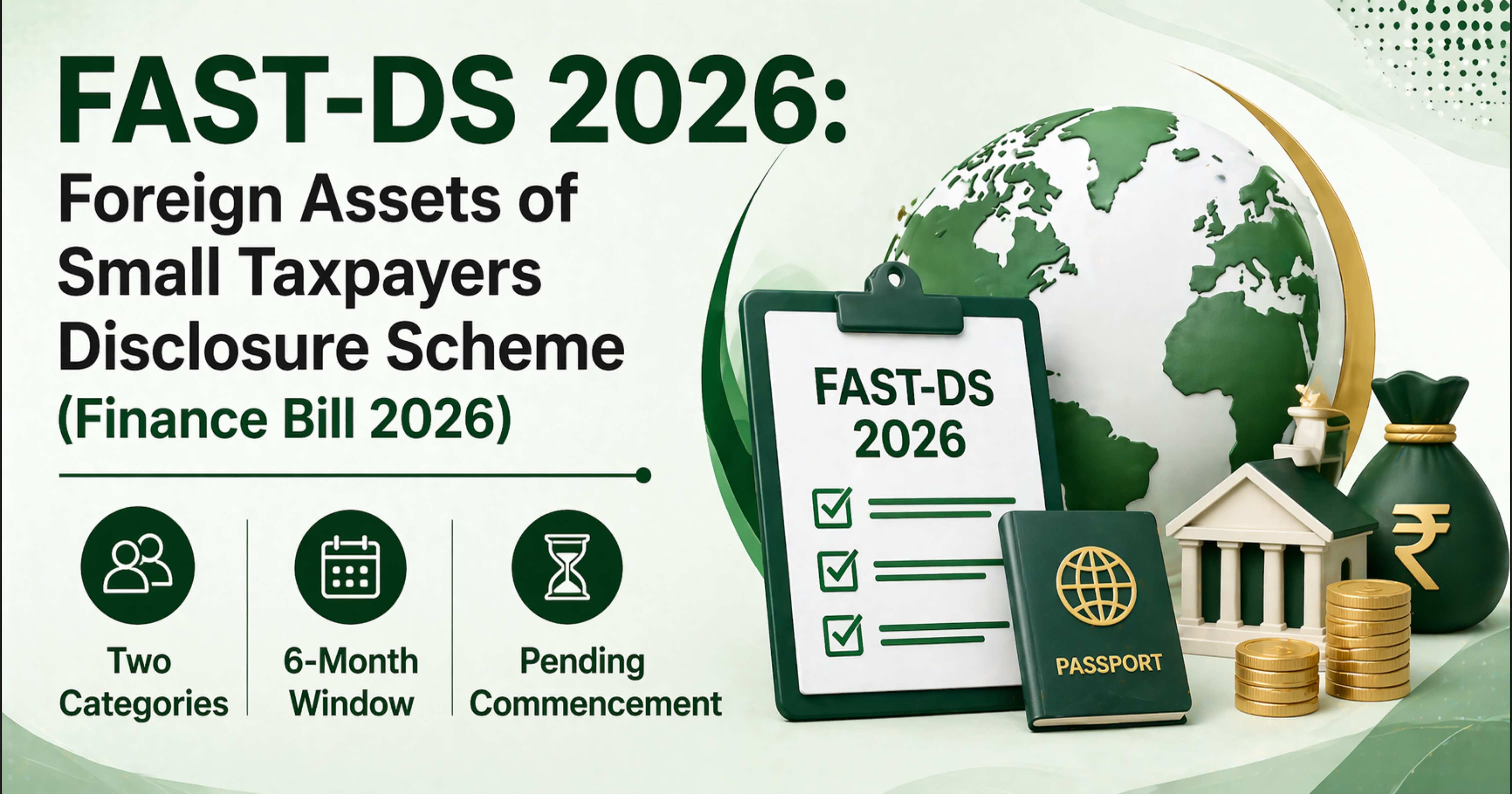

Scheme: Foreign Assets of Small Taxpayers – Disclosure Scheme, 2026 (FAST-DS 2026)
Introduced via: Finance Bill, 2026 (Union Budget 2026-27), enacted as Chapter IV, sections 130 to 144, of the Finance Act, 2026
Rules: Foreign Assets of Small Taxpayers – Disclosure Scheme Rules, 2026, Notification No. 114/2026 (G.S.R. 732(E)) dated 14 August 2026
Related statute: Black Money (Undisclosed Foreign Income and Assets) and Imposition of Tax Act, 2015 (“Black Money Act, 2015”)
Status as of 3 September 2026 (updated): The scheme commenced on 16 August 2026 and the last date for a declaration in Form 1 is 31 December 2026. The Rules, the four forms and a set of CBDT FAQs were published on 14 August 2026. This article was first written on 23 April 2026, when the scheme had been enacted but not commenced; it has been updated to the enacted text. For the operational detail — the 31 March 2026 valuation date, the bank-account valuation rule and the Form 1 to Form 4 payment clock — read the companion piece, FAST-DS 2026 Is Open.
1. Why this scheme was introduced
Under the Black Money Act, 2015, non-disclosure of foreign assets or foreign income by a person resident in India attracts heavy consequences: tax at a flat 30%, a penalty equal to three times the tax, and potential prosecution including imprisonment. The Act was designed to target concealed offshore wealth, but in practice the same framework has also applied to taxpayers with genuinely small or inadvertent non-disclosures — students who held minor foreign bank accounts, technology employees with vested RSUs or ESOPs from overseas parents, and returning NRIs who did not appreciate that their residential status in a given year required Schedule FA reporting.
FAST-DS 2026 is a one-time voluntary compliance window, open from 16 August to 31 December 2026, for such small taxpayers to regularise these defaults with certainty and immunity, without the disproportionate exposure of the default Black Money Act machinery.
2. The two categories — the core of FAST-DS 2026
The scheme draws a sharp distinction between two fact patterns. Most public summaries (including many infographics in circulation) mention only the first category; both need to be understood before deciding how to declare.
Category A — Undisclosed foreign income or foreign asset up to Rs. 1 crore
Applies to an “undisclosed asset located outside India” — a foreign asset held in the taxpayer’s name or beneficially, for which there is no satisfactory explanation of the source of investment (section 131(1)(j)) — and to “undisclosed foreign income”, income from a foreign source that was chargeable in India but never offered to tax (section 131(1)(k)). The default cured can be a return never filed, an asset or income left out of a return, or income that escaped assessment (section 132). The aggregate of the undisclosed foreign income and the value of all such assets as on 31 March 2026, taken together, must not exceed Rs. 1 crore.
- Tax: 30% of the undisclosed income, or 30% of the FMV of the undisclosed asset, as applicable.
- Additional amount: an amount equal to 100% of the tax so computed (section 133, Table, row 1). Numerically this is a further 30% of the base; the statute frames it as a multiple of the tax, and the Form 2 order will show it that way.
- Effective outgo: 60% of the undisclosed income or of the value of the asset as on 31 March 2026.
- Interest: none on the amount itself, but a payment made inside the further two-month period allowed by section 135(3) carries simple interest at 1% for every month or part of a month.
Category B — Asset acquired from taxed income or during NRI status, but not reported in Schedule FA, up to Rs. 5 crore
Applies to a foreign asset that was acquired either (a) from income accruing or arising outside India while the taxpayer was a non-resident, and not declared in the relevant Schedule of the return on becoming a resident, or (b) from income that was offered to tax under the Income-tax Act, 1961, but the asset itself was not declared in the relevant Schedule (section 133, Table, row 2). Acquisition during non-resident years is not enough on its own; the funding has to have been foreign income of that period. The aggregate value of all assets declared under this row must not exceed Rs. 5 crore (Rule 5(1) of the Scheme Rules).
- Payment: a flat fee of Rs. 1,00,000, regardless of asset value within the Rs. 5 crore aggregate ceiling.
- Rationale: the tax has already been paid on the underlying income; the default is a reporting lapse, not a tax lapse.
3. Who can declare
Section 131(1)(a) admits two kinds of declarant: a person who was resident in India in the previous year, and a person who is now a non-resident or not ordinarily resident but who was resident either in the year to which the undisclosed foreign income relates or in the year in which the undisclosed foreign asset was acquired. Category B separately contemplates assets bought from foreign income earned while non-resident. Apply the tests year by year rather than by today’s status. This is particularly relevant for:
- Returning NRIs whose residential status has shifted to resident in a past year, triggering Schedule FA reporting from that year onwards.
- Employees of Indian subsidiaries of foreign parents who hold vested RSUs, ESOPs, stock plans or retirement accounts abroad.
- Individuals who opened a small foreign bank account during study or short-term work abroad and did not later report it.
- Residents holding small cross-border mutual fund, brokerage or digital-asset wallets.
4. Immunity that follows a valid declaration
On making a valid declaration under either category and paying the specified amount within the scheme window, the declarant gets the following protections in respect of the declared asset or income:
- Immunity from prosecution under the Black Money Act, 2015.
- No further penalty under the Black Money Act, 2015 on the declared item.
- The declared income, or the investment in the declared asset, is not included in total income for any assessment year under the Income-tax Act, 1961 or the Black Money Act, 2015 (section 136), provided the amount is paid within the time section 135 allows.
Immunity is specific to the item declared and to defaults covered by the scheme; it does not retrospectively cure defaults outside its scope (for example, income that exceeds the scheme’s monetary ceilings, or non-foreign defaults).
5. A related but distinct amendment — prosecution relief for aggregates under Rs. 20 lakh
Alongside FAST-DS 2026, the Finance Act, 2026 carried a structural amendment to the Black Money Act itself: prosecution is excluded where the aggregate value of undisclosed foreign assets other than immovable property does not exceed Rs. 20 lakh, operating retrospectively from 1 October 2024.
This is not part of FAST-DS 2026; it is a permanent change to the parent Act, made by section 160 of the Finance Act, 2026 as provisos to sections 49 and 50 of the Black Money Act (the offences of failing to furnish a return, and failing to disclose foreign income or assets in one). A taxpayer whose non-immovable foreign assets are within Rs. 20 lakh in aggregate is outside those two offences regardless of whether they use FAST-DS 2026; the tax and penalty exposure, and any other offence, are unaffected. The distinction matters for planning — small-aggregate holders may or may not need the scheme, depending on their specific facts.
6. Commencement and the window — now notified
Section 130(2) provides that the scheme comes into force on such date as the Central Government appoints by notification, and section 131(1)(g) leaves the last date to be notified in the same way. Both have now been notified:
- Commencement: 16 August 2026.
- Last date for a declaration in Form 1: 31 December 2026.
- Valuation date under the Rules: 31 March 2026, for every asset regardless of when it was acquired.
The declaration is filed electronically in Form 1. The amount payable is communicated in an order in Form 2 within one month from the end of the month of filing; payment is due within two months from the end of the month in which that order is received, with a further two months available at 1% simple interest a month; the payment is intimated in Form 3 and certified in Form 4 (section 135). A payment not made within the extended period loses the section 136 exclusion, and section 138 makes every amount paid non-refundable.
7. Practical preparation checklist
- Map the years. Identify every assessment year in which you were resident under section 6 of the Income-tax Act and held any foreign bank account, securities, insurance policy, beneficial interest, retirement account, or immovable property.
- Reconstruct Schedule FA for the resident years. Schedule FA applies to a resident other than not ordinarily resident; a non-resident or RNOR was not required to fill it. For each year in which you were resident, check whether the asset was reported in Schedule FA of the return filed (or whether a return was filed at all). That omission, or the untaxed income behind the asset, is the default the scheme addresses.
- Classify into Category A or B. If the underlying income was itself never offered to tax, you are in Category A. If the income was taxed (or the asset was acquired as an NRI) and only the Schedule FA reporting was missed, you are in Category B.
- Compute aggregate values under the Scheme Rules. For Category A, value every asset as on 31 March 2026 under the Rules and add the undisclosed income; confirm the aggregate is within Rs. 1 crore. For Category B, confirm the aggregate value of all the assets you would declare is within Rs. 5 crore. Note that a bank account is valued on the sum of deposits since it was opened, net of re-deposits of its own withdrawals, not on its balance; only an account already declared and taxed under the 2015 Black Money Act compliance window is valued on deposits since that declaration.
- Check the Rs. 20 lakh prosecution-exclusion test separately. Section 160 of the Finance Act, 2026 added provisos to sections 49 and 50 of the Black Money Act so that those two non-disclosure offences do not apply where the aggregate value of assets other than immovable property is within Rs. 20 lakh, retrospectively from 1 October 2024. That is relief from those two offences only — relevant for deciding whether FAST-DS 2026 is the optimal route, but it does not settle the tax and penalty.
- Work the calendar backwards from your cash. File Form 1 well before 31 December 2026, and only once you know how the amount in the Form 2 order will be paid within two months of the end of the month you receive it.
- Document source of funds. For Category B especially, retain evidence of tax-paid income or NRI-period acquisition that funded the foreign asset.
8. What was notified in August 2026
- Commencement on 16 August 2026 and the last date of 31 December 2026.
- The Rules (Notification No. 114/2026, G.S.R. 732(E), 14 August 2026): the valuation date of 31 March 2026, asset-wise valuation methods including the cumulative-deposit method for bank accounts, the RBI reference rate for conversion, a 20% tolerance on declared values for assets other than bank accounts, and Forms 1 to 4.
- CBDT FAQs on eligibility, reinvestment tracing, the payment clock and the consequence of late payment.
The companion article linked in the status block above walks through each of these with a worked example.
Sources: Finance Act, 2026, Chapter IV, sections 130 to 144; Foreign Assets of Small Taxpayers – Disclosure Scheme Rules, 2026 (Notification No. 114/2026 dated 14 August 2026); CBDT FAQs on the scheme; Black Money (Undisclosed Foreign Income and Assets) and Imposition of Tax Act, 2015; Union Budget 2026-27 speech and Explanatory Memorandum.
This article was first published on 23 April 2026 from the Finance Bill and updated on 3 September 2026 to the enacted scheme and the notified Rules. It is general interpretation, not a substitute for professional advice on any specific fact pattern.





Comments (0)
No comments yet. Be the first to comment!