
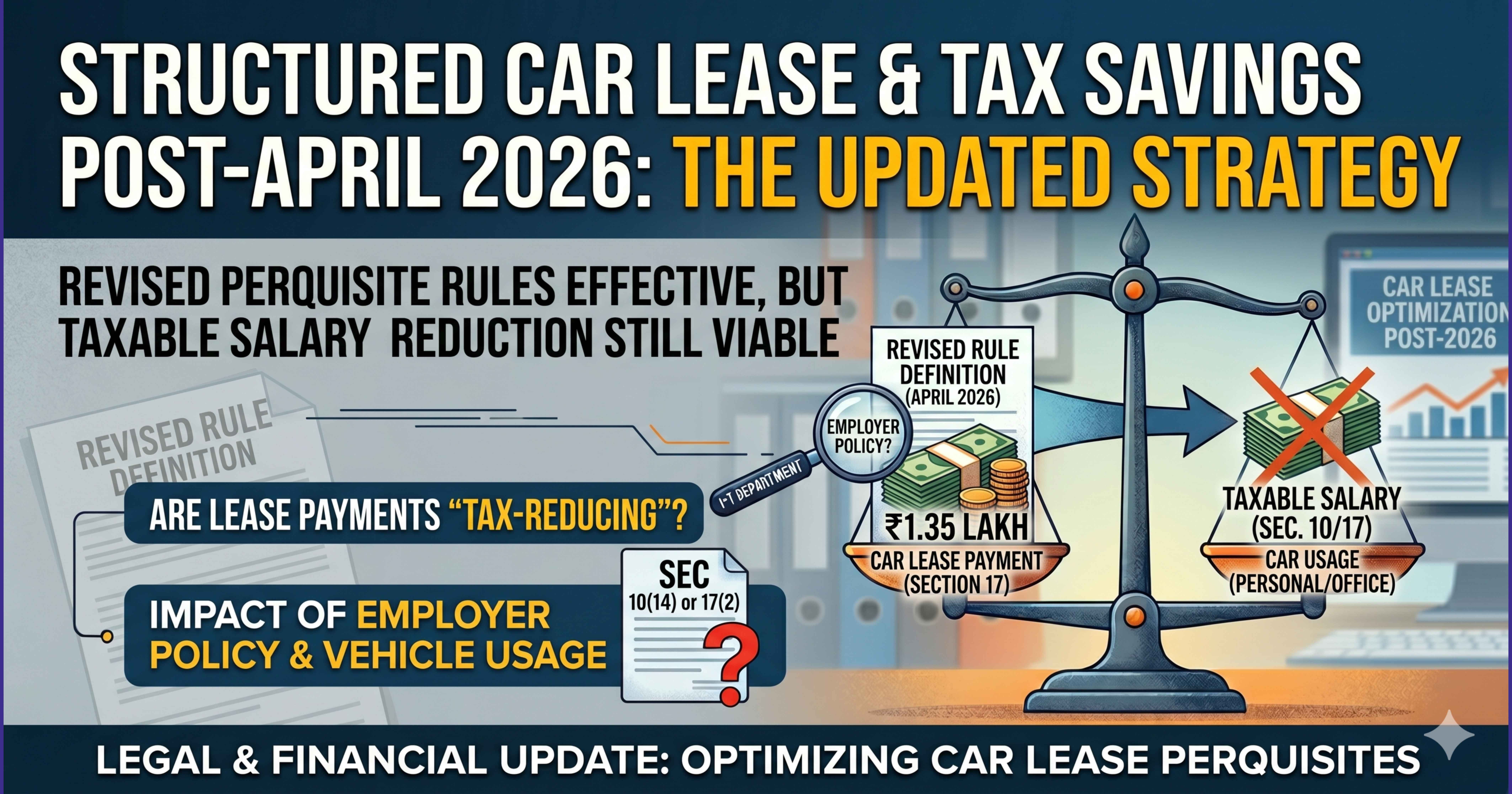
Car leasing continues to be one of the few remaining tax-efficient components for salaried individuals, even under the new tax regime. While most deductions are gone, structured salary components like car lease can still offer meaningful savings—if implemented correctly.
Let’s understand this with a practical example.
Assume an employee falls in the 25% tax bracket and opts for a car lease through their employer. The salary structure includes:
- ₹30,000 per month as lease rental
- ₹15,000 per month for fuel and driver
This totals ₹45,000 per month, or ₹5.4 lakh annually.
Now, instead of taxing the full ₹5.4 lakh, the Income-tax Rules apply a fixed perquisite value (for mixed official and personal use). From 1 April 2026, this perquisite is:
- ₹96,000 annually for cars up to 1.6 litres (or EVs)
- ₹1.2 lakh for cars above 1.6 litres
So effectively, even though the employee is receiving a benefit of ₹5.4 lakh, only ₹96,000 is added to taxable income in this case.
At a 25% tax rate:
- Tax on ₹5.4 lakh would have been ₹1.35 lakh
- Tax on ₹96,000 is only ₹24,000
This creates a significant tax saving.
In comparison, if the same employee purchases a car instead of leasing it, the tax benefit is much lower. Typically, only a limited portion—around ₹15,000 per month—can be structured efficiently, resulting in annual tax savings of about ₹45,000.
Even after considering the increased perquisite taxation from FY 2026, the net benefit remains attractive. In this example, after accounting for the ₹96,000 taxable perquisite, the employee still saves around ₹66,000 more tax compared to not opting for a lease.
However, it is important to understand that this is not a blanket rule. The tax benefit depends on several conditions:
- The car must be provided through the employer (lease structure in CTC)
- Usage should be partly official
- Employer should bear running and maintenance costs
- Proper documentation and records should be maintained
Also, the commonly used term “tax-free” is misleading here. The benefit arises because tax is calculated on a lower deemed value, not because the entire amount is exempt.
Conclusion:
Car leasing is no longer a zero-tax strategy, but it remains a smart tax planning tool when structured properly. As seen in the example, even after stricter rules from April 2026, it can still deliver meaningful savings. Salaried individuals should evaluate this option carefully in consultation with their tax professional to ensure compliance and maximum benefit.


Comments (0)
No comments yet. Be the first to comment!