
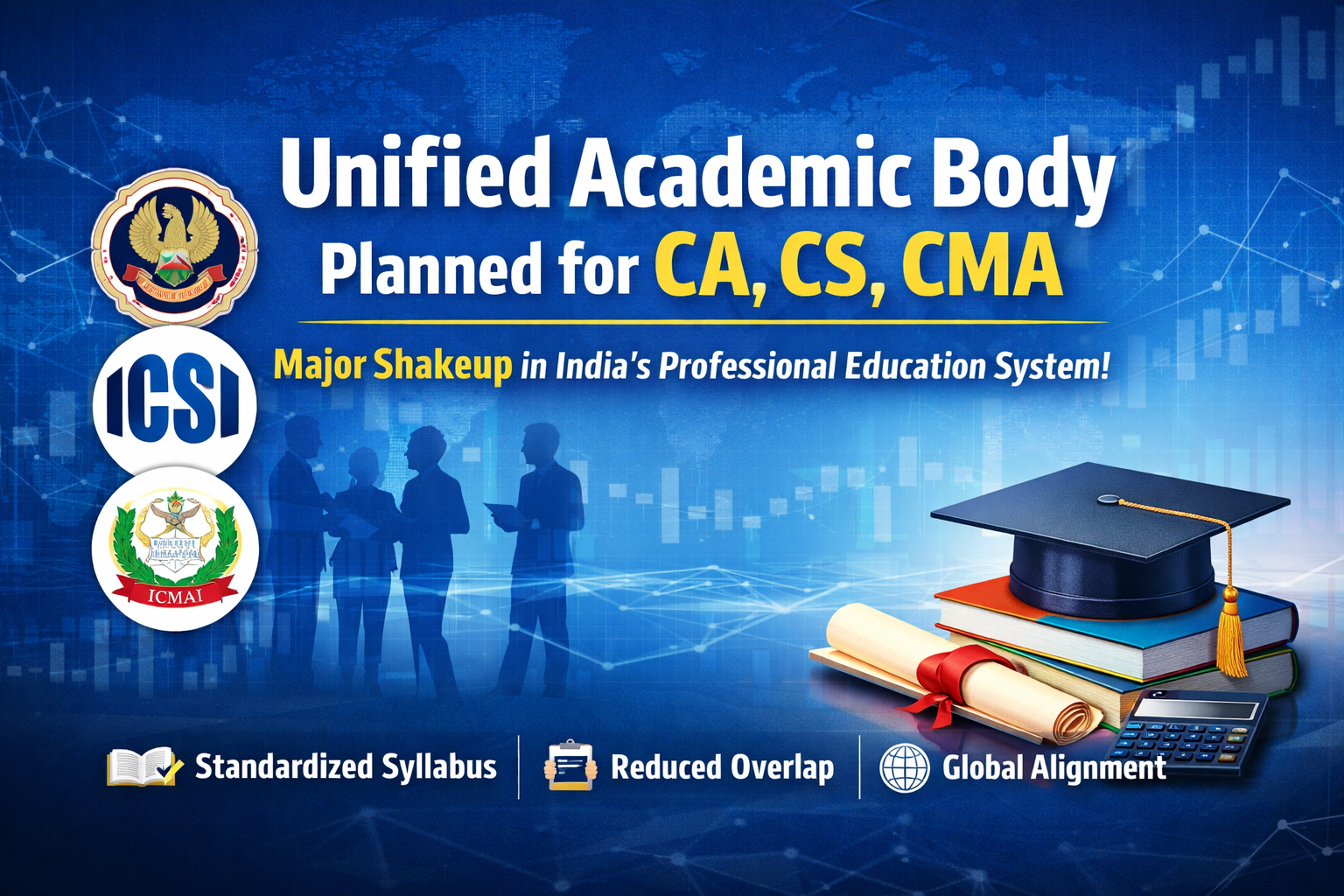

The Ministry of Corporate Affairs (MCA) is reportedly examining a proposal to create a unified academic authority for India’s three premier professional bodies—Institute of Chartered Accountants of India, Institute of Company Secretaries of India, and Institute of Cost Accountants of India. This move, if implemented, could bring a structural shift in how professional education in accounting and corporate governance is designed and delivered in India.
As per available information, an expert committee comprising more than a dozen members has been constituted to evaluate the feasibility of this proposal and recommend a structured framework. The central idea under consideration is the establishment of an “Indian Institute of Accounting” or a similar academic body that would oversee and standardise the curriculum and examination systems across these three institutes.
The primary objective behind this initiative is to bring greater uniformity and consistency in the academic structure. At present, CA, CS, and CMA courses have overlapping subjects such as accounting, taxation, and corporate laws, but they are taught and examined independently by each institute. A unified academic framework could eliminate such duplication and create a more streamlined learning pathway for students.
Another important goal is global alignment. By standardising the academic structure, the government aims to enhance the international recognition and comparability of Indian professional qualifications. This could benefit students seeking global mobility and firms operating across jurisdictions.
Significantly, the proposal does not intend to merge the regulatory functions of the three institutes. The professional autonomy of ICAI, ICSI, and ICMAI—particularly in areas such as membership, practice rights, and disciplinary control—is expected to remain unchanged. The focus is limited to academic harmonisation rather than institutional consolidation.
If implemented effectively, this reform could allow students to build a common foundational knowledge base before choosing their area of specialisation. It may also reduce redundancy in examinations and improve overall efficiency in the qualification process.
However, at this stage, the proposal remains under evaluation. Detailed guidelines on implementation, transition for existing students, and the exact structure of the unified authority are yet to be released. The success of this initiative will largely depend on coordination between the institutes and the clarity of the framework that emerges.
Overall, this move signals a policy direction towards a more integrated and globally aligned professional education ecosystem, while preserving the distinct identity and regulatory roles of India’s key professional bodies.


Comments (0)
No comments yet. Be the first to comment!