
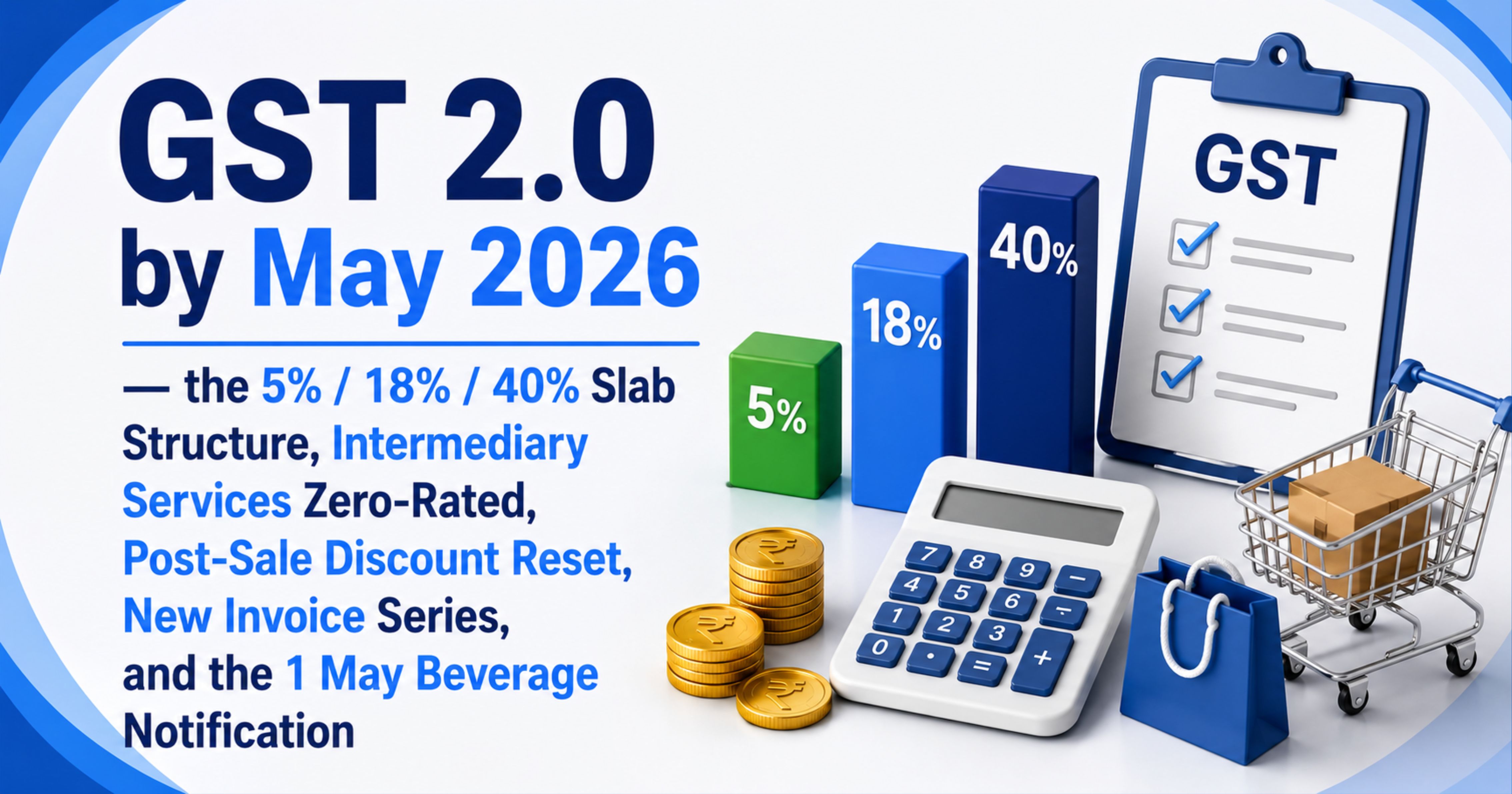

TL;DR: India's GST regime has been through a fundamental reset over the last eight months, with three more changes layered in during March-May 2026. The headline shifts:
- 22 September 2025 — GST 2.0 went live. The old 5 % / 12 % / 18 % / 28 % slab structure (with Compensation Cess on top of 28 %) was replaced by 0 % / 5 % / 18 % / 40 %. The 12 % slab was eliminated entirely. The 28 % slab survives only as a memory — most of those items moved to 18 %, and the residual luxury / sin items moved to a new 40 % de-merit slab. All individual health and life insurance policies became GST-free.
- 1 October 2025 — 90 % provisional refund framework operationalised for inverted-duty-structure (IDS) refund claims and zero-rated / export refund claims, under Section 54(6) of the CGST Act read with CGST Instruction 6/2025 dated 3 October 2025. Form RFD-04. The Council and CBIC have framed this as a faster, risk-assessed grant of provisional refund; specific timelines, triggers, and risk-screening parameters depend on the precise terms of Instruction 6/2025 — refer to the CBIC portal for the latest operative procedure.
- 30 March 2026 — Finance Act, 2026 omits Section 13(8)(b) of the IGST Act. Where a supply was earlier classified as an "intermediary service" with place of supply in India (under the deeming rule), and where the broader export-of-services conditions are met, such supplies to overseas recipients can now qualify as zero-rated exports under Section 16 of the IGST Act. Sectors most affected: portions of IT / ITES, GCCs, BPO, consulting, and marketing-support work that involved a "facilitation" leg (commission, brokerage, lead-generation) which the legacy rule pushed out of export status. Mirror change on inbound: intermediary services received from overseas suppliers attract IGST @ 18 % under Reverse Charge.
- 1 April 2026 — Section 15 / Section 34 of the CGST Act amended. Post-sale discounts no longer require a pre-existing agreement linked to a specific invoice. A credit note under Section 34 + ITC reversal by the recipient is sufficient. Circular No. 212/6/2024-GST stands superseded / rescinded by CBIC consequent to the amendment.
- 1 April 2026 — Mandatory fresh consecutive invoice / document number series for FY 2026-27 under Rule 46(b) of the CGST Rules. Continuing the same un-FY-tagged style without resetting creates reconciliation confusion, audit-trail issues, and (where invoice formats are very basic) potential mismatches between books, GSTR-1, and GSTR-2B. The compliance-safe practice is an FY-tagged fresh series like
INV/2026-27/0001. - 1 May 2026 — Notification No. 01/2026-Central Tax (Rate) dated 30 April 2026 revises the classification framework for non-alcoholic beverages under HSN 2202. Effective from 1 May 2026. Largely clarificatory — sharpens the 5 % / 40 % split for fruit-juice, milk-based, and caffeinated beverages.
This guide consolidates the changes in one place — slab structure, sector-specific resets, compliance triggers — so businesses can audit their FY 2026-27 setup in one pass. It is current to 7 May 2026; GST is a fast-moving area, so verify against the CBIC portal before relying on any specific HSN-level claim or notification.
1. The Slab Reset — Why GST 2.0 Happened
GST since 1 July 2017 ran on a five-tier rate schedule (0 % / 5 % / 12 % / 18 % / 28 %) with Compensation Cess piled on top of the 28 % rate for sin / luxury goods. The structure had two persistent complaints:
- Classification disputes — items at the boundary of two rates (textiles, footwear, foodservice, packaged snacks, electronics) generated thousands of GST advance-ruling and appellate cases over eight years.
- Inverted duty structure (IDS) — sectors where input GST was higher than output GST (textiles, fertilisers, footwear) accumulated unrefunded ITC, choking working capital.
Hon'ble Prime Minister announced a "next-generation" GST reform from the Red Fort on 15 August 2025 (Independence Day). The 56th GST Council Meeting was held in New Delhi on 3 September 2025 (with the Council's recommendations issued through the press release of the same date), chaired by Union Finance Minister Smt. Nirmala Sitharaman. The meeting approved the restructure. The CBIC then notified the revised rate schedules through fourteen notifications dated 17 September 2025 (CGST Rate notifications 09/2025-CTR through 16/2025-CTR, and parallel IGST / UTGST notifications). The structure became operationally live on 22 September 2025.
The new four-rate structure
Slab Label What lands here 0 % Exempt / Nil-rated Unbranded food grains; fresh produce; education and healthcare services; all individual health and life insurance policies (including ULIPs, family floaters, senior-citizen plans); specified essentials notified by the Council from time to time. 5 % Merit Rate Daily essentials, agricultural inputs, dairy, personal-care basics, packaged grains, basic medicines, common medical devices, several mass-consumption packaged foods, specified textile categories. 18 % Standard Rate Most goods and services — electronics, white goods (refrigerators, air-conditioners, washing machines), small cars and motorcycles, construction materials, professional and IT services, telecom, restaurant services (with caveats), most B2B services. 40 % De-merit / Sin Rate Aerated and caffeinated beverages; luxury motor vehicles; specified high-end goods historically attracting Compensation Cess on top of 28 %. Important carve-out: pan masala, gutkha, cigarettes, chewing tobacco, unmanufactured tobacco, and bidis continue under the existing GST + Compensation Cess framework — these tobacco-side products have not migrated to the 40 % slab as part of the 22 September 2025 reset, and will continue under the legacy regime until separately notified by the Council (the transition is held back while Compensation Cess liabilities are being discharged). Confirm against the latest CBIC notifications for the rate position on any specific tobacco-side product. Limited transitional cess and product-specific levies may also operate within the 40 % slab — the new framework is largely a single combined rate but is not strictly cess-free.The Council described the average-incidence effect as a drop from approximately 11.5 % to under 10 % across the basket of items affected, driven primarily by the elimination of the 12 % slab and the 28 %-to-18 % migration of around 90 % of erstwhile 28 % items.
2. Where Items Moved — The 12 % and 28 % Reorganisation
The structural change was not a one-line slab swap; it was a granular HSN-level relocation. The pattern:
The 12 % slab (eliminated)
- ~99 % of erstwhile 12 % items moved DOWN to 5 % — including dairy products (butter, ghee, cheese, condensed milk), several personal-care basics, packaged snacks, jams / jellies / sauces, several medical devices, a wide range of household items.
- ~1 % moved UP to 18 % — primarily textiles priced above the Rs. 2,500-per-piece threshold and a handful of services that the Council classified as standard-rate.
For most consumer-facing businesses, the 12 % elimination was a tax-cut event. For premium-textile players, it was a tax-hike event.
The 28 % slab (collapsed into 18 % and 40 %)
- ~90 % moved DOWN to 18 % — refrigerators, air-conditioners, washing machines, dishwashers, electric vehicles, small cars (sub-4-metre, sub-1500cc), motorcycles, cement (a long-standing industry ask), construction equipment.
- ~10 % moved UP to 40 % — luxury motor vehicles (above prescribed engine / length thresholds), high-end SUVs, aerated soft drinks, caffeinated energy drinks, specified high-cc / high-value motorcycles, and several other erstwhile-cess-attracting categories. Tobacco-side products (pan masala, gutkha, cigarettes, chewing tobacco, unmanufactured tobacco, bidis) continue under the legacy GST + Compensation Cess framework as on 7 May 2026 — they have not yet migrated to the 40 % slab; the migration is deferred until Compensation Cess liabilities are discharged and the Council separately notifies the changeover.
The 175-item rate-cut list publicised by the Council in September 2025 covered processed foods, dry fruits, dairy, packaged snacks, refrigerators, air-conditioners, automobiles within scope, tractors, agricultural implements, several construction materials, and specified medical devices. For HSN-level confirmation of what rate applies to a specific product or service, the authoritative reference is the CBIC GST Goods and Services Rates portal at cbic-gst.gov.in.
3. Health and Life Insurance — A Quiet but Big Win
One of the most consumer-meaningful 56th-Council decisions was making all individual health and life insurance policies GST-free. This includes:
- Individual health insurance (mediclaim, critical illness, top-up plans)
- Family floater policies
- Senior-citizen health plans
- Term life insurance
- Endowment / money-back / whole-life policies
- Unit-Linked Insurance Plans (ULIPs) at the policy-premium level (capital-market-side fees and charges may be treated separately under the Council's framework — review your insurer's revised premium-allocation statement post-September 2025)
Group policies (corporate health plans for employees, group term-life from employers), and specified other allied financial-services products, continue to follow the standard rate framework as notified. For specifics on a given product, refer to the Council's press release or the CBIC notifications dated 17 September 2025.
The downstream effect on FY 2025-26 ITR claims under Section 80D (1961 Act) is unchanged — the deduction continues to be available on premiums paid in respect of eligible health insurance, and the GST exemption simply means the premium itself is lower than it would have been under the prior 18 % rate. (For Tax Year 2026-27 onwards, the corresponding deduction route is under Section 123 read with Schedule XV of the Income-tax Act, 2025, and the exemption-status of the underlying premium is determined under the Council's notifications, not under the Income-tax framework.)
4. The 90 % Provisional Refund — Working Capital Relief
CGST Instruction No. 6/2025 dated 3 October 2025 operationalises Section 54(6) of the CGST Act, 2017 for an accelerated provisional-refund mechanism:
- Effective date: 1 October 2025 (applies to refund applications filed on or after this date).
- Coverage: Inverted Duty Structure (IDS) refund claims AND zero-rated supply / export refund claims.
- Quantum: Up to 90 % of the eligible refund as a provisional refund.
- Form: Refund credited via Form RFD-04.
- Risk-assessed grant: The Council and CBIC framing positions the provisional refund as a faster, risk-assessed grant — claims with cleaner compliance history (timely GSTR-1 / GSTR-3B filings, no outstanding demands, well-matched ITC ledger, LUT on file for export claims) move through the accelerated track, while higher-risk claims continue under the standard scrutiny-sanction route. The exact timeline, screening triggers, and end-to-end procedure depend on the precise terms of Instruction 6/2025 and any consequential SOP / circulars issued by CBIC. Refer to the CBIC portal for the latest operative procedure.
For exporters and inverted-duty-structure businesses (textiles, footwear, fertilisers, several specialty chemicals), the structural intent is a working-capital improvement over the legacy refund cycle. The earlier model often saw multi-week or multi-month waits for full refund grant; the post-October-2025 framework accelerates the front-end through the provisional 90 % tranche, with the residual 10 % continuing under the standard sanction process.
Practical compliance points to keep claims in the accelerated lane: GSTR-1, GSTR-3B, and ITC ledger reconciled and filed up-to-date; LUT for the relevant FY is on file (for export refunds); supplier invoices reconcile with your inward-supply records on the IMS / GSTR-2B side; no recent demand orders or compliance advisories pending. Mismatches and unresolved compliance flags can route a claim out of the accelerated track and into the standard scrutiny path.
5. Intermediary Services — The Section 13(8)(b) Reset
This is the single biggest sector-specific reform of GST 2.0 for India's services-export economy.
The legacy problem
Section 13(8)(b) of the IGST Act, 2017 deemed the place of supply of "intermediary services" to be the location of the supplier. An Indian agent / broker / facilitator providing services to an overseas client therefore had its place of supply in India — and the supply was treated as a domestic supply attracting CGST + SGST, not as an export under Section 16. This denied the LUT route, denied refund of accumulated ITC on the export-side leg, and led to ~Rs. 50,000+ crore of stranded litigation across IT / ITES, BPO, consulting, marketing-support, GCCs, and similar sectors. Eight years of advance rulings, AAARs, High Court writs, and sector-body representations later, the omission of Section 13(8)(b) finally closes the chapter.
The Finance Act, 2026 amendment
- Statute: Finance Act, 2026 (received Presidential assent on 30 March 2026).
- Operative provision: Section 13(8)(b) of the IGST Act, 2017 is OMITTED.
- Effective date: 30 March 2026.
- New default rule: The general place-of-supply rule under Section 13(2) of the IGST Act, 2017 now applies — place of supply is the location of the recipient.
What changes for the Indian intermediary supplier
The amendment helps the specific subset of supplies that were earlier classified as "intermediary services" and therefore had place of supply in India under the deeming rule. Where an Indian entity (IT / ITES, GCC, BPO, consulting firm, marketing-support entity, lead-generation agency, sales-facilitation arm, back-office facilitator) provides intermediary-classified services to overseas recipients, such supplies can now qualify as zero-rated exports under Section 16 of the IGST Act, 2017 — subject to the usual export-of-services conditions:
- Recipient is located outside India;
- Place of supply is outside India (now satisfied automatically post-omission);
- Payment received in convertible foreign exchange or INR (where permitted by RBI);
- Supplier and recipient are not establishments of the same person.
Two compliance routes:
- LUT route (Form GST RFD-11) — supply without payment of IGST. File LUT before the start of the FY; renew annually.
- IGST-and-refund route — pay IGST on the export invoice, claim full refund of IGST under Section 54.
Either way, ITC on inputs and input services attributable to such intermediary-classified exports is fully usable (against domestic outputs) or refundable (under the accelerated provisional-refund regime above) — no reversal required on account of intermediary classification, since these supplies now sit on the zero-rated side rather than as taxable domestic supplies. (Direct service exports — software development, IT consulting, custom code, professional services not classified as intermediary — were already zero-rated under Section 16; the amendment is most relevant to the facilitation-leg portion of an entity's revenue.)
What changes for the Indian intermediary recipient
Mirror change on the inbound side: where an Indian business receives intermediary services from a foreign supplier (e.g., an overseas commission agent finding customers for an Indian product, an offshore broker arranging a transaction for an Indian buyer), the place of supply is now in India — making it an import of services. The Indian recipient must self-assess and pay IGST under Reverse Charge Mechanism (RCM) at 18 %, and may claim ITC of the IGST paid (subject to the eligibility tests under Section 17).
This is a new compliance cost for some Indian businesses that historically had no GST exposure on foreign-broker arrangements. Audit your foreign-vendor ledger for the post-30-March-2026 period.
6. Post-Sale Discounts — The Section 15 / 34 Reset
Effective 1 April 2026, the Finance Act, 2026 amends Section 15(3)(b) of the CGST Act, 2017 (omitting clause (i) and recasting the rest) and provides cross-references between Section 15 and Section 34.
The legacy framework
Pre-amendment, Section 15(3)(b) allowed exclusion of post-sale discount from taxable value only if:
- the discount was established in terms of an agreement entered into at or before the time of supply; AND
- the discount was specifically linked to relevant invoices; AND
- the recipient reversed the proportionate ITC.
This blocked common commercial models — performance / volume rebates earned over a quarter or a year, year-end target incentives, retroactive trade-pricing adjustments — because the "pre-existing agreement linked to specific invoices" test was hard to evidence in distributor-retailer multi-tier structures. Departments routinely denied the discount exclusion, treating the discount as a separate supply (frequently a "service" — leading to GST demands on the discount amount).
The new framework (from 1 April 2026)
- Section 15(3)(b)(i) — the "pre-existing agreement linked to specific invoices" condition — is OMITTED.
- The supplier issues a credit note under Section 34 for the discount amount + applicable GST.
- The recipient reverses the proportionate Input Tax Credit attributable to the discount.
- The credit note + ITC reversal is sufficient to exclude the discount from the taxable value of the original supply.
- Circular No. 212/6/2024-GST stands superseded / rescinded by CBIC consequent to the amendment.
The practical effect: post-sale discounts (volume rebates, year-end incentives, performance-based payouts, trade-pricing corrections) can now be passed without the cumbersome pre-agreement evidence load. The ITC-reversal mechanism preserves tax neutrality — what the supplier reduces from output tax via the credit note, the recipient reverses from claimed ITC.
What suppliers should do
- Map your discount programmes — distributor schemes, dealer incentives, customer loyalty, year-end rebates — and confirm credit notes will be issued under Section 34 with proper invoice-tagging.
- Communicate to recipients (in writing) the corresponding ITC-reversal expectation, with the credit note quantum and reversal amount.
- Update your billing software / ERP to ensure credit notes flow into GSTR-1 (Table 9B) and the recipient's GSTR-2B in time for monthly reconciliation.
- Re-paper distributor agreements where commercial-credit-note clauses were previously drafted to fit the pre-2026 "pre-existing agreement" requirement — they no longer need to be linked to specific invoices, but must still be commercially substantiated.
Important caveat — secondary discounts (financial credit notes)
The amendment relates to discount-bearing commercial credit notes issued under Section 34 (where output tax is reduced by the supplier and ITC is reversed by the recipient). It does not automatically apply to secondary / financial credit notes — those issued purely as a financial settlement without a corresponding GST adjustment. The CBIC's clarificatory position issued in 2025 (and case-law on financial credit notes) on the no-ITC-reversal rule for purely financial credit notes continues to apply for those instruments. Do not collapse the two categories in your ERP — they are taxed differently.
7. Fresh Invoice / Document Series for FY 2026-27
This is technically a continuing rule under Rule 46(b) of the CGST Rules, 2017 (read with Rule 53 for credit / debit notes), not a new 2026 rule — but the FY 2026-27 application is mandatory and the year-on-year compliance pattern is high. Failing to reset is the single most common avoidable compliance error at the start of every financial year.
What the rule requires
- From 1 April 2026, every registered person must commence a fresh, consecutive serial-number series for tax invoices, debit notes, and credit notes for FY 2026-27.
- The series must be:
- unique within the financial year;
- sequential within the GSTIN;
- not exceeding 16 characters;
- permitted to use letters, digits, or special characters (hyphen and slash) — but the format chosen at the start of the year should remain consistent through the year.
- Common formats:
INV/2026-27/0001,2627/INV/0001, or a simple numeric0001within an FY-scoped sequence.
Why this matters more in 2026 than usual
From 1 April 2026, GST compliance has moved further into real-time, portal-enforced controls. The Invoice Management System (IMS) for recipients, the IRP (Invoice Registration Portal) for e-invoicing, and the auto-population of GSTR-1 and GSTR-3B use the document number plus FY plus GSTIN plus document type as the composite identifier per tax period. The IRP's duplicate-check uses this composite key, so the same invoice number in a new FY is not automatically a prior-year collision at the IRP — but the lack of FY-tagging in your series can still cause:
- Reconciliation confusion — without an FY identifier in the document series, your finance team / auditor / department officer cannot distinguish FY 2025-26 documents from FY 2026-27 documents at a glance, slowing audits and increasing reconciliation effort;
- GSTR-1 / GSTR-2B / books mismatch risk — when invoice numbers in two FYs visually look identical, manual reconciliation between GSTR-1, GSTR-2B, and accounting records becomes error-prone;
- Sequence-break scrutiny risk — sequence breaks within a single FY (and inconsistent series formats) are recurring red flags in GST audits, regardless of FY changeover.
The compliance-safe practice is to start a fresh, FY-tagged series on 1 April each year (e.g., INV/2026-27/0001 rather than continuing INV/0501 from FY 2025-26). The series must be unique and traceable for FY 2026-27.
If you operate multiple GSTINs (multi-state registrations), each GSTIN runs its own independent series. Branch-wise series within a single GSTIN must still be unique within the GSTIN. Validate this before the first April 2026 invoice goes out.
8. The 1 May 2026 Beverage Notification
The most recent piece of GST-2.0 follow-through is Notification No. 01/2026-Central Tax (Rate) dated 30 April 2026 (and parallel IGST / UTGST series), effective 1 May 2026. The notification revises the classification framework for non-alcoholic beverages under HSN 2202:
- Fruit juice and fruit-juice-based drinks;
- Milk-based beverages (including flavoured milk);
- Caffeinated beverages (energy drinks, ready-to-drink coffee).
The change is largely clarificatory rather than rate-changing at the GST 2.0 macro-level — it re-aligns the GST tariff entries with the revised Customs Tariff sub-heading classifications and sharpens the line between the 5 % bucket (basic milk-based drinks, several fruit-juice categories meeting specified composition tests) and the 40 % bucket (caffeinated energy drinks, certain flavoured carbonated and aerated beverages). The 18 % bucket continues to apply to mid-positioned categories.
For beverage manufacturers, distributors, retail chains, restaurants, food-service aggregators, and packaged-goods FMCG players: review your SKU master against the revised tariff entries before the 1 May 2026 effective date. The notification is published on the CBIC website at cbic-gst.gov.in under "GST Goods and Services Rates" and the broader Central Tax (Rate) notification archive.
9. FY 2026-27 GST Compliance Checklist
Pulling everything together for the operating audit your finance / compliance team should run during May 2026:
- Slab structure — confirm your SKU / service master is rated correctly under the GST 2.0 schedule (live since 22 September 2025). Particularly: products that historically sat at 12 % (now 5 % in most cases), products that were at 28 % (now 18 % in most cases), and any items that escalated to 40 %.
- Beverage SKUs (if applicable) — revisit HSN 2202 categorisation per Notification 01/2026-CTR effective 1 May 2026.
- Insurance products (if you sell or aggregate) — confirm the GST-free treatment is correctly applied to individual health and life policies; group / corporate / allied products continue under the standard rate framework.
- Invoice series reset — fresh consecutive series for tax invoices, debit notes, and credit notes from 1 April 2026, unique per GSTIN, sequential within the year. Audit the first month's invoices and the IRP / GSTR-1 auto-population for any number-collision flags.
- Intermediary services (if you export to overseas clients) — confirm LUT is filed for FY 2026-27 (Form GST RFD-11). Review your contracts and invoicing to ensure post-30-March-2026 supplies to overseas recipients are flagged as zero-rated where the supply was earlier classified as intermediary AND export conditions are met. Update working-capital model to factor in the accelerated 90 % provisional-refund track on accumulated ITC.
- Intermediary services (inbound from foreign suppliers) — set up RCM tracking for foreign-broker / foreign-agent / overseas-facilitator payments. Self-assess IGST @ 18 % on import of intermediary services post-30 March 2026; claim ITC subject to Section 17 eligibility.
- Post-sale discount programmes — review distributor / dealer / customer-loyalty schemes. From 1 April 2026, credit notes under Section 34 + ITC reversal by recipient is the framework — pre-agreement linkage is no longer required. Update distributor MoUs and customer communications.
- Refund position — for exporters and inverted-duty-structure businesses, plan refund applications (RFD-01) early in each tax period to take advantage of the accelerated 90 % provisional-refund track (RFD-04) operationalised under CGST Instruction 6/2025. Reconcile GSTR-1 / GSTR-3B / GSTR-2B / IMS in advance to keep claims in the cleaner-compliance lane that moves through faster.
- e-Invoicing threshold — verify whether your aggregate turnover for FY 2025-26 crossed the e-invoicing trigger (Rs. 5 crore, with sub-Rs.-5-crore taxpayers also being phased in by stages — confirm the latest threshold on the GST portal). For FY 2026-27 onwards, IRP integration is increasingly default rather than optional.
- IMS reconciliation discipline — Invoice Management System became operationally meaningful through FY 2025-26; for FY 2026-27, treat IMS-acceptance / rejection of inward invoices as part of the monthly close, not a quarterly catch-up.
10. Quick FAQ
Q. When did GST 2.0 actually become effective?
22 September 2025. The 56th GST Council meeting (3 September 2025) recommended it; CBIC notified the rate schedules on 17 September 2025; operational live date was 22 September 2025.
Q. Is the 12 % slab fully gone?
Yes. The 12 % rate no longer exists under GST 2.0. About 99 % of items previously rated at 12 % moved to 5 %; a small residual moved to 18 %.
Q. The 28 % slab — also fully gone?
The 28 % rate slab has been collapsed for most categories. About 90 % of erstwhile 28 % items moved to 18 %; the remaining ~10 % moved to the new 40 % de-merit slab. Important: tobacco-side products (pan masala, gutkha, cigarettes, chewing tobacco, unmanufactured tobacco, bidis) continue under the legacy GST + Compensation Cess framework — they have not migrated to the 40 % slab and will continue under the existing regime until the Council separately notifies the changeover (deferred while Compensation Cess liabilities are discharged). Limited transitional cess and product-specific levies also operate within the 40 % slab on certain categories.
Q. My health insurance premium for FY 2026-27 — is it really GST-free?
Yes for individual health and life insurance policies (including ULIPs, family floaters, senior-citizen plans). Verify with your insurer's revised premium-allocation statement post-September 2025. Group / corporate / employer-sponsored policies continue under the standard rate framework.
Q. I run a small IT consulting firm with overseas clients. Does the intermediary-services change help me?
If you provide direct services to your overseas client (software development, IT consulting, custom code), you were already exporting under Section 16 — the intermediary amendment is not the operative change for you (you weren't classified as an "intermediary"). The amendment is most relevant where your role is facilitating a supply between two other parties (commission agent, sales rep, lead-generator, marketing-support facilitator). If even part of your service mix falls into the intermediary classification (e.g., separately invoiced commission components), the post-30-March-2026 zero-rated treatment is now available for that leg.
Q. We give a 5 % year-end volume rebate to our distributors. Old framework was a nightmare. New framework?
From 1 April 2026, much simpler. Issue a credit note under Section 34 for the rebate amount + GST. Communicate the corresponding ITC-reversal expectation to the distributor. The distributor reverses the proportionate ITC in their GSTR-3B. Department cannot deny the discount-exclusion on the ground that the rebate was not "pre-agreed" — that condition has been omitted.
Q. What's the difference between a commercial credit note and a financial credit note for ITC reversal?
A commercial credit note under Section 34 carries an output-tax reduction by the supplier — and the recipient must reverse the proportionate ITC. A financial / secondary credit note is a pure money settlement (e.g., correction of a billing error not affecting taxable value, or a financial accommodation between supplier and recipient that does not change the taxable value of any specific supply). On the latter category, the no-ITC-reversal position established by the CBIC's 2025 clarification (read with case-law) continues to apply. Check with your tax counsel before classifying any specific credit note — the line is fact-specific.
Q. I forgot to start a new invoice series on 1 April 2026 and my April invoices continue from FY 2025-26 numbers. What now?
Switch to a fresh series immediately for the rest of FY 2026-27. Document the change in your books (a one-line note in the invoice register is sufficient). The legacy April invoices already issued should not be retroactively renumbered (renumbering is itself a compliance breach), but ensure your GSTR-1 and IRP records for those invoices are clean. The IRP's composite-key duplicate check (GSTIN + document type + FY + number) means a same-number-in-new-FY is generally not auto-rejected at the IRP level — but you should still switch immediately to avoid downstream audit-trail confusion. If you are also raising e-way bills / e-invoices at scale, the safer practice is the prospective-only fix; do not retroactively renumber.
Q. The 90 % provisional refund — does it apply to all my refund types?
The accelerated 90 % provisional regime under CGST Instruction 6/2025 applies to inverted-duty-structure (Section 54(3)(ii)) claims and zero-rated supply / export (Section 54(3)(i)) claims. Other refund categories (excess balance in cash ledger, deemed exports, UN body refunds, SEZ supplier refunds) continue under the broader refund framework. Refer to the Instruction and any consequential CBIC SOP / circulars for the exact procedure and timelines applicable to a specific category.
Q. Beverage manufacturer — do I need to update my GST classification before 1 May 2026?
Yes. Notification 01/2026-CTR dated 30 April 2026 is effective 1 May 2026. Re-categorise your SKUs under the revised HSN 2202 framework, update your GST master in the ERP, and confirm the IRP-side tariff lookup matches. The change is largely clarificatory but a mis-classification across the 5 % / 18 % / 40 % buckets is still a material exposure.
Q. Are Compensation Cess obligations fully gone?
Not fully. For most erstwhile 28 % luxury categories that migrated to the 40 % slab, the new framework is largely a single combined rate. But Compensation Cess continues on tobacco-side products (pan masala, gutkha, cigarettes, chewing tobacco, unmanufactured tobacco, bidis) under the legacy GST + Cess framework — these have not yet migrated to the 40 % slab and will continue under the existing regime until the Council separately notifies the changeover (the transition is deferred while existing Compensation Cess liabilities are being discharged). Limited transitional cess and product-specific levies also operate within the 40 % slab on certain categories. Confirm against the latest CBIC notifications for any specific product.
11. Statutory and Notification References
- 56th GST Council Meeting press release — meeting held on 3 September 2025; press release dated 3 September 2025; available at gstcouncil.gov.in. Approved the four-rate (0 % / 5 % / 18 % / 40 %) restructure and the related substantive policy changes (insurance GST-free, IDS refund acceleration, sectoral relief).
- CGST Rate Notifications 09/2025-CTR through 16/2025-CTR — issued 17 September 2025, effective 22 September 2025; parallel IGST and UTGST Rate notification series. Reformed rate schedules across goods and services.
- CGST Instruction No. 6/2025 dated 3 October 2025 — operationalises an accelerated 90 % provisional-refund framework for IDS and zero-rated / export refund claims under Section 54(6) of the CGST Act, 2017. Form RFD-04. Applies to refund applications filed on or after 1 October 2025. For exact timelines, screening parameters, and procedural detail, refer to the Instruction text on the CBIC portal.
- Finance Act, 2026 — received Presidential assent on 30 March 2026. Among other things: omits Section 13(8)(b) of the IGST Act, 2017 (intermediary services place of supply); amends Section 15(3)(b) of the CGST Act, 2017 (post-sale discount conditions). Subordinate clarifications previously issued under the pre-amendment framework (notably Circular No. 212/6/2024-GST on post-sale discounts) have been superseded by CBIC consequent to the statutory amendments — refer to the CBIC GST circular archive for the latest position.
- Section 13(8)(b), IGST Act, 2017 — OMITTED with effect from 30 March 2026. Place of supply for intermediary services now follows the general Section 13(2) rule (location of recipient).
- Section 15(3)(b), CGST Act, 2017 — amended with effect from 1 April 2026. Section 15(3)(b)(i) (pre-existing agreement linked to invoices) OMITTED. Post-sale discount exclusion now operates through credit note under Section 34 + ITC reversal by recipient.
- Section 34, CGST Act, 2017 — credit note framework; cross-references to Section 15 strengthened by Finance Act, 2026.
- Section 54(6), CGST Act, 2017 — provisional refund authority; basis for the 90 % provisional-refund mechanic operationalised by CGST Instruction 6/2025.
- Section 16, IGST Act, 2017 — zero-rated supply (export of services). LUT route under Form GST RFD-11; pay-and-refund route under Section 54.
- Rule 46(b), CGST Rules, 2017 — tax invoice serial number; basis for the FY-wise consecutive series requirement.
- Rule 53, CGST Rules, 2017 — credit and debit notes; serial-number requirement parallels Rule 46(b).
- Notification No. 01/2026-Central Tax (Rate) dated 30 April 2026 — revised classification framework for non-alcoholic beverages under HSN 2202; effective 1 May 2026. Published on the CBIC website under the Central Tax (Rate) notification archive.
- Circular No. 212/6/2024-GST — SUPERSEDED / rescinded by CBIC consequent to the post-1-April-2026 statutory framework for post-sale discounts. Refer to the CBIC GST circular archive for the operative position.
- CBIC GST Goods and Services Rates portal — cbic-gst.gov.in; HSN-level authoritative reference for all current rates.
This guide reflects the GST framework as on 7 May 2026. GST is a fast-moving area — Council meetings, CBIC notifications, and circulars continue to be issued. Verify any specific rate, classification, or compliance position against the CBIC portal before relying on it for a transaction. For complex situations — multi-state operations, sector-specific exemptions, intermediary classification disputes, ITC reversal calibration on financial vs commercial credit notes, or refund applications above standard thresholds — consult a practising chartered accountant or indirect-tax counsel. Nothing in this article is a substitute for professional advice.




Comments (0)
No comments yet. Be the first to comment!