
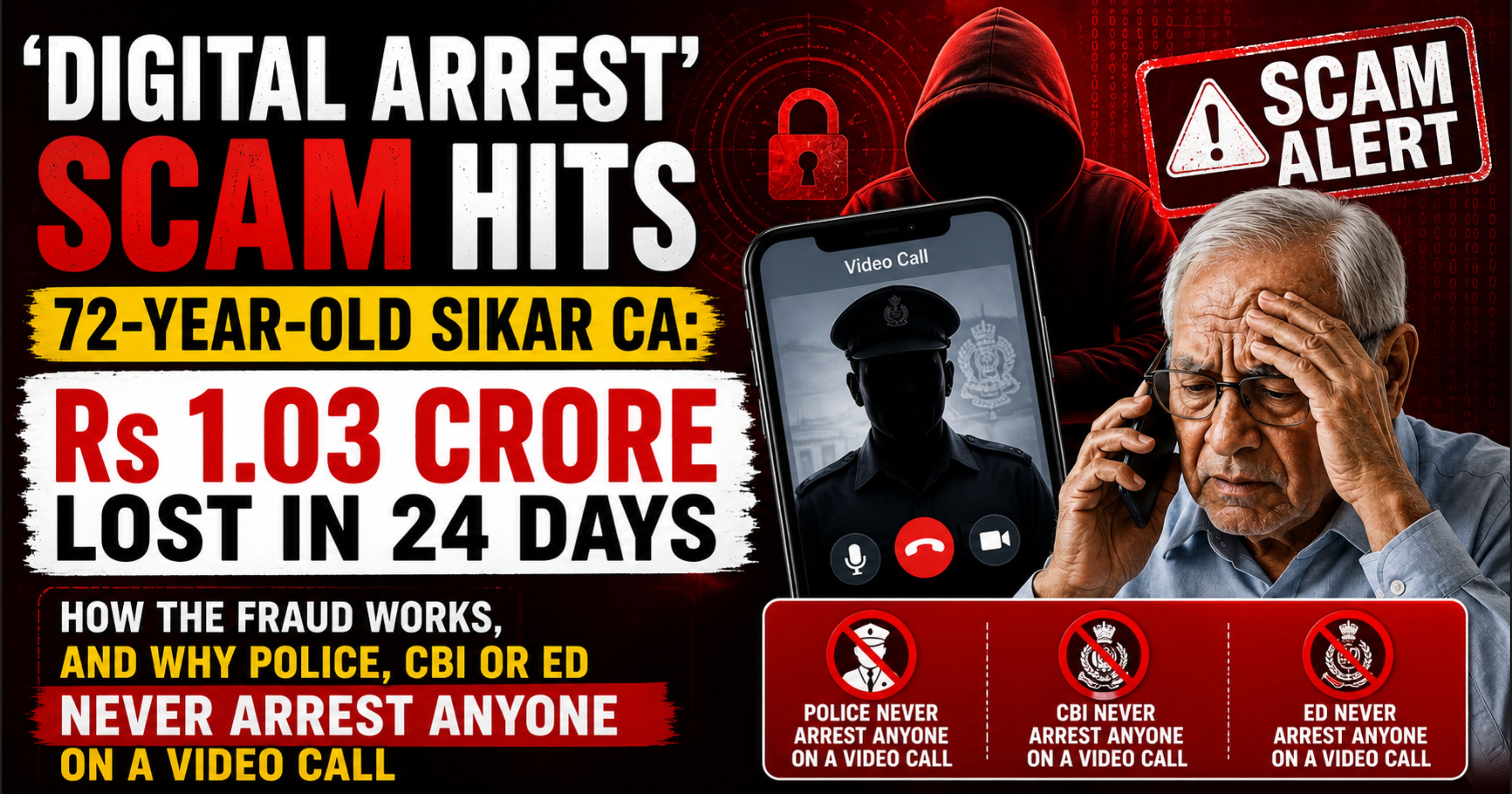

TL;DR — Verified case facts from the Patrika report (Sikar edition, May 2026):
- Victim: Hanuman Singh, age 72, a Chartered Accountant based in Sikar, Rajasthan.
- How it began: First call on 1 April from unknown numbers; voice calls then continued via social-media platforms.
- The threat used: The callers told him that obscene messages were being sent to women from his mobile number, and that illegal transactions were being routed through his bank account.
- The escalation: The accused appeared on video call wearing CBI / ED-style uniforms, set up a full fake "office" backdrop, and showed him a fabricated FIR with his name on it.
- The "digital arrest" window: He was kept under so-called digital arrest from 4 April to 27 April — 24 days.
- The money trail: He made 15 separate transactions into different bank accounts controlled by the fraudsters, totalling Rs 1.03 crore.
- FIR and police response: The case is registered at the Sikar Cyber Police Station. Station House Officer (SHO) Jeevan Lal Khatri is quoted in the Patrika report as the investigating officer.
Source for all case facts above: Rajasthan Patrika, Sikar edition, news report by Patrika News Network (patrika.com), filed under the “Patrika Raksha Kavach” campaign. This article restates only what is in that report; nothing about the case is extrapolated, embellished or assumed.
The rest of this article is awareness context: what “digital arrest” actually is (and why it is not a real legal procedure anywhere in Indian law), the standard playbook this kind of scam runs, why senior Chartered Accountants are particularly attractive targets, the seven red flags, what to do when the call comes in, and what to do if you have already paid.
1. There Is No Such Thing as “Digital Arrest” in Indian Law
This is the single most important sentence in the entire article. No Indian agency — not the police, not the CBI, not the Enforcement Directorate (ED), not Customs, not the RBI, not TRAI, not the Narcotics Control Bureau — has the legal power to “arrest” you over a video call, hold you under house confinement via WhatsApp or Skype, or order you to make payments to clear your name.
The arrest procedure in India is set out in the Bharatiya Nagarik Suraksha Sanhita, 2023 (BNSS), which replaced the Code of Criminal Procedure with effect from 1 July 2024. Under BNSS:
- An arrest must be made in person by an authorised officer.
- The officer must prepare an arrest memo, signed by the person arrested and attested by at least one witness.
- The fact of arrest, with the place where the person is being held, must be communicated to a relative or nominated friend.
- The arrested person has the right to consult a lawyer of their choice (BNSS Sec 38 permits meeting an advocate during interrogation, though not throughout) and must be produced before a Magistrate within 24 hours.
None of this can happen on a video call. The whole framework is built around physical presence and judicial oversight. A “digital arrest” is, by definition, not a procedure recognised by Indian criminal law.
The Enforcement Directorate (ED) operates under the Prevention of Money Laundering Act, 2002 (PMLA). When the ED wants to question someone, it issues a written summons under Section 50 of PMLA. The section authorises the officer to require attendance to give evidence or produce records — either by the person summoned in person or, as the officer may direct, through an authorised agent — and the proceeding is conducted at the ED office on a specified date and time. What Section 50 does not authorise: a freelance video call from an anonymous WhatsApp number that puts you under “digital arrest,” freezes your personal bank accounts over the phone, or asks you to transfer money to a “verification account” while staying on a video link. The CBI, which works under the Delhi Special Police Establishment Act, 1946, follows the same basic posture: written summons, in-person investigation, judicial oversight.
If you internalise just one rule from this article, it is this: the moment any caller claims to be from the police, CBI, ED, Customs, RBI, TRAI or any other government agency and asks you to stay on a video call, transfer money, or keep the conversation a secret, the call is a scam. There is no exception.
2. The Standard “Digital Arrest” Playbook (As Documented by I4C / MHA Public Advisories)
The Indian Cyber Crime Coordination Centre (I4C) under the Ministry of Home Affairs has, through its public advisories and the National Cyber Crime Reporting Portal at cybercrime.gov.in, documented the recurring pattern these scams follow. Prime Minister Narendra Modi devoted a segment of Mann Ki Baat episode #115 on 27 October 2024 to digital-arrest scams, played a mock recording, and gave the public the simple mantra “Ruko, Socho Aur Action Lo” — the official PMO English rendering is “Stop, Think, Take Action.” The pattern, in the order it usually runs:
- The hook call. An unknown number calls you. The caller claims to be from a courier company (FedEx is the most-used cover), the local police, the cyber crime branch, the Customs department, or the “Mumbai Cyber Police.” They say a parcel in your name has been intercepted containing illegal items — narcotics, fake passports, multiple SIM cards, MDMA tablets are common scripts. Or they say your Aadhaar / PAN / mobile number has been linked to a money-laundering case.
- The transfer to the “senior officer.” The first caller says “I am transferring you to the investigating officer” and the call moves to a video call (often on Skype, WhatsApp video, or a custom video-conferencing app the victim is asked to download). The new caller is in a uniform — police khaki, CBI insignia, ED jacket — and is sitting in front of a fake office backdrop, sometimes with a fake nameplate, official-looking case papers, and the national emblem visible.
- The fake FIR / case papers. The “officer” shows you a digitally generated FIR or charge sheet with your name, photograph, address, and details of the alleged offence. Case numbers, court names, and section references are fabricated but look real to a non-lawyer.
- Isolation and monitoring. You are told the case is “extremely sensitive,” that you are now “under digital arrest,” and that you must not contact your family, your lawyer, your bank, or anyone else. You must keep the video call running — even when sleeping, eating, going to the bathroom — or face immediate physical arrest. Many victims are kept on continuous video for days, even weeks.
- The “verification” transfer. Once you are sufficiently isolated and frightened, the demand comes: to clear your name, you must transfer your money to a “verification account” controlled by the agency. The money will be returned within 24 hours after audit. They may ask for one large transfer, or several small ones over days. They may ask you to break fixed deposits, take a loan against your shares, or sell mutual funds. The Sikar case ran 15 transactions over 24 days — that pattern is typical.
- The vanish. Once they have squeezed as much as they can, the calls stop. The numbers go dead. The video-conferencing accounts disappear. The money is moved through a chain of mule accounts, often within hours, and a large fraction is converted to crypto and routed offshore.
The exact script varies. The architecture — hook, uniform, fake FIR, isolation, “verification” transfer — does not.
3. Why Senior Chartered Accountants Are a Disproportionately Targeted Group
Going by the kind of cases that have surfaced in Indian media over 2024-26 (including the Sikar incident reported by Patrika), Chartered Accountants — particularly senior CAs in tier-2 and tier-3 cities — appear to attract this kind of fraud for a stack of structural reasons. None of these are excuses; understanding them is part of the defence.
- Liquidity. A practising CA tends to have substantial savings, fixed deposits, and the ability to liquidate assets quickly. The fraudsters know that a CA can move Rs 1 crore in a week without going through complex permissions; a salaried employee usually cannot.
- Professional vulnerability to a fake FIR. A CA in practice has a Certificate of Practice from the Institute of Chartered Accountants of India (ICAI). The threat that a serious criminal case — especially money laundering or obscene-content allegations — could be filed against them carries a real reputational and professional weight that a lay victim may not feel as acutely. The fear of disciplinary action from ICAI, of clients walking away, of losing the CoP, is leveraged by the fraudsters.
- Confidentiality conditioning. CAs are professionally trained to keep client matters confidential. The scammer’s “don’t tell anyone” instruction lands on someone who is already used to compartmentalising sensitive information from family. The natural impulse to call a friend or a spouse for a sanity check is dampened.
- Solo practice infrastructure. Many senior CAs run a small office or a sole proprietorship, not a large firm. There is no IT department, no compliance team, no senior partner to walk into and say “Hey, this call sounds odd.” The decision is theirs alone, made in the worst possible state of mind.
- Generational digital gap. A CA who is 65 or older built a career and a client base in a pre-internet world. The technical staging of the scam — uniform on video, FIR on screen, web-conferencing app downloaded onto their phone — reads as more authoritative than it would to a digitally native 30-year-old who has seen the same staging in Instagram reels.
- Knowledge that ED / CBI investigations are real in their professional world. A CA knows that PMLA cases against client companies are not theoretical. The scammer’s pitch — “a shell company you signed off on is being investigated” — lands harder on a CA than on a person whose only encounter with PMLA is the news.
The Sikar victim’s profile fits this pattern almost exactly: 72 years old, a CA, in a tier-2 city, isolated for 24 days, and bled across 15 transactions.
4. The Seven Red Flags — If You See Any One of These, the Call Is a Scam
Print this list. Stick it next to your phone. Show it to elderly parents and grandparents.
- The caller asks you to stay on a video call — or threatens immediate arrest if you hang up. No real Indian agency does this. Hang up.
- The caller is “in uniform” on the video. Real police, CBI, and ED officers do not investigate or summon citizens via video call regardless of what they are wearing. The uniform is theatre.
- The caller mentions a fake parcel, an Aadhaar misuse, an obscene-message complaint, or a money-laundering case — and says it was filed against you in a city you do not live in. The Mumbai / Delhi / Bengaluru cyber-cell framing is a standard scam script.
- You are told not to tell anyone — not your spouse, your children, your lawyer, your CA, your bank. This is the single biggest tell. Real investigations do not require secrecy from the person being investigated, and they typically allow access to a lawyer at the appropriate stages of questioning.
- You are asked to transfer money to a “verification,” “hold,” or “RBI escrow” account — with a promise of return in 24 hours. The RBI does not hold individual citizens’ money in escrow accounts. No agency does. Once you transfer, the money is gone.
- The caller knows some of your details — full name, PAN, Aadhaar last digits, address — and uses that to claim authenticity. Those details have leaked from one or more data breaches and are sold on dark-web forums for a few rupees per record. Knowing your PAN does not make a caller a CBI officer.
- You are pushed for an immediate decision and told the situation will get worse if you delay even an hour. Manufactured urgency is the universal signature of social-engineering fraud, from phishing emails to digital-arrest scams.
If you see any one of these flags, the call is a scam. You do not need a second flag, a third, a corroborating signal. One is enough. End the call.
5. What to Do When the Call Actually Comes In
- Hang up. Do not engage. Do not argue. Do not try to “catch them out” with clever questions. Just disconnect.
- Block the number. Block both the calling number and any social-media handle the calls have moved to.
- Tell someone immediately. A spouse, an adult child, a colleague, a friend. The single most powerful defence against a digital-arrest scam is breaking the isolation the scammer is trying to build. Five minutes of conversation with anyone you trust is enough to dissolve the illusion.
- If the calls continue, screenshot and report. Take screenshots of the caller-ID, the video-call interface, any “FIR” documents shown, any account numbers given for transfers. Report on the National Cyber Crime Reporting Portal at cybercrime.gov.in or call the helpline 1930. The 1930 helpline runs 24x7 and is operated by I4C.
- File a written complaint at your local police station. Even if no money has moved, the FIR establishes a paper trail. Do this even if you are embarrassed about having engaged on the call — the scam preys on shame, which is exactly why it works.
- Notify your bank and ask them to flag your accounts. Indian banks have internal fraud-watch protocols; an alert from you can stop a payment that you have, in a confused moment, already initiated.
- If you are a CA in practice, separately notify your bank that no client trust-account or escrow money should be touched without an in-person, signed instruction. Don’t let a moment of personal panic compromise your fiduciary obligations.
6. What to Do If You Have Already Transferred Money
Speed is everything. The fraudsters move funds through mule accounts very fast — often within an hour. The chance of recovery falls sharply after the first 24 hours and falls again after the first week. If a transfer has gone out:
- Call 1930 immediately. The earlier the call, the better. The 1930 system can issue a hold request to the receiving bank and freeze the funds before they are layered onward, but only if they are still in the immediate-receiving account.
- File a complaint on cybercrime.gov.in and note the acknowledgement number; you will need it for the bank.
- Walk into your bank branch in person. File a written dispute, attach the cybercrime.gov.in acknowledgement, and ask the bank to invoke the inter-bank fraud-recovery protocol on your behalf. Get a written acknowledgement of your complaint with date and time.
- File a formal FIR at the local police station / cyber police station. “Online complaint” is not a substitute — you need an FIR for any meaningful chance of legal recovery.
- Preserve every piece of evidence. Don’t delete the call logs, the screenshots, the chat messages, the bank statements, the mule account numbers. Take backups.
- Engage a lawyer. Civil recovery is slow but not impossible, especially for the first few mule accounts in the chain.
Even with all of this done well, recovery rates in Indian digital-arrest cases are modest — the I4C’s own public statements have flagged this. The defence that works is prevention, not recovery.
7. The Legal Framework — What Indian Law Says About These Fraudsters
The fraudsters in the Sikar case — and in every digital-arrest case — are committing a stack of cognisable offences under Indian criminal law, even where the original calls originate from outside India. The relevant sections, all post-1 July 2024 nomenclature:
- Section 318, Bharatiya Nyaya Sanhita, 2023 (BNS) — Cheating. Inducing a person by deception to deliver property; the core offence in every transfer-of-money fraud. (BNS Sec 318 now houses the cheating offence including the aggravated cheating-and-delivery-of-property variant — broadly the IPC Sec 415 definition together with the Sec 420 aggravated form.)
- Section 319, BNS — Cheating by personation. Pretending to be someone the person is not — precisely what impersonating a CBI / ED officer in uniform is. (Replaces Sec 416 / 419 IPC.)
- Section 308, BNS — Extortion. Putting a person in fear of injury (including reputational) and dishonestly inducing the delivery of property. The threat of a fake FIR followed by a demand for transfer fits this definition.
- Section 336, BNS — Forgery. Making a false document — the fabricated FIR / charge-sheet is exactly that. (BNS Secs 335 and 336 jointly cover the IPC Secs 463 / 464 / 465 forgery terrain.)
- Section 66C, Information Technology Act, 2000 — Identity theft. Fraudulent use of another person’s electronic signature, password, or unique identifier — covers the use of stolen PAN / Aadhaar data to make the call seem authentic.
- Section 66D, IT Act 2000 — Cheating by personation by using computer resource. The most directly-on-point cyber-law section: punishment up to three years and fine up to one lakh rupees for cheating by personation through any communication device or computer resource. Video-call impersonation of a CBI officer fits squarely.
- Sections 3 and 4, Prevention of Money Laundering Act, 2002 (PMLA). Where the downstream movement of funds through mule accounts involves dealing with proceeds derived from a scheduled offence with the requisite knowledge or participation, it can attract independent prosecution under PMLA Sec 3 (offence of money laundering) with punishment under Sec 4. The mere mechanical movement of money does not, by itself, become a PMLA offence without those statutory elements.
The architecture for prosecution is therefore not lacking. The bottleneck is the cross-border layering of the money — many digital-arrest networks are believed by Indian agencies to operate from outside India, with the on-ground mule accounts being the only domestic touchpoint.
8. For Practising CAs — Three Professional Discipline Points
If you are a CA reading this, the Sikar case has implications beyond your own personal safety:
- Client confidentiality and trust-account integrity. Under the ICAI Code of Ethics you carry a confidentiality obligation to every client. A digital-arrest scam that pressures you to discuss client matters — or worse, transfer money out of client trust accounts — is not just a personal-finance event; it is a professional-conduct event. Establish a hard rule, in writing on your office wall: no client funds move without an in-person, signed instruction from the client and a co-signature from a partner / staff member. Make it a rule that survives your own panic.
- Educate your office, including support staff. Front-desk staff often field the first call. A trained receptionist who hangs up on “CBI officer wants to speak to your CA sahib urgently” saves the firm an incident before it starts.
- Educate your senior individual clients. Many of your senior clients trust you more than they trust their bank. A one-page handout on digital-arrest scams — the seven red flags above, the 1930 helpline, the cybercrime.gov.in portal — signed by you, given to every client over 60, is a public-good intervention with near-zero cost. Several CA firms have started doing this; it is a small thing that materially helps.
9. The Bottom Line
The Sikar case as reported by Patrika is, sadly, not unique. It is one well-documented instance of a fraud architecture that has cost Indian victims hundreds of crores in 2024-26 and that has explicitly caught the attention of the Prime Minister, the Ministry of Home Affairs, the Reserve Bank of India, and the Indian Cyber Crime Coordination Centre.
The defence is simple, even if applying it under pressure is hard:
- No Indian agency arrests anyone via video call. Ever.
- No real investigation requires you to keep secrets from your family or lawyer.
- No genuine government department asks for a transfer to a “verification account.”
- If a caller pushes you on any of these three, the call is a scam. Hang up. Tell someone. Report to 1930 or cybercrime.gov.in.
If you have an elderly parent, an elderly client, or an elderly colleague, please share this article with them today. The Sikar victim’s 24-day ordeal — documented by Patrika — is the sort of thing one informed conversation can prevent.
10. Sources and References
- Primary case source: Rajasthan Patrika, Sikar edition (May 2026), news report by Patrika News Network — published under the “Patrika Raksha Kavach” consumer-safety campaign. Available at patrika.com. All case-specific facts in this article (victim age and name, dates 1 / 4 / 27 April, 24-day duration, 15 transactions, Rs 1.03 crore total, FIR at Sikar Cyber Police Station, SHO Jeevan Lal Khatri quoted) are taken from this report.
- National Cyber Crime Reporting Portal: cybercrime.gov.in — for online cybercrime complaints. Operated by the Indian Cyber Crime Coordination Centre (I4C), Ministry of Home Affairs, Government of India.
- Cybercrime helpline: 1930 — 24x7 toll-free, operated by I4C / MHA. Used for immediate transaction-hold requests to receiving banks.
- PM Mann Ki Baat episode #115, 27 October 2024 — dedicated segment on digital-arrest scams, including a mock recording and the “Ruko, Socho Aur Action Lo” mantra (PMO English rendering: “Stop, Think, Take Action”). Publicly broadcast; archived on the official PMO website (pmindia.gov.in) and on AIR / Akashvani channels; PIB press release dated 27 October 2024 (PRID 2068698).
- Bharatiya Nagarik Suraksha Sanhita, 2023 — arrest procedure (Sec 35 powers, Sec 36 arrest memo, Sec 38 advocate-during-interrogation, Sec 48 intimation to relative, Secs 57-58 production before Magistrate within 24 hours). In force from 1 July 2024 (with notified carve-outs — e.g. the BNSS First Schedule entry corresponding to BNS Sec 106(2) was not commenced on that date).
- Bharatiya Nyaya Sanhita, 2023 — Sections 308 (extortion), 318 (cheating — covering both the IPC 415 definition and the IPC 420 aggravated form), 319 (cheating by personation), 335-336 (false document / forgery, jointly covering the IPC 463/464/465 terrain). In force from 1 July 2024 (with the Sec 106(2) carve-out noted above).
- Information Technology Act, 2000 — Section 66C (identity theft) and Section 66D (cheating by personation by using computer resource). The on-point cyber-law sections.
- Prevention of Money Laundering Act, 2002 — Section 50 (ED summons power: officer may require attendance in person or through an authorised agent, as the officer may direct; written summons issued at the ED office); Sections 3 and 4 (offence and punishment for money laundering — require dealing with proceeds of a scheduled offence with statutory mens rea/participation, not every fund movement automatically).
- Delhi Special Police Establishment Act, 1946 — the parent statute under which the CBI investigates; in-person investigation framework.
- RBI public advisories on cyber-fraud safety — the Reserve Bank periodically reissues consumer-protection advisories reiterating that the RBI does not seek transfers from individuals to “hold” or “verification” accounts.
- ICAI Code of Ethics — professional confidentiality obligations relevant to practising CAs.
This article is awareness content as on 6 May 2026. Case-specific facts are restated from the cited Patrika report; legal references are restated from the named statutes and public advisories. Verify any specific reporting / FIR procedure with your local police station and the cybercrime.gov.in portal at the time of acting. If you are a CA whose client funds may have been touched in such a fraud, engage your firm’s legal counsel and ICAI’s grievance cell in parallel with the criminal complaint.



Comments (0)
No comments yet. Be the first to comment!