
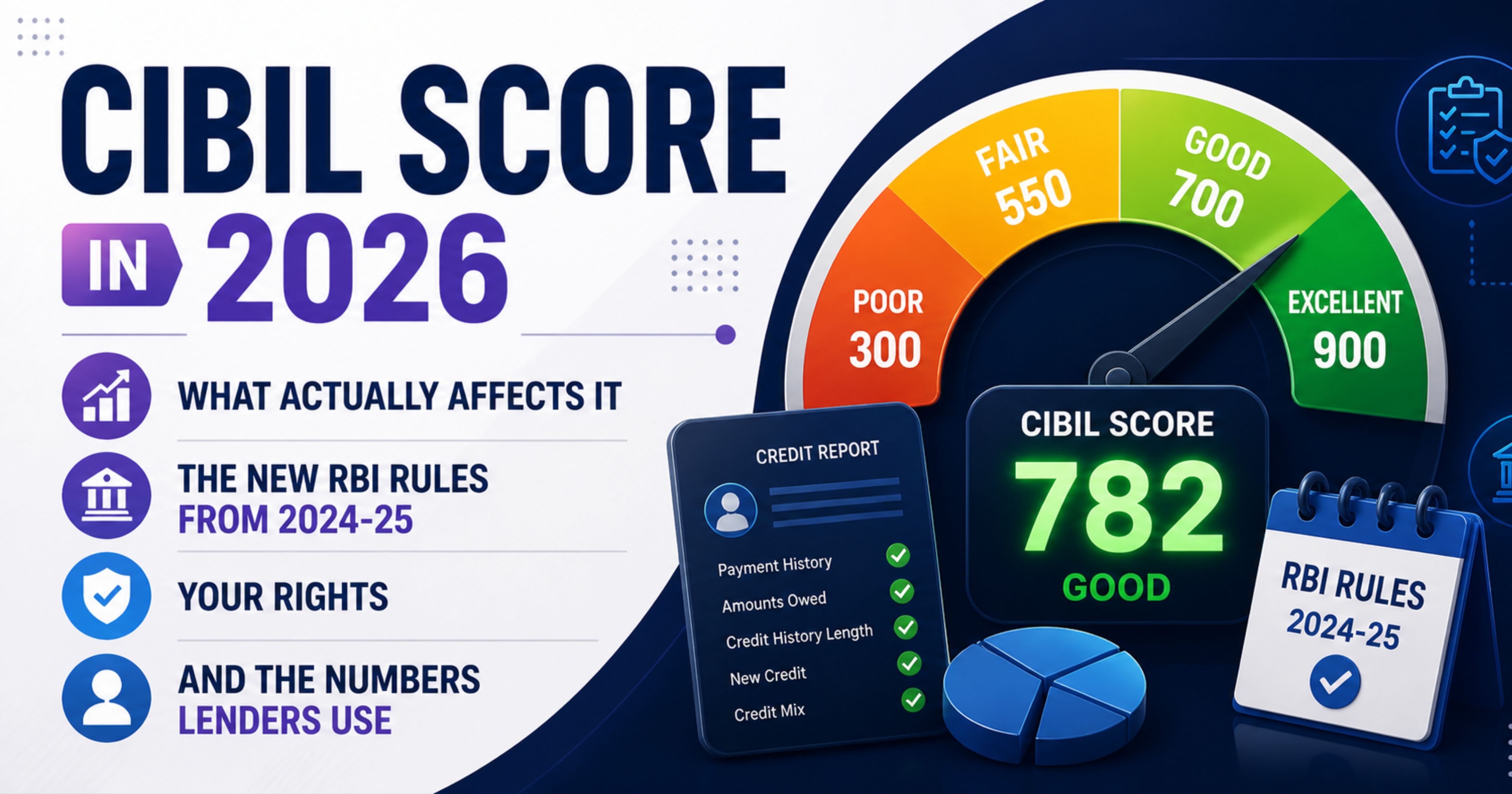

TL;DR: Your CIBIL score is a three-digit number from 300 to 900 that India’s lenders use as a first-pass risk filter on every loan and credit-card application. 750 and above is the band most lenders treat as creditworthy. CIBIL is one of four RBI-licensed Credit Information Companies (CICs) — the others are Equifax India, Experian India, and CRIF High Mark — all regulated under the Credit Information Companies (Regulation) Act, 2005.
Five things changed materially for CIBIL holders in 2024-25:
- Fortnightly reporting from 1 January 2025. Per RBI Notification dated 8 August 2024, banks and NBFCs (Credit Institutions, or CIs) must now report your credit information to CICs twice a month — on the 15th and the last day of each month — instead of once a month. CIs have 7 calendar days from the reporting date to submit; CICs must ingest within 5 calendar days. Practical effect: a payment you made on April 16th will reflect in your CIBIL report by mid-May at the latest, not next month.
- Free annual full credit report (FFCR). Under the RBI direction dated 26 October 2023, effective from 26 April 2024, every CIC must give you one free full credit report including the score per calendar year (January–December), via electronic delivery after authentication. Use this entitlement — it is the cleanest way to audit your credit data.
- SMS / email alerts on access. CICs must now send you an alert every time your CIR (Credit Information Report) is accessed by a Specified User (a lender or other authorised entity). If you receive an unexpected alert, treat it as a fraud-risk signal and dispute the access with the lender named.
- 30-day dispute resolution + Rs. 100/day compensation. If you raise a correction request and the CIC / lender does not resolve it within 30 calendar days, you are entitled to compensation of Rs. 100 per day of delay until resolution — a hard customer-protection right under the 2025 RBI Master Direction.
- 21-day lender response and reasons for rejected corrections. The lender (CI) has 21 days to respond to a CIC’s correction request; failure to respond attracts a Rs. 100/day default penalty. And where a CI / CIC rejects a data-correction request, the consumer must be told in writing why — silent rejections are not allowed under the 2025 Master Direction. (Note: this is the disclosure standard for correction-request denials; loan rejections themselves on the basis of credit information are not subject to a separate written-reason mandate under the 2025 Direction.)
The article works through what the score is, what factors move it, what the new RBI rules mean for you operationally, and the exact mechanics of disputing wrong entries.
1. Who Computes Your CIBIL Score — The Four CICs
India has four RBI-licensed Credit Information Companies under the CIC(R) Act, 2005:
- TransUnion CIBIL — the oldest, set up in 2000. Its score (the “CIBIL Score”) is the most widely cited in retail credit decisions.
- Equifax India.
- Experian India.
- CRIF High Mark.
All four operate under the same RBI Master Direction. Each one publishes its own credit information report (CIR) for you, with a score on a similar scale (300–900 in most models). When a lender pulls a report, they may pull from any of the four; some lenders prefer one CIC over another. Your data should be roughly consistent across the four, but small differences in score across bureaus are normal because each uses a slightly different model and may have a marginally different data set on you.
The score is computed from the data the CIC holds on you — payment behaviour on every loan and credit card you have, account history, balances, inquiries, defaults. The CIC does not invent data; it consolidates what banks and NBFCs report.
2. The Score Range and What the Bands Mean
Band What it means in practice 750 to 900 — Excellent Top tier. Most lenders auto-approve subject to documentation; you typically get the lowest published interest rate, the highest credit-card limit offers, and the best processing-fee waivers. About 70–80 % of formal-sector retail loans are sanctioned to applicants in this band. 700–749 — Good Approved by most lenders, sometimes with a marginal rate premium. Negotiating room on rate is limited; you may not get pre-approved offers from lenders for whom you are a non-customer. 650–699 — Fair Borderline. Some lenders approve but with higher rates, lower limits, or co-applicant requirement. Many credit-card issuers decline. Your credit history needs work before you should apply for a major loan. 550–649 — Poor Most mainstream lenders decline. NBFCs in the mid-range may approve at significantly higher rates. Likely indicates one or more recent defaults or high credit utilisation. Below 550 — Very poor Nearly all formal lenders decline. Indicates serious past default, write-off, or settlement. Recovery is possible but takes 18–36 months of consistent on-time payment behaviour.NA / NH (No History): If you have never taken a loan or credit card, your CIR will show NA / NH and there will be no numerical score. Lenders are not required to refuse a first-time borrower for lack of credit history alone — in practice, banks and NBFCs assess the application on alternative data (salary, banking conduct, employer) and approve where the broader profile fits. For any structured product (home loan, business loan), an established credit history is still preferred.
3. The Five Factors That Affect Your Score
TransUnion CIBIL publishes the factors in qualitative order but does not disclose the exact weights. The widely circulated “35 % / 30 % / 15 % / 10 % / 10 %” breakdown is from the US FICO model and should not be quoted as if it were CIBIL’s own published methodology. The factors, in approximate descending order of importance:
- Payment history. Whether you have paid every EMI and credit-card minimum on time. Late payments, missed payments, settled accounts and write-offs all show up here. CIBIL does not publish point-loss tables — the algorithm is proprietary — but practitioner experience is that a single 30-day late payment is a noticeable score drop on a previously-clean profile, and a settled or written-off account is a much larger event that suppresses the score for years until the entry ages out.
- Credit utilisation. The proportion of your sanctioned revolving credit limit (mainly credit cards) that you are using. A utilisation above 30 % of the limit, sustained, is read as credit hunger and pushes the score down. Below 30 % is the standard target.
- Length of credit history. The age of your oldest active loan / card account. A 15-year-old credit card with on-time payments is worth more to your score than a 1-year-old card. Closing your oldest card to “clean up” is a frequent self-inflicted wound.
- Credit mix. A balance of secured (home loan, auto loan) and unsecured (personal loan, credit card) lines is read as evidence that you can manage different obligations. A profile with only credit cards or only an EMI loan is slightly weaker than a balanced profile, all else equal.
- New credit / inquiries. Each fresh credit application produces a hard inquiry on your CIR; multiple hard inquiries in a short window are read as financial stress and pull the score down. Soft inquiries (your own check, pre-approved offers from lenders) do not affect the score.
What does not affect your CIBIL score (despite popular myths):
- Your salary, occupation, employer, or income.
- Your savings or fixed deposits.
- Your investment portfolio (mutual funds, equities, gold).
- Property holdings.
- Tax filing status. (PAN-Aadhaar linkage matters for KYC, not for the score itself.)
- Family members’ CIBIL scores. Each PAN holder has an independent score — your spouse’s default does not bleed into your score (unless you co-signed a loan).
4. The 2024-25 RBI Rule Changes — What is New
The Reserve Bank of India consolidated the credit-reporting framework through the Master Direction — Reserve Bank of India (Credit Information Reporting) Directions, 2025 dated 6 January 2025, issued under Section 11 of the CIC(R) Act, 2005. It pulls together earlier circulars and adds new customer-protection mechanics. The substantive changes for an individual borrower:
4.1 Fortnightly reporting from 1 January 2025
Banks and NBFCs (CIs) must report credit information to CICs as on the 15th and the last day of each month, with a 7-day window to submit. CICs must ingest within 5 calendar days of receipt. Earlier, reporting was monthly. Practical impact:
- A payment you make on April 5 reflects in your CIR by April 22 (15th cycle + 7-day submission).
- A payment you make on April 18 reflects by May 7 at the latest (end-of-month cycle + 7-day submission).
- Score recovery after clearing an overdue is faster: a one-month delay in the score updating (under the old monthly cycle) is now a maximum of two weeks.
4.2 Free annual credit report (FFCR)
Under RBI’s notification dated 26 October 2023, effective from 26 April 2024, every CIC must provide one full credit report (CIR) including the score, free of charge, per calendar year, to every individual whose credit history is on file. Delivery is electronic, after authentication.
The FFCR is per CIC — you can pull one free report from each of CIBIL, Equifax, Experian and CRIF High Mark in the same calendar year. Use them: pull all four, reconcile, and dispute any discrepancy.
4.3 SMS / email alerts on access
CICs must send you a real-time alert whenever a Specified User (a lender or authorised entity) accesses your CIR. The alert names the entity and the date. If you receive an alert for an entity you have not applied to, treat it as a fraud-risk signal — the access could be from a credit application made in your name without your consent. File a dispute with the CIC and the lender named, and consider blocking your CIR via the standard CIBIL freeze workflow.
4.4 21-day lender response and Rs. 100/day default
When a CIC raises a correction request to a CI on the back of your dispute, the CI must respond within 21 calendar days. Failure to respond attracts a Rs. 100/day default penalty from the CI. Earlier, lender response timelines were unenforced; the 2025 Direction makes them money-backed.
4.5 30-day dispute resolution + Rs. 100/day compensation to consumer
Where a correction is not resolved within 30 calendar days, the consumer is entitled to Rs. 100 per day compensation from the responsible entity (CIC or CI), payable until resolution. This is the customer-side teeth of the framework.
4.6 Reasons for rejected correction requests
Where a CI or CIC rejects a consumer’s request to correct data on the CIR, the consumer must be told the reasons in writing. Silent rejections of correction requests are not permitted under the 2025 Master Direction. This is narrower than a general adverse-action regime — loan denials on the basis of credit information are not, by themselves, subject to a separate written-reason mandate under the Direction; the rule is specifically about correction-request denials. In practice, however, most lenders today share at least the score-based component of any retail-loan decline.
5. How to Read Your CIBIL Report
The CIR is a several-page document. The fields that matter most:
- CIBIL Score — the headline three-digit number (or NA/NH).
- Personal Information — name, date of birth, PAN, address. Verify every field. A wrong PAN or name mismatch is the single most common reason for incorrect adverse data attaching to your file.
- Account Information (Account Summary) — loans and credit cards on file with the CIC under its standard retention timeline. For each: lender, account type, sanctioned amount, current balance, payment history (a 36-month grid of 0/30/60/90+ DPD codes per current CIBIL public materials), date of last payment, account status (active / closed / settled / written-off / wilfully delinquent).
- Inquiry Information — hard inquiries shown for the period covered by your CIR (current CIBIL public materials describe the enquiries section as covering up to 36 months). Each line names the lender, the date and the loan type applied for.
- Public Records — suit-filed cases and other court / public-domain debt records, where applicable. (Note: a “Settled” entry is an account status under Account Information, not Public Records.)
The Account Information section is where most disputes arise. Watch for:
- Closed loans still showing as active. Banks sometimes fail to update the closure of a settled loan. The account should show “Closed” and the balance should be zero.
- Settled / written-off entries you don’t recognise. Most likely identity-fraud or PAN-confusion. Dispute immediately.
- Late-payment markers on accounts you paid on time. Bank-side reporting errors. Get statements from the lender showing on-time receipt and dispute the marker.
- Inquiries you did not authorise. Possible credit-application fraud. Dispute and freeze if needed.
6. The Dispute Workflow Under the 2025 Master Direction
- Pull your free annual report from each of the four CICs. Use the entitlement.
- Identify the wrong entry — account, payment marker, inquiry, or personal-information field.
- File a dispute through the relevant CIC’s online portal, naming the entry and providing supporting documents (lender statement, payment proof, KYC document for an identity-mismatch case).
- The CIC contacts the lender (CI). The CI has 21 days to respond. If they confirm the entry is wrong, the CIC updates your CIR.
- If unresolved within 30 calendar days, you are entitled to Rs. 100 per day compensation under the Master Direction. Continue following up.
- If the dispute is denied unfairly, escalate to the CIC’s nodal officer, then to the RBI Ombudsman scheme for non-banking financial entities. The Ombudsman has jurisdiction over CICs under the Reserve Bank Integrated Ombudsman Scheme.
Most disputes resolve within 30 days now — the Rs. 100/day compensation has measurably tightened CIC and CI processes since 2024.
7. How to Improve a CIBIL Score — Mechanics, Not Magic
There is no shortcut. The score is a function of your data over time; the path to a better score is to shape better data and let it accumulate.
- Pay every EMI and credit-card minimum on time, every month. Set up auto-pay on credit cards (at least the minimum due, ideally the full statement). Set up standing instructions on EMIs. Payment history is the single biggest score lever.
- Keep credit-card utilisation below 30 % of your limit. If your card has a Rs. 2 lakh limit, keep the rolling balance below Rs. 60,000. If you spend more in a month, pay it down before the statement-generation date so the bureau-reported balance is below 30 %.
- Don’t close your oldest credit card. Even if you don’t use it, keep it active with one small recurring spend per quarter (a Netflix charge, a phone bill). The age of the line contributes to the length-of-history factor.
- Avoid clustering credit applications. Don’t apply for three credit cards and a personal loan in the same month. Space credit applications out by at least 3–6 months unless you have a specific large need.
- Never go for a settlement when you can repay in full. A settled account is one of the largest negative entries on a CIR and continues to depress the score for years until the entry ages out under the CIC’s standard retention practice. Restructuring or extending the tenure with full repayment is a substantially smaller hit on the score.
- If you have a write-off or settlement on file, the path to recovery is to add new on-time activity. A secured credit card (against a fixed deposit) or a small personal loan repaid on time over 12–18 months will start to lift the score; expect a meaningful recovery only after 18–36 months of consistent good behaviour, with the negative entry continuing to drag until the CIC ages it off the report under its standard retention timeline.
- Maintain a credit mix. If you have only credit cards, take a small consumer-durable loan or a similar EMI product and pay it on time. If you have only an EMI loan and no card, get a credit card and use it lightly. Diversity helps the score, all else equal.
- Pull and check your CIR annually. The free annual report is the cheapest data hygiene you can do. Errors caught early are far easier to fix than errors that have aged.
8. Common Myths That Are Wrong
- “Checking your own score lowers it.” Wrong. A self-pull is a soft inquiry and has no effect on the score. The free annual report is unambiguously safe to use.
- “Closing unused credit cards improves your score.” Usually wrong. Closing reduces your sanctioned limit (so utilisation on remaining cards goes up) and shortens average account age. Both pull the score down.
- “Settled accounts are as good as paid.” Wrong. A settlement is a partial repayment accepted by the lender as full and final. The account is marked “Settled” on the CIR and is treated as a substantial negative event for the period it remains visible on the report under the CIC’s retention practice.
- “If I pay the minimum due, my score is fine.” Partly wrong. Paying only the minimum keeps the account current (good) but the unpaid balance counts in your utilisation (bad) and triggers interest at credit-card rates (very bad). Pay the full statement balance, not just the minimum.
- “A high score guarantees loan approval.” Wrong. The score is one factor; income, employer, banking conduct, debt-to-income, age and the loan-to-value (for secured loans) all matter. A 800 score with no income proof will still be declined for a Rs. 1 crore home loan.
- “Negative entries can be removed by paying a fixer.” Wrong and dangerous. The CIC is required to keep accurate data per RBI direction. Paying anyone to remove a legitimate negative entry is at best a scam, at worst illegal. Use the formal dispute process, which is free.
9. The Tax Filing Connection — Why Lenders Still Ask for ITR
While the CIBIL score itself does not depend on your tax filing status, lenders still ask for ITR copies as part of loan processing because:
- ITR establishes income, which the score does not capture. A high score with low declared income still limits how much you can borrow.
- ITR establishes tax-paying behaviour as a secondary character signal. Consistent on-time tax filing is read as evidence of organised financial behaviour.
- For self-employed and business loans, ITR is the income-proof document; bank statements are secondary.
- Mismatch between ITR-declared income and bank-statement inflows is a red flag in underwriting, even with a high score.
Practically, file ITR every year on time even when not strictly required — the historical filing record is what lenders ask for two and three years out, when the records can no longer be created retroactively.
10. Final Takeaway
CIBIL is a data-aggregation utility, not a scoring oracle. The score is a function of how you handle credit over time — pay on time, keep utilisation low, don’t cluster applications, hold the credit lines you have, and audit your CIR annually. The 2024-25 RBI changes — fortnightly updates, free annual reports, SMS alerts on access, and the 30-day Rs. 100/day customer-compensation regime — tilt the framework materially in the borrower’s favour. Use the entitlements; ignore the “quick fix” vendors; let the discipline compound.
If your score is already in the 750+ band, your job is hygiene — keep doing what you’re doing. If your score is 650–749, the path to 750+ is 12–18 months of clean payment behaviour and lower utilisation. If your score is below 650, the recovery is real but slow — expect 18–36 months of focused effort and accept that legitimate negative entries on your report will keep dragging until they age off under the CIC’s retention timeline.
11. Legal & Regulatory References
- Credit Information Companies (Regulation) Act, 2005 — the parent statute regulating CICs in India; Section 11 is the rule-making power under which the 2025 Master Direction is issued.
- Credit Information Companies Rules, 2006 — subordinate legislation under the Act.
- RBI Master Direction — Reserve Bank of India (Credit Information Reporting) Directions, 2025, dated 6 January 2025, consolidates and supersedes earlier circulars on credit information reporting; lays out fortnightly reporting, customer-protection timelines, alerts and compensation.
- RBI Notification dated 26 October 2023 — introduces free annual full credit report (FFCR) including score, mandatory SMS/email alerts to consumers when CIR is accessed, 21-day lender response window, and 30-day complaint resolution timeline; effective 26 April 2024.
- RBI Notification dated 8 August 2024 — mandates fortnightly reporting (15th and end of each month) by Credit Institutions to CICs, effective 1 January 2025.
- Reserve Bank Integrated Ombudsman Scheme, 2021 — jurisdiction over CIC and CI complaints not resolved at the institution level.
- TransUnion CIBIL official factor framing — cibil.com; lists the qualitative factors but does not publish exact factor weights.
This article is a practitioner-oriented summary as on 5 May 2026. RBI master directions and CIC operating guidelines evolve; verify the latest RBI notifications and the current CIC dispute portal before relying on this for a specific decision. For a borderline case — particularly an unresolved dispute, suspected identity fraud, or a disputed write-off / settlement entry — escalate via the CIC nodal officer and, if needed, the RBI Ombudsman.




Comments (0)
No comments yet. Be the first to comment!