
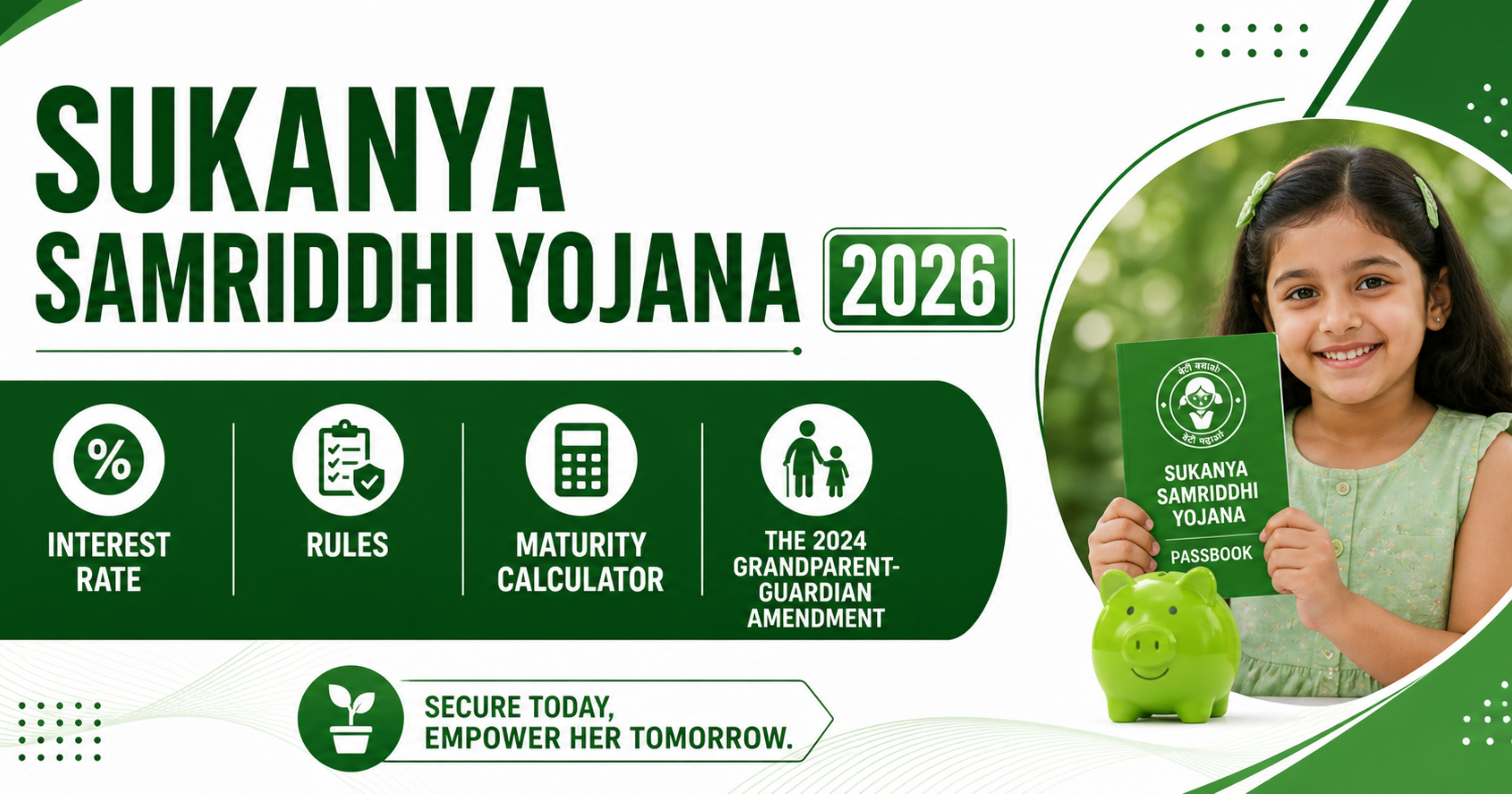

TL;DR: The Sukanya Samriddhi Account (SSY) pays 8.2 % per annum, compounded yearly, for the April–June 2026 quarter — rate held unchanged by the Ministry of Finance on 30 March 2026. It is one of the very few EEE instruments in India: contributions qualify for Section 80C deduction (under the old regime), interest is exempt, and the maturity proceeds are exempt under Section 10(11A) of the Income-tax Act, 1961. Open it for a girl child below 10, deposit Rs. 250 to Rs. 1,50,000 each financial year for 15 years, and the account matures 21 years after opening.
Two recent rule changes are worth knowing before you open or operate an SSY in 2026:
- The 2024 guardian-transfer rule. If a grandparent (other than a court-appointed legal guardian) opened the SSY account, the guardianship has to be transferred to the natural guardian (a living parent) or a legal guardian. India Post operationalised this through SB Order 17/2024 dated 21 August 2024, giving effect to the Ministry of Finance Office Memorandum dated 12 July 2024 on regularisation of irregular small-savings accounts. Accounts that have not been re-papered are flagged for regularisation; the operative direction is to transfer guardianship, not an automatic stoppage of interest, but you should action it before the next financial year closes to avoid disputes.
- The Income-tax Act, 2025 transition. Deduction under Section 80C of the 1961 Act becomes Section 123 of the 2025 Act for tax year 2026-27 onwards (AY 2027-28 returns). The exemption corresponding to Section 10(11A) carries through. The economic position is unchanged — SSY remains EEE, the limits remain the same. Only the section number changes for new-Act filers.
This article is a 2026 guide to the scheme — rates, eligibility, deposit and maturity mechanics, partial withdrawal at age 18, premature closure, the 2024 amendment, the EEE tax treatment, and a worked corpus calculation showing what Rs. 1.5 lakh a year for 15 years actually compounds to at 8.2 %.
1. The Headline Rate — April–June 2026
Small-savings rates are reset every quarter by the Ministry of Finance, Department of Economic Affairs (DEA), benchmarked against G-Sec yields under the Shyamala Gopinath Committee formula. For Q1 FY 2026-27 (April–June 2026), DEA notified on 30 March 2026 that all small-savings rates — SSY included — would be held unchanged from the previous quarter.
Scheme Rate (Q1 FY 2026-27) Compounding Tax treatment Sukanya Samriddhi Yojana 8.2 % p.a. Annual EEE — Sec. 80C in, exempt interest, exempt maturity (Sec. 10(11A)) Public Provident Fund (PPF) 7.1 % p.a. Annual EEE — Sec. 80C in, exempt interest, exempt maturity (Sec. 10(11)) Senior Citizen Savings Scheme (SCSS) 8.2 % p.a. Quarterly payout EET — Sec. 80C in, taxable interest, exempt return of capital 5-year Post Office Time Deposit 7.5 % p.a. Quarterly EET — Sec. 80C in (only 5-year), taxable interestSSY’s 8.2 % is the highest small-savings rate available to a non-senior-citizen in India today, and the EEE tax shell makes the post-tax compounded return effectively higher than any bank fixed deposit at current FD rates.
2. What SSY Is — The Legal Basis
SSY runs under the Government Savings Promotion Act, 1873 (renamed from the Government Savings Banks Act, 1873, by the Finance Act, 2018). The operative scheme is the Sukanya Samriddhi Account Scheme, 2019, notified by the Department of Economic Affairs vide GSR 914(E) dated 12 December 2019. A parallel notification of the same date, GSR 912(E), rescinded the earlier Sukanya Samriddhi Account Rules, 2016 (which had themselves replaced the 2014 rules under which the scheme was launched as part of Beti Bachao Beti Padhao).
Practically, this means the rules you operate under today are the 2019 Scheme, as amended from time to time — not the original 2014 rules many older articles still refer to. The 2019 Scheme reduced the minimum deposit from Rs. 1,000 to Rs. 250 and tightened guardianship language, among other changes.
3. Eligibility — Who, For Whom, How Many
Who can open: A natural or legal guardian, on behalf of a girl child below the age of 10 years. The girl child is the account holder; the guardian operates the account until she turns 18.
How many accounts per family: A maximum of two SSY accounts under a single family (i.e. two daughters). The 2019 Scheme provides a specific exception: a third account is allowed if the second birth results in twins, or if the first birth itself produces three girl children (triplets). The guardian must furnish an affidavit to that effect at the time of opening the third account.
Documents required:
- Birth certificate of the girl child (mandatory).
- KYC of the guardian: PAN and Aadhaar.
- Address proof of the guardian.
- Affidavit on twin/triplet births if a third account is being opened.
- Initial deposit of at least Rs. 250 in cash, cheque or DD.
Accounts can be opened at any post office or at branches of authorised public-sector and certain private banks (SBI, PNB, Canara, BoB, IDBI, ICICI, Axis among them).
4. The 2024 Grandparent-Guardian Amendment — What Changed and What You Must Do
Until 2024, several SSY accounts had been opened by grandparents acting as the guardian, even though the 2019 Scheme contemplates only the natural guardian (a living parent) or a legal guardian (court-appointed) as eligible. The Ministry of Finance issued an Office Memorandum on 12 July 2024 on regularisation of irregularly opened small-savings accounts (covering SSY, PPF and a few others). India Post then operationalised this through SB Order 17/2024 dated 21 August 2024.
The operative direction: every SSY account where the operating guardian is a grandparent (and not a court-appointed legal guardian) must be transferred to the natural guardian — a living parent — or to a legal guardian. The mechanics are:
- The grandparent and the natural guardian both visit the post office or bank branch where the account is held.
- The grandparent signs the request for transfer of guardianship.
- The natural guardian signs the request to operate the account in their capacity.
- KYC of the new guardian is captured.
- The branch updates its records and the account continues without break.
Accounts opened correctly under a court-appointed legal-guardianship order are unaffected. So are accounts where the parents have died and the grandparent is, in fact, the court-appointed legal guardian — in that case, retain the guardianship order on file and the post office cannot disturb the account.
What to do: If you opened an SSY account for a granddaughter and the natural parent is alive, action the transfer at the issuing post office or bank branch. The 2024 instruction is a regularisation order, not a freeze on interest, but until the paperwork is updated the account is on a regularisation list at the branch — cleaner to fix it now than to argue about it years later when withdrawal or maturity is at stake.
5. Deposit Rules — Minimum, Maximum, Period, Default
- Minimum deposit: Rs. 250 per financial year (reduced from Rs. 1,000 by the 2019 Scheme).
- Maximum deposit: Rs. 1,50,000 per financial year, in multiples of Rs. 50.
- Deposit period: 15 years from the date of opening of the account. After year 15, no further deposits are accepted; the account continues to earn interest until maturity at year 21.
- Default account: If the minimum Rs. 250 is not deposited in a financial year, the account becomes a default account. It can be revived by paying Rs. 50 penalty per year of default plus the missed minimum deposit, within 15 years of opening. The deposits already made continue to earn the SSY rate of interest even while the account is in default; revival is what allows further deposits to resume. If the account is not regularised within 15 years from opening, the existing balance still earns SSY-scheme interest until closure under the 2019 Scheme.
- Mode: Cash, cheque, demand draft, online transfer (where the bank or post office offers it), or standing instruction.
Most SSY holders treat the deposit period as a 15-year SIP for the daughter — standing instruction on April 1 each year for whatever the household can afford, scaling up over time. The flexibility (Rs. 250 to Rs. 1.5 lakh) is the friendliest of any small-savings scheme.
6. Interest — How and When It is Credited
SSY interest is compounded annually. The post office or bank credits interest at the end of each financial year (31 March). The rate applied for a quarter is the rate notified by DEA for that quarter; a deposit made in, say, May 2026 earns 8.2 % from May 2026 onwards, but if DEA changes the rate from 1 July 2026 (Q2 FY 2026-27), the new rate applies prospectively.
Interest is calculated on the lowest balance between the 5th and the end of the calendar month. So if you front-load your annual Rs. 1.5 lakh in April rather than spread it monthly, you earn interest on the full balance for the whole year — that is the standard SSY tax-saver tip.
7. Maturity, Lock-in, and the 21-Year Clock
The account matures on completion of 21 years from the date of opening, irrespective of the girl child’s age. So an account opened on the day of birth matures on her 21st birthday; an account opened when she was 8 matures when she is 29. The maturity proceeds — principal plus accumulated interest — are credited to the bank account of the account holder (the girl child, by then a major) and are fully exempt under Section 10(11A).
The account can also be closed earlier on the marriage of the account holder, but only after she has attained 18 years of age. The guardian must furnish a self-declaration that the account holder is at least 18 and the marriage will take place within one month before or three months after the closure.
8. Partial Withdrawal — Age 18 OR After 10th Standard, for Higher Education
Para 8 of the 2019 Scheme allows a partial withdrawal of up to 50 % of the balance as at the end of the immediately preceding financial year — specifically for the higher education of the account holder. Two important precision points many articles get wrong:
- The trigger is “attainment of age 18 OR passing of 10th standard, whichever is earlier.” So a girl who completes class 10 at 16 can use the partial-withdrawal route at 16 itself (with 10th-standard pass certificate), without waiting until 18.
- The purpose is education only, against admission/fee proof. Marriage is not a partial-withdrawal purpose under para 8; it is a separate early-closure route under para 9 of the Scheme (covered in Section 9 below). Mixing the two is a common drafting error.
The withdrawal can be taken as a lump sum or in instalments — not more than one withdrawal per year, for up to five years — subject to the 50 % cap on the preceding-year balance.
So if your daughter’s SSY balance was Rs. 12 lakh as on 31 March of the year before she turned 18 (or passed 10th, whichever is earlier), she can withdraw up to Rs. 6 lakh across the next five years for higher-education fees, hostel costs, books and related admission expenses, with proof. The remaining balance continues to earn interest until maturity at year 21.
9. Premature Closure — The Three Allowed Routes
The 2019 Scheme allows premature closure only in specific cases:
- Death of the account holder. Closure is allowed and the balance is paid to the legal heir or nominee. Interest is paid at the SSY rate up to the date of death and at the post office savings account rate thereafter until the date of payment.
- Extreme compassionate grounds. The 2019 Scheme uses the words “medical support in life-threatening diseases of the account holder” and “death of the guardian by which operation of the account has resulted in undue hardship.” Closure is permitted with the head-postmaster’s sanction in either case.
- Marriage of the account holder, after age 18. Already covered above.
The scheme does not permit premature closure for routine reasons — cash crunch, change of investment view, school fees, etc. Treat the lock-in as binding for 21 years (or to age 18 + marriage) when you decide on the deposit amount.
10. Tax Treatment — The EEE Mechanics
SSY is one of three EEE (Exempt–Exempt–Exempt) instruments available to retail savers in India today, alongside PPF and the EPF / VPF when held to maturity:
- Exempt at investment: Contribution qualifies for deduction under Section 80C of the Income-tax Act, 1961 (up to the overall Rs. 1,50,000 cap shared with PPF, ELSS, life insurance premium, principal repayment of home loan, etc.). Under the 2025 Act effective for tax year 2026-27 onwards, the corresponding section is Section 123; the limit is unchanged. The deduction is available only if the taxpayer is filing under the old tax regime; the new regime under Section 115BAC (and its successor in the 2025 Act) does not allow the Section 80C / Section 123 deduction. So if you have moved to the new regime, your SSY contributions still earn tax-free interest, but you do not get the year-of-investment deduction.
- Exempt during accrual: Annual interest credited to the account is fully exempt — no TDS, no entry in your AIS as taxable income, nothing to declare.
- Exempt at maturity: Maturity proceeds, premature-closure proceeds (in the allowed cases above) and partial withdrawals at age 18 are all exempt under Section 10(11A) of the 1961 Act. The 2025 Act carries forward an equivalent exemption for SSY proceeds.
The combined effect — deduction at the front end (old regime), exempt interest, exempt withdrawal — gives SSY an effective post-tax compounded return materially above the headline 8.2 %, especially for taxpayers in the 30 % slab who can use the deduction.
11. The Worked Corpus Calculation — What Rs. 1.5 Lakh a Year Becomes
Assume the maximum permitted deposit of Rs. 1,50,000 made at the start of every financial year for 15 years, with no further deposits in years 16–21, all compounded annually at 8.2 %. The mechanics are: each year’s deposit earns interest from its deposit date until maturity at year 21; the total maturity value is the sum of the future values of the 15 deposits.
Item Amount Annual deposit for 15 years Rs. 1,50,000 Total contributions over 15 years Rs. 22,50,000 Interest earned over 21 years (compounded annually at 8.2 %) ~Rs. 49,32,000 Approximate maturity corpus at year 21 ~Rs. 71,82,000That is the standard SSY calculator output for the maximum-deposit scenario at the current 8.2 % rate (precise value: Rs. 71,82,119; sum of future values of 15 start-of-year deposits at 8.2 % annual compounding to year 21). Two important caveats:
- The rate is not fixed for 21 years. DEA resets it every quarter. If the 21-year average rate is 7.5 % rather than 8.2 %, the maturity corpus drops to ~Rs. 64 lakh; if it averages 8.5 %, the corpus is ~Rs. 75 lakh. Plan in real terms with a margin for rate cuts.
- Inflation matters more than the headline rate. At 6 % long-run CPI, Rs. 72 lakh in 21 years is roughly Rs. 21 lakh in today’s purchasing power. SSY wins on the post-tax-real basis against most fixed-income alternatives, but it is not a wealth-multiplier in real terms — it is a tax-shielded inflation-beater.
Smaller deposit example: Rs. 50,000 a year for 15 years (Rs. 7.5 lakh total contributions) at the current 8.2 % gives a maturity corpus of ~Rs. 23.94 lakh at year 21 — roughly 3.2 times the contribution. The same multiple applies at any deposit level so long as the annual contribution is made for 15 years and the rate holds.
12. Account Transfer — Anywhere in India
If the family relocates, the SSY account can be transferred free of charge to any other post office or to a bank branch in India where SSY is offered. The account holder’s passbook moves with the account; the deposit history, interest credited and maturity date all carry across. The girl child must furnish proof of the new address; the guardian must sign the transfer form.
Transfers are also allowed between post office and bank, and between two banks. The account number changes; the maturity clock and accumulated balance do not.
13. Common Mistakes That Cost Real Money
- Skipping the minimum Rs. 250 deposit in a year. The account becomes a default account. The existing balance still earns SSY interest, but you cannot make further deposits until you revive the account by paying the Rs. 50/year penalty plus the missed minimum, within 15 years of opening — and you lose the ability to add fresh contributions in those default years.
- Late-year deposits. Depositing in March costs you a year of interest on that contribution compared to depositing in April. Front-load the deposit on or before the 5th of April for maximum interest accrual.
- Leaving a grandparent-opened account un-papered. Following India Post SB Order 17/2024 (giving effect to the MoF Office Memorandum dated 12 July 2024), branches have been directed to put such accounts on a regularisation list. Action the guardian transfer without delay.
- Claiming the Section 80C deduction under the new regime. Will be denied. If you are on the new regime and continuing SSY for the EEE shell, do not double-count by also claiming the deduction.
- Closing the account at age 18. Premature closure is not allowed at age 18 by itself — only on marriage (with declaration), death, or extreme compassionate grounds. Partial withdrawal of up to 50 % is allowed at 18; full closure is not.
- Opening more than two accounts in a family without the twin/triplet documentation. Excess accounts may be deactivated and the deposits returned without interest under Rule 12 of the 2019 Scheme.
14. SSY vs PPF for Your Daughter — Quick Compare
SSY PPF Q1 FY 2026-27 rate 8.2 % 7.1 % Tenure 21 years from opening 15 years (extendable in 5-year blocks) Deposit window 15 years from opening Whole tenure Annual cap Rs. 1.5 lakh Rs. 1.5 lakh (combined across own + minor accounts) Min deposit/year Rs. 250 Rs. 500 Tax shell EEE EEE Premature closure Death, marriage at 18+, extreme compassionate Death, severe medical, higher education, or change in residency status — after 5 years; 1% interest haircut on premature closure Earmark for a daughter Yes — she is the holder No — you (or guardian) are the holderFor a daughter, SSY beats PPF on the rate (110 bps higher), the earmark (the corpus is hers, she becomes the sole operator at 18) and the discipline (the 15-year deposit window forces you to fund it through her childhood). PPF wins on flexibility — you can open it for yourself or your minor and use it for any purpose, and the 15-year tenure compounds faster than SSY’s 21-year clock because deposits are made throughout. The textbook answer for a parent at the Section 80C cap is to use both: SSY for the daughter’s ring-fenced corpus, PPF for the parent’s.
15. Final Takeaway
SSY at 8.2 % EEE is the most aggressive risk-free instrument India offers a parent of a girl child. The mechanics — below 10 to open, 15 years of deposits, 21 years to maturity, partial withdrawal at 18, full exemption under Section 10(11A) — are unchanged in 2026 except for the 2024 grandparent-guardianship rule and the section-number shift to Section 123 of the 2025 Act for new-Act filers from AY 2027-28.
Open the account on or near her birth (or as soon as you can). Front-load the annual deposit on April 1. Treat the 15-year deposit window as non-negotiable. Re-paper any grandparent-opened account before the next FY closes. The compounding does the rest.
16. Legal & Regulatory References
- Government Savings Promotion Act, 1873 — parent statute for all post-office small-savings schemes.
- Sukanya Samriddhi Account Scheme, 2019 — notified by GSR 914(E) dated 12 December 2019 (Department of Economic Affairs, Ministry of Finance). GSR 912(E) of the same date is the parallel notification rescinding the Sukanya Samriddhi Account Rules, 2016.
- Ministry of Finance press release dated 30 March 2026 — small-savings rates for Q1 FY 2026-27 held at 8.2 % for SSY.
- Ministry of Finance Office Memorandum dated 12 July 2024 — regularisation of irregularly opened small-savings accounts (covering SSY, PPF and others). Operationalised by India Post via SB Order 17/2024 dated 21 August 2024, requiring transfer of guardianship for grandparent-opened SSY accounts to the natural or court-appointed legal guardian.
- Section 80C, Income-tax Act, 1961 — deduction for SSY contributions up to Rs. 1,50,000 (under the old tax regime). Section 123 of the Income-tax Act, 2025 carries this forward for tax year 2026-27 onwards.
- Section 10(11A), Income-tax Act, 1961 — exemption for interest credited to and proceeds from an SSY account. The 2025 Act preserves an equivalent exemption.
- Section 115BAC, Income-tax Act, 1961 — new tax regime; Section 80C deduction not available. Carried forward in the 2025 Act.
- National Savings Institute (NSI) — nsiindia.gov.in, official summary of the SSY scheme.
This article is a practitioner-oriented summary as on 5 May 2026. Small-savings rates change every quarter, and CBDT / DEA may issue further clarifications on the 2025 Act mapping. Verify the rate for the relevant quarter and the live scheme notification before relying on this summary for a specific decision. For a borderline case — particularly grandparent-guardianship transfers, NRI status questions on the daughter, or a full 21-year corpus projection — consult an experienced personal-finance practitioner.



Comments (0)
No comments yet. Be the first to comment!