
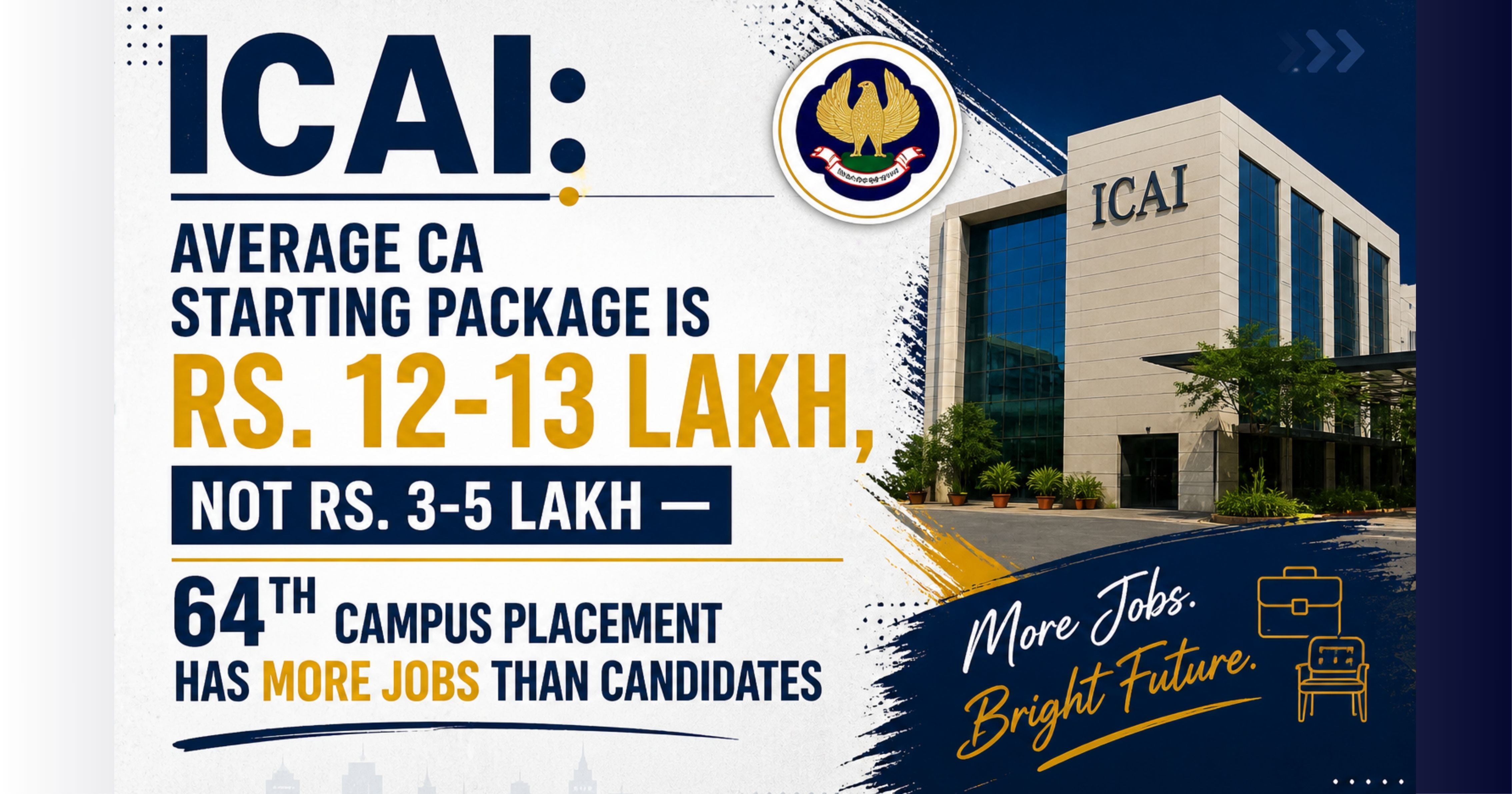

TL;DR: The Institute of Chartered Accountants of India (ICAI) has formally rejected a recent 1 Finance report that suggested CAs are starting their careers on Rs. 3-5 lakh packages. Speaking to the press on 1 May 2026, ICAI Secretary Jai Kumar Batra said the actual average starting salary for a qualified CA is Rs. 12-13 lakh per annum, international offers are crossing Rs. 50 lakh, and the 64th Campus Placement Programme (April-May 2026) put 8,911 vacancies in front of only 5,834 candidates. The picture ICAI is painting: a profession in demand surplus, not a salary slump.
1. What Triggered the Rebuttal
The backdrop is a report circulated by 1 Finance earlier this year, which painted a much grimmer picture of CA economics — claiming that the typical fresher CA was joining the workforce on a starting cost-to-company of just Rs. 3-5 lakh, comparable to a non-professional commerce graduate.
The report was widely shared on Twitter/X and LinkedIn through April 2026 and provoked an uncomfortable conversation: if a five-year, exam-heavy professional course leads to entry-level pay that overlaps with a B.Com fresher, is the CA qualification actually delivering on its promise of upward mobility?
ICAI's answer is unambiguous. Secretary Jai Kumar Batra, addressing reporters in New Delhi on 1 May 2026, told Patrika that the 1 Finance number does not reflect the data the institute itself collects through its centralised Campus Placement Programme — and that the institute is rejecting it.
2. The 64th Campus Placement: 8,911 Jobs, 5,834 CAs
The headline data point ICAI is leading with is the 64th Campus Placement Programme, conducted across centres in April-May 2026. Per Batra's statement to Patrika:
Metric 64th Campus Placement (Apr-May 2026) Vacancies offered by recruiters 8,911 Candidates participating 5,834 Vacancy-to-candidate ratio ~1.53 jobs per CAThat ratio is the headline. Even before any selection, every participating CA at the 64th campus had, on paper, more than one-and-a-half job offers waiting. In a market where most freshly qualified professionals across other streams are competing several-to-one for entry-level roles, ICAI's argument is that the CA profession is structurally short of qualified people, not short of jobs.
Of course, the 8,911 figure is the aggregate set of vacancies put up by recruiters, and it does not mean every vacancy was filled — recruiters and candidates have to match on location, function, and package. But as a measure of demand intensity, the gap between 8,911 vacancies and 5,834 candidates is the strongest single data point ICAI has put forward.
3. The Salary Numbers ICAI Is Standing Behind
On the actual compensation question, Batra was specific. According to his statement:
- Average starting package for a qualified CA: Rs. 12-13 lakh per annum (domestic offers).
- International offers crossing Rs. 50 lakh per annum, with select profiles going higher.
This is the number ICAI is putting on the record against the Rs. 3-5 lakh figure that was circulating. The institute's framing is straightforward: the average is roughly three to four times what the 1 Finance report indicated, and the upper end of the international cohort is more than ten times that figure.
What does Rs. 12-13 lakh translate to in practice? At a 30% effective tax incidence and standard deductions, an average fresher CA on a Rs. 12.5 lakh package takes home roughly Rs. 75,000-85,000 a month after tax — a starting cash flow that comfortably supports an EMI on a small flat in a Tier-1 city while still leaving room to save 30-40% of income. That is materially different from the Rs. 3-5 lakh narrative.
4. The ROI Argument: Rs. 80,000 In, Rs. 12 Lakh Out
The single most striking line from Batra's statement was the cost side of the ledger:
"The CA course costs only Rs. 80,000." — Jai Kumar Batra, Secretary, ICAI
The Rs. 80,000 figure refers to the institute's own registration, study material, and examination fees across Foundation, Intermediate, and Final levels — the official ICAI fee envelope, not the all-in cost (which includes coaching, books, and opportunity cost during articleship). Even with a generous overlay for coaching and incidentals, the all-in spend for a CA aspirant typically lands well under Rs. 3 lakh end-to-end.
Set against an average first-year package of Rs. 12-13 lakh, the simple return on educational investment is striking:
Cost Element Approximate Spend ICAI registration + study material + exam fees (per Batra) ~Rs. 80,000 Coaching / books / incidentals (typical) Rs. 1.0 - 2.0 lakh Total all-in spend (typical upper-bound) ~Rs. 2.0 - 2.8 lakh Year-1 package (ICAI average, qualified CA) Rs. 12-13 lakh Payback in year 1 (gross) 4x to 5x of all-in spendBatra's framing is that on an "economic and educational investment ratio" the CA course remains one of the most attractive professional qualifications in India. A first-year salary that pays back the entire course cost three to five times over, in a single year, is a hard yardstick for any other professional course in the country to match.
5. Why the Demand Side Is Strong
The ICAI demand-surplus story is not just optimism — there are real structural drivers under it. A few worth naming:
- GST and direct-tax compliance load. The compliance footprint per business has expanded materially over the last decade. GST returns, e-invoicing, TDS reconciliations, faceless assessments, and the new Income-tax Act 2025 transition have all enlarged the in-house and consulting CA need.
- NFRA, audit quality, and the listed-company audit pipeline. Independent audit oversight has tightened, audit hours have gone up, and the cost of a quality audit has risen. That flows through into demand for both signing partners and quality-control reviewers.
- GCC / Global Capability Centres in India. Multinationals continue to expand finance, FP&A, and controllership shared services in Bengaluru, Hyderabad, Pune, and Gurugram. These centres are the source of the higher-band offers that pull the average package up.
- Fintech, NBFC, and listed-mid-cap CFO pipeline. The fintech and NBFC build-out has created a steady stream of CA roles in financial reporting, treasury, internal audit, and risk — in addition to traditional Big 4 hiring.
- Constrained pass percentages. The CA Final pass percentage has historically run in the mid-teens to mid-twenties. That keeps the qualified-CA supply below the rate at which demand has expanded — which is exactly the gap the 64th Campus Placement vacancy-to-candidate ratio is reflecting.
6. What This Means If You Are a CA Aspirant
The signal from ICAI's data is clear, but the takeaway for an aspirant is not "everyone gets Rs. 12 lakh and crosses Rs. 50 lakh internationally". It is more nuanced — and more useful:
- The qualification still pays. On a pure cost-versus-first-year-cash-flow basis, very few professional courses in India come close to a CA's economics, even after adjusting for the multi-year journey and articleship opportunity cost.
- Demand is concentrated, not uniform. The Rs. 12-13 lakh average sits between Big 4 / GCC / large industry offers (which pull the top up) and smaller-firm / Tier-2 / Tier-3 offers (which sit below the line). Aspirants who can tilt toward placement-eligible profiles, technical specialisations, and high-growth sectors capture more of the upside.
- The articleship is now the differentiator. Recruiters at ICAI campus rounds increasingly screen on articleship firm quality, exposure to listed-company audits, and direct-tax / IFC / data-analytics specialisations. A strong articleship is the single highest-leverage decision a CA student can make for the placement outcome they want.
- International is real, but it is a top-decile outcome. The Rs. 50 lakh+ international offers ICAI cited are achievable, but they typically go to candidates with a combination of high ranks, Big 4 experience, and willingness to relocate to the Middle East, UK, Singapore, or Australia.
7. Honest Caveats — Read the Average Right
To stay balanced, three things are worth keeping in mind even within ICAI's positive picture:
- An average is not a median. The Rs. 12-13 lakh figure is an average across all packages declared at campus. Top-tier offers (Big 4, GCC, international) pull the average up. The median qualified CA — particularly outside campus, joining smaller firms or going into practice — may earn somewhat below the average in their first year.
- Campus placement is one channel, not the only one. A meaningful share of qualified CAs do not participate in the centralised campus and instead join family practice, take direct industry offers, or build their own practice. Their year-1 economics look different and are not captured in the 8,911-vs-5,834 ratio.
- The Rs. 80,000 institute fee is the floor, not the ceiling. Honest aspirants and parents should plan with an all-in figure of Rs. 2.0-2.8 lakh including coaching, books, and incidentals, not just the ICAI fee envelope. Even at that figure the ROI math still works — but it is an honest framing.
None of these caveats undermines ICAI's central rebuttal. They just sharpen the version of the message a CA student should walk away with.
8. The Bottom Line
ICAI's position, on the record from the institute Secretary on 1 May 2026, is that the CA profession in India is a demand-surplus market: more recruiter vacancies than qualified candidates at the 64th Campus Placement, an average starting package roughly 3-4x the figure that was being circulated by the 1 Finance report, international offers crossing Rs. 50 lakh, and a course fee envelope that pays itself back several times over in the very first year of employment.
For students currently in the CA pipeline, that is a significant signal. For working CAs, it is confirmation of what the hiring market has been telling them anyway. And for anyone re-evaluating whether the qualification still earns its multi-year cost — ICAI's own placement data is now the strongest answer in the public record.
9. FAQ
Where are the numbers in this article from? All figures — 8,911 vacancies, 5,834 candidates, average package of Rs. 12-13 lakh, international offers crossing Rs. 50 lakh, and the Rs. 80,000 course fee — are attributed to ICAI Secretary Jai Kumar Batra's statement to the press on 1 May 2026, as reported in the Patrika print edition.
Does every campus-participant CA get Rs. 12-13 lakh? No. Rs. 12-13 lakh is the average across all offers made at the 64th Campus Placement Programme. Top-tier offers from Big 4, GCCs, and international postings pull the average upward; offers from smaller firms and Tier-2 cities sit below the average. Plan with both the average and the band, not just the headline.
What was the 1 Finance report saying? Per ICAI's characterisation in Patrika, the 1 Finance report suggested that fresher CA starting packages are typically in the Rs. 3-5 lakh range. ICAI has rejected this framing, arguing that it does not match the data captured through the institute's own centralised Campus Placement Programme.
Is Rs. 80,000 really the all-in cost of becoming a CA? Rs. 80,000 is the figure ICAI Secretary cited for institute registration, study material, and examination fees across Foundation, Intermediate, and Final levels. The all-in spend for a typical aspirant — including coaching, books, and incidentals — is closer to Rs. 2.0-2.8 lakh. Even at that level, year-1 starting compensation pays it back several times over.
How can a student maximise the chance of being on the higher side of the average? The largest single lever is articleship quality and specialisation. A strong articleship at a recognised firm with exposure to listed-company audits, direct tax, IFC / internal audit, or transfer pricing positions a candidate well for Big 4 / GCC / industry roles where the Rs. 12 lakh+ packages cluster. Rank in the CA Final examination is the second major lever for top-of-band offers and international placements.
Are international offers crossing Rs. 50 lakh realistic? They are real but concentrated. Per ICAI's data, select profiles in the 64th Campus Placement received international offers above Rs. 50 lakh per annum. These typically combine a strong rank, prior Big 4 experience, and willingness to relocate to the Middle East, UK, Singapore, Hong Kong, or Australia. Most fresh qualifiers will earn at the domestic average; a top-decile cohort will earn at the international band.
Is this opinion or financial advice? This is a news analysis of ICAI's official statement, not personalised career or financial advice. For decisions on whether to pursue the CA qualification, articleship choice, or campus participation, students should rely on their own situation, ICAI's official notifications, and qualified academic counselling.



Comments (0)
No comments yet. Be the first to comment!