
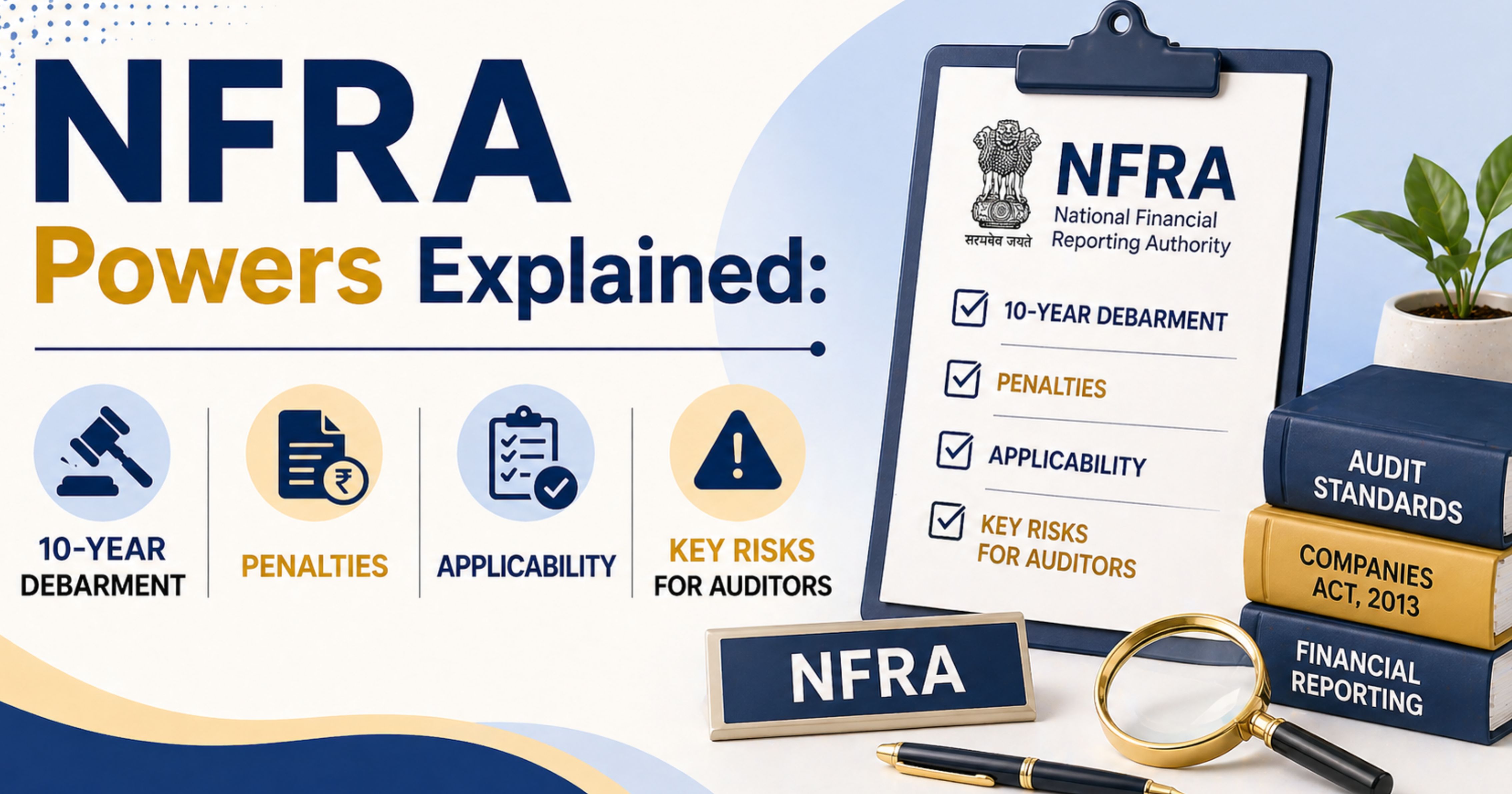

TL;DR: The National Financial Reporting Authority (NFRA), under Section 132 of the Companies Act, 2013 read with the NFRA Rules, 2018, can debar an auditor or audit firm for 6 months to 10 years and impose penalties of up to 5 times audit fees on individuals (minimum Rs. 1 lakh) and 10 times audit fees on firms (minimum Rs. 10 lakh). Its disciplinary jurisdiction overrides ICAI for listed companies, large unlisted public companies, banks, insurers, electricity companies, and certain group entities. Claims of imprisonment for non-payment of NFRA penalties are not yet enacted law as of April 2026 — rely only on official notifications.
Introduction
In recent months, discussions around the powers of the National Financial Reporting Authority (NFRA) have gained traction. Claims such as “NFRA can debar your firm for 10 years and impose heavy penalties” are widely circulating.
While broadly correct, such statements often lack legal precision and context. For Chartered Accountants and audit professionals, understanding the exact scope, applicability, and consequences of NFRA’s powers is essential.
This article explains the law, real-world implications, and what it means for audit practice today.
1. Legal Framework: Source of NFRA’s Powers
NFRA derives its authority from Section 132 of the Companies Act, 2013, read with the NFRA Rules, 2018.
It is empowered to:
- Investigate professional or other misconduct by auditors
- Enforce compliance with accounting and auditing standards
- Take disciplinary action independent of ICAI
NFRA operates as an independent enforcement authority for specified classes of companies and is not a mere advisory body.
2. Debarment: Can NFRA Ban You for 10 Years?
Yes.
Under Section 132(4)(c)(B), NFRA can debar:
- An individual auditor, or
- An audit firm
For a period ranging from a minimum of 6 months up to a maximum of 10 years.
Importantly, debarment applies to:
- Audit assignments — being appointed as an auditor, internal auditor, or undertaking any audit of financial statements / functions of any company or body corporate, and
- Valuation services under Section 247 of the Companies Act.
This is one of the most stringent professional consequences available under Indian corporate law.
3. Monetary Penalties: What the Law Actually Says
The penalty framework under Section 132(4)(c)(A) is clearly defined in statute:
Auditor Minimum Penalty Maximum Penalty Individual Rs. 1 lakh Up to 5 times the audit fees received Firm Rs. 10 lakh Up to 10 times the audit fees receivedIn practice, NFRA has imposed multi-crore penalties in cases involving large corporate audits — including high-profile listed-entity matters. This confirms that enforcement is active and the financial impact is substantial.
4. Civil Court Powers: The Strength of Investigation
Under Section 132(4)(b), NFRA has the same powers as a civil court under the Code of Civil Procedure, 1908 while trying a suit, in respect of the following matters:
- Discovery and production of books of account and other documents
- Summoning and enforcing the attendance of persons
- Examining persons on oath
- Inspection of any books, registers, and other documents
- Issuing commissions for examination of witnesses or documents
This makes NFRA’s investigative process legally enforceable and evidence-driven, putting it on an entirely different footing from purely institutional disciplinary proceedings.
5. Relationship with ICAI: Who Has Authority?
NFRA does not replace ICAI entirely.
The two regulators co-exist:
- NFRA — has overriding disciplinary authority for entities falling under its jurisdiction (listed companies, large unlisted public companies, specified sectors, etc.).
- ICAI — continues to govern small and mid-size audit engagements, non-NFRA entities, and the broader profession (membership, training, ethical standards, CPE).
For audits within NFRA’s remit, NFRA takes precedence in disciplinary matters relating to the auditor.
6. Applicability: Who Comes Under NFRA?
This is the most misunderstood aspect of NFRA’s framework. Under Rule 3 of the NFRA Rules, 2018, NFRA applies to the following classes of companies and bodies corporate:
a) Listed Companies
All companies whose securities are listed on any stock exchange in India or outside India.
b) Large Unlisted Public Companies
Unlisted public companies meeting any one of the following thresholds as on 31 March of the immediately preceding financial year:
- Paid-up capital of not less than Rs. 500 crore
- Annual turnover of not less than Rs. 1,000 crore
- Aggregate of outstanding loans, debentures and deposits of not less than Rs. 500 crore
c) Specific Sectors
- Insurance companies
- Banking companies
- Companies engaged in the generation or supply of electricity
- Companies governed by any special Act for the time being in force
- Bodies corporate or persons referred to NFRA by the Central Government
d) Certain Group Entities
Bodies corporate registered outside India that are subsidiaries or associates of any company or body corporate covered above, if the income or net worth of such subsidiary / associate exceeds 20% of the consolidated income or consolidated net worth of the Indian parent.
Practical takeaway: For many small and mid-size practitioners, ICAI remains the primary regulator. But for any firm signing audits of listed entities, large unlisted publics, banks, insurers, or covered group entities, NFRA exposure is direct and significant.
7. What Triggers NFRA Action?
A review of NFRA orders issued so far reveals consistent patterns. Common triggers include:
- Lack of professional skepticism
- Failure to detect or respond to red flags / fraud indicators
- Inadequate or backdated audit documentation
- Signing audit reports without sufficient and appropriate audit evidence
- Failure to verify related-party transactions
- Non-compliance with the Standards on Auditing (SAs)
- Inadequate evaluation of going-concern assumptions
- Breakdown of engagement quality control reviews (EQCR)
The recurring theme across NFRA orders is clear: audit quality and contemporaneous evidence matter more than form. Templates, ticked checklists and signed memos do not protect a file that lacks substance.
8. Real Impact on Audit Practice
The regulatory environment has changed materially over the last few years.
Earlier (ICAI-only era) Now (NFRA + ICAI co-existence) ICAI-driven discipline only Independent regulator (NFRA) for covered entities Slower proceedings Structured, time-bound enforcement Limited public visibility of orders Detailed, publicly available NFRA orders Modest financial penalties Penalties up to 5x / 10x of audit fees Largely institutional risk Personal and reputational risk to the engagement partnerAudit risk has evolved into career risk and reputational risk. A debarment order is, in effect, a public document detailing exactly which auditing standards the engagement partner failed to comply with.
9. Important Note on Recent Developments
There are ongoing discussions in professional circles — and on social media — about strengthening NFRA’s enforcement powers, including stricter consequences for non-compliance.
However, as of April 2026:
👉 There is no confirmed, enacted provision introducing imprisonment for non-payment of NFRA penalties.
Audit professionals should rely only on official notifications, gazette publications, or enacted amendments to the Companies Act when assessing personal liability under NFRA. Forwarded WhatsApp messages and social-media claims are not a substitute for primary-source verification.
10. What Should Audit Professionals Focus On?
In the current environment, every audit professional — regardless of firm size — should prioritise the following:
a) Documentation
Maintain detailed, contemporaneous and defensible working papers. Documentation is the single biggest determinant of how an audit file holds up under NFRA scrutiny. If it isn’t in the file, it didn’t happen.
b) Professional Skepticism
Critically evaluate management representations. Ask the awkward questions. Document the responses. Where management explanations don’t add up, escalate — do not paper over.
c) Risk-Based Approach
High-risk engagements (related-party transactions, complex revenue recognition, material judgment areas, going concern) require proportionately higher audit rigor. A risk-based audit programme is now an enforcement defence, not just good practice.
d) Compliance with Standards
Strict adherence to the Standards on Auditing is essential. Technical lapses — for example, failing to perform fraud-risk procedures under SA 240, or not obtaining sufficient appropriate audit evidence under SA 500 — are no longer tolerated.
e) Internal Review Systems
Strengthen quality control within the firm before signing. Engagement quality control reviews (EQCR) for higher-risk engagements are not optional formalities — they are a key line of defence.
11. Conclusion
The claim that “NFRA can debar your firm for 10 years and impose heavy penalties” is legally accurate, but incomplete without context.
NFRA represents a structural shift in India’s audit ecosystem:
- From compliance → enforcement
- From process → accountability
- From institutional risk → personal professional risk
For audit professionals, the takeaway is unambiguous:
Your audit file is your strongest defence. If it cannot defend your judgment, nothing else will.
12. Quick Summary
NFRA, under Section 132 of the Companies Act, 2013, has significant powers to investigate and penalize auditors. It can debar auditors for up to 10 years and impose penalties ranging from Rs. 1 lakh / Rs. 10 lakh minimum, extending up to 5x (individuals) and 10x (firms) of audit fees. Its jurisdiction covers listed companies, large unlisted public companies (including those with high borrowings), banks, insurers, electricity companies, and certain group entities. While enforcement is active and penalties can be substantial, recent claims regarding imprisonment provisions for non-payment are not yet supported by enacted law.
13. Legal References
- Section 132, Companies Act, 2013 — constitution and powers of the National Financial Reporting Authority.
- Section 132(4)(b) — civil-court powers under the Code of Civil Procedure, 1908.
- Section 132(4)(c)(A) — monetary penalty structure (individuals and firms).
- Section 132(4)(c)(B) — debarment from audit and Section 247 valuation work for 6 months to 10 years.
- National Financial Reporting Authority Rules, 2018 — in particular Rule 3 (classes of companies and bodies corporate governed by the Authority).
- Section 247, Companies Act, 2013 — valuation by registered valuers (also subject to NFRA debarment).
- Standards on Auditing (SAs) issued by the ICAI Auditing and Assurance Standards Board — particularly SA 240 (fraud), SA 500 (audit evidence), SA 550 (related parties) and SA 570 (going concern), which feature prominently in NFRA orders.
NFRA jurisprudence is evolving. Verify the latest NFRA orders, MCA notifications, and any amendment to the Companies Act before relying on this summary for a specific engagement. For a borderline case, consult an experienced practising chartered accountant or legal counsel.








Comments (0)
No comments yet. Be the first to comment!