
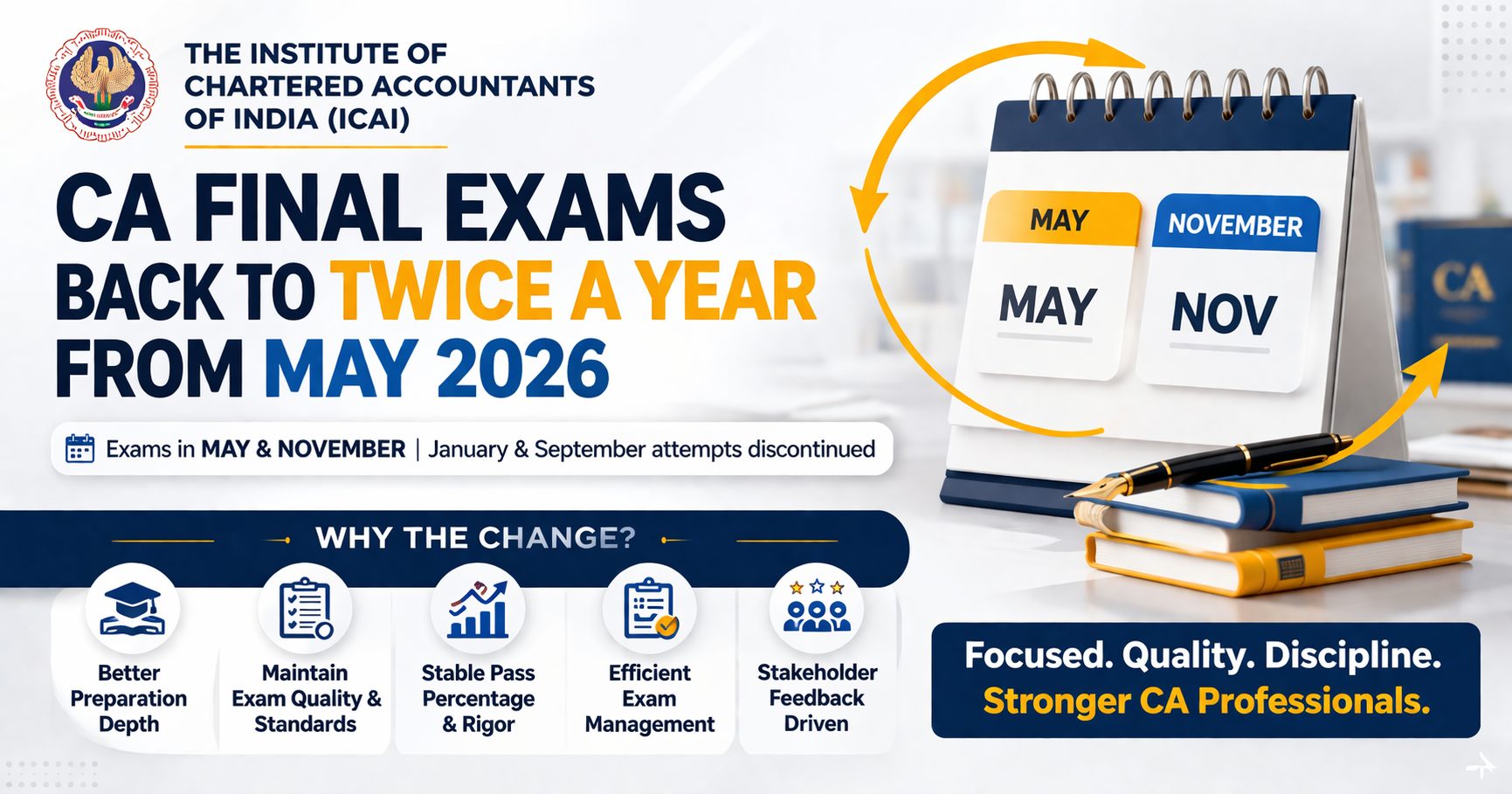

The Institute of Chartered Accountants of India (ICAI) has announced a significant shift in the examination cycle for CA Final students. Starting from the May 2026 attempt, CA Final examinations will be conducted twice a year—May and November, instead of the recently introduced three-attempt system.
Earlier System (Before 2025)
Traditionally, the CA Final examination followed a biannual pattern, conducted in May and November every year. This system was stable and widely accepted, allowing students structured preparation cycles and sufficient revision time.
Shift to Three Attempts (2025 Reform)
In a major reform, ICAI had introduced three attempts per year (January, May, September) starting from 2025. The objective was:
- To increase opportunities for students
- To reduce waiting time after failure
- To align CA Final with Intermediate and Foundation levels
This move was considered progressive and student-friendly.
Current Change: Back to Two Attempts (From May 2026)
Now, ICAI has decided to revert to two attempts annually—May and November—based on stakeholder feedback. This means the January and September attempts will be discontinued for CA Final.
Why This Change? (Practical Reasons)
While ICAI has cited stakeholder feedback, the decision appears to be driven by several practical factors:
1. Quality of PreparationFrequent attempts reduce preparation depth.
Students may rush attempts instead of building conceptual clarity.
More attempts can sometimes lead to:
- Lower seriousness per attempt
- Impact on overall professional standards
Conducting CA Final exams is highly resource-intensive:
- Evaluation capacity
- Examiner availability
- Result timelines
Managing this three times a year at Final level is significantly more complex than lower levels.
4. Industry & Training AlignmentArticleship, employment cycles, and campus placements are often aligned with:
- May attempt
- November attempt
Too many attempts may disrupt this ecosystem.
5. Stakeholder FeedbackFeedback from:
- Students
- Practising members
- Coaching ecosystem
likely indicated that two well-prepared attempts are more effective than three rushed ones.
Conclusion
This decision reflects ICAI’s attempt to strike a balance between opportunity and quality. While three attempts offered flexibility, the return to two attempts ensures:
- Better preparation cycles
- Stronger professional standards
- Smoother exam administration
For students, the key takeaway is clear:
Fewer attempts, but higher focus and discipline will be expected going forward.



Comments (0)
No comments yet. Be the first to comment!