
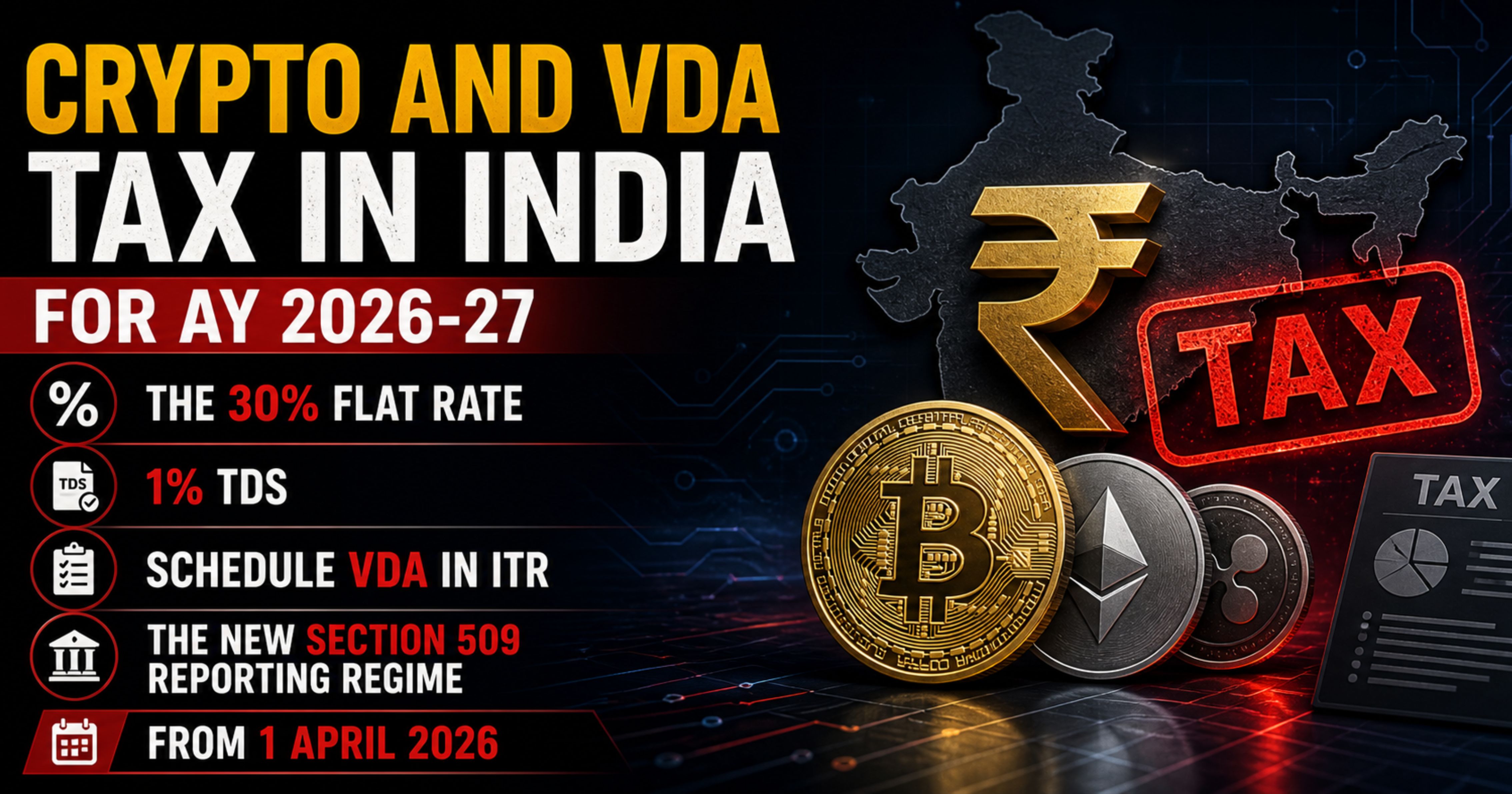

TL;DR: India taxes income from the transfer of any Virtual Digital Asset (VDA) — cryptocurrency, NFTs, and certain tokens covered by Section 2(47A) of the Income-tax Act, 1961 — at a flat 30 %, plus applicable surcharge and cess. The framework was introduced by the Finance Act, 2022 and runs under Section 115BBH (Section 1961 cite) read with Section 194S for the 1 % TDS on transfer consideration. The Income-tax Act, 2025, in force from 1 April 2026, carries the 30 % rule forward as Clause / Section 194. The economics for a crypto investor are unchanged across the transition.
Five rules to internalise before you trade your next coin:
- Flat 30 % on VDA gains. No slab-rate benefit, no LTCG / STCG distinction, no benefit of basic exemption against this income. The flat rate applies to your gain whether you held for one day or one decade.
- Only cost of acquisition is deductible. Gas fees, exchange fees, slippage, brokerage, software subscriptions, taxes paid abroad — none of it reduces your taxable gain. Just the rupee cost of buying the coin.
- No loss set-off, no carry-forward. A loss on one VDA cannot offset a gain on another VDA, and certainly cannot offset salary, FD interest, F&O profit, or any other income. Crypto losses simply expire.
- 1 % TDS under Section 194S on every consideration paid for VDA transfer above the de-minimis threshold. The deductor reflects it in your Form 26AS / AIS via the relevant TDS return (Form 26QE for a specified-person deductor; Form 26Q for other deductors such as exchanges with business). You credit it against your final liability or claim a refund.
- From 1 April 2026 — Section 509 reporting on exchanges. The Income-tax Act, 2025 introduces a new reporting obligation: prescribed reporting entities (crypto exchanges, custodians) must furnish a crypto-asset transaction statement to the income-tax department for every user. Failures attract Rs. 200/day under Section 446 plus Rs. 50,000 for inaccurate information. Your transactions will arrive in AIS automatically.
The article works through each rule, the worked computation including the TDS credit mechanics, the Schedule VDA reporting in ITR-2 / ITR-3 for AY 2026-27, the airdrop / mining / staking treatment, and the practical impact of Section 509 reporting on a retail crypto investor.
1. What Counts as a VDA — Section 2(47A)
The Income-tax Act defines a virtual digital asset in Section 2(47A) of the 1961 Act (carried forward as the equivalent definition in the 2025 Act). The substantive scope:
- Cryptocurrencies — Bitcoin, Ethereum, Solana, Cardano, Ripple, BNB, USDT, USDC and every other coin or token whose value is generated cryptographically.
- NFTs (Non-Fungible Tokens) — CBDT Notification No. 75/2022 dated 30 June 2022 includes NFTs that are not based on the underlying tangible asset (most art / collectible NFTs qualify).
- Tokens — utility, governance, and security tokens issued on a blockchain, where the token represents a right or value.
The Act explicitly excludes, via CBDT Notification No. 74/2022 dated 30 June 2022:
- Gift cards and vouchers redeemable for goods or services.
- Mileage points, reward points, loyalty cards on a platform.
- Subscriptions to website / platform / application that confer access only.
If your Air India miles, Amazon gift card, or D-Mart loyalty points feel digital and asset-like — they are not VDAs and do not attract Section 115BBH.
2. The 30 % Tax Under Section 115BBH
Section 115BBH(1) says income arising from the transfer of any VDA shall be taxed at the rate of 30 %. The Income-tax Act, 2025 reproduces this as a special-rate provision in Section 194 of the new Act — the rate, scope, and computational rules carry forward unchanged for tax year 2026-27 onwards (AY 2027-28).
The mechanics:
- Tax base: Sale consideration minus cost of acquisition.
- Allowable deduction: Cost of acquisition only. No deduction for transaction fees (gas, exchange, brokerage), advisory, software subscriptions, electricity, internet, or any other expense.
- No indexation: Even for VDAs held over the long term, the cost is the rupee cost on acquisition date, not an indexed cost.
- Surcharge and cess apply: The 30 % is the basic rate; surcharge (10 %, 15 %, 25 % or 37 % depending on income slab) and Health and Education Cess at 4 % apply on top.
- No basic exemption benefit: Even if your total income is below the basic exemption threshold, VDA income is taxed at 30 % from the first rupee. (Sub-section (1)(b) explicitly disallows benefit of basic exemption for VDA income.)
Worked example. You bought 0.5 BTC for Rs. 12,00,000 on 15 May 2025 and sold it for Rs. 18,00,000 on 12 February 2026. Gain is Rs. 6,00,000. Tax under Section 115BBH is 30 % of Rs. 6,00,000 = Rs. 1,80,000. Add 4 % cess (Rs. 7,200), and surcharge if your total income takes you into a surcharge bracket. Even if the entire transaction was your only income for the year, you owe Rs. 1,87,200 — you cannot use the Rs. 2.5 lakh basic exemption against this gain.
3. The No-Loss-Set-Off Rule — Why VDA Losses Hurt
Section 115BBH read with the proviso to Section 70 / Section 115BBH(2) creates the harshest loss-treatment regime in Indian tax law:
- VDA loss cannot offset another VDA gain. If you lose Rs. 4 lakh on Coin A and gain Rs. 4 lakh on Coin B in the same year, you do not net out to zero. You owe 30 % of Rs. 4 lakh = Rs. 1,20,000 on Coin B; the Coin A loss is dead.
- VDA loss cannot offset any other income. Salary, business income, capital gains, FD interest — none of it can be reduced by a VDA loss.
- VDA loss cannot be carried forward. No 8-year carry forward, no 4-year, no anything. Loss = expired.
Worked example. A trader has Rs. 3 lakh gain on ETH, Rs. 5 lakh loss on a memecoin, in FY 2025-26. They owe 30 % of Rs. 3 lakh = Rs. 90,000 on the ETH gain. The Rs. 5 lakh memecoin loss is gone — cannot offset the ETH gain, cannot offset salary, cannot carry forward. This is in stark contrast to F&O loss (which carries forward 8 years and offsets any non-speculative income) or even capital loss (which carries forward 8 years against capital gains). For high-frequency crypto trading, this asymmetry is the single most important risk to internalise.
4. Section 194S — The 1 % TDS Mechanics
Section 194S, inserted by the Finance Act, 2022 effective 1 July 2022, requires any person responsible for paying consideration for the transfer of a VDA to deduct 1 % TDS at the time of credit or payment, whichever is earlier.
Threshold:
- Rs. 10,000 in a financial year per buyer / payer — the general threshold.
- Rs. 50,000 in a financial year for a “specified person” — defined as an individual or HUF whose total sales / turnover / gross receipts from business does not exceed Rs. 1 crore (or whose professional gross receipts do not exceed Rs. 50 lakh) in the immediately preceding financial year, and who does not have business or professional income.
For a retail user trading on an Indian exchange (CoinDCX, WazirX, Binance India, etc.), the exchange is the deductor. The TDS shows up in your Form 26AS and AIS, and you can claim credit against your final 30 % tax liability on the gain. If your total VDA gains for the year are small enough that the actual liability is less than the TDS deducted, you get a refund.
P2P trades and DEX transactions: Where you trade directly with another individual or via a decentralised exchange, the buyer is the deductor. CBDT Circular No. 13/2022 dated 22 June 2022 lays out the operational mechanics. The form workflow depends on the deductor:
- Specified person (individual / HUF without business income or whose business turnover ≤ Rs. 1 crore / professional gross receipts ≤ Rs. 50 lakh): challan-cum-statement Form 26QE within 30 days from end of the month of deduction; Form 16E as the TDS certificate to the seller.
- Other deductors (e.g. companies, larger businesses): Form 26Q quarterly TDS return; Form 16A as the TDS certificate.
In practice, P2P participants frequently miss this; the seller can still pay self-assessment tax on the gain at 30 % at year-end, but the buyer’s default carries its own consequences (interest under Section 201, penalty under Section 271C).
Foreign exchanges: If you trade on Coinbase, Kraken, Bybit, or another offshore exchange, the exchange does not deduct Indian TDS. Section 194S applies where the consideration is paid to a resident seller; where you are the buyer in India and the seller is a non-resident, the 1 % TDS obligation does not arise under Section 194S (other withholding obligations under Sections 195 / 206AA may apply depending on the counterparty status). The 30 % tax on the gain (where you are the resident seller) is, however, due unambiguously under Section 115BBH regardless of the exchange’s location.
5. Schedule VDA — The ITR Reporting Requirement for AY 2026-27
From AY 2023-24, ITR-2 (for individuals not having business income) and ITR-3 (for those with business income) include a separate Schedule VDA. For AY 2026-27 (FY 2025-26 income, due 31 July 2026), you must report each VDA transfer transaction-wise. The official AY 2026-27 ITR-3 schema captures, for each transfer:
- Date of acquisition.
- Date of transfer.
- Head under which the income is offered (capital gains or business income).
- Cost of acquisition (in INR).
- Consideration received (in INR).
- Income from transfer (consideration minus cost).
The schedule auto-totals to the 30 % tax computation, which then carries to the main ITR form as a separate line in the tax computation table. The 1 % TDS deducted under Section 194S is not recorded transaction-wise within Schedule VDA — it is claimed as a TDS credit through the standard TDS schedules (TDS-2 / TDS-3 / similar) of the ITR, the same way as TDS on salary or interest. Reconcile against Form 26AS / AIS to ensure every TDS entry is claimed.
If you have hundreds of trades a year, most exchanges (CoinDCX, ZebPay, etc.) issue a year-end VDA tax report in the format required for Schedule VDA — download it, reconcile it against your AIS, and import it into your ITR utility.
Capital gains vs business income classification:
- If you trade infrequently as an investor, declare under Capital Gains in ITR-2 + Schedule VDA.
- If you trade actively (high frequency, large volumes, leveraged positions), the income may be classified as business income; use ITR-3 + Schedule VDA. The 30 % rate under Section 115BBH applies in either case — the form choice is procedural.
6. Mining, Airdrops, Staking, and Receipt-Side Events
Section 115BBH taxes income from transfer of a VDA. The treatment of receipt-side events — mining rewards, airdrops, staking, hard forks — is not exhaustively settled in the bare Act or by a single CBDT clarification. The mainstream practitioner positions, on which most CAs file, are:
- Mining rewards: Received from solving a block / validating a transaction. The bare Act does not expressly characterise the receipt event itself; the conservative position is that the FMV of the coin on the date of receipt is income (taxed at slab rate as residual income or business income, not under Section 115BBH which addresses transfer). When the miner later sells the mined coin, Section 115BBH applies on the transfer; the safer position is to take cost of acquisition as the FMV already brought to tax on the receipt date (avoiding double tax). Where the FMV was not brought to tax on receipt, the cost of acquisition is treated as nil — meaning the entire sale consideration is taxable at 30 %.
- Airdrops: Free coins received from a project / protocol. The mainstream view is that an airdrop without consideration is a gift-like receipt: if the FMV exceeds Rs. 50,000 in aggregate per FY, Section 56(2)(x) is the practitioner-anchored basis on which it is brought to tax in the recipient’s hands. On subsequent sale of the airdropped coin, Section 115BBH applies; cost of acquisition is the FMV already taxed (where it was), failing which it is nil.
- Staking and yield rewards: Treatment is unsettled in primary law. Most practitioners treat staking rewards as income at FMV on receipt (slab rate, residual income or business income). On later sale, Section 115BBH applies with cost step-up where the receipt was already taxed.
- Hard forks: Coins received from a chain split (e.g. BCH from BTC, ETC from ETH) follow the airdrop logic in practitioner usage. Bare law does not name hard forks.
- Wallet-to-wallet transfers between your own wallets: The mainstream beneficial-ownership view is that an inter-wallet move where you remain the beneficial owner is not a transfer that crystallises Section 115BBH or Section 194S. There is no CBDT clarification expressly stating this; the position is an inference from the “transfer” language in Section 2(47) read with the VDA-specific provisions. Document the move (transaction hash, both wallet addresses) so a later AIS / Section 509 query can be answered.
- Crypto-to-crypto trades: Each leg is a transfer for Section 115BBH purposes. Selling BTC for ETH is a sale of BTC at the rupee FMV of the ETH received, and a fresh acquisition of ETH at the same rupee value.
Gift of VDA: Section 56(2)(x) makes a VDA gift above Rs. 50,000 in aggregate per FY taxable in the recipient’s hands at FMV. Gifts from specified relatives, on the occasion of marriage, or under a will are exempt — the standard Section 56 exclusions apply. This is the only receipt-side fact pattern unambiguously settled in primary law for VDAs.
Practitioner caution: The receipt-side framework above is how most Indian CAs and crypto tax platforms file. Where the rupee values are large — significant airdrops, large mining yields, sustained staking rewards — the conservative path is to obtain a written opinion. CBDT may issue further guidance under the new Section 509 framework once exchanges start filing crypto-asset statements from 1 April 2026.
7. The Section 509 Reporting Regime — New from 1 April 2026
The Income-tax Act, 2025, effective 1 April 2026, introduces Section 509(1) — a reporting obligation on prescribed reporting entities (crypto exchanges, custodians, and other intermediaries handling VDAs) to furnish a crypto-asset transaction statement to the income-tax department for every user. The statement is to be filed in the prescribed form within the prescribed time. CBDT will notify the form, the filing frequency (likely annual), and the precise data fields under the rules.
The architecture mirrors what already exists for SFT (Specified Financial Transactions) under Section 285BA / Section 508 of the new Act — banks, mutual funds and registrars file periodic statements that flow into the AIS. Section 509 brings crypto exchanges into the same reporting fold. The user-facing impact:
- Every crypto transaction on a registered Indian exchange will be visible in your AIS, alongside salary, interest, dividend, and SFT data.
- The income-tax department will be able to cross-verify your Schedule VDA disclosures against the exchange’s Section 509 filing. Mismatch → notice.
- The reporting framework was already partial (via SFT for certain large transactions) — Section 509 makes it comprehensive and PMLA-aligned.
Section 446 penalties (Budget 2026): The Income-tax (Amendment) provisions accompanying the 2026 Budget introduced Section 446 in the 2025 Act:
- Rs. 200 per day of failure to furnish the statement under Section 509(1).
- Rs. 50,000 for furnishing inaccurate information (with no rectification within the prescribed time).
The penalties target the reporting entity, not the taxpayer — but their effect on you is to ensure that exchanges have a strong incentive to file accurately. Expect tighter KYC, more PAN-based reconciliation, and a cleaner AIS feed for crypto from FY 2026-27 onwards.
8. Foreign Crypto Holdings and Schedule FA
If you hold cryptocurrency outside India — for instance, balances on a foreign exchange (Coinbase, Kraken, Bybit, Binance international, etc.) — the conservative position is that the holding falls within the broad scope of Schedule FA (Foreign Assets) of ITR-2 / ITR-3, which captures financial interests, custodial accounts, and “any other capital asset” held outside India. Schedule FA does not yet name “cryptocurrency” expressly in its categorical headings, but the residuary capital-asset / financial-interest fields cover foreign crypto holdings on the practitioner view.
- Schedule FA requires disclosure of foreign assets held at any time during the relevant accounting period.
- Failure to report foreign assets — with crypto held on a foreign exchange a clear example — attracts the Black Money (Undisclosed Foreign Income and Assets) and Imposition of Tax Act, 2015: flat 30 % tax on the asset value plus penalty up to 300 % and prosecution up to 10 years. The penal regime is far harsher than ordinary income-tax.
- The IT Act 2025 carries forward Schedule FA-equivalent reporting; CBDT may align the form fields with the Section 509 framework as that reporting regime stabilises post-1 April 2026.
Self-custodied wallets are a grey area — the “asset held outside India” test in Schedule FA traditionally turns on the location of the issuer, custodian or counter-party. For a self-custodied non-custodial wallet there is no third-party custodian abroad; for a wallet on a foreign exchange there clearly is. Where the line falls for hardware wallets and self-custody is unsettled. The conservative path: disclose any holding whose fact pattern points outside India, and seek a written opinion if the values are large.
9. The Filing Workflow for AY 2026-27
- Pull your year-end VDA report from each exchange where you traded in FY 2025-26. Most Indian exchanges generate this in the format required for Schedule VDA.
- Reconcile against AIS. The 1 % TDS on every transfer should appear in AIS under the Section 194S category. Cross-check with Form 26AS (TDS-only view).
- Compute Section 115BBH liability: 30 % of (consideration minus cost of acquisition), per transaction, summed.
- Bring receipt-side events to tax per Section 6 above — airdrops above the Rs. 50,000 aggregate threshold under Section 56(2)(x) at FMV on receipt; mining, staking and hard-fork rewards on the practitioner basis (FMV at receipt as residual income or business income, depending on activity character). All taxed at slab rate, not 30 %. The 30 % under Section 115BBH applies only on the subsequent transfer of the coin.
- File ITR-2 or ITR-3 with Schedule VDA. The TDS deducted under 194S flows in as a credit. If the credit exceeds the final liability, you receive a refund.
- If you have foreign crypto holdings — complete Schedule FA in addition.
10. Common Mistakes That Cost Real Money
- Netting losses against gains across coins. The Act forbids it. Each VDA gain stands alone.
- Claiming gas / exchange fees as deductions. Not allowed under Section 115BBH. The cost is purely the rupee acquisition cost.
- Forgetting airdrops and staking rewards. Both are taxable on receipt at FMV, separately from the eventual sale gain. AIS will catch this once Section 509 reporting kicks in from 1 April 2026.
- Treating own-wallet shuffles as transfers. The mainstream beneficial-ownership view is that an inter-wallet move where you remain the beneficial owner is not a transfer event. There is no express CBDT clarification on this; document the move (transaction hash, both wallet addresses) in case AIS / Section 509 reporting raises a query later.
- Skipping the TDS credit. Always reconcile Form 26AS / AIS Section 194S entries and claim the TDS as credit in ITR; you can be refunded the excess.
- Ignoring Schedule FA for foreign exchange holdings. Black Money Act penalties dwarf the gain you tried to hide.
- Not declaring P2P trades. Section 509 reporting will eventually surface offshore exchange data via tax-treaty information exchange (CARF / OECD). The undeclared gain compounds risk.
11. Final Takeaway
India’s VDA tax regime is, by design, the harshest treatment of any asset class — flat 30 %, no loss set-off, no carry-forward, mandatory 1 % TDS. The intent is to discourage speculative crypto activity by retail investors. If you are a long-term holder, the practical effect is that you defer the 30 % until you sell, and you should never sell at a loss expecting the tax system to soften the blow — it will not.
For AY 2026-27 returns (filed by 31 July 2026 for FY 2025-26 income), file under the existing Section 115BBH / Section 194S framework with Schedule VDA. From AY 2027-28 onwards, the 2025 Act’s Section 194 (special rate provision) and Section 509 (exchange reporting) take over — the rules tighten on the reporting side but the rate is unchanged.
The expensive mistakes are the avoidable ones — missing airdrop disclosures, mis-claiming fees as deductions, ignoring Schedule FA on foreign holdings. The flat 30 % is high but well-defined; the procedural and reporting failures are what generate notices, penalties under the Black Money Act, and Section 270A actions.
12. Legal & Regulatory References
- Section 2(47A), Income-tax Act, 1961 — definition of Virtual Digital Asset; carried forward in the 2025 Act with equivalent definition.
- Section 115BBH, Income-tax Act, 1961 (Clause / Section 194 of the Income-tax Act, 2025) — flat 30 % tax on income from transfer of VDA; introduced by the Finance Act, 2022, effective AY 2023-24.
- Section 194S, Income-tax Act, 1961 — 1 % TDS on consideration paid for VDA transfer; threshold Rs. 10,000 / Rs. 50,000 for specified person.
- Section 56(2)(x), Income-tax Act, 1961 — gift of VDA above Rs. 50,000 (in aggregate per FY) taxable in recipient’s hands at FMV. Airdrops are commonly brought to tax under this provision in practice. Staking and hard-fork rewards are not expressly covered by primary law; the practitioner approach is to bring the FMV at receipt to tax as residual income or business income (slab rate), with cost step-up on subsequent Section 115BBH transfer.
- CBDT Notification No. 74/2022 dated 30 June 2022 — exclusions from VDA definition (gift cards, vouchers, mileage points, subscription tokens).
- CBDT Notification No. 75/2022 dated 30 June 2022 — inclusion of NFTs (other than those representing tangible underlying) within VDA definition.
- CBDT Circular No. 13/2022 dated 22 June 2022 — operational guidelines for Section 194S TDS; Form 26QE filing mechanics; Form 16E TDS certificate.
- Section 509, Income-tax Act, 2025 — crypto-asset transaction reporting by prescribed reporting entities; effective 1 April 2026.
- Section 446, Income-tax Act, 2025 (Budget 2026 amendment) — Rs. 200/day penalty for failure to furnish under Section 509(1); Rs. 50,000 for inaccurate information.
- Black Money (Undisclosed Foreign Income and Assets) and Imposition of Tax Act, 2015 — foreign-held crypto disclosure obligations; flat 30 % + penalty up to 300 % + prosecution.
This article is a practitioner-oriented summary as on 5 May 2026. CBDT clarifications, Schedule VDA schema, Section 509 rules and Section 446 penalty notifications continue to evolve — verify the latest CBDT circulars and the current ITR utility schema before relying on this for a specific filing decision. For a borderline case — particularly cross-border crypto transfers, large airdrops with valuation ambiguity, or a Section 56(2)(x) / Black Money Act notice — consult an experienced practising chartered accountant.






Comments (0)
No comments yet. Be the first to comment!