
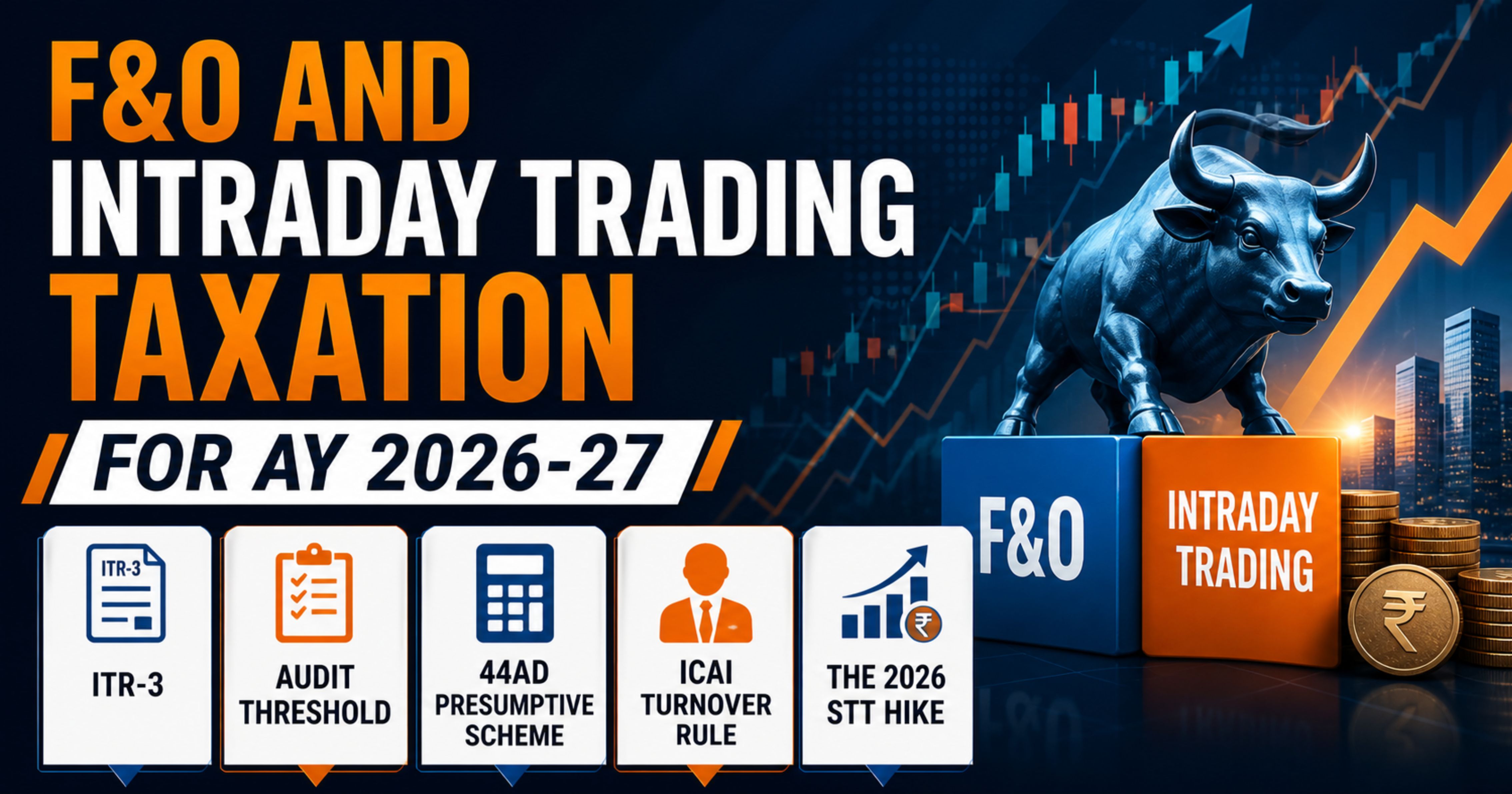

TL;DR: If you trade futures, options, or intraday equity in India, the income is business income, and you file ITR-3. F&O is non-speculative business under proviso (d) to Section 43(5); intraday equity is speculative business under the main limb of Section 43(5). Both are taxed at your slab rate, both let you deduct trading expenses (brokerage, exchange fees, STT, internet, software, advisory). The differences kick in at three places — turnover computation, set-off and carry-forward, and the 1 April 2026 STT hike.
Five things every trader filing AY 2026-27 should know:
- Audit threshold: Section 44AB triggers a tax audit at Rs. 10 crore turnover if 95 % of your receipts and 95 % of your payments are digital (which is automatic for F&O); otherwise Rs. 1 crore.
- Section 44AD presumptive scheme: Available for F&O (eligible business) up to Rs. 3 crore turnover if cash receipts ≤ 5 % — declare ≥ 6 % of digital turnover as profit and skip the audit. The 5-year continuity rule under Section 44AD(4) is the catch: once you opt in, opting out within the next five AYs activates the Section 44AB(e) audit if your income exceeds the basic exemption.
- Turnover (ICAI 8th edition Guidance Note, August 2022): For F&O, turnover = sum of absolute profits and losses on each closed trade. Option premium received on sale is no longer added separately if already part of net P&L. This brought audit-trigger turnover sharply lower for most traders post-AY 2022-23.
- Set-off and carry-forward: F&O (non-speculative business) loss can be set off against any income except salary in the same year and carried forward 8 AYs under Section 72. Intraday equity (speculative) loss can only be set off against speculative gains, carry forward 4 AYs under Section 73.
- STT hike from 1 April 2026 (Finance Act, 2026): Sale of futures from 0.02 % to 0.05 % of traded price; sale of options on premium from 0.10 % to 0.15 %; sale of options where exercised, on intrinsic price, from 0.125 % to 0.15 %. Equity delivery and intraday rates unchanged. Important timing point: these new rates apply to transactions entered on or after 1 April 2026, i.e. for tax year 2026-27 (AY 2027-28). Your AY 2026-27 return covers FY 2025-26, where the pre-1 April 2026 STT rates apply.
The article works through each piece, with worked examples and the AY 2026-27 ITR-3 specifics.
1. The Section 43(5) Framework — What is “Speculative” and What is Not
Section 43(5) of the Income-tax Act, 1961 defines a “speculative transaction” as a contract for the purchase or sale of any commodity (including stocks and shares) settled otherwise than by actual delivery. The main limb pulls intraday equity in: you buy and sell on the same day without taking delivery, so the transaction is speculative.
Proviso (d) to Section 43(5) carves out a specific exception: an eligible transaction in derivatives carried out on a recognised stock exchange is not a speculative transaction. So index futures, stock futures, index options and stock options — the entire F&O universe traded on NSE / BSE — are non-speculative business income.
Activity Classification Provision Set-off scope Carry-forward F&O (futures + options on stocks / indices) Non-speculative business Section 43(5) proviso (d) Any income except salary 8 AYs (Section 72) Intraday equity (delivery-less buy/sell) Speculative business Section 43(5) main Speculative gains only 4 AYs (Section 73) Equity delivery short-term Capital gain (STCG) Section 111A (taxed at 20% for transfers on or after 23 July 2024) Other capital gains 8 AYs (Section 74) Equity delivery long-term (held > 12 mo) Capital gain (LTCG) Section 112A (taxed at 12.5% above Rs. 1.25 lakh, transfers on or after 23 July 2024) LTCG only 8 AYs (Section 74)If you do all four — F&O, intraday, short-term and long-term — you have two business heads (speculative and non-speculative) and two capital-gains heads, all on the same ITR-3.
2. ITR-3 — The Form, the Schedules
Both F&O and intraday equity are reported in ITR-3 — the form for individuals and HUFs with income from business or profession. Salaried professionals who also trade still use ITR-3 (not ITR-1 or ITR-2). The relevant schedules are:
- Schedule BP — Business or Profession: P&L from F&O (non-speculative) and intraday (speculative) is reported separately within Schedule BP. Both are at slab rate.
- Schedule Part A — Trading Account: For AY 2026-27, the Income-tax Department has expanded the disclosure under this schedule for F&O traders — turnover, gross profit, and other line items now have to be furnished here, even if you also use Schedule BP for the final P&L. This is a procedural tightening, not a tax change.
- Schedule CG — Capital Gains: Equity delivery (short-term and long-term) trades go here.
- Schedule CFL — Carried-Forward Losses: Speculative loss line and non-speculative business loss line are kept distinct.
- Schedule TPSA, TR, FA: If you trade overseas derivatives or hold foreign assets, additional schedules apply.
Salary, house-property, and other-source income flow into ITR-3 alongside — the form handles all of it on a single return.
3. The ICAI 8th Edition Guidance Note — F&O Turnover Done Right
How you compute “turnover” for F&O matters because it drives both the Section 44AB audit threshold and the Section 44AD presumptive cap. The Institute of Chartered Accountants of India (ICAI) issues a Guidance Note on Tax Audit under Section 44AB that the income-tax department treats as authoritative on this question.
The 8th edition (August 2022) reset the methodology. Under the earlier (7th) edition, F&O turnover for an option seller included the premium received on sale in addition to the absolute differences — which inflated turnover sharply for active option writers. From AY 2022-23 onwards, the rule is:
“The total of favourable and unfavourable differences shall be taken as turnover.”
“Premium received on sale of options is also to be included in turnover. However, where premium received is included for determining net profit for transactions, the same should not be separately included.”
“In respect of any reverse trades entered, the difference thereon, should also form part of the turnover.”
In practical terms, for a trader who already accounts for option premium in net P&L (most do, via the broker’s P&L statement), turnover collapses to the sum of absolute profit/loss values on closed trades. A profit of Rs. 30,000 on one trade and a loss of Rs. 10,000 on another contribute Rs. 40,000 to turnover, not the gross contract value or the premium. Reverse-trade differences are included separately.
Worked example: A trader closes 200 F&O trades in FY 2025-26 with absolute P&L values summing to Rs. 75 lakh and net P&L of Rs. 4 lakh profit. Turnover is Rs. 75 lakh. Section 44AB(a) does not trigger (well under the Rs. 10 crore digital threshold). Section 44AD is available (Rs. 75 lakh is well under the Rs. 3 crore cap). Net P&L of Rs. 4 lakh on Rs. 75 lakh turnover is roughly 5.3 % — below the 6 % presumptive threshold. The right call here is to not opt into 44AD (declaring 6 % deemed would mean paying tax on Rs. 4.5 lakh instead of the actual Rs. 4 lakh) and file regular ITR-3 with books showing the actual numbers. No audit is required — assuming the trader has never opted into 44AD in an earlier AY. (If they had opted into 44AD before and are now opting out within the 5-year continuity window with income above basic exemption, Section 44AB(e) would trigger.)
4. Section 44AB — When the Tax Audit Triggers
Section 44AB prescribes when a trader has to get accounts audited by a chartered accountant and file Form 3CB / 3CD. Three triggers are relevant for F&O / intraday:
- Section 44AB(a): Turnover > Rs. 1 crore — standard threshold. Raised to Rs. 10 crore by the second proviso to Section 44AB(a) where:
- cash receipts (including amounts received in cash) do not exceed 5 % of the total receipts; AND
- cash payments do not exceed 5 % of the total payments.
- Section 44AB(b): Profession with gross receipts > Rs. 50 lakh — not relevant for traders.
- Section 44AB(e): Audit applies where the conditions of Section 44AD(4) are attracted — i.e. the trader opted into Section 44AD in an earlier AY and then opted out in any of the next five AYs — and the trader’s income for the year exceeds the basic exemption. This is the “continuity trap”: a one-time low-margin or loss year, by itself, does not trigger 44AB(e) for someone who has never opted into 44AD.
Practical decision rule (assumes F&O receipts/payments are 95 %+ digital, so the Rs. 10 crore digital threshold applies):
Turnover (ICAI 8th edition basis) Genuine profit margin Audit? ≤ Rs. 3 crore ≥ 6 % of turnover Optional — opt into 44AD, no audit (note 5-year continuity rule) ≤ Rs. 3 crore < 6 % or in loss, never opted into 44AD No automatic audit. File regular ITR-3 with books and declare actual income / loss. ≤ Rs. 3 crore < 6 % or in loss, but opted into 44AD in an earlier AY within the 5-year continuity window Section 44AB(e) audit triggered if total income > basic exemption. The continuity trap. Rs. 3 crore to Rs. 10 crore Any 44AD not available. Audit under 44AB(a) only if turnover > Rs. 10 crore (with 95 % digital test); ≤ Rs. 10 crore = no audit if regular books are kept. > Rs. 10 crore Any Audit under 44AB(a).5. Section 44AD — The Presumptive Scheme and Its Lock-in
Section 44AD lets an “eligible assessee” carrying on an “eligible business” declare income at a deemed rate without maintaining detailed books or getting audited:
- Deemed profit: 6 % of turnover received via digital modes (banking channels, cheque, NEFT, RTGS, UPI) on or before the ITR due date; 8 % otherwise.
- Turnover ceiling: Rs. 3 crore per FY where cash receipts ≤ 5 % of total receipts (Finance Act, 2023 amendment, effective FY 2023-24); Rs. 2 crore otherwise.
- Eligibility: Resident individual, HUF, or partnership firm (not LLP); F&O is an eligible business since it is non-speculative business income.
- Continuity rule (Section 44AD(4)): If you opt for 44AD in any AY and then opt out in any of the next five AYs, you are locked out of 44AD for the next five AYs after the opt-out year, and must maintain books and get a tax audit if your income exceeds the basic exemption.
For traders with consistent ≥ 6 % profit margin and turnover ≤ Rs. 3 crore, 44AD is the simplest filing route — no audit, no detailed books. But the continuity rule means you should not casually flip in and out: a trader who has a profitable year, opts in, and then has a losing year and wants to claim the loss is locked out of 44AD for the next five AYs. Whether that opt-out year also triggers a Section 44AB(e) audit depends on whether total income for that year exceeds the basic exemption — if it does, audit kicks in; if not, the trader still files normally without audit but loses the option to use 44AD again until the lockout window passes.
Intraday equity and Section 44AD — the practitioner position. Section 44AD does not, in the bare text of sub-section (6), name speculative business in its express exclusions (which are profession under Section 44AA(1), commission/brokerage income, and agency business). However, the term “eligible business” in Section 44AD has been read in practice and in CBDT guidance as referring to non-speculative business. Most chartered accountants therefore file intraday-only traders outside the 44AD scheme — under regular books with audit-when-applicable, or with no books if income is below the Section 44AA threshold (Rs. 2.5 lakh / Rs. 25 lakh for individuals). If you intend to claim 44AD on intraday turnover, treat that as a position that needs CA review and may invite scrutiny.
6. Allowable Deductions — What You Can Claim
Treating F&O / intraday as business income (which the Act forces you to do) opens the full menu of business deductions under Section 30 to Section 37 of the 1961 Act. The common claims:
- STT — allowable under Section 36(1)(xv) for those treating securities transactions as business income. (For investors treating short-term capital gains, STT is not deductible.)
- Brokerage and exchange transaction charges — deductible under Section 37(1) as business expenditure.
- SEBI turnover fees, stamp duty, GST on brokerage — deductible.
- Internet, electricity, rent (proportionate, if home office) — deductible to the extent attributable to trading.
- Trading software, charting platforms, market-data subscriptions, advisory fees — deductible.
- Depreciation on computers / laptops used for trading — under Section 32, at 40 % WDV.
- Salary paid to a clerk / assistant if any — deductible.
You cannot deduct personal expenses, household electricity (other than the home-office proportion), or any item that does not bear a direct nexus to the trading business. Keep clean books — broker P&L statement, contract notes, bank statements, expense invoices — and the deductions stand on audit.
7. Set-Off and Carry-Forward — Why F&O Loss is Worth More Than Intraday Loss
F&O loss (non-speculative business):
- Same year: set off against any head except salary (Section 71). So your F&O loss can wipe out your bank-FD interest, your house-property income, your capital gains.
- Carry forward: 8 AYs under Section 72; can be set off against any non-speculative business income in the carry-forward years.
- Condition: ITR must be filed within the Section 139(1) due date (31 July for non-audit cases, 31 October for audit cases) to claim carry-forward.
Intraday equity loss (speculative business):
- Same year: set off only against speculative business gains (Section 73(1)). Cannot wipe out salary, FD interest, or F&O profit. This is the binding constraint.
- Carry forward: 4 AYs only under Section 73(4); can be set off only against speculative business income.
- Same condition on timely return filing applies.
Worked example: A salaried professional has Rs. 12 lakh salary, Rs. 1 lakh FD interest, Rs. 3 lakh F&O loss, Rs. 50,000 intraday equity loss for FY 2025-26. The F&O loss of Rs. 3 lakh sets off against the Rs. 1 lakh FD interest, leaving Rs. 2 lakh of F&O loss to carry forward 8 years. The intraday loss of Rs. 50,000 cannot offset salary or FD interest — it sits idle and is carried forward 4 years for set-off only against future speculative gains. Net taxable income for the year is the Rs. 12 lakh salary at slab.
8. STT Rates and the Finance Act, 2026 Hike
Securities Transaction Tax (STT) is levied on the sale (and in some cases purchase) of securities. For a business-income trader, STT is a deductible expense under Section 36(1)(xv); for an investor, it is not. The rates that apply to F&O / intraday equity trades:
Transaction type Rate up to 31 March 2026 Rate from 1 April 2026 (Finance Act, 2026) Charged on Side Sale of futures 0.02 % 0.05 % Traded price Seller Sale of options (on premium) 0.10 % 0.15 % Option premium Seller Sale of options where exercised (on intrinsic price) 0.125 % 0.15 % Settlement price Buyer Intraday equity sale 0.025 % 0.025 % (unchanged) Sale value Seller Equity delivery purchase 0.10 % 0.10 % (unchanged) Purchase value Buyer Equity delivery sale 0.10 % 0.10 % (unchanged) Sale value SellerThe Finance Act, 2026 increase applies only to derivatives — equity delivery and intraday equity rates are unchanged. The hike was announced in the Union Budget 2026-27 to “provide reasonable course correction in the F&O segment”.
For an active F&O trader, the post-1 April 2026 STT bill on futures roughly 2.5x the pre-hike level (0.02 % to 0.05 %), and on options roughly 1.5x (0.10 % to 0.15 % on premium). The broker P&L statements absorb this automatically; what you should adjust is your expectation of net post-cost return on each trade.
9. Books of Accounts — Section 44AA
Section 44AA(2) requires maintenance of books of accounts for individuals/HUF carrying on business if:
- income from the business exceeds Rs. 2,50,000 in any of the three preceding years; or
- turnover or gross receipts of the business exceeds Rs. 25,00,000 in any of the three preceding years.
For F&O traders on the post-2022 ICAI methodology, turnover crosses Rs. 25 lakh comfortably for anyone with even moderate activity. Practical implication: maintain a basic ledger, broker contract notes, P&L statements, bank statements and expense vouchers. If you opt for Section 44AD presumptive, you are exempted from these maintenance requirements for that year, but the underlying records still help if the AO asks questions later.
The penalty for failure to keep books is Rs. 25,000 under Section 271A. (Section 271AA, which prescribes a 2 % penalty, applies only to transfer-pricing documentation defaults under Section 92D — not ordinary trader book-keeping; popular write-ups sometimes confuse the two.) Either penalty is avoidable simply by keeping the broker reports, contract notes, and bank statements on file.
10. Filing Decision Tree for AY 2026-27
- Compute turnover on the ICAI 8th edition basis (sum of absolute P&L on F&O closed trades; sale value for intraday equity; sum of absolute P&L for commodity / currency derivatives if any).
- Compute net P&L from broker statements after deducting STT, brokerage, exchange fees, GST, internet, software, and depreciation.
- Apply the audit triggers:
- F&O turnover > Rs. 10 crore → audit under 44AB(a).
- F&O turnover ≤ Rs. 3 crore + net profit < 6 % (or in loss): no automatic audit if the trader has never opted into 44AD. Audit under 44AB(e) triggers only when Section 44AD(4) applies — i.e. a prior 44AD opt-in followed by opt-out within the next five AYs — and total income for the year exceeds the basic exemption.
- Otherwise — no audit, file regular ITR-3.
- Pick the filing path:
- If profitable above 6 % and turnover ≤ Rs. 3 crore: 44AD is the simplest.
- If you have F&O loss to carry forward: do not opt for 44AD — you will lose the loss-carry-forward benefit (44AD declares deemed profit). File regular ITR-3 with audited or non-audited books as applicable.
- If turnover > Rs. 3 crore: regular ITR-3, audit if > Rs. 10 crore.
- Pay advance tax in four instalments (15 June / 15 September / 15 December / 15 March) under Section 211 to avoid Section 234B / 234C interest.
- File ITR-3 by 31 July 2026 (non-audit) or 31 October 2026 (audit) to preserve loss-carry-forward.
11. Common Mistakes That Trigger Notices
- Filing ITR-2 instead of ITR-3. Treating F&O / intraday income as “capital gains” in ITR-2 misclassifies the head. By itself, picking the wrong form is not a Section 270A under-reporting trigger — but if the misclassification leads to actual under-reporting (different rate, missed business deductions, wrong loss-set-off), the under-reporting attracts Section 270A. Filing ITR-3 with the correct head is the cleaner default.
- Computing turnover on contract value, not absolute P&L. Inflates turnover, may push you into needless audit. Use the ICAI 8th edition methodology.
- Mixing intraday and F&O loss. Speculative loss cannot offset non-speculative gain. Keep them in separate buckets in Schedule BP.
- Opting for 44AD when in loss. 44AD declares deemed profit; the loss is gone. Only opt in if your real margin is ≥ 6 %.
- Missing the ITR due date. Loses the right to carry forward F&O loss (8 years) and intraday loss (4 years) under Section 80.
- Not paying advance tax. Even on F&O profits, advance tax under Section 211 is due. Skipping it triggers Section 234B / 234C interest.
- Ignoring the 44AD continuity trap. Once opted in, exiting in any of the next 5 AYs locks you out of 44AD for the following 5 AYs. The audit consequence is conditional: Section 44AB(e) triggers only if your total income in that opt-out year exceeds the basic exemption. Plan the in/out decision for the long term to avoid the trap.
12. Final Takeaway
F&O traders sit on the favoured side of the Indian tax system: non-speculative business income, full set of business deductions, an 8-year loss-carry-forward window, and a Rs. 10 crore digital audit threshold. Intraday equity is the worse cousin — speculative income, 4-year loss window, no offset against any non-speculative income.
The two AY 2026-27 changes worth pricing in: the new Schedule Part A – Trading Account disclosure on ITR-3, and the Finance Act, 2026 STT hike on derivatives from 1 April 2026 (which affects FY 2026-27 onwards, i.e. AY 2027-28 returns — not the AY 2026-27 you are filing in 2026 for FY 2025-26 income).
The Income-tax Act, 2025 carries the framework forward with renumbered sections (Section 44AB → Section 63, Section 44AD → Section 58, Section 72 → Section 112, Section 73 → Section 113, Section 44AA → Section 62) but no substantive change to the F&O / intraday treatment. AY 2026-27 returns are filed under the 1961 Act; AY 2027-28 onwards use the 2025 Act numbering. The economics — classification, audit thresholds, presumptive scheme, set-off rules, deductions — stay the same.
13. Legal & Regulatory References
- Section 43(5), Income-tax Act, 1961 — definition of speculative transaction; proviso (d) carves out eligible derivatives transactions on a recognised stock exchange.
- Section 44AB, Income-tax Act, 1961 (Section 63 of the 2025 Act) — tax audit; second proviso to clause (a) for the Rs. 10 crore digital threshold; clause (e) for the 44AD opt-out trigger.
- Section 44AD, Income-tax Act, 1961 (Section 58 of the 2025 Act) — presumptive taxation for eligible business; sub-section (4) continuity rule; Finance Act, 2023 amendment for the Rs. 3 crore cap with 5 % cash limit.
- Section 44AA, Income-tax Act, 1961 (Section 62 of the 2025 Act) — books of account thresholds (Rs. 2,50,000 / Rs. 25,00,000 for individual / HUF).
- Section 36(1)(xv), Income-tax Act, 1961 — STT deductible as business expense for those treating securities transactions as business income.
- Section 72, Income-tax Act, 1961 (Section 112 of the 2025 Act) — carry forward and set off of business loss other than speculation; 8 AYs.
- Section 73, Income-tax Act, 1961 (Section 113 of the 2025 Act) — speculation business losses; set off against speculation gains only; 4 AYs.
- ICAI Guidance Note on Tax Audit under Section 44AB, 8th Edition (August 2022) — F&O turnover methodology.
- Finance Act, 2026 — STT rate increases on F&O effective 1 April 2026 (futures sale 0.02 % → 0.05 %; options sale on premium 0.10 % → 0.15 %; options on intrinsic price 0.125 % → 0.15 %).
- Finance Act (No. 2), 2024 — earlier STT increase effective 1 October 2024 (futures sale 0.0125 % → 0.02 %; options sale on premium 0.0625 % → 0.10 %).
- Section 111A and Section 112A, Income-tax Act, 1961 — STCG and LTCG on listed equity (rates updated by Finance (No. 2) Act, 2024 effective 23 July 2024).
This article is a practitioner-oriented summary as on 5 May 2026. CBDT clarifications, ICAI Guidance Note revisions, and ITR utility schemas evolve over time — verify the latest CBDT circulars, the ICAI Guidance Note’s current edition, and the AY 2026-27 ITR-3 schema before filing. For a borderline case — particularly turnover above Rs. 3 crore, 44AD opt-in/out decisions with carry-forward losses on hand, or a Section 44AB audit trigger — consult an experienced practising chartered accountant.




Comments (0)
No comments yet. Be the first to comment!