
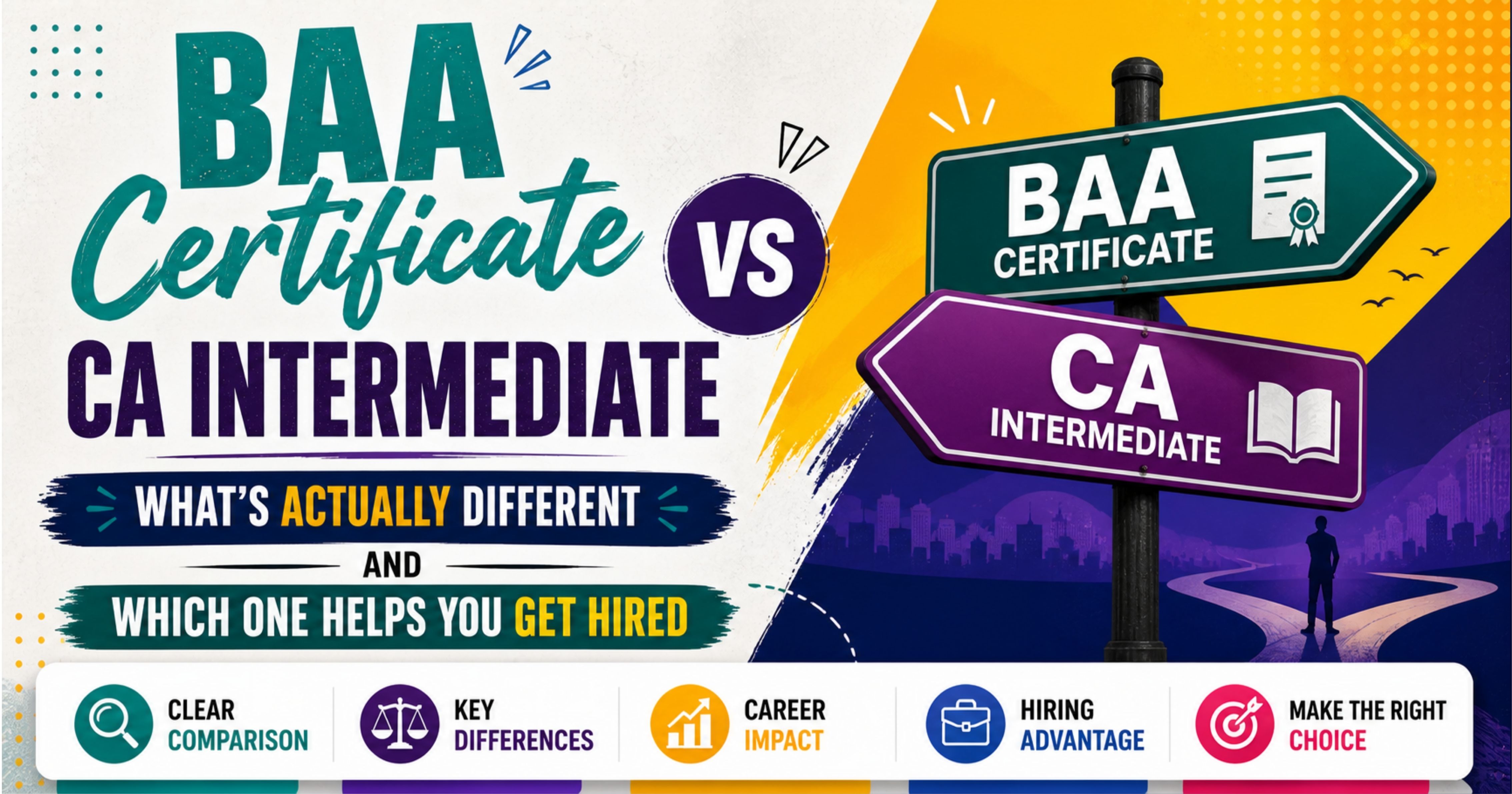

Once ICAI announced the Business Accounting Associate (BAA) certificate, the most common confusion among CA Intermediate students has been simple: how is BAA different from already having cleared CA Intermediate? Both sit between the start of the CA journey and the Final, both involve the same Intermediate exams, and both go on a CV. But they are not the same thing, and using them interchangeably misses what BAA was actually built to do.
This article lays out the real differences — what each one actually represents, what employers see, and which one to lead with on your CV depending on where you are in the CA pipeline.
What Each One Actually Is
CA Intermediate is an exam stage in the Chartered Accountancy course. Clearing both groups of CA Intermediate is a milestone, but it is not, by itself, a separately issued professional certificate from ICAI. Your status is reflected in your ICAI student record, and on your mark sheets. It says you have cleared the second of three exam levels in the CA course.
BAA Certificate is a separate, formally issued certificate from ICAI that you apply for and pay for through the Self Service Portal (SSP). It is named "Business Accounting Associate" and exists as a standalone credential. You have to qualify for it (Intermediate alone is not enough), and once issued it is a discrete document with your name on it that you can attach to a job application.
The cleanest way to think about it: CA Intermediate is an exam result. BAA is a certificate. Different categories of thing.
Eligibility: BAA Asks for More Than Just Intermediate
If clearing both groups of CA Intermediate were enough to be a Business Accounting Associate, BAA would be redundant. It is not enough. Per ICAI's published BAA FAQs, you also need:
- At least two years of articleship (practical training) completed
- Advanced ICITSS course completed
- All Self-Paced Online Modules (SPOM) cleared
So a student who has cleared both Intermediate groups but has only six months of articleship done is CA Intermediate qualified, but is not yet eligible for the BAA Certificate. Conversely, a student who has done all four — Intermediate + 2 years of articleship + Advanced ICITSS + SPOM — but has not yet attempted Final, is exactly the audience BAA was designed for.
The four conditions together signal something specific: you have done the bulk of the practical and conceptual training that goes into becoming a CA, you just have not cleared the Final exam yet.
What Employers Actually See
This is where the difference becomes practical. When a hiring manager looks at a CV, "CA Intermediate cleared" is read as an exam pass. It tells them you got through the second level of the CA course. It does not, by itself, tell them whether you have done articleship, or completed ICITSS, or are job-ready for an executive-level accounting role.
"Business Accounting Associate (BAA), ICAI" is read as a certified credential. The employer can verify it on ICAI's record. It tells them, in one line, that you have completed Intermediate, two years of articleship, ICITSS, and SPOM — without you having to spell each one out.
For roles like accounting executive, audit assistant, finance associate, and similar non-CA-required positions, BAA is the more legible single line on a CV than listing each milestone separately.
Does BAA Replace CA Intermediate on Your CV?
No. BAA does not replace CA Intermediate; it sits on top of it as additional recognition. You would still typically mention CA Intermediate (with year of passing and group details) under your education, and BAA under certifications. Together they give an employer the full picture.
If you want to be space-efficient on a one-page CV, you can lead with BAA in the certifications section and let the Intermediate detail live in the education section. The two complement each other; they don't compete.
Does BAA Affect Your CA Final Journey?
No. The BAA Certificate does not stop you from continuing CA Final. ICAI has been clear that BAA is parallel recognition — you can hold the BAA Certificate and continue attempting Final in the same attempt cycle. If and when you clear Final, you become a Chartered Accountant; the BAA Certificate from your earlier stage continues to exist as part of your record.
So holding BAA is not a "downgrade" or an "exit" in the sense of giving up on Final. It is closer to a credential you collect along the way that is useful in the job market while you continue preparing.
Cost and Application: One Small Practical Difference
CA Intermediate has a one-time registration fee at the start of the level and per-attempt exam fees. BAA, separately, has its own application fee — Rs. 500 for Indian candidates as published by ICAI — paid through SSP at the time of applying for the certificate.
The BAA fee is a one-time cost for the certificate itself, not a recurring fee. Once issued, the certificate does not expire and does not require renewal.
So Which One Should You Mention First?
It depends entirely on where you are in your career and what role you are applying to.
You have only cleared Intermediate (no articleship done yet): You list CA Intermediate. BAA is not yet available to you, so the question doesn't arise.
You have cleared Intermediate, completed two years of articleship, finished ICITSS and SPOM, but not yet cleared Final: Apply for BAA and lead with it on your CV for accounting / audit / finance executive roles. Mention CA Intermediate under education. The BAA credential gives you a single line that condenses all four milestones.
You have cleared CA Final: "Chartered Accountant (CA)" supersedes both Intermediate and BAA on your CV. You don't need to highlight BAA separately. How BAA appears in your ICAI record once you become a CA depends on ICAI's notification at that time — see the application guide for the current ICAI position on transcript treatment.
You are in the middle of articleship and applying for a part-time / supporting role: CA Intermediate (passed) is the right line to use. BAA does not yet apply.
Summary in One Table
Type: CA Intermediate is an exam stage; BAA is a certificate.
What it certifies: Intermediate certifies you cleared the exam level; BAA certifies Intermediate + two years of articleship + Advanced ICITSS + SPOM.
Application: Intermediate is part of the CA registration; BAA is a separate online application via SSP.
Fee: Intermediate has its own ICAI fee structure; BAA is Rs. 500 for Indian candidates as a one-time application fee.
Affects CA Final: Neither blocks Final; both are compatible with continuing the CA journey.
Best CV usage: Intermediate goes under education; BAA goes under certifications.
Bottom Line
BAA and CA Intermediate are not interchangeable. CA Intermediate is the exam stage that says you cleared two of the three CA levels. BAA is the standalone certificate that says you cleared Intermediate and completed two years of articleship, ICITSS, and SPOM. For students at the eligible stage, BAA is the more powerful single credential to put on a CV for accounting, audit, and finance executive roles. For students still mid-articleship, BAA does not yet apply and CA Intermediate remains the line to use. And for everyone, BAA does not stop you from continuing the CA Final journey — it sits alongside it.

Comments (0)
No comments yet. Be the first to comment!