
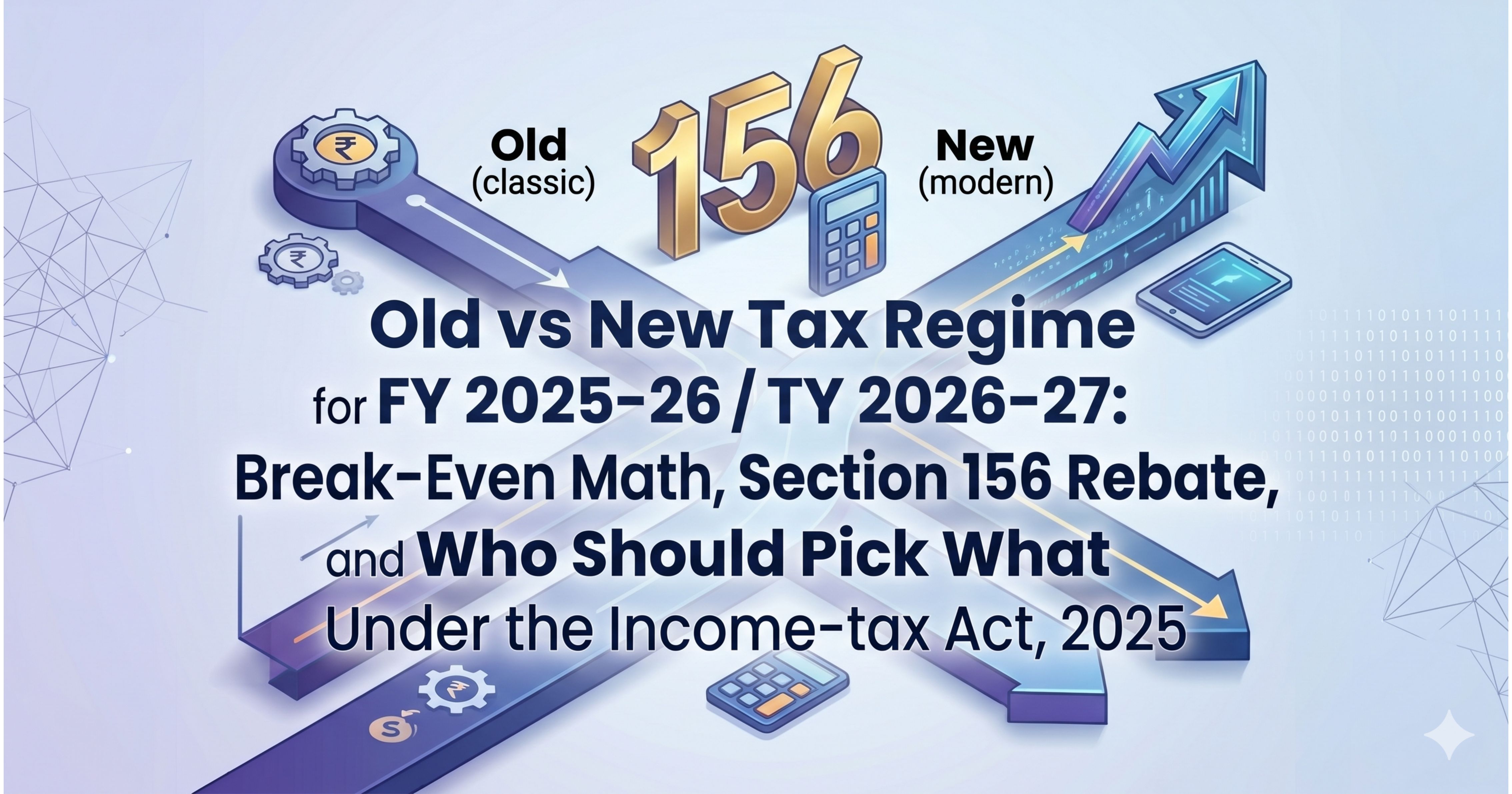

TL;DR: Under the Income-tax Act, 2025 (effective Tax Year 2026-27), the new regime under Section 202 is the default and gives you a Rs. 4 lakh basic exemption, a Rs. 75,000 standard deduction (salaried), and a Rs. 60,000 / Rs. 12 lakh rebate under Section 156 — effectively making salary income up to Rs. 12.75 lakh tax-free. The old regime is now an opt-in, with lower slabs (Rs. 2.5L exemption, 5/20/30% slabs) but the full Section 80C / Section 80D / HRA / home loan interest stack of deductions. The break-even rule of thumb: if your total deductions (including HRA, 80C, 80D, home loan, NPS) exceed roughly Rs. 3.5-4 lakh, the old regime usually wins; below that, the new regime usually wins. HUFs and other non-individuals do NOT get Section 156 rebate — the new-regime math changes meaningfully for them.
The 30-Second Summary
Every salaried Indian's annual decision: tick the new regime (default, simpler, almost-no-deductions) or tick the old regime (opt-in, lower slabs, full deduction stack). For most under-Rs. 12 lakh salary earners, the new regime is now mathematically unbeatable thanks to the Section 156 rebate. For Rs. 15-30 lakh earners with rented housing, education loans, full Section 80C investments and senior parents, the old regime can still save Rs. 30,000-Rs. 1.5 lakh annually. Beyond Rs. 30 lakh of income, the old regime needs an exceptionally heavy deduction stack to compete. The math is income-bracket and deduction-load specific — this guide gives you the framework.
1. Section 202 New Regime — The Default
Section 202 of the Income-tax Act, 2025 (successor to Section 115BAC of the 1961 Act) is the default regime for individuals, HUFs, AOPs (other than co-operative societies), BOIs, and artificial juridical persons. To pay tax under the old regime, you must affirmatively opt out in your ITR.
A. Slab Structure (FY 2025-26 onwards)
Total income Tax rate Up to Rs. 4,00,000 Nil Rs. 4,00,001 to Rs. 8,00,000 5% Rs. 8,00,001 to Rs. 12,00,000 10% Rs. 12,00,001 to Rs. 16,00,000 15% Rs. 16,00,001 to Rs. 20,00,000 20% Rs. 20,00,001 to Rs. 24,00,000 25% Above Rs. 24,00,000 30%Plus health and education cess at 4% on the tax. Surcharge of 10% / 15% / 25% applies above the standard income thresholds; the 37% surcharge slab is capped at 25% under the new regime.
B. Standard Deduction
Rs. 75,000 for salaried taxpayers and pensioners. Codified in Section 202 itself — not a separate Chapter VI-A item. So the salaried tax-free limit is effectively Rs. 12 lakh + Rs. 75,000 = Rs. 12.75 lakh.
C. Section 156 Rebate — The Headline Benefit (Individuals Only)
Section 156 of the 2025 Act (successor to Section 87A) gives resident individuals a rebate of up to Rs. 60,000 or 100% of tax payable, whichever is lower, when total income does not exceed Rs. 12 lakh. Combined with the slab structure, this means tax payable on Rs. 12 lakh of total income under the new regime is nil.
Important — HUFs are NOT eligible for Section 156 rebate. Many secondary articles wrongly state HUFs get the Rs. 60,000 rebate. They do not. For an HUF in the new regime, tax actually payable starts from Rs. 4 lakh of income, with no rebate to absorb tax up to Rs. 12 lakh. This significantly changes the regime-choice math for HUF assessees.
D. Marginal Relief Above Rs. 12 Lakh
Section 156 includes a marginal-relief proviso so that the tax payable on income just above Rs. 12 lakh does not exceed the amount by which the income exceeds Rs. 12 lakh. So if your total income is Rs. 12,10,000, the maximum tax (after marginal relief) is Rs. 10,000 — preventing a sharp jump from Rs. 0 to Rs. 60,000+ that the slab math alone would produce.
E. Deductions Allowed Under the New Regime
Most Chapter VI-A / Section 123-onwards deductions are not available. The narrow whitelist:
- Standard deduction Rs. 75,000 (salary / pension)
- Family pension deduction Rs. 25,000 (raised from Rs. 15,000 by FA 2024)
- Transport allowance for specially abled employees
- Conveyance allowance for performance of office duties
- Employer's contribution to NPS under Section 80CCD(2) successor — up to 14% of salary under the new regime (raised by FA 2024 for non-government employees too); the cap remains 10% for non-government employees under the old regime
- Agniveer Corpus Fund contribution (Section 80CCH successor)
- Additional employee cost deduction under Section 146 of 2025 Act (was Section 80JJAA) for eligible employers
- Standard 30% deduction on annual value of let-out property under Section 22 successor (the house-property-head deduction, which is in computing income from house property, not Chapter VI-A)
What is NOT available in the new regime: Section 80C (Section 123) / Section 80D (Section 126) / Section 80E (Section 124) / Section 80G (Section 130) / HRA exemption / Section 24(b) home loan interest on self-occupied property / Section 80CCD(1B) NPS additional Rs. 50,000 / LTA / leave encashment / professional tax / employee's NPS contribution under Section 80CCD(1).
2. Old Regime — The Opt-In
A. Slab Structure
Total income Below 60 Senior (60-79) Super-senior (80+) Up to Rs. 2,50,000 Nil Nil Nil Rs. 2,50,001 to Rs. 3,00,000 5% Nil Nil Rs. 3,00,001 to Rs. 5,00,000 5% 5% Nil Rs. 5,00,001 to Rs. 10,00,000 20% 20% 20% Above Rs. 10,00,000 30% 30% 30%Plus 4% cess. Surcharge 10/15/25/37% as applicable.
B. Standard Deduction
Rs. 50,000 for salaried / pensioners under old regime — lower than the new regime's Rs. 75,000.
C. Section 156 Rebate (Old Regime)
Up to Rs. 12,500 when total income does not exceed Rs. 5 lakh. Effectively makes total income up to Rs. 5 lakh tax-free under the old regime.
D. The Full Deduction Stack — Where the Old Regime Earns Its Keep
- Section 80C (Section 123 of 2025 Act read with Schedule XV): Rs. 1,50,000 — PPF, ELSS, NSC, life insurance premium, principal on home loan, EPF, school tuition, etc.
- Section 80D (Section 126): up to Rs. 1,00,000 family + senior parent health insurance.
- Section 80CCD(1B): additional Rs. 50,000 NPS Tier-1 contribution (over and above the Section 80C cap).
- HRA exemption under Section 10(13A) successor — full HRA can be claimed against actual rent paid.
- Section 24(b): home loan interest on self-occupied property up to Rs. 2 lakh; no cap on let-out property (with Rs. 2 lakh overall set-off limit for losses).
- Section 80E (Section 124): education loan interest — no cap, 8 years.
- Section 80G (Section 130): 50% / 100% of donations to specified institutions.
- Section 80GG (Section 127): rent paid when no HRA — up to Rs. 60,000 / year.
- Section 80TTA / 80TTB (Sections 133 / 134): savings / FD interest deduction Rs. 10,000 / Rs. 50,000 (senior).
- LTA, professional tax, leave encashment, gratuity exemptions.
For families with elderly parents, rented housing, two earning spouses both running Section 80C, and employee NPS contribution, the cumulative deduction can exceed Rs. 5-6 lakh easily — territory where the old regime's lower slabs more than compensate for its lower basic exemption.
3. The Break-Even — Where Old Regime Beats New Regime
The break-even calculation depends on income and exact deduction stack. The practitioner heuristic:
Annual gross salary Approx break-even deductions for old to win Default winner Up to Rs. 7 lakh N/A — old can't beat new even with maxed deductions New regime Rs. 7 to Rs. 12 lakh ~Rs. 2-3 lakh Usually new regime (rebate dominates) Rs. 12 to Rs. 15 lakh ~Rs. 3.5-4 lakh Roughly even — depends on individual stack Rs. 15 to Rs. 25 lakh ~Rs. 4-5 lakh Old regime wins for most with full HRA + 80C + 80D Rs. 25 to Rs. 50 lakh ~Rs. 5-6 lakh+ Old regime if full deduction stack; new regime otherwise Above Rs. 50 lakh ~Rs. 6 lakh+ Surcharge differential matters; new regime caps at 25%, old can go to 37%. Modelling required.Quick mental model: if you live in a metro on rent, contribute fully to PPF / ELSS, have an active home loan, and your parents are senior — the old regime usually wins. If you live in your own house, don't max out 80C, and have light deduction profile — new regime usually wins.
4. Worked Examples
Example A — Rs. 7 Lakh Salary, No Deductions
Salary Rs. 7,00,000.
New regime: Total income after Rs. 75K standard deduction = Rs. 6,25,000. Tax = 5% on (Rs. 6,25,000 − Rs. 4,00,000) = Rs. 11,250. Section 156 rebate = full (income < Rs. 12L). Net tax: Nil.
Old regime: Total income after Rs. 50K standard deduction = Rs. 6,50,000. Tax = 5% on (Rs. 5L − Rs. 2.5L) + 20% on (Rs. 6.5L − Rs. 5L) = Rs. 12,500 + Rs. 30,000 = Rs. 42,500. Section 156 rebate not available (income > Rs. 5L). Plus 4% cess = Rs. 44,200.
New regime saves Rs. 44,200.
Example B — Rs. 12 Lakh Salary, Rs. 2 Lakh Deductions
Salary Rs. 12,00,000. Old-regime deductions: 80C Rs. 1.5L + 80D Rs. 25K + 80CCD(1B) Rs. 25K = Rs. 2,00,000.
New regime: After Rs. 75K standard deduction = Rs. 11,25,000. Tax via slabs = Rs. 20,000 (5% on 4-8L) + Rs. 32,500 (10% on 8-11.25L) = Rs. 52,500. Section 156 rebate available (income ≤ Rs. 12L) = full Rs. 52,500. Net tax: Nil.
Old regime: After Rs. 50K standard deduction + Rs. 2L deductions = Rs. 9,50,000. Tax = Rs. 12,500 (5% on 2.5-5L) + Rs. 90,000 (20% on 5-9.5L) = Rs. 1,02,500 + 4% cess = Rs. 1,06,600.
New regime saves Rs. 1,06,600. The Section 156 rebate is decisive at this income.
Example C — Rs. 18 Lakh Salary, Heavy Deductions
Salary Rs. 18,00,000 (metro, on rent). Old-regime deductions: 80C Rs. 1.5L + 80D Rs. 75K (with senior parents) + 80CCD(1B) Rs. 50K + HRA Rs. 3L (rent and basic-pay-driven) + Section 24(b) home loan interest Rs. 2L = Rs. 7,75,000 deductions.
New regime: After Rs. 75K standard deduction = Rs. 17,25,000. Tax = Rs. 0 (4L) + Rs. 20K (5% on 4-8L) + Rs. 40K (10% on 8-12L) + Rs. 60K (15% on 12-16L) + Rs. 25K (20% on 16-17.25L) = Rs. 1,45,000. Income > Rs. 12L, so no Section 156 rebate. Plus 4% cess = Rs. 1,50,800.
Old regime: After Rs. 50K standard deduction + Rs. 7.75L deductions = Rs. 9,75,000. Tax = Rs. 12,500 (5% on 2.5-5L) + Rs. 95,000 (20% on 5-9.75L) = Rs. 1,07,500 + 4% cess = Rs. 1,11,800.
Old regime saves Rs. 39,000. The deduction-heavy stack flips the decision.
Example D — Rs. 25 Lakh Salary, Moderate Deductions
Salary Rs. 25,00,000. Old-regime deductions: 80C Rs. 1.5L + 80D Rs. 50K + Section 24(b) Rs. 2L = Rs. 4,00,000. No HRA (own house).
New regime: After Rs. 75K standard deduction = Rs. 24,25,000. Tax through slabs = Rs. 0 + Rs. 20K (4-8L) + Rs. 40K (8-12L) + Rs. 60K (12-16L) + Rs. 80K (16-20L) + Rs. 1,00,000 (20-24L) + Rs. 7,500 (24-24.25L at 30%) = Rs. 3,07,500. Plus 4% cess = Rs. 3,19,800.
Old regime: After Rs. 50K standard deduction + Rs. 4L deductions = Rs. 20,50,000. Tax = Rs. 12,500 + Rs. 1,00,000 (5-10L at 20%) + Rs. 3,15,000 (10.5-20.5L at 30%) = Rs. 4,27,500 + 4% cess = Rs. 4,44,600.
New regime saves Rs. 1,24,800. Without HRA, the Rs. 4L of deductions is not enough to beat the new-regime slabs.
Example E — Rs. 25 Lakh Salary, Heavy Deductions Including HRA
Same Rs. 25 lakh salary, but on rent in metro: HRA exemption Rs. 5L + 80C Rs. 1.5L + 80D Rs. 75K + 80CCD(1B) Rs. 50K + Section 24(b) Rs. 2L = Rs. 9,75,000 deductions.
Old regime: After Rs. 50K standard deduction + Rs. 9.75L deductions = Rs. 14,75,000. Tax = Rs. 12,500 + Rs. 1,00,000 + Rs. 1,42,500 (10-14.75L at 30%) = Rs. 2,55,000 + 4% cess = Rs. 2,65,200.
New regime: Rs. 3,19,800 (same as Example D).
Old regime saves Rs. 54,600. HRA is the lever that flips the decision.
Example F — HUF, Rs. 15 Lakh Income
Sharma HUF, business income Rs. 15,00,000. No salary in HUF (no standard deduction). Deductions under old regime: 80C / Section 123 Rs. 1,50,000 + Section 24(b) Rs. 2,00,000 (let-out property) = Rs. 3,50,000.
New regime (Section 202): Tax on Rs. 15L = Rs. 0 + Rs. 20K + Rs. 40K + Rs. 45K (12-15L at 15%) = Rs. 1,05,000. HUF gets NO Section 156 rebate. Plus 4% cess = Rs. 1,09,200.
Old regime: Total income after deductions = Rs. 11,50,000. Tax = Rs. 12,500 + Rs. 1,00,000 + Rs. 45,000 (10-11.5L at 30%) = Rs. 1,57,500 + 4% cess = Rs. 1,63,800.
New regime saves Rs. 54,600 even without the §156 rebate. The HUF math typically favours new regime when Chapter VI-A deductions are below ~Rs. 5 lakh because the Rs. 4L exemption + lower marginal slabs beat the old regime's Rs. 2.5L exemption + 30% slab kicking in at Rs. 10L.
5. Decision Framework — A 5-Step Check
- Compute total old-regime deductions: 80C + 80D + 80CCD(1B) + HRA + 24(b) + 80E + 80G + 80TTA/TTB.
- Compare to break-even threshold for your income band (per the table above).
- If deductions far exceed the threshold (50%+): old regime wins. Opt out of new regime in ITR.
- If deductions are below threshold: new regime wins. Stay default; do nothing in ITR.
- If close to threshold (within 10%): run both regime calculations; pick the lower-tax one. The Income Tax Department's e-filing portal has a comparison calculator built in.
6. Common Mistakes
- Treating new regime as automatically better. True for income up to Rs. 12 lakh. Beyond that, deduction-heavy salaried with HRA / home loan / NPS often save more in old regime.
- Forgetting that HRA is gone in new regime. Renters in metros lose Rs. 3-5 lakh of exempt allowance under new regime — the single biggest swing factor.
- Forgetting Section 24(b) home loan interest for self-occupied is gone in new regime. Rs. 2 lakh deduction on self-occupied home loan disappears.
- Letting an HUF claim Section 156 rebate. HUF doesn't get it. Period.
- Switching regime annually for non-salary taxpayers. Salaried can switch year-to-year. Business income earners get only one switch back to old regime, after which they cannot return to new regime in some scenarios. Confirm rules before flipping.
- Not modelling the marginal relief at Rs. 12L threshold. Income just above Rs. 12L gets marginal relief. Example: Rs. 12,10,000 income ⇒ tax max Rs. 10,000.
- Ignoring senior-citizen old-regime advantages. Old regime gives Rs. 3 lakh basic exemption (60+), Rs. 5 lakh (80+), plus Section 80TTB Rs. 50,000 interest deduction — significant for retirees.
- Forgetting employer NPS Section 80CCD(2) IS available in new regime. 14% of salary contribution by employer flows through both regimes. Many employees don't realise this.
- Choosing regime BEFORE making investments. If you'll opt for new regime, don't lock up Rs. 1.5 lakh in PPF in March hoping for 80C deduction. The deduction won't apply.
- Not running the calculation annually. Income and deduction patterns change. Last year's regime choice may be wrong for this year. Recompute.
7. Bottom Line
The new regime under Section 202 is now the rational default for salaried income up to ~Rs. 12 lakh, and for any salaried earner without significant deductions (rent, home loan, full Section 80C, senior-parent insurance). The Rs. 60,000 / Rs. 12 lakh rebate under Section 156 is the headline benefit and is typically decisive in the Rs. 7-12 lakh salary band.
The old regime survives for the deduction-heavy: metro renters paying full HRA, families with senior parents and ~Rs. 1 lakh of Section 80D premiums, NPS-active investors using Rs. 50,000 Section 80CCD(1B), home-loan EMI payers using Rs. 2 lakh of Section 24(b). For salaried earning Rs. 15 lakh+ with this stack, the old regime saves real money. For HUFs, the math is different — no Section 156 rebate — and the new regime usually wins unless deductions are unusually heavy.
Run the math before you tick the regime box. The number on your tax slip depends on it.
8. Legal References
- Income-tax Act, 2025 — effective Tax Year 2026-27 (1 April 2026).
- Section 202, Income-tax Act, 2025 — new tax regime, default for individuals, HUFs, AOPs (other than co-operative), BOIs, AJPs. Slabs Nil/5/10/15/20/25/30 from Rs. 4 lakh to Rs. 24 lakh+. Standard deduction Rs. 75,000 codified within the section. Surcharge capped at 25%. Successor to Section 115BAC of the 1961 Act.
- Section 156, Income-tax Act, 2025 — rebate. Resident individuals only (not HUFs). Old regime: Rs. 12,500 / Rs. 5L. New regime: Rs. 60,000 / Rs. 12L with marginal relief above the threshold. Successor to Section 87A of the 1961 Act.
- Section 123 of 2025 Act read with Schedule XV — Rs. 1.5 lakh aggregate deduction (was Section 80C / 80CCC / 80CCD(1)).
- Section 126, Income-tax Act, 2025 — health insurance (was Section 80D).
- Section 124, Income-tax Act, 2025 — education loan interest (was Section 80E).
- Section 130, Income-tax Act, 2025 — donations (was Section 80G).
- Section 127, Income-tax Act, 2025 — rent paid where no HRA (was Section 80GG).
- Sections 133 / 134, Income-tax Act, 2025 — savings / FD interest (was Section 80TTA / 80TTB).
- Section 146, Income-tax Act, 2025 — additional employee cost deduction available under new regime (was Section 80JJAA).
- Section 80CCD(2) successor — employer's NPS contribution available under new regime.
- Section 22 / 24 successors, Income-tax Act, 2025 — income from house property; standard 30% deduction on annual value of let-out property.
- Finance Act, 2025 — codified the FY 2025-26 new-regime slab structure (Rs. 4L exemption, Rs. 60K rebate up to Rs. 12L, Rs. 75K standard deduction).
- Old-Act anchors: Sections 87A, 115BAC, 80C, 80CCC, 80CCD, 80D, 80E, 80G, 80GG, 80TTA, 80TTB, 80JJAA, 16(ia), 24(b), 10(13A) of the Income-tax Act, 1961.
For specific decisions on regime choice — multiple income heads, family-pension recipients, NRI / RNOR taxpayers, those with foreign income or DTAA credits, business income earners constrained by the §202 once-back rule, and HUF assessees — consult a chartered accountant. The Income Tax Department e-filing portal also has a regime-comparison calculator that produces an authoritative answer for your specific salary and deduction profile. Run it before filing.





Comments (0)
No comments yet. Be the first to comment!