
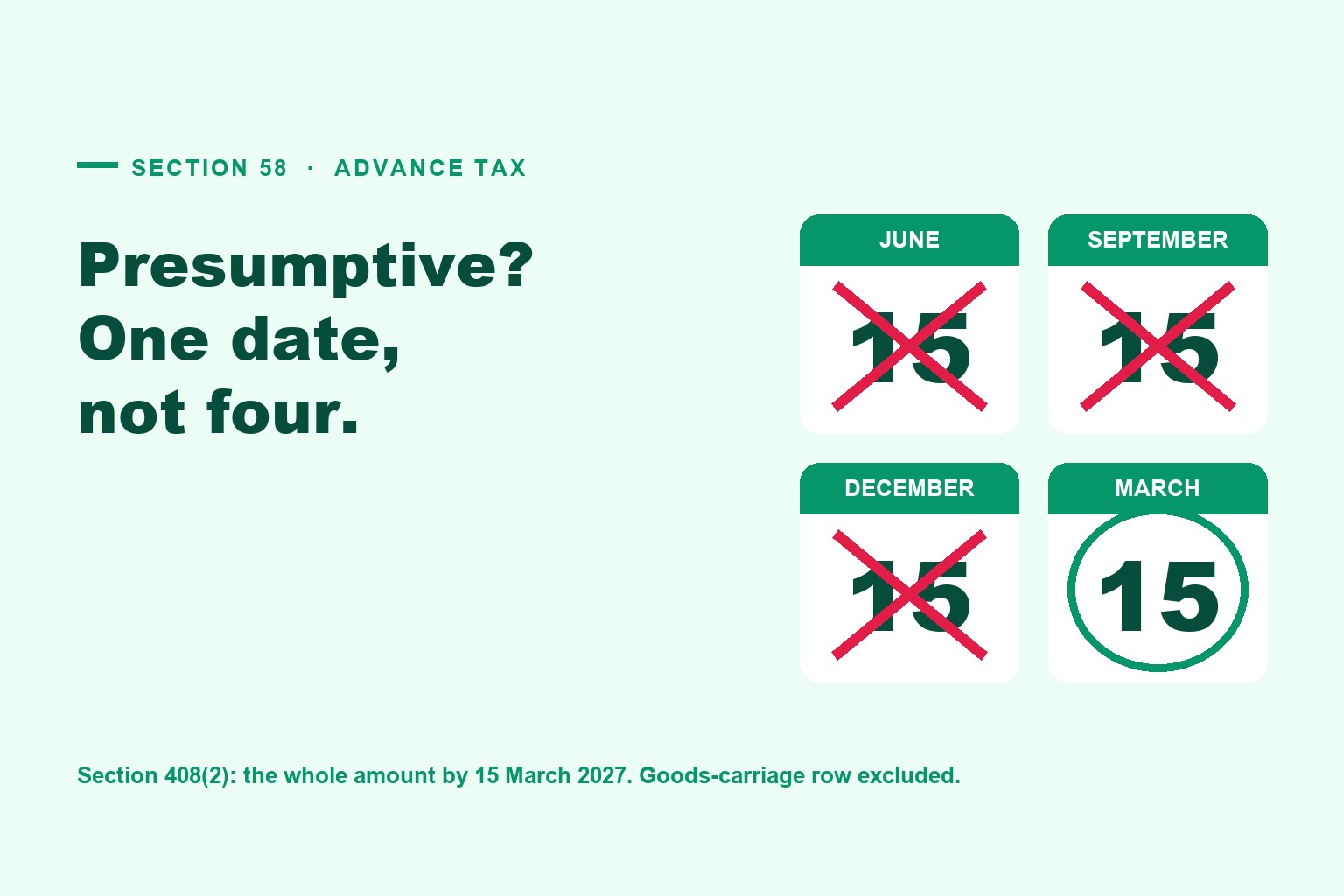

TL;DR: If you declare your income under the presumptive scheme, the old Sections 44AD and 44ADA, which since 1 April 2026 are Sl. No. 1 (business) and Sl. No. 3 (profession) of the Section 58(2) table of the Income-tax Act, 2025, the 15 September advance-tax date is not your date. Section 408(2) gives you one instalment: the whole of the year’s advance tax on or before 15 March 2027. Nothing is due in June, September or December, and no interest runs for those dates. If you miss 15 March and pay by 31 March, the cost is 1 per cent of the shortfall, once, under Section 425(3). And if your clients deduct tax at source, the answer for many freelancers is that nothing is due at all, because advance tax is only payable when the tax left after TDS is Rs 10,000 or more.
1. Who this applies to
Section 58 of the Income-tax Act, 2025 merged the three old presumptive sections into one table. The single-instalment rule in Section 408(2) is written for two of the three rows:
| Section 58(2) row | Old section | Who | Advance tax |
|---|---|---|---|
| Sl. No. 1 | 44AD | Resident individual, HUF or firm (not LLP) in any business other than goods carriage, turnover up to Rs 2 crore (Rs 3 crore where cash receipts are within 5 per cent), declaring 8 per cent or more (6 per cent on the part received through prescribed banking or online modes by the return due date) | One instalment, 15 March |
| Sl. No. 2 | 44AE | Goods-carriage owners with up to ten vehicles | Four instalments: 15 June, 15 September, 15 December, 15 March |
| Sl. No. 3 | 44ADA | Resident individual or firm (not LLP) in a specified profession, gross receipts up to Rs 50 lakh (Rs 75 lakh on the same 5 per cent cash test), declaring 50 per cent or more | One instalment, 15 March |
Two readers this page is not for. If you run trucks under Sl. No. 2, the concession does not reach you; the 1961 Act said the same, naming 44AD and 44ADA but not 44AE. And if you have business or professional income but declare it on regular books, not under Section 58, you are on four instalments. Vijay’s explainer on presumptive taxation under Section 58 covers who is eligible and what the deemed income is.
2. Why nothing is due on 15 September
Section 408(1) lays down the four instalments for “all the assessees who are liable to pay advance tax, other than the assessee referred to in sub-section (2)”. Section 408(2) then says that an assessee who declares profits and gains under Sl. No. 1 or 3 of the Section 58(2) table “shall pay the whole amount of advance tax on the current income … on or before the 15th March”.
The interest section mirrors it. Section 425(1), the table that charges 3 per cent on a shortfall at each of 15 June, 15 September and 15 December, opens with “other than the assessee mentioned in sub-section (3)”, and sub-section (3) is the presumptive rule. So there is no September shortfall for you to be charged on, because there is no September instalment. The 12 per cent and 36 per cent tolerances in Section 425(2) are irrelevant to you for the same reason.
If someone has told you to pay 45 per cent by 15 September because “everyone has to”, that is the general rule in Section 408(1), and it is the rule Section 408(2) takes you out of. Paying early is allowed and harmless; it is simply not required.
3. Do you owe advance tax at all? The Rs 10,000 test
Before the date matters, the amount has to. Section 404 makes advance tax payable only where the amount computed under Section 405 is Rs 10,000 or more for the year. Section 405 computes it as A = B minus C: B is the tax on your estimated total income at the rates in force, C is the tax that will be deducted or collected at source on income included in that estimate.
For a freelancer whose clients deduct tax at source (10 per cent on professional fees where the payer is one the Act requires to deduct at that rate), C is often larger than B, because the presumptive scheme taxes only half the receipts. A worked example, new regime, tax year 2026-27:
- Gross professional receipts Rs 30,00,000; income under Sl. No. 3 = 50 per cent = Rs 15,00,000.
- Tax at the new-regime slabs: 5 per cent on Rs 4 to 8 lakh (Rs 20,000), 10 per cent on Rs 8 to 12 lakh (Rs 40,000), 15 per cent on Rs 12 to 15 lakh (Rs 45,000) = Rs 1,05,000; plus 4 per cent cess = Rs 1,09,200. That is B.
- Clients required to deduct 10 per cent do so on Rs 30,00,000 = Rs 3,00,000. That is C.
- A = Rs 1,09,200 minus Rs 3,00,000, which is negative. No advance tax for the year. The excess comes back as a refund with the return.
The same person whose payers are not required to deduct, say individual clients below the threshold at which an individual must deduct, has C of nil, A of Rs 1,09,200, and the whole of it is due by 15 March 2027. A mix of the two is the common case: work out C from what the deducting clients will actually withhold, and only the balance is advance tax. Vijay’s page on who has to pay advance tax and who does not walks through the other exclusions, including the one for resident senior citizens without business income.
4. What if you miss 15 March?
Section 425(3) is your only instalment-interest provision. If you fail to pay, or pay less than the tax due on returned income, by 15 March, you owe simple interest at 1 per cent on the shortfall. Once, not per month. On the Rs 1,09,200 example, a complete miss costs Rs 1,092.
Section 408(3) then does something useful: any amount paid on or before 31 March is treated as advance tax paid during the year. So a payment on 31 March 2027 still counts as advance tax for the 90 per cent test in Section 424, even though it is late for Section 425(3). Pay the full amount between 16 and 31 March and the total cost of the miss is the 1 per cent. Pay it after 31 March and Section 424 starts: 1 per cent for every month or part of a month from 1 April 2027 on the amount by which what you paid falls short of the assessed tax, until you pay. A payment with the return on 31 July 2027 costs four months, or Rs 4,368 on the example, on top of the Rs 1,092.
Two things the March rule does not change. The base is the tax due on the returned income (Section 425(5)), so if you end up declaring more than the presumptive minimum, the interest is on the higher figure. And Section 425(4) still applies: a shortfall that arises from capital gains, dividend or similar income that you could not estimate carries no interest if the tax on it is paid by 31 March.
5. Three traps
- Opting out mid-year. If by March you decide to declare less than the presumptive figure on regular books, you are no longer a Section 58 declarant for the year, the four-instalment schedule applied all along, and Section 425(1) interest on the June, September and December shortfalls arises. For the business row it can also start the five-year exclusion in Section 58(7), which applies where you had declared under the scheme in an earlier year and depart from it within the following five years, and, where total income is above the exemption limit, books and audit. Decide by December, not March.
- The goods-carriage row. Sl. No. 2 pays four instalments. Section 408(2) is written for the assessee, not the income: on its text, a person who declares any income under Sl. No. 1 or 3 pays the whole of the advance tax on current income by 15 March, even where other income, including goods-carriage income, sits alongside it. Take advice before relying on that reading for a mixed case.
- Salary plus freelance. If you are salaried and also declare consultancy income under Sl. No. 3, the presumptive single instalment covers the advance tax on the whole of your current income under Section 408(2). The employer’s TDS on salary is part of C. Get the estimate right by 15 March rather than trying to split the schedule.
6. How to pay when the time comes
e-Pay Tax on the income-tax portal, select the Income-tax Act, 2025, the year ending 31 March 2027, minor head 100 (Advance Tax). The challan under the new Act is ITNS 280N. Najma’s step-by-step guide to paying advance tax online has the screens, and a challan generated on or after 16 March for advance tax stays valid until 31 March.
7. Quick answers
I am a designer on 44ADA, my clients deduct 10 per cent. Do I pay on 15 September? No. And if the TDS exceeds the tax on 50 per cent of your receipts, you pay nothing in advance at all.
I run a kirana store under 44AD with no TDS. When? The whole amount by 15 March 2027.
I paid 45 per cent in September anyway. Wasted? No. It counts towards the 15 March amount. It was just not required.
I missed 15 March and paid on 25 March. 1 per cent of the shortfall under Section 425(3). Nothing under Section 424, because the 31 March payment counts as advance tax.
I own three trucks under the presumptive scheme. Four instalments; 45 per cent by 15 September.
Does the 12 per cent / 36 per cent tolerance help me? It is not needed; you have no June or September instalment.
Sources
- Income-tax Act, 2025 — Section 58(2) and (7), Section 403, Section 404, Section 405, Section 408(1) to (3), Section 424, Section 425(1) to (5).
- Income-tax Act, 1961 — Section 211(1)(b) (the predecessor rule, naming 44AD and 44ADA only), for the comparison.
- Finance Act, 2025 — rates in force for tax year 2026-27 (Budget 2026 made no change to the individual slabs).
Written as at 10 September 2026 for tax year 2026-27 under the Income-tax Act, 2025. The example uses the new regime with 4 per cent cess and no surcharge, before rounding. Take advice from a Chartered Accountant on a specific computation.



Comments (0)
No comments yet. Be the first to comment!