
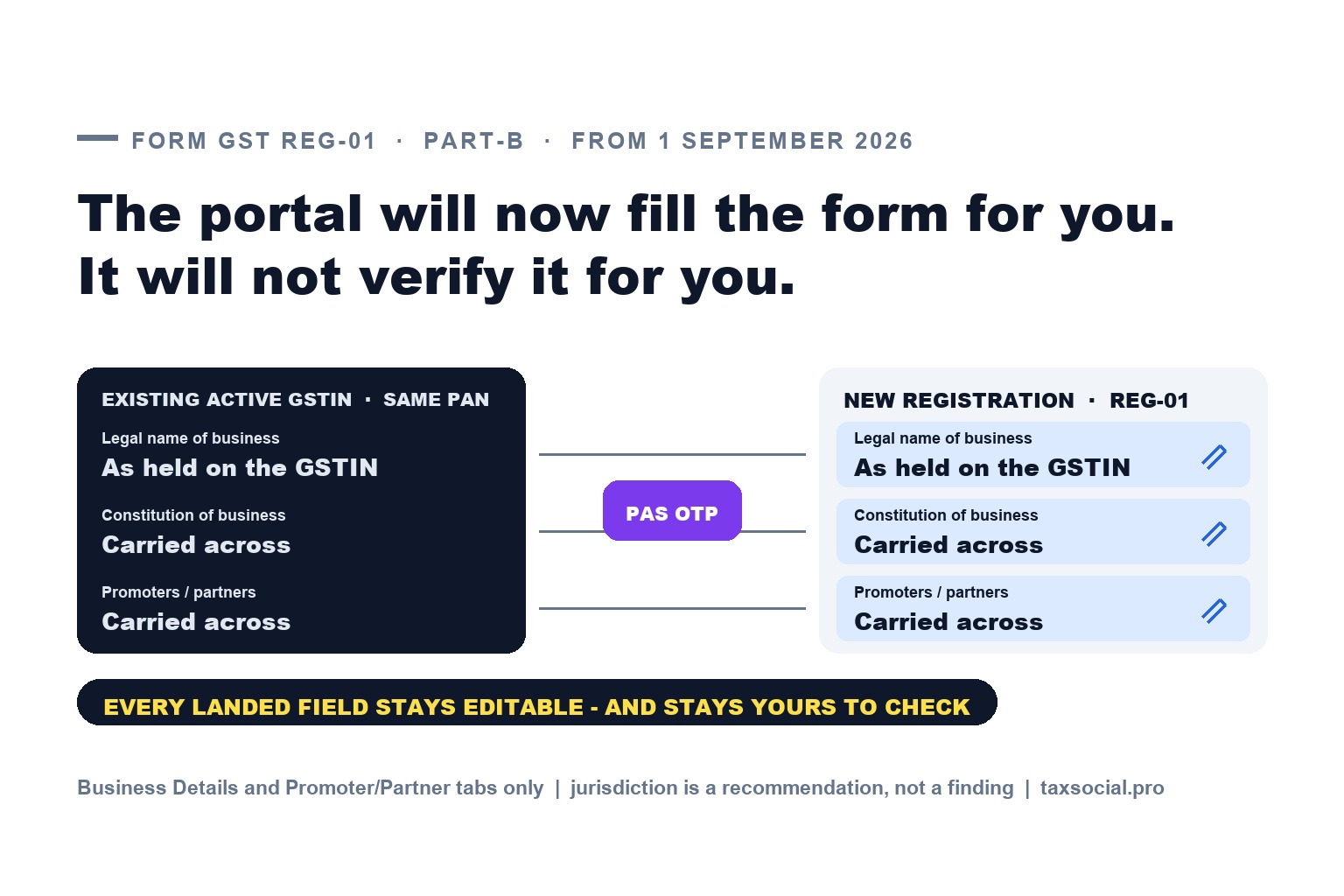

Three things changed in FORM GST REG-01 on 1 September 2026, and all three do the same kind of work: they give you a default instead of a blank. If you already hold an active GSTIN under the same PAN, Part-B of REG-01 now offers to pre-fill the Business Details and Promoter/Partner tabs from it — but only after the Primary Authorised Signatory of the existing GSTIN approves by OTP, and the relevant promoters and partners are told by SMS and email that it happened. Separately, the form now shows information messages and hover tooltips at the fields people get wrong, and it recommends your State and Centre jurisdiction from the geo-coordinates of your principal place of business. Every one of those defaults is editable, and that is the whole point: pre-filled is not verified, the declaration in REG-01 is still yours, and the fastest new way to get a registration wrong is to let a stale detail travel from an old GSTIN into a new application unread. One trap the screen will not warn you about: if the existing registration was taken under the simplified Rule 14A route, Rule 14A(3) bars another Rule 14A registration in that same State or Union territory under the same PAN.
1. What changed, precisely
GSTN published three updates on 10 September 2026, each recording that the facility concerned is live on the GST Portal with effect from 1 September 2026. Before going further, one note on sourcing, because it affects how much weight to put on any of this.
These did not go out as numbered advisories. The portal's News and Updates feed for 2026 carries twenty-three items, and none of the three is among them — the September entries there are the enabling of appeals in NIL-demand cases and the August revenue collections. So there is no advisory number to cite, no notification, and no amendment to the CGST Rules behind any of it. These are portal functionality changes announced through GSTN's published updates. That matters in a specific way: a portal facility can be modified or withdrawn without anything being notified, and it confers no right. The law governing your registration application is unchanged, which is the theme of the rest of this article.
With that said, here is what the three updates say.
- Auto-population from an existing GSTIN. An applicant who already has an active GSTIN under the same PAN — "whether applying in the same State or another State" — can have eligible details carried into the new REG-01, subject to OTP consent of the existing registration's Primary Authorised Signatory.
- Contextual guidance. Relevant information messages now appear at the appropriate fields as you fill REG-01, with additional help available as tooltips on hover. GSTN describes the pattern as "Hover → Learn → Proceed".
- Geo-coordinate based jurisdiction recommendation. The latitude and longitude of your principal place of business are used to recommend the appropriate State jurisdiction and Centre jurisdiction, instead of your working them out from a jurisdiction table.
2. The auto-population flow, step by step
The sequence is short and there is one screen in it worth reading carefully rather than clicking through.
- You start a fresh registration application in REG-01 as normal. This is not a separate form and not a separate route. It is a switch inside Part-B of the ordinary application.
- In Part-B, the portal offers the option and, importantly, tells you what it proposes to do. The prompt reads: "Do you wish to auto-populate some of the fields for this application in Business Details and Promoter/Partner tab from GSTIN [the existing GSTIN]?" — with a note that "An OTP will be sent to Primary Authorized Signatory of above GSTIN which will be verified for auto-populating the fields." You select "Yes – Auto-Populate Details".
- The Primary Authorised Signatory of the existing GSTIN consents by OTP. Not the applicant, not the person filling the form — the PAS of the registration the data is coming from.
- On successful verification the fields land, pre-filled and editable, and you review, edit where required, and save and continue. GSTN's update also records that the relevant promoters and partners are notified by SMS and email after successful verification.
Two things about step 2 are worth pulling out, because the secondary coverage of this change has consistently blurred them.
The scope is narrower than "your details". The prompt names two tabs: Business Details and Promoter/Partner. It does not offer to carry your principal place of business, your additional places of business, your bank account, your goods and services, or your authorised signatory for the new registration — and it would be surprising if it did, since in a genuine expansion most of those are exactly what is different about the new registration. Treat the facility as removing the retyping of the constitutional and people-related particulars, not as cloning a registration.
GSTN's own wording is "some of the fields" and "eligible registration details". No published field list exists. So the only safe working assumption is that you do not know in advance which fields will be pre-filled, and you find out by reading the form after they land.
3. The OTP goes to the existing GSTIN's signatory, and that is the interesting bit
The consent design is the part of this change with real-world consequences, and it cuts both ways.
On the protective side, it is a genuine control. Someone cannot quietly stand up a second registration on your PAN and furnish it with your existing registration's particulars: the OTP goes to the Primary Authorised Signatory of the source GSTIN, and GSTN's update says the relevant promoters and partners get an SMS and an email telling them the data was used. Read that qualifier as written — GSTN has not published which promoters or partners are "relevant" for this purpose, so do not promise a client that every one of them will be notified. For a group with several entities, or a family business where one person has historically handled everything, that notification is the first time some of those people will have seen a message about a registration event at all. Expect at least one panicked phone call the first time a client uses this.
On the practical side, it introduces a dependency that did not exist before. The application now cannot proceed down this route unless a specific individual, associated with a different registration, is reachable on the mobile number recorded against that registration. Three situations where that bites:
- The recorded PAS has left. If the person shown as Primary Authorised Signatory on the old GSTIN is a former employee or a departed partner, the OTP goes to them. Fix the old registration first — a change of authorised signatory is a non-core amendment — rather than trying to work around it.
- The consultant holds the number. Common, and usually harmless, but it means the consent is being given by someone who may not be instructed on the new registration at all.
- The promoters are in dispute. The notification means an additional registration under the same PAN is no longer necessarily invisible to the other promoters. If that is a live issue in the client's affairs, know it before you press the button, not afterwards.
None of this is a reason to avoid the facility. It is a reason to check who currently sits as PAS on the source GSTIN before you start, which takes a minute.
4. Editable is the safeguard, and editable is the risk
GSTN says twice, in two of the three updates, that what the portal produces stays editable: the auto-populated fields are "pre-filled and editable", and the recommended jurisdiction "is editable". That is the right design. It is also the point at which the responsibility comes straight back to you.
None of the three portal changes altered the law. They amended no rule and were notified nowhere. REG-01 is still an application under Rule 8, it still carries a verification, and the particulars in it are still the applicant's declaration. That is not the same as saying the registration process is untouched — it plainly is not, but by Notification 18/2025 and by the courts, not by anything that happened on 1 September. The ordinary Rule 8 path and its Rule 9 verification remain the default, subject now to Rule 9A, to the Rule 14A option, and to the Delhi High Court's biometric direction; and the Rule 8(4A) rule that fixes when the clock starts is unchanged. What the September changes did was move work from typing to checking. They moved nothing about who is answerable for the result.
The specific hazard is the one that comes with every pre-fill system anyone has ever built: the old record is imported complete with whatever is wrong in it. An existing GSTIN that has been running for five years may carry a promoter who has since exited, a partner whose PAN details were entered with a typo that never mattered, a constitution described in a way that no longer reflects a reconstituted firm, or a director list that predates two resignations. Typed fresh, those get noticed. Pre-filled, they arrive looking authoritative — and they now appear in a second registration, on the same PAN, alongside the source record they came from. Whether and how the department reconciles the two is not something GSTN has published — but a wrong particular is a wrong particular in both places, and it now exists in two.
So the honest way to use this facility is to treat the pre-filled screen as a draft prepared by someone else, and read it with the same suspicion you would apply to a junior's first cut. If anything, the older and more settled the source registration, the more carefully it deserves reading, because a registration nobody has amended in years is precisely the one carrying stale particulars.
5. The Rule 14A bar nobody is mentioning
This is the one thing in this article that is not on any of the creatives, and it applies to exactly the people the facility is aimed at.
Since 1 November 2025 there has been a second way into registration. Rule 14A of the CGST Rules, inserted by Notification No. 18/2025 – Central Tax, gives an applicant whose total output tax liability on supplies to registered persons is not expected to exceed ₹2.5 lakh per month the option of a simplified, Aadhaar-authenticated registration granted electronically within three working days. Aadhaar authentication is a condition of the route, not an optional extra: Rule 14A(2) says a person who has not opted for it is not eligible for a grant under the rule, other than a person notified under Section 25(6D) of the CGST Act. It is exercised inside REG-01 itself: the same notification inserted serial number 4.1 into Part-B, "Option for registration under rule 14A", with a declaration at 4.1.1. So as of today, Part-B of REG-01 carries both the Rule 14A switch and the auto-population switch.
Rule 14A(3) then says this:
"Notwithstanding anything contained in rule 11, a person registered under this rule in a State or Union territory shall not be eligible to obtain another registration in the same State or Union territory under this rule against the same Permanent Account Number."
Read the words "under this rule" carefully, because it is easy to overstate this and the overstatement would be wrong. The bar is on a second Rule 14A registration in the same State or UT on the same PAN. It is not a bar on a second registration. An ordinary application under Rule 8, verified under Rule 9 in the normal way, remains open to you. What you lose is the simplified route and its three-working-day grant for that second registration in that State.
Note also what it overrides. Rule 11 is the provision that lets a person with multiple places of business in a State take separate registrations for them. Rule 14A(3) is expressed to apply notwithstanding Rule 11 — so the Rule 11 entitlement does not rescue a second Rule 14A registration.
The practical consequence for anyone using the new auto-population facility is straightforward, and it is a question to ask before the application is started rather than after:
- Same State as the existing GSTIN, and that GSTIN is a Rule 14A registration? The simplified route is closed for the new one. Plan for the ordinary Rule 8 and Rule 9 path and the ordinary timeline. Nothing in GSTN's update restricts auto-population by registration route, so on the face of it the pre-fill remains available — but the update does not address the interaction at all, so check the live form rather than assuming it. Either way, pre-fill will not buy back the three-day grant.
- A different State? Rule 14A(3) is expressed State by State, so it does not speak to this at all.
- Not sure whether the existing GSTIN is a Rule 14A registration? Find out before you advise on the timeline, because a client told "three days" who then waits on a Rule 9 verification will remember the conversation.
And if the existing Rule 14A registration is the problem — for example because the business has outgrown the ₹2.5 lakh threshold anyway — there is an exit. Rule 14A(5) provides for withdrawal by an application in FORM GST REG-32, subject to provisos on the returns that must already be on record, with the proper officer's order allowed in FORM GST REG-33 or rejection in FORM GST REG-05. That is a separate exercise with its own timeline, not something to start in the middle of a registration application.
6. The jurisdiction recommendation is a recommendation
The geo-coordinate feature is the least discussed of the three and the easiest to misread. The portal takes the latitude and longitude of your principal place of business, checks them against the jurisdiction databases, and proposes a State jurisdiction and a Centre jurisdiction. GSTN's own description of what you do next is explicit: review the recommendation, keep it as suggested, or select another available jurisdiction from the drop-down.
That is a convenience, and a welcome one — picking a ward or a range out of a list has been a reliable source of avoidable queries since 2017. But it is a suggestion generated from coordinates, not a determination. If the recommendation is wrong and you accept it, you have furnished a wrong particular in your application. GSTN has not published what follows — but a particular furnished in REG-01 is one you are answerable for, and correcting it after the event is work you did not need to do. Two situations deserve a second look before you accept:
- Premises near a jurisdictional boundary, where a pin dropped a few metres either way can land in a different ward or range.
- Addresses where the geocoding is likely to be imprecise to begin with — industrial estates, large campuses, shared or co-working premises, newly developed areas — because the recommendation is only as good as the coordinates behind it.
Where the client has an existing registration in the same State, the simplest sanity check is the one already to hand: compare the recommended jurisdiction against the jurisdiction on the existing GSTIN, and if they differ, understand why before you proceed.
7. Where this sits in a front door that has been rebuilt over eleven months
Taken alone each of these is a small usability change. Taken together with what came before them, GST registration in September 2026 works materially differently from how it worked in October 2025, and it is worth seeing the shape of it.
- 1 November 2025 — Rule 9A. A person applying under Rule 8, 12 or 17 who is identified on the common portal "based on data analysis and risk parameters" is granted registration electronically within three working days, notwithstanding Rule 9. Note what the rule does and does not say: it prescribes an accelerated grant for applications the portal identifies, and it says nothing about slowing anything down. That the effect is a fast lane for the applicants the system likes is an operational inference from how it must work in practice, not the rule's own stated test.
- 1 November 2025 — Rule 14A. The opt-in simplified route described above, for small suppliers to registered persons, with mandatory Aadhaar authentication and a three-working-day grant.
- 8 September 2026 — biometric Aadhaar authentication. The Delhi High Court directed "all the authorities across the country not to allow any GST Registration without biometric based AADHAR authentication henceforth". The court's complaint was precisely that biometric authentication driven by risk parameters is not the same thing as mandatory biometric authentication. It is an interim direction and the implementation mechanics are still settling, but the position to plan around today is that every new applicant should expect a biometric step — not only those a risk engine selects. We covered that order separately.
- 1 September 2026 — the form itself. Pre-filled particulars, guidance at the field, and a jurisdiction recommendation.
The direction is consistent enough to plan around. The department is investing in an accelerated path for applications its systems are comfortable with, in stronger identity checks at the door, and in getting the form right at the point of entry rather than through queries afterwards. For a practitioner the shift is real but unglamorous: less of the work is data entry and more of it is verification and advice on the two or three questions — which State, which route, whose consent, which jurisdiction — that the portal will now happily answer for you with a default.
8. Before you submit: the short list
- Check who is the Primary Authorised Signatory on the source GSTIN, and that they are reachable, before starting the application.
- Tell the client the promoters and partners will get an SMS and email. This one sentence prevents the panicked phone call.
- Read every pre-filled field as though a stranger typed it, with particular attention to the promoter and partner list and the constitution of business.
- Establish whether the existing GSTIN in the same State is a Rule 14A registration before you promise anyone a three-day turnaround.
- Sanity-check the recommended State and Centre jurisdiction, especially for boundary, campus or shared premises, and against the existing registration where there is one in that State.
- Build the biometric step into the timeline you quote the client, for every new application rather than only where you expect to be selected — that is what the 8 September direction says.
- Remember what has not changed — the Rule 8 application, the Rule 9 verification, and the fact that the declaration is the applicant's.
Sources
- GSTN published updates dated 10 September 2026, each recording the facility as live on the GST Portal from 1 September 2026: auto-population in REG-01 from an existing GSTIN under the same PAN; contextual guidance in FORM GST REG-01; geo-coordinate based auto-population of State and Centre jurisdiction. Not issued as numbered advisories — see Section 1.
- Notification No. 18/2025 – Central Tax, G.S.R. 805(E), dated 31 October 2025 — Central Goods and Services Tax (Fourth Amendment) Rules, 2025, in force 1 November 2025: inserting Rule 9A and Rule 14A, and amending FORM GST REG-01.
- CGST Rules, 2017 — Rules 8, 9, 11 and 14A as they now stand.
This article states the position as at 19 September 2026 and describes portal functionality that GSTN can change without notification. Verify the current behaviour of the form before relying on any particular step, and confirm the position on your own facts before advising.




Comments (0)
No comments yet. Be the first to comment!