
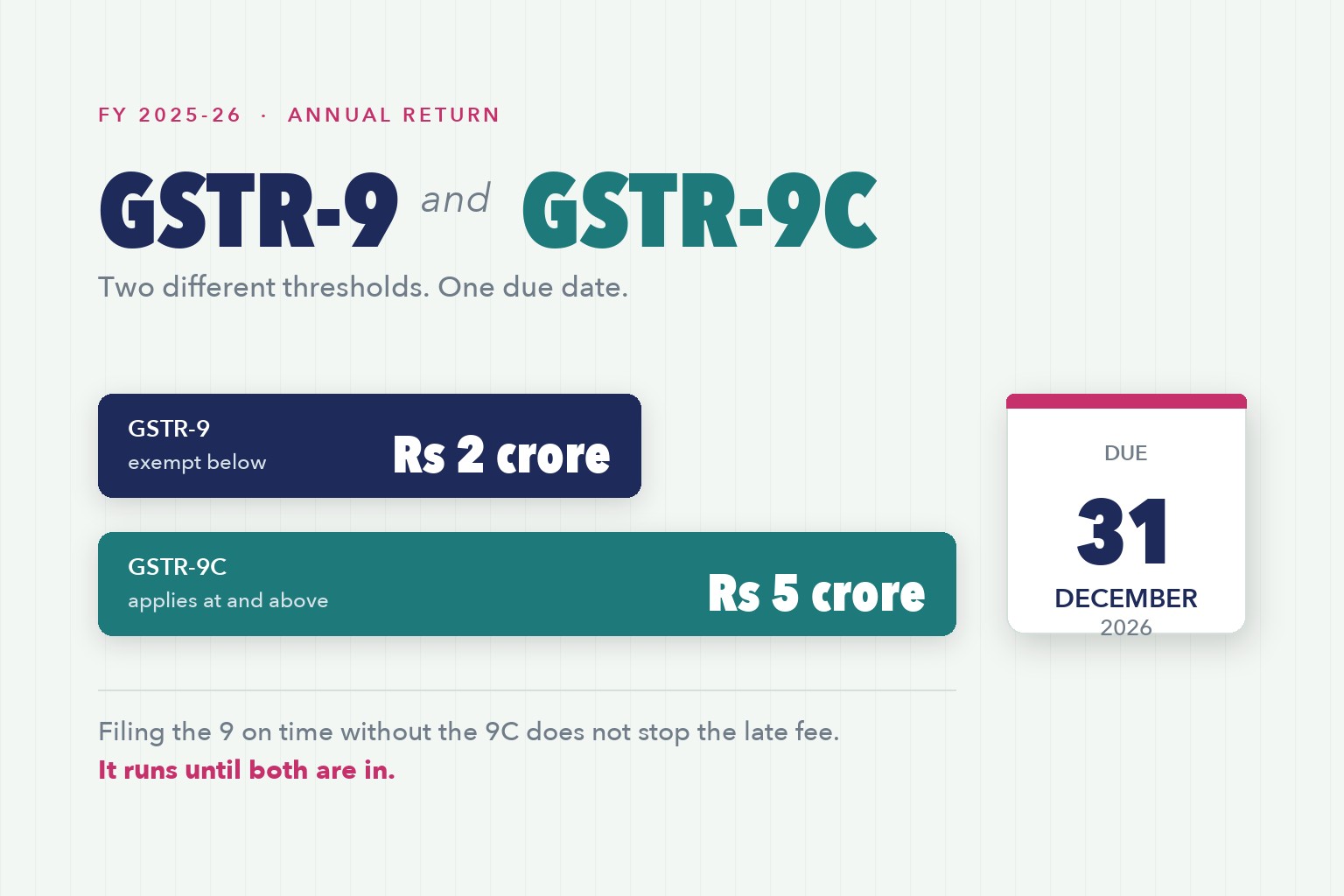

TL;DR: The GST annual return for FY 2025-26 is due on 31 December 2026. If your aggregate turnover for the year is up to ₹2 crore, you are exempt from filing GSTR-9 at all — and that exemption is now standing law, not a favour renewed each year. If your aggregate turnover exceeds ₹5 crore, you must also file a self-certified reconciliation statement in GSTR-9C. Those are two different tests on two different numbers, and people routinely apply one to the other. The sting is in the late fee: filing GSTR-9 on 31 December and the 9C in March does not save you anything, because the annual return is not treated as furnished until both are in.
1. Who has to file GSTR-9
Rule 80(1) of the CGST Rules requires every registered person to file an annual return in FORM GSTR-9 for every financial year, electronically, on or before the thirty-first day of December following the end of that year. The rule then carves out a short list who do not file GSTR-9:
- an Input Service Distributor;
- a person deducting tax at source under section 51;
- a person collecting tax at source under section 52;
- a casual taxable person;
- a non-resident taxable person; and
- those covered by the second proviso to section 44 — departments of the Central or a State Government, and local authorities, whose accounts are audited by the Comptroller and Auditor-General or by an auditor appointed under a local-authority law.
Two neighbouring categories have their own forms. An e-commerce operator collecting tax at source files the annual statement in GSTR-9B, not GSTR-9.
A person paying tax under the composition scheme (section 10) also does not file GSTR-9 — and here the rule book and the portal have drifted apart, so it is worth being precise. The proviso to Rule 80(1) still says a composition taxpayer furnishes the annual return in FORM GSTR-9A. In practice that form has not been in use since FY 2018-19. From FY 2019-20 the composition taxpayer's annual return is FORM GSTR-4, and from FY 2024-25 its due date is 30 June following the end of the financial year, extended from 30 April by Notification No. 12/2024-Central Tax dated 10 July 2024. So a composition dealer's annual return for FY 2025-26 fell due on 30 June 2026 — a date that has already passed — and not on 31 December 2026. If you are reading this as a composition taxpayer who has been waiting for December, you are already late.
One thing worth being clear about at the outset: the annual return is filed GSTIN by GSTIN. If you hold registrations in four States, you file four GSTR-9s. But the threshold that decides whether you have to file at all is computed on aggregate turnover, which is a PAN-level, all-India figure. That mismatch is the most common structural error in this whole area, and it is worth its own section.
2. Aggregate turnover is not the number on your State return
Aggregate turnover is defined in section 2(6) of the CGST Act as the aggregate value of all taxable supplies, exempt supplies, exports and inter-State supplies of persons having the same Permanent Account Number, computed on an all-India basis. It excludes central tax, State tax, Union territory tax, integrated tax and cess, and it excludes the value of inward supplies on which you pay tax under reverse charge.
So a business with ₹1.4 crore of turnover in Maharashtra and ₹0.9 crore in Gujarat has an aggregate turnover of ₹2.3 crore — over the ₹2 crore line — and must file GSTR-9 for both registrations, even though neither State's own figure crosses ₹2 crore. Reading the threshold off a single State's books is how businesses end up with a missed annual return they did not know was due, discovered a year later when the late fee has already run into six figures.
3. The two thresholds for FY 2025-26
| Aggregate turnover, FY 2025-26 | GSTR-9 | GSTR-9C |
|---|---|---|
| Up to ₹2 crore | Exempt — optional, may be filed voluntarily | Not applicable |
| More than ₹2 crore and up to ₹5 crore | Mandatory | Not applicable |
| More than ₹5 crore | Mandatory | Mandatory, self-certified |
The ₹2 crore exemption no longer expires
This is the part that has genuinely changed, and it is the reason the annual scramble to check whether the exemption notification has issued is over. The first proviso to section 44(1) lets the Commissioner, on the Council's recommendation, exempt any class of registered persons from the annual return by notification. For years that power was exercised one financial year at a time, so each autumn the trade waited to see whether small taxpayers were let off again.
Notification No. 15/2025-Central Tax dated 17 September 2025 exempts registered persons whose aggregate turnover in the financial year is up to ₹2 crore from filing the annual return for FY 2024-25 and onwards. The words "and onwards" do the work: the exemption runs forward on its own rather than lapsing at the end of the year it was issued for, so for FY 2025-26 you are not waiting on a fresh notification. Below ₹2 crore, GSTR-9 is optional.
One practical caution, given that this power had been exercised one year at a time for the seven years before it: if you are relying on the exemption to not file, check that no later notification has narrowed or withdrawn it before you make that call. A standing exemption can be replaced as easily as it was granted, and the cost of being wrong is a late fee running from 1 January 2027 on every registration.
Optional is not the same as pointless. If you know your GSTR-3B for the year understated a liability, the annual return is the orderly place to disclose and pay it, and doing so voluntarily reads very differently in a later proceeding from being found out. But it is your call, and once you file voluntarily you cannot revise it — GSTR-9 has no revision facility.
GSTR-9C is a separate test on the same number
Rule 80(3) requires a registered person whose aggregate turnover during the financial year exceeds five crore rupees to also furnish a self-certified reconciliation statement in FORM GSTR-9C, along with the annual return, by the same 31 December date.
Note the word self-certified. Until FY 2019-20 this statement had to be certified by a Chartered Accountant or Cost Accountant, backed by a statutory GST audit under the old section 35(5). That audit requirement was omitted with effect from 1 August 2021. Since FY 2020-21, GSTR-9C is certified by the taxpayer. Plenty of businesses still refer to it as "the GST audit" and still assume someone else signs it; the legal responsibility sits with the registered person.
4. Do the reconciliation before you file, not after
GSTR-9 is a consolidation of what you already reported: outward supplies from GSTR-1, tax paid through GSTR-3B, input tax credit availed and reversed, and the amendments you made during the year. GSTR-9C then reconciles the turnover and the tax paid, and the ITC claimed, against your audited annual financial statements.
What the annual return is not is a place to claim credit you forgot. Input tax credit is claimed only through a section 39 return — GSTR-3B. Nothing in GSTR-9 revives a credit whose time limit has run. That is why the sequence of dates for FY 2025-26 matters so much:
| Date | What closes |
|---|---|
| 30 November 2026 | Last date to take ITC on FY 2025-26 invoices, and to amend FY 2025-26 outward supplies — or the date you file the FY 2025-26 annual return, whichever is earlier |
| 31 December 2026 | Due date for GSTR-9, and for GSTR-9C where applicable |
Read that first row again. Filing GSTR-9 early shortens your own ITC window — the statute cuts it off at the earlier of 30 November and the date of the annual return. A business that gets organised in September 2026 and files its annual return then has voluntarily surrendered two months of correction time. Reconcile first, take every credit and amendment you are entitled to, and file the annual return after that.
What to reconcile, in the order that finds errors fastest
- Books turnover against GSTR-1, State by State, including credit notes, exports and supplies to SEZs.
- GSTR-1 against GSTR-3B — any gap here is a liability difference that will surface in the annual return whether or not you look for it.
- ITC in books against GSTR-2B, invoice by invoice for anything material. Credit that never reached your 2B is not yours to take.
- Reverse charge — inward supplies liable to RCM, tax paid in cash, and the corresponding credit. Under-reported RCM is the most common finding in annual-return scrutiny.
- ITC reversals under Rules 42 and 43 where you have exempt or non-business turnover, recomputed on the year's actual figures rather than the monthly provisional ones.
- The HSN summary, which is now a reporting requirement with real granularity and is a common source of last-week panic.
Where the reconciliation throws up tax actually payable, it is paid in cash through DRC-03. It cannot be discharged out of the credit ledger as part of the annual return exercise.
5. The late fee, computed the way the department computes it
Section 47(2) of the CGST Act provides that a registered person who fails to furnish the return required under section 44 by the due date pays a late fee of one hundred rupees for every day during which the failure continues, subject to a maximum of a quarter per cent of turnover in the State or Union territory.
That is the CGST Act. The State GST Act carries an identical provision. So the real-world figures are double what the section says: ₹200 per day, capped at 0.5% of State turnover.
Notification No. 07/2023-Central Tax dated 31 March 2023 then reduced this for FY 2022-23 onwards, on a turnover-slab basis. Stated in the combined CGST + SGST terms you will actually pay:
| Aggregate turnover for the year | Late fee per day | Maximum |
|---|---|---|
| Up to ₹5 crore | ₹50 (₹25 CGST + ₹25 SGST) | 0.04% of turnover in the State or UT |
| More than ₹5 crore and up to ₹20 crore | ₹100 (₹50 + ₹50) | 0.04% of turnover in the State or UT |
| More than ₹20 crore | ₹200 (₹100 + ₹100) | 0.5% of turnover in the State or UT — the unreduced section 47(2) position |
Two details people get wrong. First, the per-day figure is per registration: four late GSTINs means four late fees, not one. Second, the cap is a percentage of turnover in that State, while the slab you sit in is decided by aggregate turnover — so a large group with a small State registration can be in the ₹200-a-day slab with a cap that is reached very quickly, and a mid-sized single-State business can be in the ₹50 slab with a cap it will never reach.
6. The trap: filing GSTR-9 on time does not stop the clock
This is the most expensive misunderstanding in the annual-return cycle, and CBIC settled it in Circular No. 246/03/2025-GST dated 30 January 2025.
The reasoning is short. Reading section 44 with Rule 80, where a reconciliation statement is required, the annual return consists of GSTR-9 together with GSTR-9C. If only GSTR-9 is furnished and the 9C is required but not furnished, then the annual return under section 44 has not been furnished at all. The circular's conclusion:
Late fee under section 47(2) is leviable for the delay in furnishing the complete annual return — both GSTR-9 and GSTR-9C where the 9C is required — and is payable from the due date up to the date of furnishing the complete annual return.
Which resolves into a simple rule:
- If no 9C is required: the clock stops on the date you file GSTR-9.
- If a 9C is required and you file both together: the clock stops on that date.
- If a 9C is required and you file it after the GSTR-9: the clock runs to the date of the GSTR-9C.
The circular also makes clear that late fee is not levied separately on each form — it is one continuous computation from the due date to the completion date. So a company that files GSTR-9 on 31 December 2026 and its 9C on 15 March 2027 has not filed late by zero days; it has filed late by 74 days, on every registration where the 9C was due.
For completeness: the amnesty in Notification No. 08/2025-Central Tax waived the excess late fee attributable to a delayed 9C for financial years up to FY 2022-23, but only where the 9C was furnished on or before 31 March 2025, and no refund was allowed of late fee already paid. That window has closed. There is no equivalent relief on the horizon for FY 2025-26.
7. The three-year wall
Section 44(2) — inserted by the Finance Act 2023 — provides that a registered person shall not be allowed to furnish an annual return after the expiry of three years from the due date of furnishing it. A proviso lets the Government allow late filing by notification, subject to conditions, but that is a discretion, not a right, and GSTN has now built the bar into the portal.
For FY 2025-26 that means a hard stop:
| Financial year | Due date | Barred from |
|---|---|---|
| FY 2023-24 | 31 December 2024 | 1 January 2028 |
| FY 2024-25 | 31 December 2025 | 1 January 2029 |
| FY 2025-26 | 31 December 2026 | 1 January 2030 |
Once the bar operates, the return simply cannot be filed. The obligation does not disappear, and the department's own assessment powers remain — you lose the ability to put your own version on record, which is the worst of both outcomes.
8. A working timetable for FY 2025-26
| By when | What to do |
|---|---|
| September – October 2026 | Finish the books-to-GSTR-1-to-3B reconciliation and the 2B-to-books ITC match. Identify unclaimed credit and unamended invoices while there is still time to act on them. |
| By 30 November 2026 | Take any remaining FY 2025-26 ITC and make any remaining amendments in the October 2026 return. This is the last return in which it can be done. |
| December 2026 | Prepare GSTR-9; where turnover exceeds ₹5 crore, prepare GSTR-9C against the audited financials. Pay any differential through DRC-03. |
| On or before 31 December 2026 | File GSTR-9 and GSTR-9C together, for every registration. Filing the 9 alone does not stop the late fee. |
Sources
- CGST Act, 2017, section 44 — annual return; first proviso (power to exempt a class of registered persons); second proviso (CAG-audited government departments); sub-section (2), the three-year bar inserted by the Finance Act, 2023.
- CGST Act, 2017, section 47(2) — late fee of ₹100 per day, maximum a quarter per cent of turnover in the State or Union territory, per Act.
- Rule 80, CGST Rules, 2017 — sub-rule (1), GSTR-9 by 31 December following the end of the financial year, and the excluded categories; sub-rule (3), self-certified GSTR-9C where aggregate turnover exceeds ₹5 crore.
- Notification No. 15/2025-Central Tax dated 17 September 2025 — exemption from the annual return for aggregate turnover up to ₹2 crore, for FY 2024-25 onwards.
- Notification No. 07/2023-Central Tax dated 31 March 2023 — reduced late fee slabs for GSTR-9 from FY 2022-23.
- Circular No. 246/03/2025-GST dated 30 January 2025 — late fee where GSTR-9C is furnished after GSTR-9; the annual return is complete only when both are filed.
- Notification No. 08/2025-Central Tax dated 23 January 2025 — the closed waiver window for delayed GSTR-9C up to FY 2022-23.
- Notification No. 12/2024-Central Tax dated 10 July 2024 — due date for FORM GSTR-4 shifted to 30 June from FY 2024-25.
- Section 35(5), CGST Act — the statutory GST audit requirement, omitted with effect from 1 August 2021.
This article states the position under the CGST Act and Rules as in force on 31 August 2026. GST law changes frequently by amendment Act, notification and circular, and the State GST Acts mirror but are separate enactments; confirm the current text on the CBIC portal before acting. Due dates are extended from time to time. Nothing here is advice on your particular facts — for a specific position, especially one involving a large reconciliation difference or an unfiled return from an earlier year, consult a qualified GST practitioner.


Comments (0)
No comments yet. Be the first to comment!