
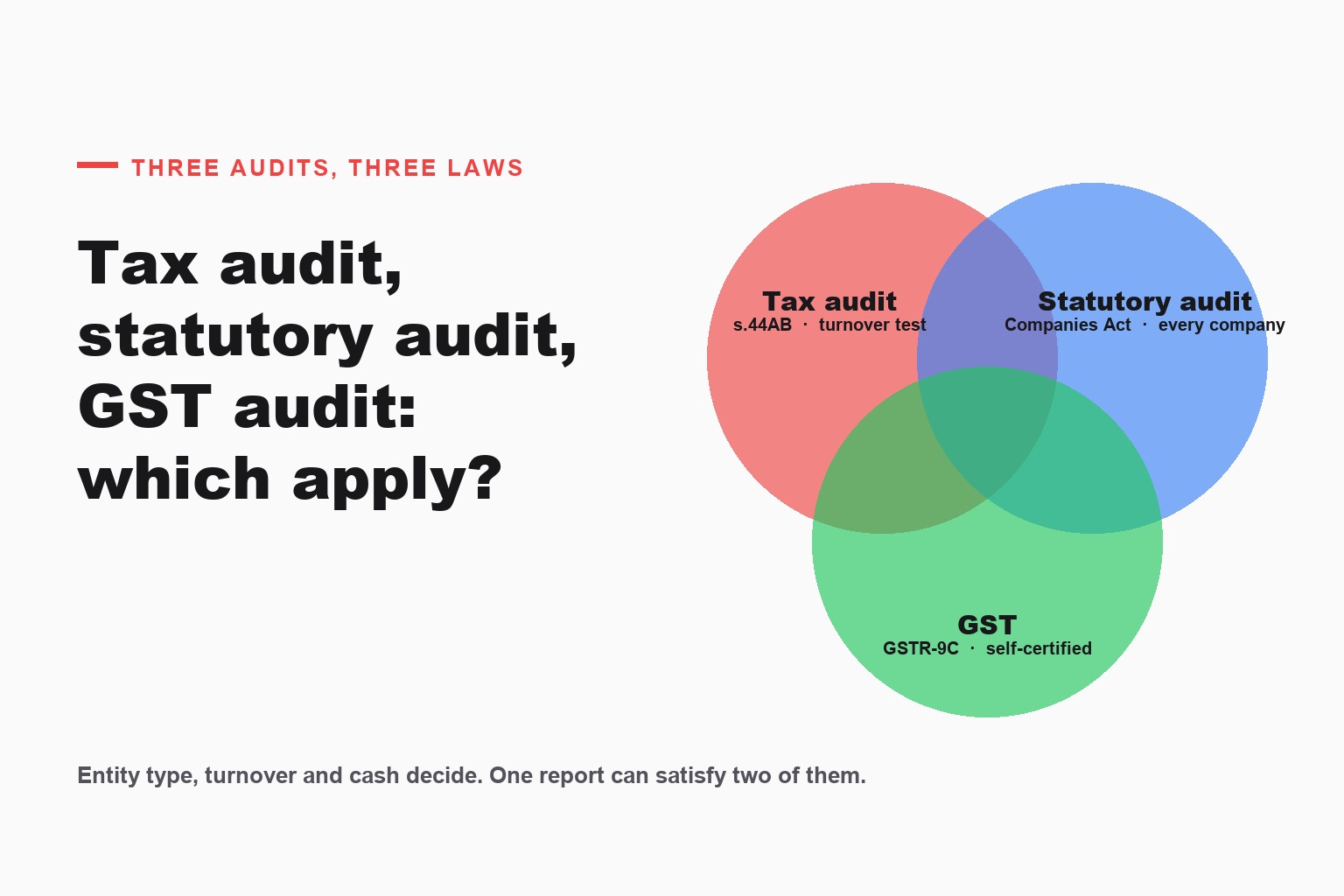

TL;DR: Three audits, three laws, three triggers. Tax audit is Section 44AB of the Income-tax Act, 1961: turnover above Rs 1 crore (Rs 10 crore where cash receipts and cash payments are each within 5 per cent), professional receipts above Rs 50 lakh, or a presumptive opt-out; report in Form 3CA or 3CB with Form 3CD by 30 September 2026 for AY 2026-27. Statutory audit is the audit of financial statements under the law that creates the entity: the Companies Act, 2013 requires it for every company, with no turnover threshold; the LLP Rules exempt an LLP whose turnover does not exceed Rs 40 lakh or whose contribution does not exceed Rs 25 lakh, a proviso whose “or” is read two ways (see section 3); a proprietorship or ordinary partnership has no statutory audit at all. GST audit in the sense of a CA-certified audit no longer exists: Section 35(5) of the CGST Act was omitted from 1 August 2021, and what remains is a self-certified reconciliation statement in GSTR-9C for aggregate turnover above Rs 5 crore, filed with GSTR-9 by 31 December, plus the department’s own audit under Section 65 and the special audit it can order under Section 66. A company with Rs 12 crore turnover has all three; a Rs 80 lakh proprietorship on the presumptive scheme may have none.
1. The three, side by side
| Tax audit | Statutory audit | GST | |
|---|---|---|---|
| Law | Income-tax Act, 1961, Section 44AB (Section 63 of the Income-tax Act, 2025 from tax year 2026-27) | Companies Act, 2013 (Sections 139 and 143); LLP Act, 2008 with LLP Rules, 2009 rule 24(8) | CGST Act, 2017, Sections 44, 65 and 66; CGST Rules rule 80 |
| Who must | Any person whose turnover, receipts or presumptive position crosses the Section 44AB tests, whatever the entity type | Every company; an LLP outside the rule 24(8) exemption; nobody else by this route | Self-certified GSTR-9C: a registered person with aggregate turnover above Rs 5 crore, other than the categories rule 80(3) leaves out (input service distributors, TDS and TCS persons under Sections 51 and 52, casual and non-resident taxable persons, and the government departments and local authorities covered by the proviso to Section 44). Departmental and special audits: any registered person the department selects |
| Threshold | Rs 1 crore business (Rs 10 crore with the 5 per cent cash tests); Rs 50 lakh profession; presumptive lower-profit cases (clauses (c) to (e)) | Companies: none. LLPs: exempt where turnover does not exceed Rs 40 lakh or contribution does not exceed Rs 25 lakh | GSTR-9C: Rs 5 crore aggregate turnover (PAN-level). GSTR-9 itself: above Rs 2 crore; Notification 15/2025-Central Tax exempts aggregate turnover up to Rs 2 crore from FY 2024-25 onwards |
| Who signs | A Chartered Accountant (“accountant” under Section 288) | A Chartered Accountant appointed as auditor of the company or LLP | The taxpayer, self-certifying GSTR-9C; a CA or Cost Accountant nominated by the Commissioner in a special audit |
| Form | Form 3CA (entity audited under another law) or 3CB (others), each with Form 3CD | Auditor’s report on the financial statements; for companies, filed with AOC-4 | GSTR-9C with GSTR-9; audit findings under Section 65(6); special audit report under Section 66(2) |
| Due date | Specified date, one month before the return due date: 30 September 2026 for AY 2026-27 (31 October 2026 where a Section 92E transfer-pricing report applies) | Companies: in time for the AGM, ordinarily within six months of year end (first AGMs and one-person companies run on their own timetable); LLP Form 8 by 30 October | 31 December following the financial year for GSTR-9 and 9C |
| If missed | Section 271B penalty, 0.5 per cent of turnover up to Rs 1,50,000, at the officer’s discretion, reasonable-cause defence under Section 273B | Company and officers in default under the Companies Act; late-filing fees on AOC-4 | Late fee on GSTR-9; GSTR-9C not filed is treated as the annual return being incomplete |
2. Tax audit: a test on numbers, not on entity type
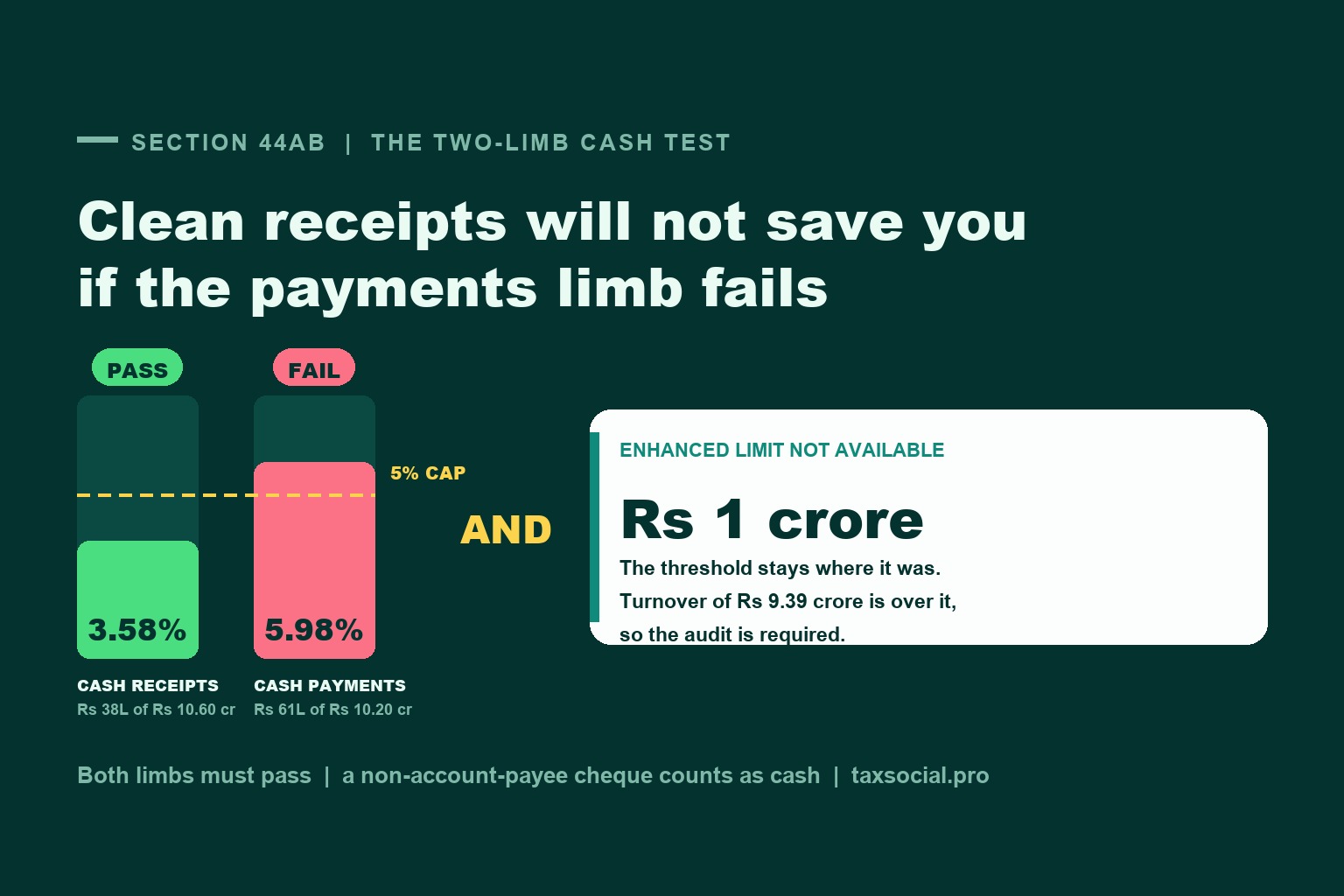
Section 44AB does not care whether you are a company, a firm or an individual. It asks whether business turnover exceeded Rs 1 crore in the year, with the limit read as Rs 10 crore where cash receipts and cash payments are each within 5 per cent of the total; whether professional gross receipts exceeded Rs 50 lakh; and the presumptive lower-profit cases: a goods-carriage declarant under Section 44AE claiming less than the deemed profit (clause (c), with no income condition), a Section 44ADA professional claiming less than 50 per cent with income above the exemption limit (clause (d)), and a Section 44AD(4) case with income above the exemption limit (clause (e)). A person declaring under Section 44AD(1) or Section 44ADA(1) is outside the section altogether under its proviso (as substituted from 1 April 2024); the Rs 2 crore (or Rs 3 crore) and Rs 50 lakh (or Rs 75 lakh) ceilings are the eligibility limits of those schemes. The tax audit limit hub works through each test, and Vijay’s under-8-per-cent trap piece covers the presumptive opt-out.
The output is a report by a Chartered Accountant in Form 3CB, with the statement of particulars in Form 3CD, furnished electronically by the specified date. It is an audit for the income-tax department’s purposes: the Form 3CD clauses (Section 43B, MSME dues, cash transactions, TDS defaults, the GST break-up in clause 44) feed the computation of taxable income. Vijay’s Form 3CD checklist and his Section 271B penalty explainer cover the file and the consequence.
3. Statutory audit: a test on entity type, not on numbers
“Statutory audit” is the audit that the entity’s own governing law requires of its financial statements, for the benefit of its members and the public record, whatever its size.
- Companies. Section 139(1) of the Companies Act, 2013 requires every company to appoint an individual or firm as auditor at its first annual general meeting, to hold office until the conclusion of the sixth AGM, with the appointment notified to the Registrar within fifteen days. The auditor reports to the members under Section 143 on whether the financial statements give a true and fair view. There is no turnover threshold: a one-person company with Rs 5 lakh of revenue is audited.
- LLPs. Rule 24(8) of the LLP Rules, 2009 requires the accounts of every LLP to be audited, with a proviso: an LLP “whose turnover does not exceed, in any financial year, forty lakh rupees, or whose contribution does not exceed twenty-five lakh rupees” is not required to, unless the partners decide to have one. Read literally, the exemption holds while either figure is within its limit, so audit is compulsory only when turnover exceeds Rs 40 lakh and contribution exceeds Rs 25 lakh; that is how the Ministry of Corporate Affairs has itself described the rule. Much of the profession reads it the other way and audits when either limit is crossed. An LLP with Rs 60 lakh turnover and Rs 10 lakh contribution is exempt on the literal reading and audited on the cautious one; take a view with your CA and record it.
- Proprietorships and partnership firms. No statute requires an audit of their accounts as such. Their only audit is the tax audit, if Section 44AB is triggered.
The statutory audit is the one that produces audited financial statements; the tax audit is the one that produces Form 3CD. For a company the two are done by the same or different auditors, and the Income-tax Act lets them overlap, which is section 6.
4. GST: the audit that was removed, and the three things that remain
Until 31 July 2021, Section 35(5) of the CGST Act required a registered person above a prescribed turnover to get accounts audited by a Chartered Accountant or Cost Accountant and to file a certified reconciliation statement; rule 80(3) set the limit at Rs 2 crore. The Finance Act, 2021 omitted Section 35(5) and substituted Section 44, and Notification 29/2021-Central Tax brought the change into force on 1 August 2021. Since then:
- Self-certified GSTR-9C. Rule 80(3), as amended, requires a registered person (other than the excluded categories in the table above) with aggregate turnover above Rs 5 crore in the financial year to furnish a self-certified reconciliation statement in GSTR-9C, reconciling the supplies declared in GSTR-9 with the annual financial statements, with GSTR-9 by 31 December. The taxpayer certifies it; no CA signs it, and it does not itself require any audit. Where the accounts are audited under another law, it reconciles to those audited statements. Sachin’s GSTR-9 and GSTR-9C for FY 2025-26 page covers the forms and the late fee.
- Departmental audit, Section 65. The Commissioner or an authorised officer may audit any registered person, at the place of business or in office, on not less than fifteen working days’ notice, to be completed within three months of commencement (extendable by up to six months for recorded reasons), with the findings communicated within thirty days. Anything found leads to proceedings under Section 73 or 74 for periods up to FY 2023-24, and under Section 74A for FY 2024-25 onwards. This is an audit of you, not by you.
- Special audit, Section 66. An officer not below Assistant Commissioner, in scrutiny or investigation, with the Commissioner’s prior approval, may direct you to have your records audited by a Chartered Accountant or Cost Accountant nominated by the Commissioner, with a report in ninety days (extendable by ninety), at the department’s expense. It applies even if your accounts have been audited under another law.
So when a client asks “do I need a GST audit”, the answer in 2026 is: no CA-certified GST audit exists; above Rs 5 crore you self-certify GSTR-9C; and the department may audit you under Section 65 whatever your size.
5. Which apply to you: by entity and turnover
The GST columns assume the figure shown is the PAN-level aggregate turnover and that the person is not in a rule 80(3) excluded category.
| Entity, FY 2025-26 | Tax audit | Statutory audit | GSTR-9C |
|---|---|---|---|
| Proprietor, turnover Rs 80 lakh, presumptive at 8 per cent | No | No | No (GSTR-9 not required below Rs 2 crore either) |
| Proprietor, turnover Rs 1.5 crore, regular books, mostly cash | Yes (above Rs 1 crore, cash tests failed) | No | No (below Rs 5 crore); GSTR-9 yes |
| Partnership firm, turnover Rs 6 crore, all digital | No (below Rs 10 crore with the cash tests met) | No | Yes, self-certified |
| LLP, turnover Rs 30 lakh, contribution Rs 10 lakh | No | No (below both rule 24(8) thresholds) | No |
| LLP, turnover Rs 60 lakh, contribution Rs 30 lakh | No | Yes (both limits exceeded) | No |
| LLP, turnover Rs 60 lakh, contribution Rs 10 lakh | No | Exempt on the literal reading of rule 24(8); audited in practice by many | No |
| Private limited company, turnover Rs 50 lakh | No | Yes (every company) | No |
| Private limited company, turnover Rs 3 crore, cash tests met | No (below Rs 10 crore) | Yes | No (below Rs 5 crore); GSTR-9 yes |
| Private limited company, turnover Rs 12 crore | Yes (Form 3CA + 3CD) | Yes | Yes, self-certified |
| Doctor, receipts Rs 60 lakh, declaring 50 per cent | No (Section 44ADA up to Rs 75 lakh on the cash test; 44AB(d) only on a lower claim) | No | Health services exempt; registration and returns depend on other supplies |
6. Where one audit serves two laws: Form 3CA
The third proviso to Section 44AB provides that where a person is required by any other law to get accounts audited, it is sufficient compliance to have the accounts audited under that law before the specified date, furnish that report, and furnish “a further report by an accountant in the form prescribed under this section”. That further report is Form 3CA, which attaches the statutory auditor’s report and adds Form 3CD; a person with no other-law audit uses Form 3CB, in which the tax auditor reports on the accounts themselves. For a company or an LLP above the thresholds, the statutory audit therefore does the financial-statement work, and the tax audit reduces to the Form 3CD particulars. The GST reconciliation in GSTR-9C then draws on the same audited statements. One set of audited accounts, used three times.
The sequencing this implies for a company in September: statutory audit signed first (it has to be, for Form 3CA to attach it), Form 3CA-3CD by 30 September, return by 31 October, GSTR-9 and 9C by 31 December. Harsh’s piece on the halved audit window explains why that chain is tight this year.
7. Quick answers
Do I need a GST audit by a CA? No, not since 1 August 2021. Above Rs 5 crore you file a self-certified GSTR-9C.
My company has Rs 20 lakh turnover. Any audit? Statutory audit, yes, every company. Tax audit and GSTR-9C, no.
My proprietorship has Rs 2 crore turnover, all digital. Tax audit no (Rs 10 crore test) if you are not a presumptive opt-out; statutory audit no; GSTR-9 yes, 9C no.
Is the tax audit due date the same as the statutory audit date? No. Tax audit is the specified date (30 September 2026, or 31 October in a Section 92E case); statutory audit is in time for the AGM; GSTR-9C is 31 December.
Can the same CA do all of it? The statutory auditor can also be the tax auditor; GSTR-9C is self-certified by you, prepared with whoever you like.
Does the department’s GST audit under Section 65 depend on my turnover? No. Any registered person can be selected.
Sources
- Income-tax Act, 1961 — Section 44AB (clauses (a) to (e), the provisos, Explanation (ii)), Section 271B, Section 273B; Income-tax Rules, 1962 — Forms 3CA, 3CB and 3CD.
- Companies Act, 2013 — Sections 139(1) and 143.
- Limited Liability Partnership Rules, 2009 — rule 24(8) and its provisos.
- Central Goods and Services Tax Act, 2017 — Section 35(5) (omitted w.e.f. 1 August 2021 by the Finance Act, 2021; Notification No. 29/2021-Central Tax dated 30 July 2021), Section 44 (as substituted), Sections 65, 66, 73 and 74; CGST Rules, 2017 — rule 80(3); CBIC Circular No. 246/03/2025-GST.
Written as at 10 September 2026. Thresholds are for FY 2025-26 (AY 2026-27) under the Income-tax Act, 1961; from tax year 2026-27 the tax-audit provision is Section 63 of the Income-tax Act, 2025 and the report is Form 26. Take advice from a Chartered Accountant on a specific entity.




Comments (0)
No comments yet. Be the first to comment!