

Every other tax audit question depends on one number, and it is computed before anybody opens Form 3CD. Section 44AB asks whether your total sales, turnover or gross receipts exceed ₹1 crore — ₹10 crore if you clear the cash test — or ₹50 lakh for a profession. Get that number wrong on the low side and you do not make a reporting error that can be corrected in a clause; you conclude that no audit was required, file without one, and sit on a Section 271B exposure. Five errors account for most of it: testing the 5% cash proviso against sales when the statute tests all receipts and all payments; carrying the Section 44AB test across to Section 44AD, which has no payments limb at all; reconciling against GST aggregate turnover, which is a different concept measured at PAN level; putting receipts into the figure that are not turnover, such as a fixed asset sale or the contract value of a derivative; and netting discounts and credit notes the wrong way round. None of this is new law. The thresholds and the two cash tests are statutory, and they reward reading closely. What actually counts as turnover is not defined in Section 44AB at all — which is exactly why it gets assumed rather than computed.
1. Why this number carries more risk than anything in the report
A tax audit engagement has two quite different kinds of error in it, and practitioners tend to spend their time on the wrong one.
The first kind is a reporting error — a clause filled in imperfectly, a disclosure that could have been fuller, a reconciliation that does not tie to the rupee. These are real, they can draw a query, and the exposure is proportionate to the item: the auditor's professional judgement is on the record and the particulars can be explained. Be careful, though, about assuming they can simply be refiled. Rule 6G(3) is a narrow door, not a general revision route. It allows a revised report only where, after the report has been furnished, the assessee makes a payment that requires the disallowance under Section 40 or Section 43B to be recalculated, and the revised report must be furnished before the end of the relevant assessment year. It is not a mechanism for correcting ordinary reporting errors.
The second kind is a threshold error, and it is different in character. If the turnover figure is understated and the conclusion is that Section 44AB does not apply, then no audit is conducted, no Form 3CD is filed, and there is nothing to correct — because nothing was filed. What opens up instead is Section 271B. The Assessing Officer may levy a penalty of half a per cent of the sales, turnover or gross receipts, capped at ₹1.5 lakh — and Section 273B protects an assessee who proves reasonable cause, so it is a penalty to be defended rather than one that follows automatically. But note what the base is: the penalty is computed on the correct turnover, which is to say on the very figure that was understated in the first place. The error that hid the liability is also the error that sizes the penalty.
So the number deserves more care than it usually gets. What follows are the five places it goes wrong, each traced back to the statutory words rather than to habit.
2. Mistake one: testing the 5% cash proviso against sales
This is the most common error of the five, and it comes from summarising the proviso instead of reading it.
The headline everyone remembers is right: the ₹1 crore threshold in Section 44AB(a) becomes ₹10 crore where cash is under 5%. What gets lost is 5% of what. The first proviso says:
"Provided that in the case of a person whose—
(a) aggregate of all amounts received including amount received for sales, turnover or gross receipts during the previous year, in cash, does not exceed five per cent of the said amount; and
(b) aggregate of all payments made including amount incurred for expenditure, in cash, during the previous year does not exceed five per cent of the said payment,
this clause shall have effect as if for the words 'one crore rupees', the words 'ten crore rupees' had been substituted"
Three things follow, and each of them is routinely missed.
- It is not a turnover test. It is a receipts test and a payments test. Limb (a) measures cash receipts against "all amounts received" — the word "including" tells you sales are one component of the base, not the whole of it. Capital introduced, a loan taken, a refund, a recovery of an advance: if it came in, it belongs in the denominator, and if it came in as cash it belongs in the numerator too.
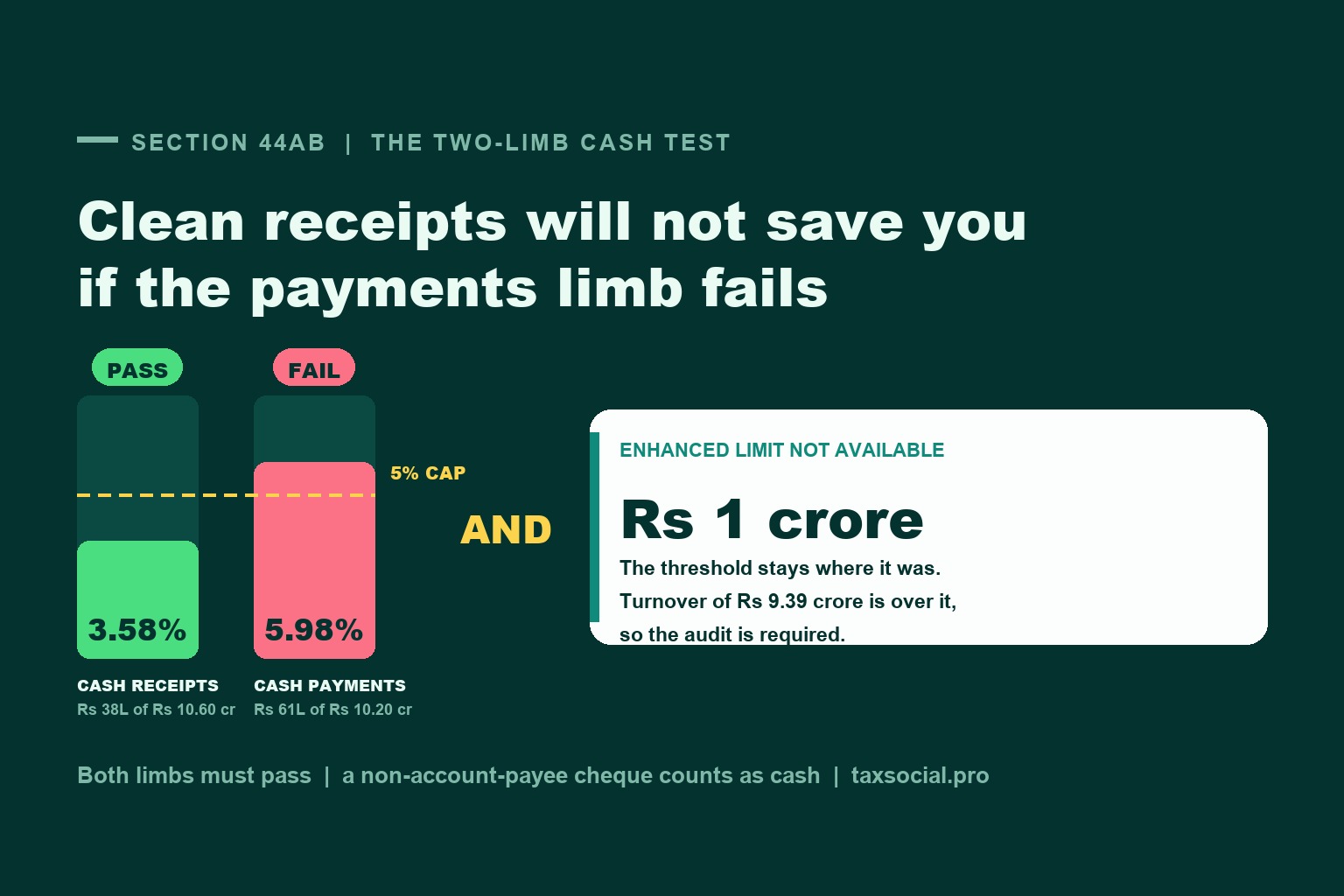
- Both limbs must pass. The word joining them is "and". A business that banks every rupee it receives but pays a meaningful share of its expenses in cash fails limb (b) and stays on the ₹1 crore threshold, however clean its receipts look.
- The payments limb has its own denominator. Limb (b) tests cash payments against "the said payment" — total payments — not against turnover and not against the receipts figure from limb (a). They are two separate fractions.
Then there is the deeming provision, which sits in the second proviso and catches people who thought they had no cash at all:
"Provided further that for the purposes of this clause, the payment or receipt, as the case may be, by a cheque drawn on a bank or by a bank draft, which is not account payee, shall be deemed to be the payment or receipt, as the case may be, in cash."
A bearer cheque is cash for this test. So is a crossed cheque that is not marked account payee. It reads as a banking transaction in the cash book and in the bank statement, and it counts as cash in the proviso. Note also that the deeming runs both ways — "the payment or receipt, as the case may be" — so it can sink either limb.
What to do about it. Compute both fractions explicitly and put them in the file, with the denominators stated. Two lines of working, retained, is the difference between a defensible position and a recollection.
3. Mistake two: carrying the Section 44AB test across to Section 44AD
Both sections have an enhanced limit. Both enhanced limits turn on 5% cash. They are not the same test, and the difference decides real cases.
Section 44AD's definition of an eligible business caps turnover at ₹2 crore, and the proviso lifts it:
"Provided that where the amount or aggregate of the amounts received during the previous year, in cash, does not exceed five per cent of the total turnover or gross receipts of such previous year, this sub-clause shall have effect as if for the words 'two crore rupees', the words 'three crore rupees' had been substituted"
Read it against the Section 44AB proviso quoted above and the difference is plain. Section 44AD's enhanced limit has a receipts limb and nothing else. There is no payments test in it. Section 44AB's has both.
The practical consequence is a business that lands on opposite sides of the two tests. Take a trader with ₹2.6 crore of turnover, 3% of receipts in cash, and 18% of payments in cash — a wholesaler paying transporters and casual labour in cash is the standard fact pattern. That business:
- fails the Section 44AB enhanced limit, because limb (b) is breached, so its audit threshold stays at ₹1 crore; and
- qualifies as an eligible business under Section 44AD, because 3% receipts is inside the only limb that section applies, so the ₹3 crore ceiling is available to it.
That is not a contradiction, and it does not cancel out. If the business declares under Section 44AD(1), the first proviso to Section 44AB takes it outside the section entirely — and note that since the Finance Act, 2023 substituted that proviso, the exclusion is expressed by reference to Section 44AD(1) and Section 44ADA(1) without the old ₹2 crore qualifier attached to it. If it does not declare under 44AD(1), it is back on the ₹1 crore threshold and it needs an audit.
Section 44ADA follows Section 44AD's pattern rather than Section 44AB's: ₹50 lakh of gross receipts, lifted to ₹75 lakh on a receipts-only 5% test. The same non-account-payee deeming proviso appears in all three sections, so a professional who took a bearer cheque has the same problem as the trader.
For how the presumptive scheme and its five-year lock-in interact with all this, and the separate route by which Section 44AD(4) can force an audit well below ₹1 crore, see our pieces on the Section 44AD(4) trap and the tax audit thresholds.
4. Mistake three: reconciling to the GST number
The instinct is a good one — the GST returns are filed, the figures are already reconciled, so use them. The trouble is that "turnover" in GST and "turnover" in Section 44AB are different measurements, and reconciling to the wrong one produces a confident answer to the wrong question.
GST aggregate turnover is measured at PAN level across India. It sweeps in exempt supplies, nil-rated and non-GST supplies, exports, and the turnover of every registration held on the same PAN, and it is computed on an all-India basis. The Section 44AB threshold is applied to the person's business. A proprietor with two registrations in two states has one aggregate turnover for GST and a quite different starting point for Section 44AB. Neither number is wrong; they are answers to different questions.
Then there is the tax itself. Section 145A is the provision usually cited here, and it is worth reading its opening words:
"For the purpose of determining the income chargeable under the head 'Profits and gains of business or profession',— ... (ii) the valuation of purchase and sale of goods or services and of inventory shall be adjusted to include the amount of any tax, duty, cess or fee (by whatever name called) actually paid or incurred by the assessee to bring the goods or services to the place of its location and condition as on the date of valuation"
Section 145A is addressed to the computation of income. It prescribes an inclusive method for valuing purchases, sales and inventory so that the computation is neutral. It is not written as a definition of turnover for the Section 44AB threshold, and it should not be pressed into service as one.
What actually drives the answer is the accounting presentation the entity follows, and the rule of thumb runs on where the tax sits rather than on a general principle about agency. GST that is included in the sale price is ordinarily part of turnover. GST that is separately credited to a GST-liability account and paid out of that account is ordinarily excluded. There is no across-the-board exclusion of indirect tax from turnover, and the common shorthand that "GST is collected as agent, so it is never turnover" is not a safe statement of the position. What matters is that the treatment follows the books, is applied consistently, and is documented as a position taken rather than a default assumed.
A related caution about authority. The thresholds and the two cash tests are statutory and you can point at the section. "Turnover" is not defined in Section 44AB, so what belongs in the figure falls back on commercial meaning, the regular method of accounting, and the ICAI's Guidance Note on Tax Audit under Section 44AB — influential professional guidance that a tax auditor is expected to work to, and which the courts read alongside the facts, but not itself the statute. Check the edition current for the year you are auditing: its treatment of particular items has been revised across editions.
What to do about it. Prepare a written bridge from the audited financial statements to the Section 44AB figure, and a second bridge from the financial statements to the GST returns. Keep them separate. The first decides whether you have an audit; the second answers a GST query. The second bridge is prudence rather than a Form 3CD requirement — clause 44 asks for a break-up of total expenditure between registered and unregistered suppliers, not for a reconciliation of turnover to the GST returns. On what clause 44 does ask for, see our note on clause 44 and the GST break-up of expenditure.
5. Mistake four: putting things in that are not turnover
Section 44AB(a) speaks of "total sales, turnover or gross receipts ... in business". The qualifier does work. A receipt can be perfectly genuine, sit in the bank, appear in the financial statements, and still not belong in the figure.
- Sale of a fixed asset. Disposing of a delivery van or an office is not a sale in the course of the business of selling vans or offices. It is dealt with through the block of assets or under capital gains. It is not turnover, and including it can push a business over a threshold it never crossed.
- Income that is not trading income. Interest on deposits, dividends, rent from a let-out property, a profit on sale of investments — these are receipts, and several of them are taxable, but they are not "sales, turnover or gross receipts in business". Where an item is genuinely incidental to the business the position can differ, so the test is what the business does, not which ledger the credit landed in.
- Capital receipts. A loan drawn, fresh capital introduced, a security deposit received. These belong in the Section 44AB proviso computation, because that one tests all amounts received — but they are not turnover for the threshold itself. This is a useful pair to keep straight: the same rupee can be inside the proviso's denominator and outside the threshold figure.
- The contract value of derivatives. The notional value of a futures contract is not the turnover measure. Keep the two sources straight: proviso (d) to Section 43(5) does one job only — it takes eligible exchange-traded derivative transactions out of the definition of a speculative transaction — and it says nothing about how to compute their turnover. That comes from the ICAI Guidance Note, which for ordinary squared-off positions builds turnover from the favourable and unfavourable differences, with its own rules for option premium and reverse trades, and separate treatment where a contract goes to delivery. The full working, including how intraday equity is treated differently, is in our F&O and intraday taxation article.
- Someone else's sales. An agent, a commission agent or a broker who never takes title is turning over the principal's goods, not their own. What belongs in the figure is the commission or brokerage earned. Getting this wrong on a consignment arrangement can inflate turnover by an order of magnitude.
6. Mistake five: netting the wrong way round
The last one is the quietest, because every item involved is small and the errors run in both directions.
- Trade discount is a reduction of the sale price. It is deducted in arriving at turnover — and it usually never appears separately, because the invoice is raised net.
- Cash discount is different in character, and the dividing line is the invoice. A cash discount allowed after invoicing, for early settlement, is in substance a financing cost and does not reduce turnover. A discount built into the sales invoice itself is part of how the sale price was set, and reduces it. The label on the ledger decides nothing; where it was granted decides a good deal.
- Sales returns reduce turnover. The question that gets fumbled is timing — a return received after the year end, against a sale made inside it, follows the ordinary accounting treatment rather than being pulled back by convenience.
- Credit notes have to be split by substance, not by what the note is called. A credit note reduces turnover to the extent it is in substance a sales return, a price revision, or a trade or turnover discount. One issued for something else — a post-sale discount that does not reduce the transaction value, a commission being settled, a financing adjustment, the settlement of a dispute — does not.
- Scrap and by-product sales arising from the business ordinarily form part of business receipts. They are easy to leave out because they are booked to a miscellaneous income line.
Individually none of these moves the needle. Together, on a business sitting close to a threshold, they decide the question — and "close to the threshold" is exactly where the figure gets challenged.
7. The boundary itself: "exceeds"
One point of drafting that is worth a sentence, because it comes up every year. Section 44AB(a) applies where turnover "exceed or exceeds one crore rupees". Section 44AB(b) applies where gross receipts "exceed fifty lakh rupees". Exactly ₹1 crore is not exceeding ₹1 crore. A business landing precisely on the figure is outside clause (a).
Contrast the drafting in Section 44AD, where an eligible business is one whose turnover "does not exceed an amount of two crore rupees" — so ₹2 crore exactly is still inside the scheme. The two sections are consistent with each other on this, but neither of them rounds, and neither of them is approximate.
Note also that clauses (a) and (b) are separate clauses with separate thresholds, addressed respectively to a person carrying on business and a person carrying on a profession. Where a person does both, each clause is read against what it is addressed to. Do not assume the two figures are simply added together, and do not assume they are watertight either — set the facts out and take a documented position.
8. A worked example
A resident individual runs a trading business. The financial statements for the year show:
- Sales, net of GST: ₹9.30 crore
- Sale of a delivery van: ₹18 lakh
- Interest on fixed deposits: ₹11 lakh
- Scrap sales, booked to miscellaneous income: ₹9 lakh
- Unsecured loan received during the year: ₹40 lakh
- Total amounts received during the year: ₹10.60 crore, of which ₹38 lakh in cash
- Total payments made during the year: ₹10.20 crore, of which ₹61 lakh in cash
Step one — the turnover figure. Sales of ₹9.30 crore, plus scrap of ₹9 lakh as a business receipt, gives ₹9.39 crore. The van is a capital disposal; the interest is not a business receipt; the loan is capital. None of the three is turnover.
Step two — the proviso. Receipts limb: ₹38 lakh on ₹10.60 crore is 3.58%, inside 5%. Payments limb: ₹61 lakh on ₹10.20 crore is 5.98%, outside 5%. Because the limbs are joined by "and", the enhanced limit is not available.
Step three — the conclusion. The threshold stays at ₹1 crore. Turnover of ₹9.39 crore exceeds it, so a tax audit is required.
Now change one fact. Suppose ₹14 lakh of those cash payments had gone out by account payee cheque instead. Cash payments become ₹47 lakh on ₹10.20 crore, or 4.61%. Both limbs pass, the threshold becomes ₹10 crore, and turnover of ₹9.39 crore falls under it — no audit. A single decision about how a handful of payments were made, taken months earlier by someone not thinking about Section 44AB at all, is what separates the two outcomes.
9. What belongs in the file
None of this is complicated, but it is only defensible if it is written down while the facts are in front of you.
- A one-page bridge from the audited financial statements to the Section 44AB turnover figure, with every add and every exclusion named — fixed asset disposals, non-business income, capital receipts, agency arrangements, derivative positions.
- Both proviso fractions, with numerators and denominators stated separately: cash receipts over total receipts, and cash payments over total payments.
- A note on non-account-payee instruments, confirming that the cash figures include any cheque or draft not marked account payee.
- The basis on which GST has been treated, and a separate bridge to the GST returns that does not pretend to be the same document.
- Where the business is near a threshold, the working for the alternative treatment of any contested item, so that the position taken is visibly a choice and not an oversight.
The auditor who can produce those five things has answered the question. The one who computed the figure from the sales ledger and moved on has only assumed it.
Sources
- Income-tax Act, 1961, Section 44AB — clauses (a) to (e), the first proviso (the two-limb 5% cash test and the substitution of "ten crore rupees"), the second proviso (non-account-payee cheque or draft deemed to be cash), the first proviso to the section as substituted by the Finance Act, 2023, and the Explanation defining "specified date".
- Income-tax Act, 1961, Section 44AD — sub-sections (1) to (5) and the Explanation, in particular clause (b)(ii) defining an eligible business and its proviso, which applies the 5% test to amounts received only.
- Income-tax Act, 1961, Section 44ADA — sub-section (1) and its provisos (fifty lakh rupees, seventy-five lakh rupees on the receipts test).
- Income-tax Act, 1961, Section 145A — clauses (i) to (iv), read with its opening words limiting it to the determination of income chargeable under the head "Profits and gains of business or profession".
- Income-tax Act, 1961, Section 43(5) and the first proviso, clause (d) — eligible transactions in exchange-traded derivatives are not speculative transactions.
- Income-tax Act, 1961, Section 271B — penalty for failure to get accounts audited.
- Institute of Chartered Accountants of India, Guidance Note on Tax Audit under Section 44AB of the Income-tax Act, 1961 — the professional standard on the meaning of turnover and gross receipts. Refer to the edition current for the year under audit.



Comments (0)
No comments yet. Be the first to comment!