
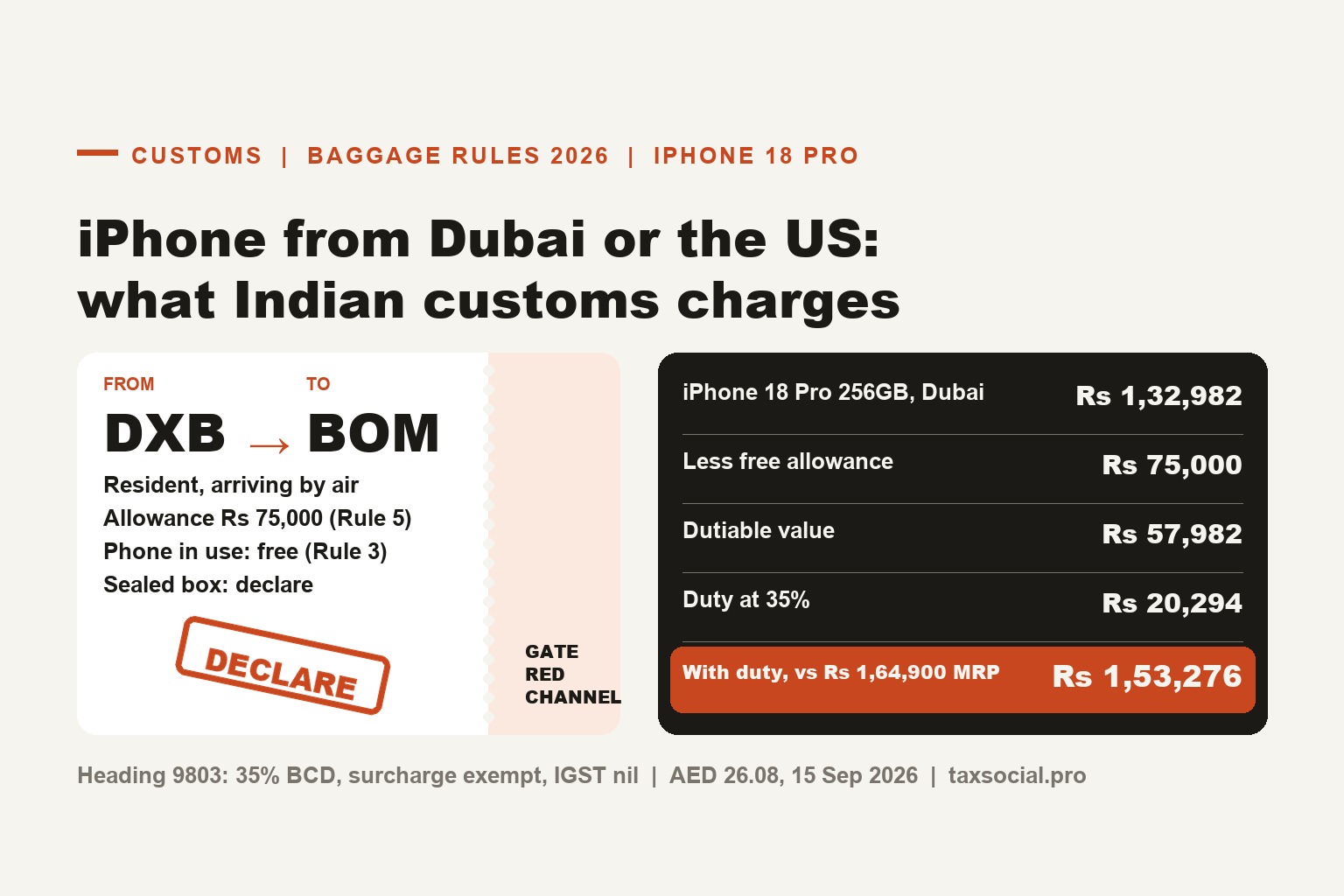

The maths first. An Indian resident flying in gets Rs 75,000 of articles free of duty under Rule 5 of the Baggage Rules, 2026. A new iPhone bought abroad is an article. On the value above Rs 75,000, customs charges 35 per cent basic duty; the social welfare surcharge is exempt for baggage since February 2025, and there is no IGST. An iPhone 18 Pro (256GB) bought in Dubai at AED 5,099 is about Rs 1,32,982 at this week’s rate; the duty on the Rs 57,982 above the allowance is about Rs 20,294; purchase plus duty is about Rs 1,53,276 against an Indian price of Rs 1,64,900. Bought in the US at $1,199 it comes to about Rs 1,28,695 with duty. The iPhone 17, now Rs 99,900 in India, costs about the same in Dubai before duty and more after it. The widely repeated line that duty fell to a flat 10 per cent from 1 April 2026 is true of goods sent by post or courier under heading 9804, and not of what you carry through the airport under heading 9803. Declare a sealed phone at the Red Channel; the phone you have been using on the trip is a personal effect.
1. Three rules decide what you pay
The Baggage Rules, 2026, notified on 1 February 2026 and in force from 2 February, replaced the 2016 rules. Three of them matter to a phone.
Rule 3, used personal effects. A passenger, including an infant, is allowed used personal effects required for satisfying the daily necessities of life, and travel souvenirs, free of duty, apart from the Annexure I articles. Rule 2 defines personal effects as articles, new or used, a passenger may reasonably require for personal use during the journey, excluding anything imported for commercial purposes. The phone in your pocket, with your SIM in it and your photographs on it, is the paradigm case.
Rule 5, the general free allowance. A resident, a tourist of Indian origin, or a foreigner on a visa other than a tourist visa (a defined class, staying in India for more than six months), arriving by any mode other than land, may clear articles up to a value of Rs 75,000, carried on the person or in accompanied baggage, free of duty. A tourist of foreign origin gets Rs 25,000. An infant gets only used personal effects. Separately, a passenger of eighteen or above, other than a crew member, may bring one new laptop computer (notebook computer) free of duty, and the laptop does not eat into the Rs 75,000. The allowance is per passenger and cannot be pooled: two adults cannot combine their Rs 75,000s to clear one Rs 1,50,000 phone, which is the department’s own answer at question 43 of its baggage FAQ.
Annexure I lists what the allowance never covers: firearms and more than fifty cartridges, cigarettes above 100, cigars above 25, tobacco above 125 grams, more than two litres of alcohol, gold and silver in any form other than ornaments, and a flat-panel LCD, LED or plasma television. A phone is not on it.
What the allowance covers is every dutiable article you carry, added together. A phone at Rs 1,32,982, a watch at Rs 40,000 and perfume at Rs 15,000 is Rs 1,87,982 of articles against one Rs 75,000 allowance.
2. The rate, and the 10 per cent story
Dutiable articles cleared as bona fide passenger baggage are classified under heading 9803 of the Customs Tariff, whatever they would be classified as if imported commercially; commercial quantities are not baggage and are assessed separately. Notification 26/2016-Customs of 31 March 2016 fixes the effective rate: baggage is exempt from so much of the duty as exceeds 35 per cent ad valorem, charged on the value that exceeds the passenger’s free allowance (and on the full value of unaccompanied baggage). The Budget of 1 February 2026 amended that notification, by Notification 4/2026-Customs, for one purpose only: to replace the words “Baggage Rules, 2016” with “Baggage Rules, 2026”. The rate did not move.
Until February 2025 the social welfare surcharge, 10 per cent of the duty, sat on top of that, which is where the 38.5 per cent figure still quoted on many travel sites comes from. Notification 7/2025-Customs of 1 February 2025 inserted “all goods falling under heading 9803” into the surcharge exemption list (serial 8G of Notification 11/2018-Customs), so baggage has paid no surcharge since Budget 2025. There is no IGST either: goods imported by a passenger or crew member as baggage are exempt under the integrated-tax exemption notification, other than motor vehicles, alcohol and tobacco. So the number to hold in your head is 35 per cent of everything above Rs 75,000, and a site that says 38.5 is a year out of date.
The 10 per cent figure that has been travelling on social media and in some travel columns comes from the same Budget, and it is real, but it is about a different heading. The Joint Secretary (Tax Research Unit)’s letter explaining the Budget changes says the tariff rate “is being reduced from 20% to 10% on all dutiable goods, imported for personal use under heading 9804”, from 1 April 2026, with the surcharge now levied on those goods as well. Heading 9804 is goods imported for personal use by post or courier, the parcel you order from abroad. Heading 9803, the suitcase, is not mentioned in the letter, the Explanatory Memorandum or any of the Budget notifications. A column that tells you the airport rate is now 10 or 11 per cent has read the wrong heading.
3. What an iPhone actually lands at
Apple’s own prices as at 16 September 2026, converted at Rs 26.08 to the dirham (mid-market, 15 September) and the RBI reference rate of Rs 95.7245 to the dollar (11 September). The conversions are illustrations: customs assesses on the declared transaction value at the exchange rate notified by CBIC for the date of the declaration, and can ask for evidence of the price. Each example assumes the phone is the passenger’s only dutiable article and is declared.
| Phone | Bought at | In rupees | Above Rs 75,000 | Duty at 35% | Purchase plus duty | Indian MRP | Difference |
|---|---|---|---|---|---|---|---|
| iPhone 18 Pro 256GB | Dubai, AED 5,099 | 1,32,982 | 57,982 | 20,294 | 1,53,276 | 1,64,900 | 11,624 less |
| iPhone 18 Pro Max 256GB | Dubai, AED 5,499 | 1,43,414 | 68,414 | 23,945 | 1,67,359 | 1,79,900 | 12,541 less |
| iPhone 18 Pro 256GB | US, $1,199 before state sales tax | 1,14,774 | 39,774 | 13,921 | 1,28,695 | 1,64,900 | 36,205 less |
| iPhone 17 256GB | Dubai, AED 3,799 | 99,078 | 24,078 | 8,427 | 1,07,505 | 99,900 | 7,605 more |
Read the last row twice. Since the iPhone 18 Pro launch on 9 September, Apple’s UAE store lists the iPhone 17 (256GB) at AED 3,799, about Rs 99,078, and Apple India lists it at Rs 99,900. Before duty the two are within a thousand rupees of each other; after duty on the sealed box, Dubai is dearer. The Dubai bargain on last year’s phone no longer exists. On the 18 Pro the saving from Dubai is about Rs 11,600 once duty is paid honestly, and that is before the card’s foreign-exchange mark-up, which at a typical 3.5 per cent on Rs 1,32,982 is about Rs 4,654 plus GST of Rs 838 on the mark-up, about Rs 5,492 in all, and before the warranty question in section 6. The US saving is real, and it exists because the US price is lower to begin with, not because of the duty; add the sales tax of the place you take delivery, from nil in Oregon and Delaware to 8.875 per cent in New York City, before you compare.
4. The phone in your pocket and the phone in the box
A phone customs accepts as a used personal effect required for the daily necessities of life clears under Rule 3, outside the Rs 75,000. There is no statutory one-phone rule: the SIM in it, the photographs on it and the absence of a box are evidence of use, not a legal test, and the decision is the officer’s on the facts. A phone in a sealed retail box is not a personal effect; it is an article, and it goes against the allowance. More than one sealed box is where the trouble begins. The Master Circular of 1 February 2026 says goods in commercial quantity are not bona fide baggage at all, though a marginal excess of otherwise genuine baggage may be cleared on payment of duty. It sets no number; whether additional sealed phones are a marginal excess or a commercial quantity is decided on the facts, and the safe course is to declare every phone that is not the one you are using.
The case Gulf News reported in January 2026 shows how it goes. A passenger landed in Mumbai from Dubai with the phone he was using and a sealed iPhone 17 Pro Max for a relative, walked into the Green Channel, and was stopped. The officer’s words, as reported: you are carrying more than one mobile device and this one is sealed, this is treated as a commercial import, you must declare it at the Red Channel and pay duty on its value above the allowance. He paid about Rs 22,000, at the rate then in force. It is one reported incident, not a ruling, and it was under the 2016 rules and the old Rs 50,000 allowance; the lesson that survives is that a second, sealed phone is an article to declare, and that a second phone with no SIM and no data on it does not become a personal effect by being taken out of its box.
5. How to declare, and what it costs not to
The Customs Baggage (Declaration and Processing) Regulations, 2026 replaced the 2013 declaration regulations. A passenger with dutiable goods files the declaration in Form CBD-I, either on arrival or up to three days before, through the Atithi application or the ICEGATE portal, and walks to the Red Channel. Customs normally starts from the declared transaction value, so carry the invoice; it can ask for evidence and redetermine the value if the invoice does not look right. Duty is paid at the counter, by card. You get a receipt; keep it with the phone’s papers, because it is the evidence that the phone was declared and assessed.
The Green Channel is for passengers who have nothing to declare. Walking through it with a sealed phone above the allowance is a non-declaration, and the Master Circular says non-declaration or mis-declaration attracts action under the Customs Act, 1962: goods not declared are liable to confiscation under Section 111(l), goods declared with false particulars under Section 111(m), with a penalty under Section 112, and, where confiscated goods are released, a redemption fine under Section 125, all on top of the duty. A passenger who does not want to pay may ask for the article to be detained against a detention receipt and take it out of the country on departure.
6. What the price tag does not tell you
GST. The Indian MRP includes 18 per cent GST. A GST-registered business that buys the phone in India from a registered dealer, with a tax invoice, for use in its business can take that as input tax credit under Section 16 of the CGST Act, subject to the usual conditions and to the extent of business use, which turns a Rs 1,64,900 phone into Rs 1,39,746 net of credit; a phone carried in from Dubai carries no IGST at all, and the 35 per cent basic duty is not creditable. For a business buyer the Dubai saving on the 18 Pro is gone before it starts.
Warranty and returns. Check Apple’s warranty terms for the country of purchase before you rely on Indian service; the terms differ by product and region, and a phone bought abroad is serviced on the terms of that purchase. Apple India’s return window does not apply to a phone bought in Dubai.
The card. A foreign-currency purchase on an Indian card carries a mark-up, commonly around 3.5 per cent plus 18 per cent GST on the mark-up; rates vary by issuer. International credit card spending while you are overseas is, as at publication, outside the LRS tax collection at source, so the mark-up is the whole of the cost; confirm the position and your issuer’s fee before you travel.
The other passengers. If a family member is also flying, their Rs 75,000 is theirs, for their articles; it cannot be lent to your phone. A child’s allowance covers a child’s articles.
7. The short version for the departure lounge
- The phone you are using: a used personal effect, on the facts; nothing to declare.
- One sealed phone: an article; Rs 75,000 free, 35 per cent on the rest; declare at the Red Channel or in Atithi before you land.
- More than one sealed phone: expect a commercial-quantity question; declare them all and carry invoices.
- The 10 per cent rate is for parcels, not passengers.
- Do the sum with today’s exchange rate and the Indian MRP before you buy; on the iPhone 17 it no longer works, on the 18 Pro from Dubai it is about Rs 11,600 before card costs, from the US it is real.
FAQ
How much customs duty is there on an iPhone from Dubai? 35 per cent of the value above your Rs 75,000 allowance. The surcharge has been exempt for baggage since February 2025 and there is no IGST. On an iPhone 18 Pro at AED 5,099 that is about Rs 20,300.
Did the duty fall to 10 per cent in April 2026? For goods imported for personal use by post or courier (heading 9804), yes. For baggage carried through the airport (heading 9803), no; it is still 35 per cent.
Is an iPhone within the Rs 75,000 allowance duty-free? Yes, if the total of your dutiable articles is within Rs 75,000. Only the excess is dutied.
Can I carry a sealed iPhone from Dubai to India? Yes, declared, with duty on the value above the allowance. An undeclared sealed phone is a mis-declaration.
Can I carry two iPhones? The one you are using is normally a personal effect. A second sealed phone is an article; additional sealed phones invite a commercial-quantity question. Declare and carry invoices.
Can two of us combine our allowances for one phone? No. The allowance cannot be pooled.
Is the laptop allowance separate? Yes, one new laptop for a passenger of eighteen or above, in addition to the Rs 75,000.
Is it cheaper to buy the iPhone 17 in Dubai now? No. Apple UAE lists the 256GB iPhone 17 at AED 3,799, about Rs 99,078, against Rs 99,900 in India; the duty on the sealed box makes Dubai dearer.
What if I walk through the Green Channel and get caught? Duty, plus liability to confiscation under Section 111(l), a penalty under Section 112 and, on release, a redemption fine under Section 125 of the Customs Act, 1962.
Sources
- Baggage Rules, 2026, Notification No. 14/2026-Customs (N.T.) dated 1 February 2026 (Rules 2, 3, 5; Annexure I); Customs Baggage (Declaration and Processing) Regulations, 2026, Notification No. 15/2026-Customs (N.T.); CBIC Master Circular No. 04/2026-Customs dated 1 February 2026; CBIC Indian Customs traveller guide and FAQ on the Baggage Rules, 2026 (Q43 on pooling, Q44 on laptops).
- Notification No. 26/2016-Customs dated 31 March 2016 (heading 9803, 35 per cent) as amended by Notification No. 4/2026-Customs dated 1 February 2026; Notification No. 11/2018-Customs (social welfare surcharge exemptions) as amended by Notification No. 7/2025-Customs dated 1 February 2025, serial 8G, all goods falling under heading 9803; Notification No. 2/2017-Integrated Tax (Rate) (baggage exempt from IGST); Customs Act, 1962, ss.14, 77, 111(l), 111(m), 112, 125.
- Budget 2026-27: D.O. letter of the Joint Secretary (TRU) dated 1 February 2026, page 21 (heading 9804 reduced to 10 per cent from 1 April 2026; Notification No. 03/2026-Customs on the surcharge); Explanatory Memorandum to Notifications 01/2026 onwards.
- Apple India, Apple UAE and Apple US online stores, prices read 16 September 2026.
- Exchange rates: AED/INR mid-market 26.08 on 15 September 2026; RBI reference rate USD/INR 95.7245 on 11 September 2026. Customs assessment uses the CBIC-notified rate for the date of declaration.
- Gulf News, “He flew from Dubai with new iPhone 17. Indian customs stops him, charges duty”, 14 January 2026 (a December 2025 journey).


Comments (0)
No comments yet. Be the first to comment!