
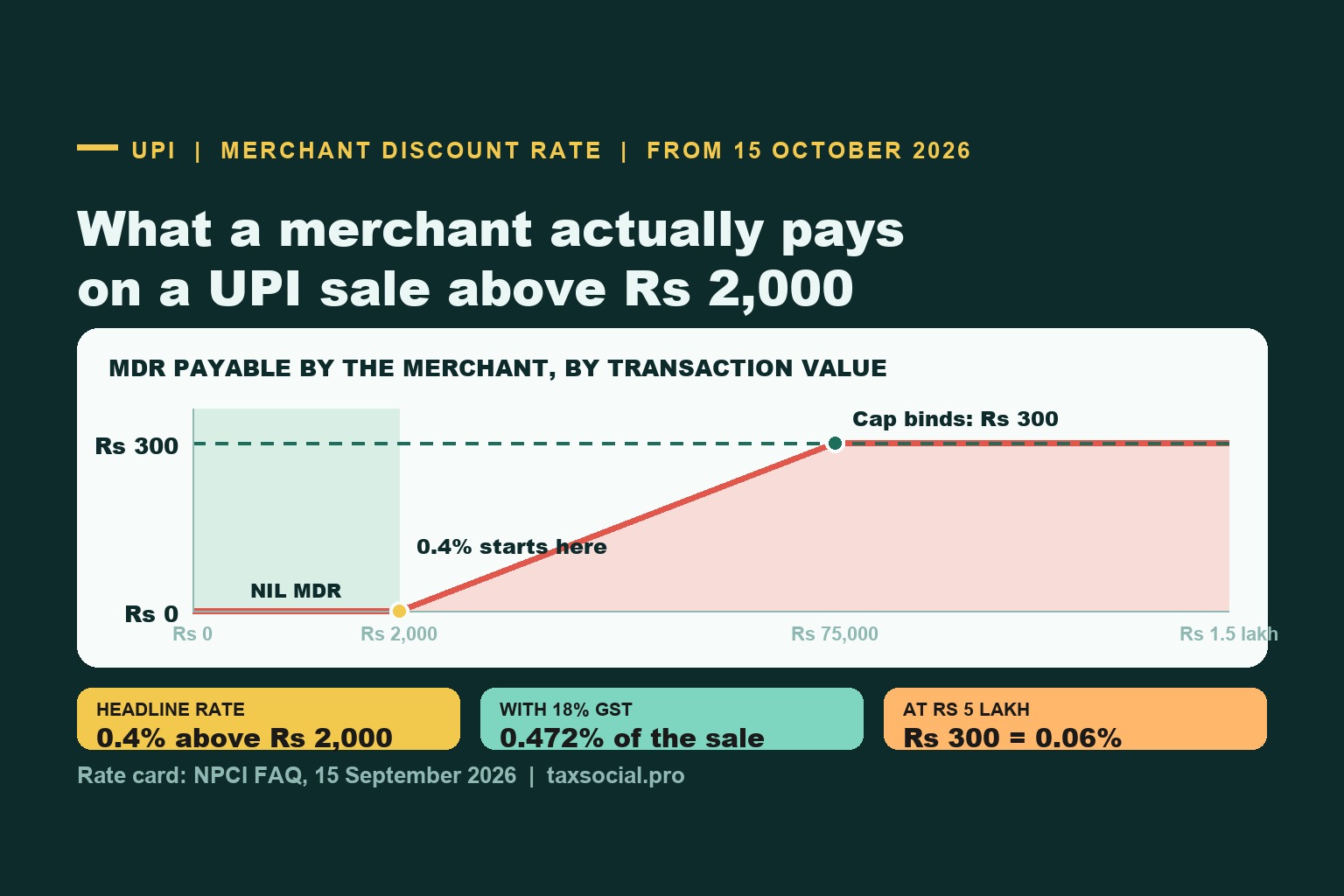

From 15 October 2026 a merchant pays 0.4% on UPI payments above Rs 2,000, with 18% GST on top — so the real outlay is 0.472% of the sale. The charge is capped at Rs 300 from Rs 75,000 upwards, which is the single most useful fact in the whole framework: the cap bites at exactly the point where 0.4% first reaches Rs 300, so on large tickets the effective rate collapses — 0.06% on a Rs 5 lakh sale. Some sectors pay a flat Rs 5 instead, capital markets pay 0.02%, and small merchants in the P2PM category pay nothing until their UPI receipts cross Rs 1 lakh a month for three consecutive months. Customers pay nothing, and a merchant is not permitted to add the fee to the bill. For the practitioner the four questions that follow are: can the merchant take input tax credit on the GST, does TDS have to be deducted, does turnover go down, and what happens to a client on presumptive taxation. The answers are yes-usually, probably-not-but-nobody-has-said-so, no, and nothing good.
1. The rate card
The framework was announced by the Ministry of Finance on the evening of 15 September 2026 and set out in a 42-question FAQ published by NPCI the same day. It takes effect on 15 October 2026. MDR — merchant discount rate — is the fee an acquiring bank or payment aggregator charges a merchant for accepting a digital payment. It has been nil on UPI since January 2020. That ends next month for one slice of transactions.
| Transaction | MDR payable by the merchant |
|---|---|
| Any person-to-person transfer, any amount | Nil |
| Merchant payment up to Rs 2,000 | Nil |
| Merchant payment above Rs 2,000 | 0.4% of the whole amount |
| Merchant payment of Rs 75,000 or more | Rs 300, capped |
| Railways, telecom, insurance, fuel, agricultural inputs, utilities — above Rs 2,000 | Flat Rs 5 |
| Mutual funds, securities, stockbrokers and dealers | 0.02%, capped at Rs 300 |
| Small merchant in the P2PM category (up to Rs 1 lakh a month) | Nil, at any transaction value |
| UPI Mandates and AutoPay — SIPs, subscriptions, utility standing instructions | No prescribed MDR |
| RuPay credit card or a pre-sanctioned credit line used through a UPI app | Outside this framework — card rules apply |
Two points about that table are worth reading twice, because both are widely misreported.
The 0.4% runs on the whole amount, not on the excess over Rs 2,000. NPCI's own worked example settles it: a Rs 3,000 payment attracts Rs 12, which is 0.4% of Rs 3,000, not 0.4% of the Rs 1,000 above the threshold. The consequence is a genuine cliff at the threshold. A Rs 2,000 sale costs the merchant nothing. A Rs 2,001 sale costs Rs 8. One rupee of extra revenue carries eight rupees of fee.
The flat Rs 5 categories are better off than the percentage, always. Rs 5 equals 0.4% of Rs 1,250, and the flat rate only applies above Rs 2,000 — so for every transaction it touches, Rs 5 is cheaper than the percentage would have been. A Rs 3,000 fuel purchase costs Rs 5, not Rs 12. That does not make it popular: the All India Petroleum Dealers Association is seeking a full exemption, on the ground that fuel retailing runs on a prescribed commission per litre and has no margin to absorb a new per-transaction cost, and officials of the Ministry of Petroleum and Natural Gas met the association on 17 September. Retail and apparel bodies have objected to the timing, a month before the festive season. The Confederation of All India Traders has called the rates balanced. Nothing has been withdrawn.
2. Why the cap matters more than the rate
0.4% of Rs 75,000 is exactly Rs 300. The cap is not an arbitrary ceiling bolted on to a percentage; it is the point where the percentage stops. Above Rs 75,000 the merchant keeps paying Rs 300 and nothing more, so the effective rate falls away:
| Sale value | MDR | Effective rate | With 18% GST |
|---|---|---|---|
| Rs 2,000 | Nil | — | Nil |
| Rs 3,000 | Rs 12 | 0.40% | Rs 14.16 |
| Rs 50,000 | Rs 200 | 0.40% | Rs 236 |
| Rs 75,000 | Rs 300 | 0.40% | Rs 354 |
| Rs 1,00,000 | Rs 300 | 0.30% | Rs 354 |
| Rs 5,00,000 | Rs 300 | 0.06% | Rs 354 |
For a business whose UPI receipts are mostly large — a car dealer, a jeweller, a builder taking booking amounts, a hospital settling a discharge bill — the cost of this framework is far closer to a flat Rs 354 per transaction than to four-tenths of a per cent. For a business whose receipts cluster just above Rs 2,000 — a mid-market restaurant, a pharmacy, a clothing store — the full 0.472% applies to almost every UPI sale it makes. The same headline rate lands very differently on the two, and the modelling a client needs is not "0.4% of UPI turnover" but a distribution of ticket sizes.
The capital-markets tier works the same way in miniature: 0.02% capped at Rs 300 means the cap binds from Rs 15 lakh upwards. The FAQ sets that tier out without restating the Rs 2,000 floor, but the floor still applies: the 14 September notification protects every UPI transaction up to Rs 2,000 from any charge and makes no exception for capital-market payments, so the 0.02% can only bite above that line unless the government moves the notification. In practice a lump-sum purchase through UPI attracts it and a SIP running on AutoPay does not, because mandates carry no prescribed MDR at all.
3. The threshold that moves without anyone telling you
The zero-MDR protection for small merchants is not a per-transaction exemption. It is an account classification. A vendor in the P2PM category — the category NPCI created for small merchants who receive money through a QR code straight into a personal bank account — pays no MDR on anything, including on a payment above Rs 2,000. What defines the category is the money coming in: up to Rs 1 lakh a month.
The mechanism is the part to warn clients about. Acquiring banks run a velocity check on inward UPI credits. A merchant whose UPI receipts exceed Rs 1 lakh a month for three consecutive months is transitioned to the ordinary P2M category. What NPCI has published is the velocity check and the three-month trigger; it says nothing about what notice, if any, a merchant gets, and it confirms that no QR code needs replacing — existing QR stands and soundboxes keep working. What changes is that from that point the merchant starts paying 0.4% on everything above Rs 2,000.
Three practical consequences. First, a seasonal business that crosses Rs 1 lakh in October, November and December because of festive trade can find itself reclassified in a quarter when it was not thinking about payment costs at all. Second, the trigger is UPI inward credit, not turnover, not GST registration and not income — NPCI has confirmed that GST registration is irrelevant to the zero-MDR tier. Third, because the classification sits with the acquiring bank rather than with the merchant, a client may not register the change until the settlement figures stop matching the sales figures. Ask for the settlement statements, not just the sales figures.
4. GST on MDR, and who actually eats it
MDR is consideration for a supply of service by the acquiring bank or payment aggregator to the merchant. It is taxable at 18%. So the headline 0.4% is an invoice outlay of 0.472% of the sale, and the Rs 300 cap is an outlay of Rs 354.
Whether that 18% is a cost or a wash depends entirely on the merchant:
- A GST-registered merchant making taxable outward supplies can ordinarily take input tax credit on it. Banking and payment services are not blocked credits, so the usual Section 16 conditions are what govern — a valid tax invoice, receipt of the service, tax actually paid to the government by the supplier, and the return filed, with the credit claimed by the November deadline for the year in question. For this merchant the real cost is 0.4%, and the GST is recovered.
- A merchant making exempt supplies — a hospital, a school, much of the insurance intermediation chain — cannot take the credit, or must reverse it proportionately. The 18% is a dead cost, and the effective rate really is 0.472%.
- A composition dealer takes no input tax credit at all. Same answer: 0.472%.
- An unregistered merchant is in the same position, which is the mildly perverse part of the design — the smaller and less formal the business, the more of the fee it bears, once it is large enough to have left the P2PM tier.
One dead end worth closing off, because it comes up. There is a long-standing GST exemption for an acquiring bank on settlement of amounts up to Rs 2,000 in a single transaction, and a January 2025 circular extended it to RBI-regulated payment aggregators. It does not help here. The entry is written for "credit card, debit card, charge card or other payment card services", and UPI is not a card. In any event MDR on UPI below Rs 2,000 is nil, so there is no consideration for the exemption to attach to.
5. The TDS question nobody has answered
This is the part practitioners will be asked about first, and it has no clean answer yet.
Commission or brokerage attracts TDS at 2% once it exceeds Rs 20,000 in a year — the provision the profession knew as Section 194H, now Section 393(1), Table Sl. No. 1(ii) of the Income-tax Act, 2025. Two qualifiers before anything else. Not every merchant is a deductor: an individual or Hindu undivided family below the preceding-year business and profession thresholds is outside the obligation entirely, and the payee has to be a resident. And for everyone who is a deductor, the fact that MDR is taken by the acquirer out of the settlement rather than paid across by the merchant is not an escape — retention by the payee is payment by the payer, and the card cases discussed below were themselves about charges retained from settlement proceeds.
There is a CBDT notification in this area, and most commentary still cites the wrong one. Notification No. 56/2012 was superseded on 17 June 2016 by Notification No. 47/2016, S.O. 2143(E), issued under the same power in Section 197A(1F) and carrying the same file number. Anyone reasoning from the 2012 text — which is still the version that comes up first in most searches — is reasoning from a replaced instrument, and the replacement changed two things that matter here.
- The payee class is wider. The 2012 notification only covered payments to a bank listed in the Second Schedule to the Reserve Bank of India Act, 1934, excluding a foreign bank. The 2016 notification adds any payment systems company authorised by the RBI under Section 4(2) of the Payment and Settlement Systems Act, 2007. So a merchant acquired by an RBI-authorised payment aggregator rather than by a bank is inside the notification, not outside it.
- The clearing-charges clause is wider, and it is instrument-neutral. Where the 2012 text said simply “clearing charges (MICR charges)”, the 2016 text extends it to interchange fee or any other similar charges charged at the time of settlement or for clearing activities under the Payment and Settlement Systems Act, 2007. That clause is not tied to cards, and the Payment and Settlement Systems Act is precisely the statute UPI runs under.
The card clause in the 2016 notification is still a card clause — credit card or debit card commission for transactions between the merchant establishment and the acquirer bank — and UPI is neither. So the notification does not cover UPI MDR by that route. Whether it covers it by the other route is a genuine, unsettled question worth putting to a client in terms: MDR is the merchant-facing fee of which interchange is one component, and the clause speaks of an interchange fee “or any other similar charge” levied at settlement under that Act. It is a real argument. It is not a decided one, and we have seen no CBDT clarification either way.
The independent ground lies in case law, and it is the stronger of the two. In CIT v. JDS Apparels (P) Ltd [2015] 370 ITR 454 (Delhi) the High Court held that the amount a bank retains on a card settlement is a fee for banking services, not commission to an agent: the bank has no concern with the price, quality or nature of the goods, takes no part in the negotiation between buyer and seller, and deals with the merchant on a principal-to-principal basis. The same court reached the same conclusion on card payment-gateway charges in Pr. CIT v. Make My Trip India (P) Ltd [2019] 104 taxmann.com 263 (Delhi). Neither case decides UPI, and neither considers a non-bank aggregator's contractual position, so this is an analogy rather than a holding — but the analogy is a close one, because what makes it work is the absence of agency rather than the presence of a card. Where the acquiring contract genuinely puts the parties in a principal-to-principal relationship, the reasoning should carry across. Where it does not, it will not.
What to do until CBDT speaks. The defensible position is that no deduction is required, resting primarily on JDS Apparels and secondarily on the settlement-charges clause of Notification 47/2016, and it is worth recording that reasoning in the file now rather than reconstructing it during an assessment three years from now. Read what the acquiring contract actually says about the relationship between the parties, because that is what the case law turns on. Keep the acquirer's tax invoices — they are needed for the input tax credit regardless. And check which notification any adviser's note is citing: a memo built on Notification 56/2012 is built on an instrument that was replaced ten years ago. And expect a clarification: an entirely new, industry-wide bank charge landing on lakhs of merchants is exactly the kind of thing that produces one.
6. What it does to the books, and what it does not do to turnover
MDR is netted at settlement. A Rs 3,000 sale arrives as Rs 2,985.84 after fee and GST. The temptation — particularly in small accounting packages that book the bank credit as the sale — is to record revenue of Rs 2,985.84. That is wrong, and it is wrong in a direction that causes real problems.
Revenue is the consideration receivable from the customer, which is Rs 3,000. MDR is an expense paid to a third party, not a discount given to the customer. So:
- GST is charged on Rs 3,000. The value of supply is the price payable by the recipient for the supply. What the merchant separately pays its bank does not reduce it. A merchant who books net will under-report outward supplies and will not reconcile.
- Turnover stays gross for every threshold that runs on turnover — the tax audit limits, the GST registration and composition limits, the presumptive limits. MDR does not shrink the top line.
- The expense is deductible as ordinary business expenditure, subject to the normal conditions — including any withholding consequence, on which see section 5. It is paid through banking channels, so none of the cash-payment disallowances are in play.
- Reconciliation gets a new line. Gross sales less MDR less GST on MDR equals bank credits. Where that reconciliation is not performed monthly, the difference between recorded sales and banked receipts will look like an unexplained shortfall — to an auditor and, later, to an assessing officer.
The case that deserves a specific warning is a client on presumptive taxation under Section 58, Table Sl. No. 1 — the eligible small business that used to sit in Section 44AD, with its eligible-assessee conditions and its Rs 2 crore and Rs 3 crore turnover limits. (Section 58 also carries the old goods-carriage and specified-profession regimes, which are computed differently; the point here is about Sl. No. 1.) For that taxpayer presumptive income is 6% of receipts through prescribed banking or online modes, and UPI is one. The base is the whole of turnover — gross, as above — and Section 58(4) bars any deduction, allowance or loss against presumptive income. So a presumptive merchant pays tax on 6% of the gross receipt and gets no relief whatever for the MDR deducted from it. Take the worst case: a merchant billing Rs 1 crore a year through UPI entirely in tickets above Rs 2,000 and below the Rs 75,000 cap pays about Rs 47,200 of MDR and GST, and deducts none of it. The same Rs 1 crore taken as a hundred payments of Rs 1 lakh costs Rs 35,400, because every one of them hits the cap — the ticket-distribution point again, now with tax attached. On the margins, that is a real argument for running the comparison before the advance tax instalment rather than after — but it is not a free annual choice. Opting out after having used the scheme triggers the five-year lock-out, and declaring a lower income than the presumptive figure brings the books and audit requirements with it. The arithmetic is one input into that decision, not the decision.
7. Refusing UPI is not the easy way out
Petrol dealers have said publicly that they may refuse UPI for large transactions. For a small business that is a commercial decision. For a large one it runs into a statute.
Every business or profession whose sales, turnover or gross receipts exceeded Rs 50 crore in the preceding tax year must provide the facility to accept payment through the prescribed electronic modes — Section 187 of the Income-tax Act, 2025, carrying forward what was Section 269SU. Rule 133 of the Income-tax Rules, 2026 prescribes four: a RuPay debit card, BHIM-UPI, a BHIM-UPI QR code, and full-KYC central bank digital currency wallets. The penalty for not providing them is Rs 5,000 for every day the failure continues, under Section 452.
So the large merchant is in an unusual position from 15 October. One statute obliges it to provide the UPI facility. The statute that used to stop anyone charging it for doing so — Section 10A of the Payment and Settlement Systems Act, 2007 — now protects only what the Central Government notifies, and the notification of 14 September 2026 protects UPI only up to Rs 2,000. Above that figure, acceptance is compulsory and the charge is permitted.
Whether a business that displays a QR code but declines an individual high-value UPI payment has still "provided the facility" is an open question, and we have seen no clarification on it. Section 187 requires the facility to be provided; it does not say in terms whether declining a particular valid payment while keeping the QR code up is a failure to provide it, and we have found nothing adjudicated either way. What can be said is that a standing policy of refusing UPI above Rs 2,000 carries material Section 187 risk, which is a different thing from a settled rule against it. A business near the Rs 50 crore line should know which side of it the preceding year put it on before it sets any such policy.
8. And you cannot add it to the bill
The government's position is unambiguous: MDR "is neither a tax nor a charge collected by the Government or NPCI", it is a charge within the merchant payment ecosystem and not a charge on the customer, and banks have been advised to ensure merchants do not pass it on. NPCI's FAQ puts it more plainly still — merchants who have been onboarded cannot pass MDR charges to customers, and the framework ensures consumers pay only the posted price. UPI apps are separately prohibited from levying any platform fee.
The distinction to hold on to is between surcharging and pricing. A merchant may not add a line to the invoice for paying by UPI. A merchant remains free to set its own prices. The first is barred; the second is ordinary commerce. Note also where the prohibition actually bites: it reaches the merchant through the acquiring contract and the scheme rules rather than through a provision of statute that binds the merchant directly, so the most immediate consequence of breaching it is contractual, and the sanction an acquirer holds is the merchant account itself. That is not necessarily the only exposure — a line added to a bill for paying by UPI is also the kind of thing a consumer forum takes an interest in.
9. The cash answer is the expensive answer
The predictable response to a fee on large digital receipts is to take large receipts in cash, and trade bodies have said as much in the last week. It is worth putting the arithmetic in front of any client who raises it.
On a Rs 2.5 lakh sale, the MDR is Rs 300 and the GST on it is Rs 54. Taking the same Rs 2.5 lakh in cash from one person in one day contravenes Section 186 of the Income-tax Act, 2025 — the Rs 2 lakh bar that was Section 269ST — and the penalty under Section 451 is an amount equal to the amount received. Rs 2.5 lakh of penalty to save Rs 354 of fee. Reasonable cause under Section 470 is not a plan.
Below Rs 2 lakh the statutory bar does not apply, but the rest of the picture is unchanged: cash handling costs, the deposit trail, and the fact that a business whose banked receipts fall while its declared turnover holds steady has created its own scrutiny flag. Splitting a single supply into sub-Rs 2,000 tranches to sit under the threshold has the same problem from the other direction — it does not change the value of the supply for GST, and structuring is exactly what the acquirer's velocity monitoring is built to notice.
10. Before 15 October
- Pull the last six months of UPI settlement reports for each merchant client and plot the distribution of ticket sizes above Rs 2,000. That distribution, not the turnover figure, is the cost.
- Identify clients sitting near Rs 1 lakh of monthly UPI receipts. Three consecutive months over the line moves them out of zero-MDR, and nobody will tell them.
- Check whether the client's merchant category has been mapped correctly — fuel, telecom, insurance, railways, utilities and agricultural inputs are flat Rs 5, and a misclassified petrol pump paying 0.4% instead of Rs 5 on every fill above Rs 2,000 is a material leak.
- Set up the MDR expense head and the GST input before the first settlement lands, and put the gross-sales-less-MDR-equals-bank-credits reconciliation into the monthly close.
- Confirm the acquirer is issuing a GST invoice in the client's GSTIN. No invoice, no input tax credit, and a fee that costs 0.472% instead of 0.4%.
- Decide the TDS position and write it down, with the reasoning in section 5 above.
- Re-run the presumptive comparison for any Section 58 client with substantial UPI receipts above the threshold.
- Tell the client they cannot surcharge, before someone in the billing team decides that they can.
11. What is still moving
Three things could change this page. The fuel exemption representation is live and the oil ministry has met the dealers' association. The concessional treatment of education has been announced as "flat-fee structures or capped processing rates" with no figure attached, so a school's actual rate is not yet knowable from any published document. And the small-merchant fund — an amount equivalent to 5% of total MDR collections — is to be worked out with the Reserve Bank within three months, which means its terms will arrive after the framework is already running. The rates themselves come from the UPI and Services Steering Committee headed by NPCI, and NPCI is where a change to them would most likely surface first — though the floor beneath them sits in a notification under Section 10A, which the government can move, and the RBI has its own powers over the payment system.
FAQ
Will customers be charged? No. MDR is a merchant cost. Person-to-person transfers stay free at any amount, merchant payments up to Rs 2,000 stay free, UPI apps cannot levy a platform fee, and there are no monthly caps on free usage for individuals.
Is the 0.4% only on the amount above Rs 2,000? No — on the whole amount. A Rs 3,000 payment costs Rs 12.
What is the maximum a merchant can pay on one transaction? Rs 300, plus Rs 54 of GST, from Rs 75,000 upwards.
Can a merchant take input tax credit on the GST? A registered merchant making taxable supplies ordinarily can, on the usual Section 16 conditions. A composition dealer, an unregistered merchant, and a merchant making exempt supplies cannot, and bears 0.472%.
Does MDR reduce turnover? No. Turnover is the gross amount billed to the customer; MDR is an expense. Booking net will break the GST reconciliation.
What about a presumptive client? An eligible business under Section 58, Table Sl. No. 1 pays tax on 6% of gross UPI receipts and gets no deduction for the MDR taken out of them, because Section 58(4) bars deductions against presumptive income.
Does TDS apply? Probably not, but nobody has said so authoritatively. The operative notification is 47/2016, not the 56/2012 most notes still cite; its card clause does not reach UPI, though its settlement-charges clause is instrument-neutral and arguably does. The stronger ground is the Delhi High Court's reasoning in JDS Apparels — bank charges, not commission, principal to principal. Not every merchant is a deductor in the first place.
Are small merchants really exempt? Yes, while they stay in the P2PM tier, which means UPI receipts up to Rs 1 lakh a month. Crossing that for three consecutive months moves them into the charged category.
Do SIPs and utility auto-debits attract MDR? No. UPI Mandates and AutoPay carry no prescribed MDR.
What about RuPay credit cards on UPI? Outside this framework — credit-linked UPI follows card rules.
Can a shop add a UPI charge to my bill? No. Merchants cannot pass MDR to customers, and the posted price is what is payable.
Sources
- Press Information Bureau, Ministry of Finance, Release ID 2310586, 15 September 2026, "UPI Continues to Remain Free for Peer to Peer Transactions and 96% of Merchant Transactions".
- National Payments Corporation of India, "Merchant Discount Rate (MDR) on Select UPI (P2M) Transactions — Frequently Asked Questions", 15 September 2026 (42 questions), in particular Q3, Q5, Q22, Q23, Q24, Q25, Q28, Q29, Q31 to Q42.
- Ministry of Finance, Department of Financial Services, Notification S.O. 5067(E) dated 14 September 2026 under Section 10A of the Payment and Settlement Systems Act, 2007; Section 10A as amended by the Taxation and Other Laws (Amendment) Act, 2026 (Act 21 of 2026).
- Income-tax Act, 2025: Section 58 (presumptive taxation) and Section 58(4); Section 186 and the penalty under Section 451, with Section 470; Section 187 and the penalty under Section 452; Section 393(1), Table Sl. No. 1(ii); Section 536(2)(j). Income-tax Rules, 2026, Rule 133.
- Notification No. 47/2016, S.O. 2143(E) [F. No. 275/53/2012-IT(B)] dated 17 June 2016 under Section 197A(1F) of the Income-tax Act, 1961, in supersession of Notification No. 56/2012 dated 31 December 2012 — the clearing and settlement charges clause and the credit card or debit card commission clause, and the extension of the payee class to payment systems companies authorised by the RBI under Section 4(2) of the Payment and Settlement Systems Act, 2007.
- CIT v. JDS Apparels (P) Ltd [2015] 370 ITR 454 (Delhi), ITA 608/2014, decided 18 November 2014; Pr. CIT v. Make My Trip India (P) Ltd [2019] 104 taxmann.com 263 (Delhi), ITA 136/2019, decided 25 March 2019.
- Notification No. 12/2017-Central Tax (Rate) dated 28 June 2017, Sl. No. 34; CBIC Circular No. 245/02/2025-GST dated 28 January 2025, paragraphs 3.1 to 3.6.
- Reports of 16 and 17 September 2026 on representations from the All India Petroleum Dealers Association, retail and apparel bodies and the Confederation of All India Traders (Business Standard, Business Today, The Federal, Free Press Journal).




Comments (0)
No comments yet. Be the first to comment!