
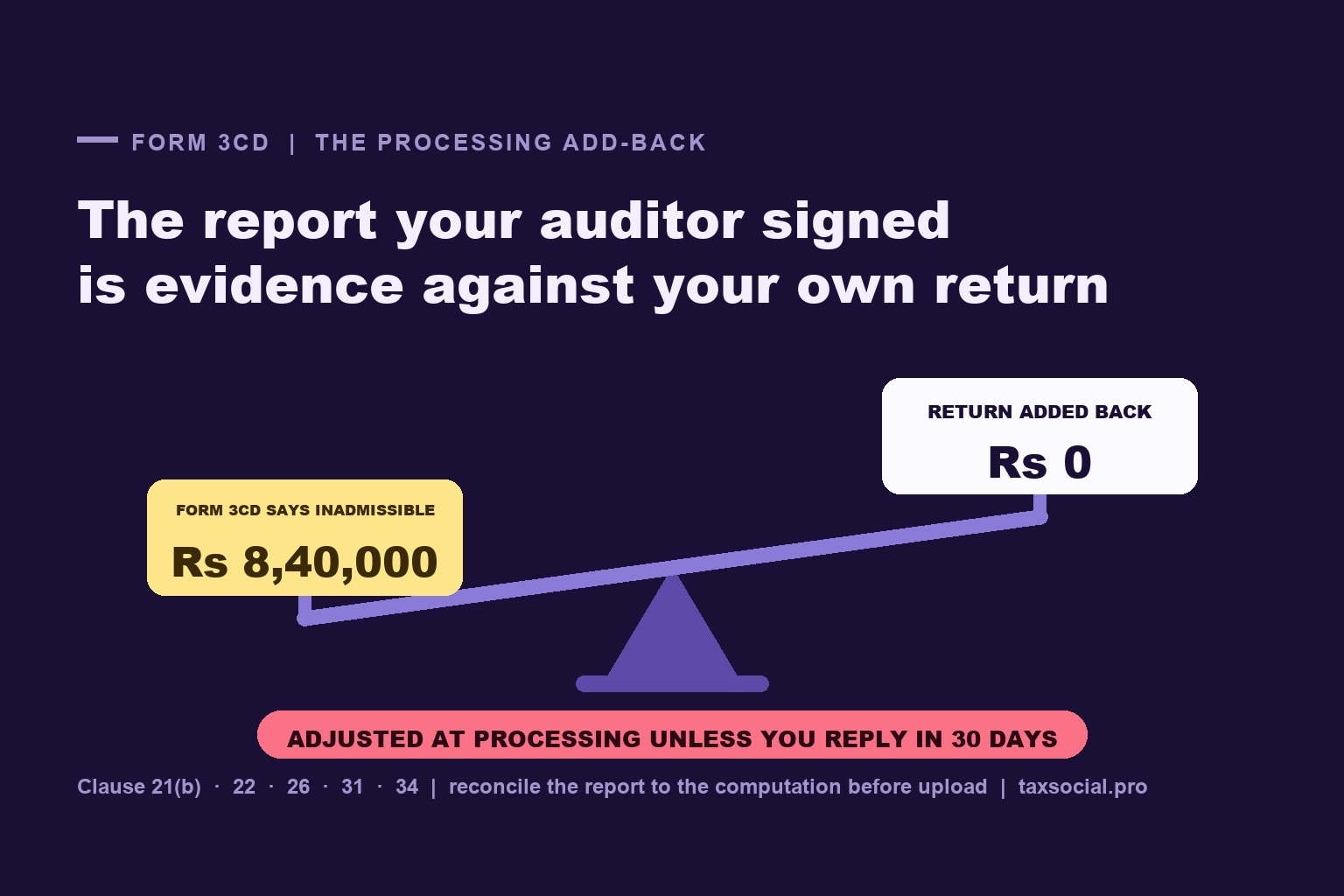

The mismatch that costs money is not the one most people prepare for. The usual worry is that Form 3CD will fail to tie to the department's third-party data. The provision that actually does the damage is Section 143(1)(a)(iv), which allows the return to be adjusted at processing for a "disallowance of expenditure or increase in income indicated in the audit report but not taken into account in computing the total income in the return". Read that again: the audit report is your own document, signed by your own auditor, and it is admissible against your own computation. Every clause where the auditor writes down an inadmissible amount is a clause where the return has to add that amount back — and if it does not, an intimation follows, with thirty days to respond before the adjustment is made. Five entries are worth reconciling line by line: clause 21(b) and the 30% disallowance under Section 40(a)(ia); clause 26 and clause 22, where the Section 43B proviso saves clauses (a) to (g) and pointedly does not reach clause (h); clause 34 and the TDS and TCS statements; clause 31, where a journal entry can attract a penalty equal to the whole loan; and clause 16. None of them is obscure. All of them are reconciliations somebody has to actually perform before upload.
1. The audit report is evidence against your own return
Start with the mechanism, because it explains why the rest matters.
When a return is processed under Section 143(1), the total income is computed after a defined list of adjustments. Most of them are what you would expect — arithmetical errors, an incorrect claim apparent from the return, a loss disallowed because the earlier return was late. Sub-clause (iv) is the one that concerns a tax audit:
"(iv) disallowance of expenditure or increase in income indicated in the audit report but not taken into account in computing the total income in the return"
There is nothing hidden about this. The audit report is filed before the return. Its particulars are structured data. If the report says an amount is inadmissible and the computation of total income does not add it back, the two documents contradict each other, and the statute allows that contradiction to be resolved by a proposed adjustment. It is a proposal, not a conclusion: the audit disclosure is not made conclusive, and a response may show that the report does not in fact indicate a disallowance, or that the amount has been mapped to the wrong head.
Two procedural points are worth keeping in view, both from the provisos. No adjustment may be made without first giving the assessee an intimation, in writing or electronically. And the response, if any, must be considered — but where no response is received within thirty days of that intimation, the adjustment is made. So the window is real, it is short, and it opens at a moment nobody is watching for it.
The practical consequence is a discipline, not a worry. Before the return is filed, somebody has to sit with the 3CD and the computation side by side and tick off every inadmissible amount the report discloses against the add-back in the computation. That single reconciliation prevents most of what follows.
2. Clause 21(b) — the 30% that gets reported and not added back
Clause 21(b) of Form 3CD is headed "Amounts inadmissible under section 40(a)". It is a frequent practical source of a Section 143(1)(a)(iv) adjustment, because the auditor is looking at the TDS ledger and the person preparing the computation is looking at the profit and loss account.
The current text of Section 40(a)(ia) — and it is worth being precise, because the clause was substituted and the older, wider version is still widely quoted — reads:
"(ia) thirty per cent of any sum payable to a resident, on which tax is deductible at source under Chapter XVII-B and such tax has not been deducted or, after deduction, has not been paid on or before the due date specified in sub-section (1) of section 139"
Three things follow from that sentence.
- It is 30%, not the whole amount. The pre-substitution version disallowed 100% and was confined to a list of payment types. The current clause is 30% and reaches any sum payable to a resident on which tax was deductible. Wider base, smaller bite.
- Deducting is not enough. The clause catches two failures — not deducting, and deducting but not paying by the Section 139(1) due date. The second is the one that surprises people, because the TDS was in fact deducted and the ledger looks clean.
- The disallowance reverses, but on payment. Under the first proviso, where tax is deducted in a later year, or was deducted during the year but paid after the Section 139(1) due date, thirty per cent of the sum is allowed in computing the income of the previous year in which that tax is paid. Deducting later is not the endpoint; paying is. It is a timing difference, which is exactly why it gets treated as not worth the trouble — right up to the point where it is added back in the wrong year.
There is one relief that is routinely missed. The second proviso provides that where the assessee failed to deduct but is not deemed to be an assessee in default under the first proviso to Section 201(1) — broadly, because the resident payee has furnished their return, taken the sum into account and paid the tax on it — then the assessee is deemed to have deducted and paid the tax on the date the payee furnished that return. If that is the position, obtain the accountant's certificate the machinery requires and get the clause 21(b) reporting right at source. Arguing it after an adjustment is a great deal harder than documenting it before upload.
3. Clause 26 and clause 22 — the Section 43B split, and the proviso that stops short
This is the entry where the form's own architecture tells you the answer, and reading the form carelessly gets it wrong.
Clause 26 asks about sums referred to in clauses (a) to (g) of Section 43B — taxes and duties, employer contributions to provident and similar funds, bonus and commission, interest to specified financial institutions and to notified NBFCs, interest to banks and co-operative banks, leave encashment, and payments to Indian Railways. It splits them into liabilities that pre-existed at the start of the year and liabilities incurred during it, and asks in each case whether they were paid.
Clause 22 is a different clause entirely, and it is where the MSME limb lives. Note that it was substituted by Notification 23/2025, so a checklist rolled forward from last year will have the old wording. As it now stands it reports: (i) interest inadmissible under Section 23 of the MSMED Act; (ii) the total amount required to be paid to a micro or small enterprise under Section 15 of that Act during the year; and (iii), out of that amount, the sum paid within the Section 15 time limit and the sum not so paid. The clause (h) disallowance is the amount in clause 22(iii)(b) — reported as required to be paid, and reported as not paid in time.
The reason for the split is a single phrase in the proviso to Section 43B:
"Provided that nothing contained in this section except the provisions of clause (h) shall apply in relation to any sum which is actually paid by the assessee on or before the due date applicable in his case for furnishing the return of income under sub-section (1) of section 139..."
So the familiar rule — pay before the return due date and the deduction survives — is real, and it covers clauses (a) to (g). It does not cover clause (h). For an amount payable to a micro or small enterprise, the only thing that preserves the deduction is payment inside the time limit in Section 15 of the MSMED Act. Paying in August, before the return goes in, does nothing for the year under audit.
Two errors follow from missing this. The first is reporting an MSME amount in clause 26, where the proviso appears to rescue it. The second is reporting it correctly in clause 22(iii)(b) and then not adding it back in the computation, because the person doing the computation applied the clause 26 logic to it. The second error is the one Section 143(1)(a)(iv) is built to catch. Our Form 3CD checklist for AY 2026-27 works the clause 22 mechanics through with dates.
4. Clause 34 — the clause that is checked against a return you filed yourself
Clause 34 asks, at 34(a), whether the assessee is required to deduct or collect tax, and then wants the details transaction-head by transaction-head: the section, the nature of payment, the total amount, the amount on which tax was deductible, the amount actually deducted or collected, the amount deducted at less than the specified rate, and — the row that matters most — the amount deducted or collected but not deposited to the credit of the Central Government. Clause 34(b) records the due date and the actual filing date of each TDS and TCS statement, and asks whether the statements contain all the transactions required to be reported; where they do not, the details have to be given. Clause 34(c) asks about interest under Section 201(1A) or 206C(7).
What makes this clause different from the others is that the document it has to agree with is one you produced yourself. The reconciliation runs between clause 34, the books and challans, and the TDS and TCS statements actually filed — Forms 24Q, 26Q, 27Q and, for collections, 27EQ. The auditor is certifying, in structured form, a summary of returns the assessee filed. Form 26AS and the Annual Information Statement are useful corroboration, but they are not the deductor's own statements: Form 26AS is principally the recipient's tax-credit and information statement, built from what deductors, collectors and other reporting entities have filed about them.
Three failure modes recur:
- Reconstructing clause 34 from the TDS ledger rather than from the filed statements. The ledger shows what was booked. The statement shows what was reported. Where a challan was mapped to the wrong quarter or a deductee row was left out, only the statement knows.
- Treating "deducted at a lower rate" as an exception rather than a disclosure. Where a lower-deduction certificate or a declaration is on file, the amount still belongs in the clause. Leaving it out to keep the row clean removes the very explanation that would have answered the query.
- Forgetting that the same facts carry a separate penalty. Section 271C provides a penalty equal to the amount of tax the person failed to deduct or pay. It is not a substitute for the Section 40(a)(ia) disallowance and it is not extinguished by it — though Section 273B does make reasonable cause available against it.
5. Clause 31 — where a journal entry becomes a penalty equal to the loan
Clause 31 reports loans, deposits and specified sums taken or accepted, and repayments, by reference to Sections 269SS and 269T. It is a reporting clause with an unusually violent consequence attached to it.
Section 269SS prohibits taking or accepting any loan, deposit or specified sum otherwise than by account payee cheque, account payee bank draft, electronic clearing system or a prescribed electronic mode, where the amount — or the aggregate, read with amounts already outstanding from the same depositor — is ₹20,000 or more. Section 269T works the same way on the repayment side, for a loan, deposit or specified advance, with the ₹20,000 tests applied to the amount together with any interest payable on it, and with its own aggregation limbs. The threshold is low and the aggregation limbs mean a series of small amounts from one person can cross it without any single transaction looking remarkable.
The penalties are the point. Section 271D imposes "a sum equal to the amount of the loan or deposit or specified sum so taken or accepted". Section 271E does the same for a repayment. That is 100% of the amount, not a percentage of the tax. A ₹6 lakh loan accepted in cash is a ₹6 lakh penalty, on a transaction that produced no income at all.
Two things about these penalties deserve a note.
- Who imposes them changed recently. Both sections said the penalty was to be imposed by the Joint Commissioner. A proviso inserted with effect from 1 April 2025 provides that on or after that date the penalty is to be imposed by the Assessing Officer. From that date the Assessing Officer is the statutory authority for these penalties, replacing the Joint Commissioner for penalties imposed on or after 1 April 2025.
- Section 273B applies. Its list expressly includes 271D and 271E, so no penalty is imposable if the person proves reasonable cause. That is a genuine defence, and it is a great deal more persuasive when the circumstances were documented at the time than when they are reconstructed afterwards.
The reporting mistake that creates the exposure is narrower than the law. Clause 31 gets answered from the bank statement, because that is where payments live. But a loan can be created, converted and settled entirely by journal entry — a director's current account adjusted against a purchase, a sister concern's balance set off, an advance reclassified at the year end. None of it touches a bank account, and the codes the form now uses exist precisely because these are not bank transactions. Whether any particular entry is a loan, deposit, specified sum or specified advance at all — and whether Section 269SS or 269T is breached, and whether a penalty survives a reasonable-cause defence under Section 273B — turns on the substance of the transaction, not on the fact that it was booked by journal. The point is that journal entries have to be looked at, which answering the clause from the bank statement guarantees they will not be.
6. Clause 16 — the receipts that never reached the profit and loss account
Clause 16 asks for "Amounts not credited to the profit and loss account", and it is the quietest of the five because, by definition, nothing in the profit and loss account will prompt anybody to look for it.
The clause reaches, among other heads: items falling within Section 28 that were not credited to the profit and loss account; specified proforma credits, drawbacks and listed indirect-tax refunds admitted as due by the authority concerned — note that it is the admission that matters, not the eventual receipt; escalation claims accepted during the year; other items of income; and capital receipts. What they have in common is that the profit and loss account will not prompt anybody to ask about them.
The reconciliation risk here is real, and it runs against data the department already holds. An amount invoiced and reported in GSTR-1 but parked on the balance sheet rather than taken to the profit and loss account shows up as a difference between the GST turnover and the reported revenue. Receipts reflected in the Annual Information Statement or in Form 26AS that do not appear in revenue raise the same question.
Be careful not to make clause 16 do more work than it can. It is not a general explanation slot for every AIS, Form 26AS or GST difference — most such differences come from timing, tax head, credit notes, gross-versus-net presentation or plainly non-income receipts, and none of those belongs in clause 16. Report under clause 16 only what falls within its specified heads and was not credited to the profit and loss account, and keep a separate reconciliation for everything else.
A separate point, easy to conflate and worth keeping apart: clause 16 concerns what was not credited to the profit and loss account. Whether an item belongs in the Section 44AB turnover figure at all is a different question with a different answer, and we work it through in five ways turnover gets computed wrong.
7. The reconciliation to do before upload
None of this requires new information. It requires putting documents that already exist next to each other, in a specific order.
- Form 3CD against the computation of total income. Every inadmissible amount the report discloses — clause 21(b), clause 22, clause 26, clause 23, clause 20 — ticked off against its add-back. This is the Section 143(1)(a)(iv) reconciliation, and it is the one that prevents an adjustment rather than answering one.
- Clause 34 against the filed TDS and TCS statements, quarter by quarter and section by section, not against the ledger.
- Clause 22 dated invoice by invoice — acceptance date, written credit period, Section 15 deadline, payment date — rather than read off the closing MSME balance.
- Clause 31 against the ledgers, not the bank, with journal-created and journal-settled balances specifically looked for.
- An independent reconciliation of GSTR-1, the AIS and Form 26AS to the books, with anything that belongs in clause 16 reported there and every other difference explained in the working papers rather than forced into the clause.
And keep the working. Where a position is taken — a Section 201(1) certificate relied on, a reasonable cause for a cash transaction, an item excluded from turnover — the contemporaneous note is what converts a defensible position into a demonstrable one. For what the file should contain before any of this starts, see our 15-item document checklist; for what happens if the audit is not filed at all, the Section 271B penalty.
Sources
- Income-tax Act, 1961, Section 143(1)(a) — in particular sub-clause (iv) (disallowance indicated in the audit report but not taken into account in computing total income in the return), the first proviso (intimation) and the second proviso (response considered; adjustment made where no response within thirty days).
- Income-tax Act, 1961, Section 40(a)(ia) as currently in force — thirty per cent of any sum payable to a resident; the first proviso (allowance in the year of payment); the second proviso read with the first proviso to Section 201(1).
- Income-tax Act, 1961, Section 43B, clauses (a) to (h), and the proviso permitting payment by the Section 139(1) due date "except the provisions of clause (h)".
- Income-tax Act, 1961, Sections 269SS and 269T (mode of acceptance and repayment; the ₹20,000 threshold and its aggregation limbs), and Sections 271D and 271E (penalty equal to the amount taken, accepted or repaid), each as amended with effect from 1 April 2025 so that the penalty is imposed by the Assessing Officer.
- Income-tax Act, 1961, Section 271C (penalty equal to the tax not deducted or not paid) and Section 273B (no penalty where reasonable cause is proved; the list includes Sections 271B, 271C, 271D and 271E).
- Form 3CD, Statement of particulars required to be furnished under Section 44AB, read with Rule 6G(2) — clauses 16, 21(b), 22, 26, 31, 34 and 44.


Comments (0)
No comments yet. Be the first to comment!