
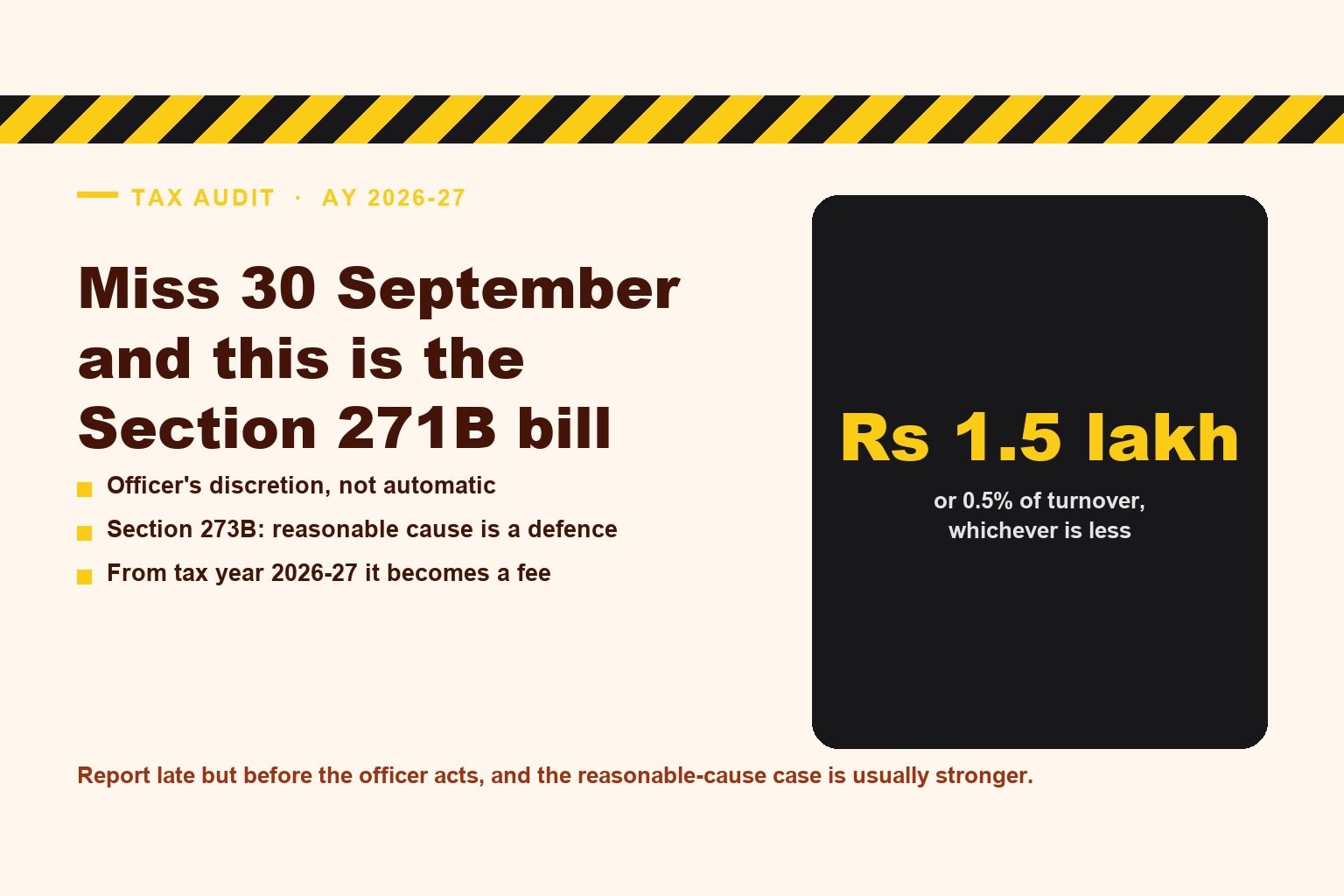

TL;DR: The tax-audit report for AY 2026-27 (FY 2025-26) is due on 30 September 2026, one month before the 31 October return date for audit cases (31 October and 30 November where a Section 92E transfer-pricing report applies). As at 10 September no extension has been notified. Miss it and Section 271B of the Income-tax Act, 1961 allows the Assessing Officer to levy a penalty of one-half per cent of turnover or gross receipts, capped at Rs 1,50,000. Two things soften that: the section says the officer may direct the penalty, and Section 273B bars it altogether if you prove reasonable cause. The bigger reason not to be late is what comes next: for tax year 2026-27 onwards, the Income-tax Act, 2025 replaces the penalty with a fee under Section 428, Rs 75,000 for a delay of up to one month and Rs 1,50,000 after that, drafted like the late-filing fee rather than like a penalty.
1. The date, and why it is 30 September
Section 44AB requires the audit report to be furnished by the specified date, which Explanation (ii) defines as one month before the due date for the return under Section 139(1). The Finance Act, 2026 rewrote the Section 139(1) table: a company, or any assessee whose accounts must be audited under the Income-tax Act or any other law, or a partner of such a firm, files by 31 October. One month before is 30 September (31 October where Section 92E applies and the return date is 30 November). The audit report precedes the return by a month, but the two dates do not automatically move together: a CBDT extension order has to extend the specified date expressly, and in 2025 the report date ended at 10 November while the return date ended at 10 December. Harsh’s piece on why the Finance Act 2026 halved the audit window tracks the extension record and the representations pending this September; this article deals with what happens if the date stands and you miss it.
Who is inside Section 44AB, and therefore inside this penalty, is a separate question: the Rs 1 crore and Rs 10 crore turnover tests, the Rs 50 lakh profession test, the presumptive opt-out cases under clauses (c) to (e). The tax audit limit hub works through them; Vijay’s companion piece on the under-8-per-cent trap covers the one that surprises small businesses.
2. What Section 271B says, and what it costs
The section is short: if any person fails to get his accounts audited for the previous year, or fails to furnish the report of such audit as required under Section 44AB, the Assessing Officer may direct a penalty of one-half per cent of the total sales, turnover or gross receipts in business, or of the gross receipts in profession, for that year, or Rs 1,50,000, whichever is less.
| Turnover or gross receipts (FY 2025-26) | 0.5 per cent | Section 271B penalty (lower of the two) |
|---|---|---|
| Business turnover Rs 60 lakh (in audit through a presumptive opt-out) | Rs 30,000 | Rs 30,000 |
| Business turnover Rs 2 crore | Rs 1,00,000 | Rs 1,00,000 |
| Business turnover Rs 3 crore | Rs 1,50,000 | Rs 1,50,000 (cap reached) |
| Business turnover Rs 10 crore | Rs 5,00,000 | Rs 1,50,000 (cap) |
| Professional gross receipts Rs 60 lakh | Rs 30,000 | Rs 30,000 |
Three points about the wording matter more than the table.
- “Or furnish a report.” The penalty attaches to a report that was signed on time but uploaded late just as it attaches to an audit that never happened. The report is “furnished” when it is filed on the portal and accepted by you, not when the auditor signs it.
- “May direct.” The penalty is not automatic and is not computed by the system. It requires a penalty proceeding, notice, and an order by the officer after hearing you.
- The base is turnover, not tax. A loss-making business with Rs 3 crore turnover faces the full Rs 1,50,000. The penalty has nothing to do with how much tax was at stake.
3. Section 273B: reasonable cause
Section 273B lists Section 271B among the provisions under which no penalty is imposable “if he proves that there was reasonable cause for the said failure”. The burden is on you, and the cause has to explain the failure to meet the date, not merely make you sympathetic.
The cause has to be one that explains the delay: outside your control, documented, and followed by compliance as soon as it could be. Examples that have been accepted on their facts, and that the ICAI’s own guidance recognises, include the auditor’s resignation or incapacity late in the season, serious illness of the person who keeps the books, seizure of records by an authority, and a natural calamity; a bona fide belief on a point of law that the audit did not apply, or a portal failure that is on record, are argued in the same way. Each case turns on its own facts; there is no list that works automatically, and pressure of work or a busy auditor is not usually enough. Two habits improve the odds: get the audit done and the report furnished as soon as possible after the date, before any notice is issued, and keep the paper (medical records, correspondence with the outgoing auditor, portal error screenshots, the CBDT’s own extension circulars showing the department recognised the difficulty) in the file from the start.
4. What else a late audit costs
The penalty is the headline, not the whole bill.
- The return follows the report. The return for an audit case is due 31 October 2026, and the portal expects the audit report to be on file before the return is filed. A late report tends to mean a late return: Section 234F fee of Rs 5,000 (Rs 1,000 where total income is up to Rs 5 lakh), Section 234A interest at 1 per cent a month, from 1 November, on the tax that remains unpaid after advance tax, TDS, TCS and the specified credits, and, under Section 80, the loss of the right to carry forward a business loss or capital loss that the belated return declares. For a loss-making year that last item is usually the most expensive line. Deep’s piece on what filing late actually costs prices it.
- Disallowances that depend on the audit. Several Form 3CD clauses feed the computation: Section 43B payments, MSME dues under Section 43B(h), TDS defaults under Section 40(a). A rushed or missing audit is where those get lost. Vijay’s Form 3CD checklist for AY 2026-27 covers the file itself.
- Presumptive lock-outs. For a business that fell into audit through Section 44AD(4), declaring below 8 per cent (6 per cent on qualifying digital receipts) with total income above the basic exemption limit is what triggered the audit under Section 44AB(e); skipping the audit does not undo the low declaration, and the five-year exclusion follows from that declaration, not from the audit.
5. From tax year 2026-27: a fee, not a penalty
This is the last audit season under Section 271B. The Income-tax Act, 2025 commenced on 1 April 2026 and governs tax year 2026-27, whose audit report is due in September 2027. The Finance Act, 2026 substituted Section 428 of the new Act, and clause (c) provides that a person who fails to get his accounts audited for any tax year and furnish the report under Section 63 (the successor of Section 44AB) shall be liable to pay, by way of fee:
| Delay | Section 428(c) fee |
|---|---|
| Up to one month for which the failure continues | Rs 75,000 |
| Thereafter | Rs 1,50,000 |
Three differences from Section 271B stand out on the face of the text. The amount is fixed, not a percentage of turnover, so a Rs 60 lakh presumptive opt-out case that would have faced Rs 30,000 faces Rs 75,000 for a week’s delay. The provision is drafted as a fee, in the same section as the late-filing fee and the fee for a late transfer-pricing report, using “shall be liable to pay” rather than “the Assessing Officer may direct”. And the fee steps up after a delay of one month, which makes that first month after the specified date the only cheap window. Whether any reasonable-cause relief reaches a Section 428 fee is a question for the 2025 Act’s penalty chapter and is not settled by the section itself; do not plan on it. The practical reading is that from next year, a late audit costs money by formula, the way a late return already does.
6. If you are going to be late: the order of operations
- Furnish a complete report on time. A report on file on the date is not a Section 271B default. Do not plan on “file now, fix later”: Rule 6G(3) allows a revised report before the end of the assessment year only where a payment made after the report requires the Section 40 or Section 43B disallowance to be recalculated.
- If you will miss it, miss it by as little as possible, and write down why, contemporaneously.
- File the return by 31 October regardless, with the report on file before it, to keep Section 234F, Section 234A and the loss carry-forward off the table.
- Respond to a Section 271B notice with the cause and the documents, and with the fact that the default was cured before the notice, which weighs heavily in these proceedings.
7. Quick answers
Is the 30 September 2026 date extended? Not as at 10 September 2026. Representations have been made; nothing has issued.
My auditor signed on 28 September but uploaded on 3 October. The report was furnished late; Section 271B is attracted in principle. Reasonable cause under Section 273B is your defence.
Is the penalty automatic? No. It needs a proceeding and an order by the Assessing Officer, who “may” levy it.
My turnover is Rs 4 crore and I made a loss. 0.5 per cent is Rs 2,00,000, capped at Rs 1,50,000. The loss does not reduce it.
I am on the presumptive scheme with turnover Rs 1.5 crore and declared 8 per cent. If you are validly within Section 44AD (turnover within its Rs 2 crore, or Rs 3 crore, ceiling) and declaring under Section 44AD(1), the proviso to Section 44AB takes you out of the section; no audit, no penalty.
What about next year? Tax year 2026-27 is under the Income-tax Act, 2025: a fee of Rs 75,000 for up to a month’s delay, Rs 1,50,000 after, under Section 428(c).
Sources
- Income-tax Act, 1961 — Section 44AB (including Explanation (ii)), Section 139(1) Explanation 2 as substituted by the Finance Act, 2026, Section 271B, Section 273B, Section 234A, Section 234F, Section 80, Section 44AD(4).
- Income-tax Act, 2025 — Section 63; Section 428 as substituted by section 96 of the Finance Act, 2026 (Gazette of India, Extraordinary, 30 March 2026).
- Income Tax Department e-filing portal — help page on due dates for AY 2026-27 (audit report 30 September 2026, return 31 October 2026), as at 10 September 2026.
Written as at 10 September 2026 for AY 2026-27 (FY 2025-26) under the Income-tax Act, 1961, with the tax year 2026-27 position under the Income-tax Act, 2025 as enacted. If CBDT extends the specified date, the 30 September references above move with it. Take advice from a Chartered Accountant on a specific case.


Comments (0)
No comments yet. Be the first to comment!