
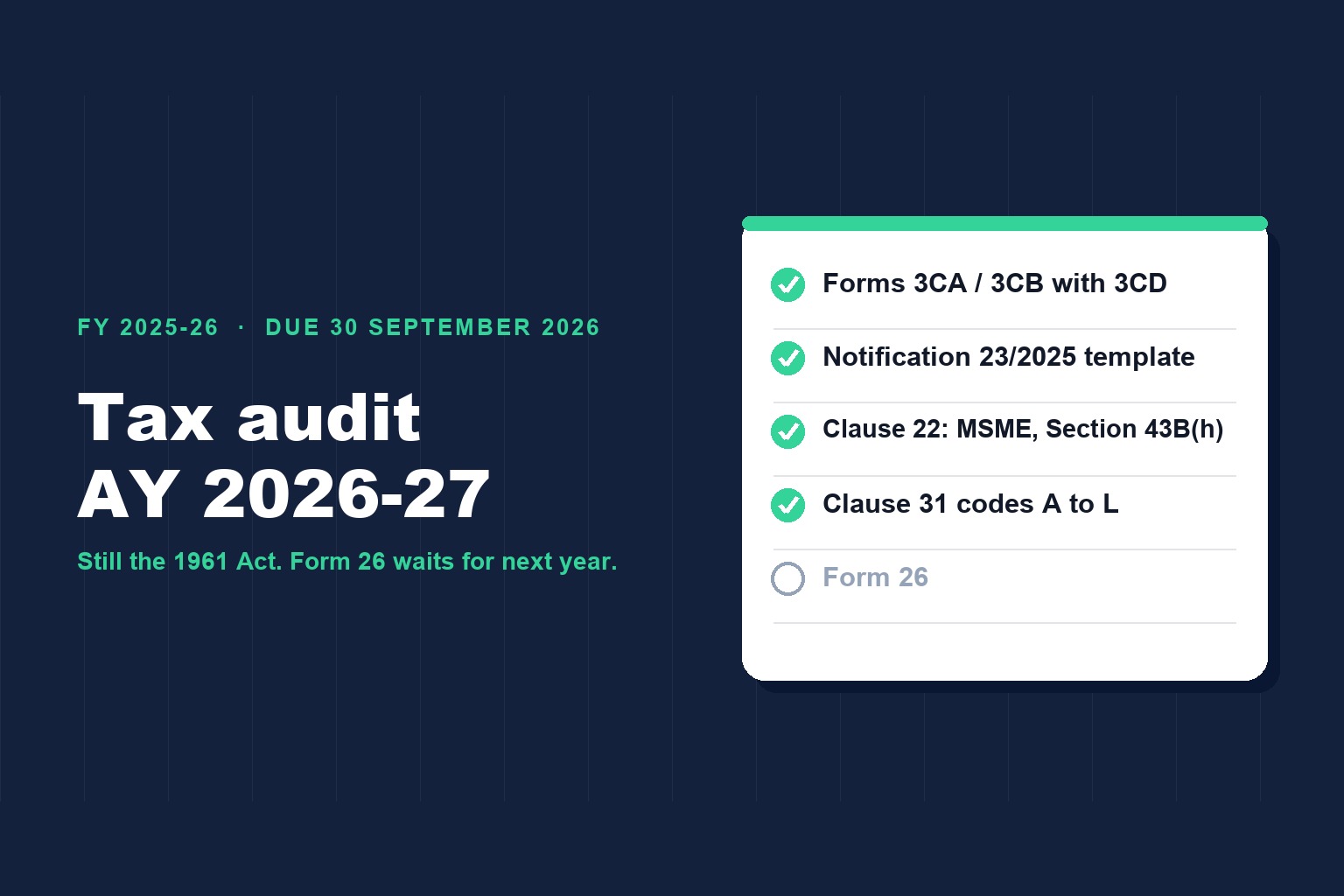

TL;DR: The tax audit you are signing this month is for FY 2025-26, which the Income-tax Act, 1961 calls assessment year 2026-27. It stays entirely under the 1961 Act: Section 44AB, Rule 6G, and Form 3CA or 3CB with Form 3CD. The new Form 26 under the Income-tax Act, 2025 does not apply to it; the Income Tax Department’s own FAQ says the old forms continue up to AY 2026-27. The report is due on 30 September 2026 for ordinary cases and 31 October 2026 where transfer-pricing reporting applies, and as at 7 September no extension has been notified. The Form 3CD you file is the one amended by CBDT Notification 23/2025: Clause 22 was rewritten around MSME dues and Section 43B(h), Clause 31 now wants a transaction code for every loan, deposit and repayment, Clause 36B asks about buyback receipts, and Clauses 28 and 29 are gone. If your working template still carries last year’s clause list, that is the first thing to fix.
1. Which law, which forms
Two years share the same digits this September, and the audit file has to be clear about which one it belongs to. Income earned between 1 April 2025 and 31 March 2026 is FY 2025-26, assessed in AY 2026-27 under the Income-tax Act, 1961. Income earned from 1 April 2026 onwards is tax year 2026-27 under the Income-tax Act, 2025, which came into force on that date. The date on which you sign or upload the report is irrelevant; what matters is the year whose accounts you are auditing. Our companion piece on AY 2026-27 versus tax year 2026-27 goes through the vocabulary; for the audit the consequences are these:
| Particular | FY 2025-26 / AY 2026-27 | Tax year 2026-27 (for comparison) |
|---|---|---|
| Governing Act | Income-tax Act, 1961 | Income-tax Act, 2025 |
| Audit provision | Section 44AB | Section 63 |
| Rule | Rule 6G, Income-tax Rules, 1962 | Rule 47, Income-tax Rules, 2026 |
| Forms | Form 3CA or 3CB, with Form 3CD | Form 26 (Parts A to D) |
| Report due (ordinary case) | 30 September 2026 | 30 September 2027 |
| Return due (audit case) | 31 October 2026 | 31 October 2027 |
The Department’s FAQ on Form 26 puts it in one sentence: Forms 3CA, 3CB and 3CD continue for previous years relevant to assessment years up to 2026-27, and Form 26 begins with tax year 2026-27. Everything in our guide to Form 26 is for next year’s season, not this one.
2. The due date, and the state of play on extensions
Section 44AB requires the report to be furnished by the “specified date”, which Explanation (ii) to the section defines as the date one month prior to the due date for furnishing the return under Section 139(1). For a company, and for any other assessee whose accounts are required to be audited, Explanation 2 to Section 139(1) sets that return date at 31 October 2026, so the audit report is due on 30 September 2026. Where the assessee has to furnish a transfer-pricing report under Section 92E, the return date is 30 November 2026 and the audit report is due on 31 October 2026.
As at 7 September 2026, no circular extending the AY 2026-27 specified date has been issued. Professional bodies have made representations, as they do every year. For AY 2025-26 the Board did extend the date, but the extension came on 25 September 2025, five days before the deadline, and after High Court proceedings. Nothing about that sequence should be planned around. Work to 30 September; if an extension arrives, it is a bonus, not a schedule.
3. Who is covered
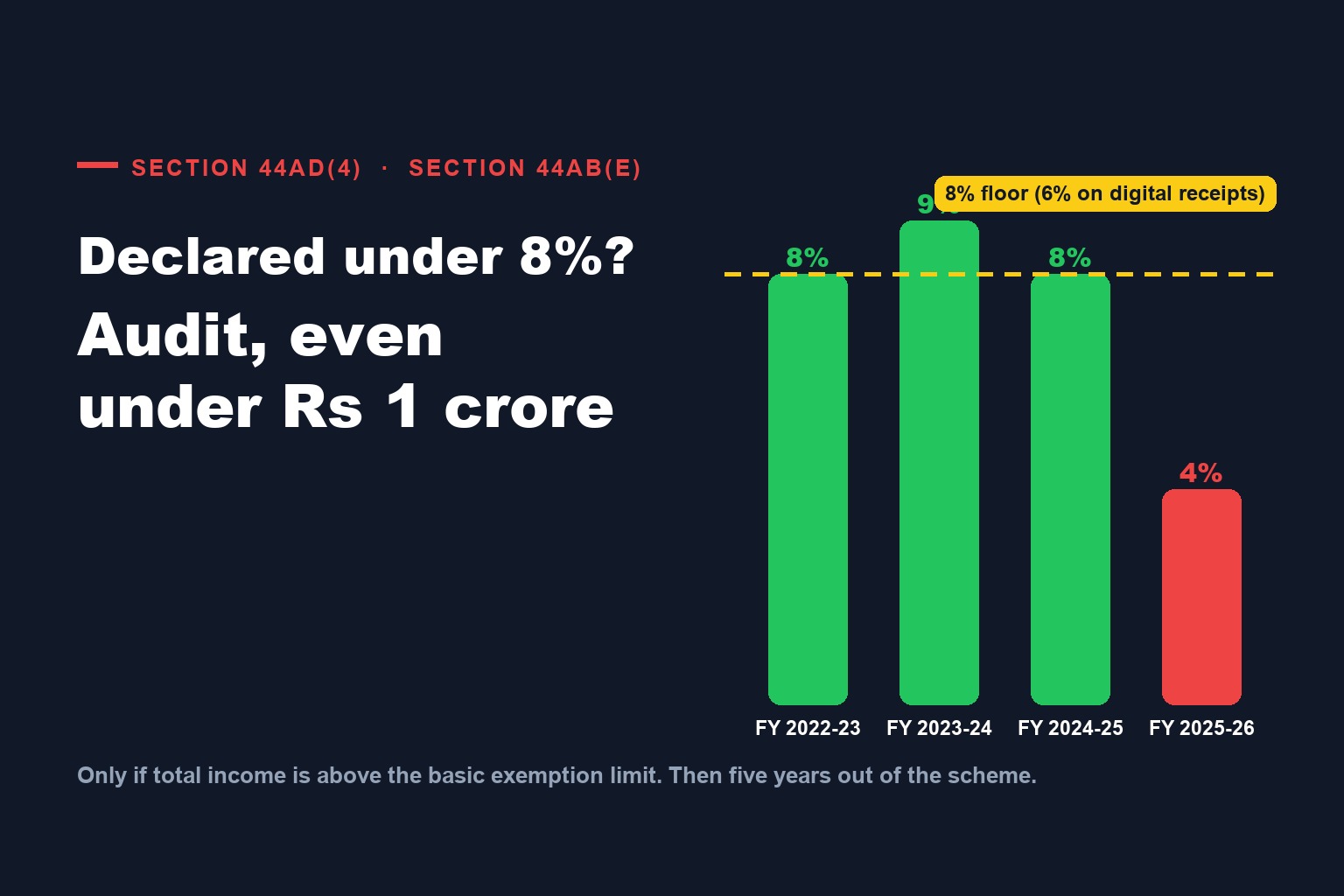
The thresholds have not moved for FY 2025-26. In brief, under Section 44AB(a) a person carrying on business needs an audit where total sales, turnover or gross receipts exceed Rs 1 crore, subject to the presumptive carve-out below; the proviso lifts that to Rs 10 crore where cash receipts are not more than 5% of aggregate receipts and cash payments are not more than 5% of aggregate payments, with a cheque or draft that is not account payee deemed to be cash for both tests. Under 44AB(b) a profession needs an audit where gross receipts exceed Rs 50 lakh. Clauses (c) to (e) bring in the presumptive cases: declaring less than the deemed profit under 44AE, 44BB or 44BBB; declaring less than the deemed profit under 44ADA with income above the basic exemption limit; and the 44AD(4) opt-out where income is above the basic exemption limit. The carve-out that matters for small traders is the proviso to Section 44AB itself: the section does not apply to a person who declares profits under Section 44AD(1) and whose business turnover does not exceed Rs 2 crore. Crossing Rs 1 crore does not, by itself, put an eligible 44AD assessee declaring the presumptive profit into audit; the lower-profit and opt-out conditions do.
Both 5% tests must be met for the higher limit, the presumptive tests turn on income declared and not on turnover alone, and the basic exemption limit for the new regime is Rs 4 lakh for this year. How the Rs 3 crore limit inside Section 44AD interacts with that proviso, and the full decision tree with the traps, is in our tax audit limit guide for AY 2026-27; this article assumes you have already established that the audit applies.
4. 3CA or 3CB, and the one revision Rule 6G allows
Rule 6G(1) decides the cover form. Where the accounts have already been audited under any other law — a company under the Companies Act, a co-operative society under its state Act, an LLP above the audit threshold — the report is in Form 3CA, and the tax auditor relies on that statutory audit. In every other case the tax auditor audits the accounts for Section 44AB purposes and reports in Form 3CB, which carries the true-and-fair opinion. Either way the particulars go in Form 3CD under Rule 6G(2).
Rule 6G(3) is worth remembering in a year when 43B(h) is in play. Where, after the report has been furnished, the assessee makes a payment that requires the disallowance under Section 40 or Section 43B to be recalculated, the report may be revised, and the revised report has to be furnished before the end of the relevant assessment year, that is by 31 March 2027. It is a narrow door, limited to those two sections, but it exists.
5. What Notification 23/2025 changed in Form 3CD
CBDT issued Notification No. 23/2025 on 28 March 2025 (G.S.R. 207(E)), the Income-tax (Eighth Amendment) Rules, 2025, in force from 1 April 2025. It amended Part B of Form 3CD in Appendix II. Because it took effect before FY 2025-26 began, every AY 2026-27 report is on the amended form. The changes, in clause order:
Clause 12: Section 44BBC added
The list of presumptive provisions in clause 12 — where profit assessable on a presumptive basis is included in the profit and loss account — now includes 44BBC, the scheme for non-residents operating cruise ships, inserted by the Finance (No. 2) Act, 2024. It affects a handful of assessees; the drop-down affects everyone.
Clause 19: four rows omitted
The rows for 32AC, 32AD, 35AC and 35CCB have been removed from the deductions table. These are dead or sunset provisions; if your template still prints them, it is out of date.
Clause 21(a): settlement expenditure
A new row has been inserted after the row for benefits and perquisites: “Expenditure incurred to settle proceedings initiated in relation to contravention under such law as notified by the Central Government in the Official Gazette in this behalf.” This tracks the Explanation added to Section 37(1) by the Finance (No. 2) Act, 2024. In practice it means any settlement, compounding or consent-type payment in the legal and professional ledger has to be examined for the character of the underlying proceeding, not booked as an ordinary business expense and moved on.
Clause 22: rewritten around MSME dues
Until 2024 the clause asked for one number, the interest inadmissible under Section 23 of the MSMED Act; Notification 27/2024 added a Section 43B(h) limb. Notification 23/2025 replaces all of that with four items:
- (i) the amount of interest inadmissible under section 23 of the MSMED Act, 2006;
- (ii) the total amount required to be paid to a micro or small enterprise under section 15 of the MSMED Act during the previous year;
- (iii)(a) of that amount, the part paid within the time given under section 15; and
- (iii)(b) the part not paid within that time and inadmissible for the previous year.
Item (iii)(b) is the Section 43B(h) disallowance, reported clause by clause. Section 6 below works through it.
Clause 26: aligned with the current Section 43B
Three drafting changes: the reference to “clause (a), (b), (c), (d), (e), (f) or (g) of” Section 43B has been dropped so the clause covers the whole section, “allowed” becomes “allowable” in sub-clause (A), and the return-due-date limb in sub-clause (B) is now qualified so that the ordinary “paid before the due date of the return” relief is reported for clauses other than the MSME clause. The reason is in the statute: the proviso to Section 43B, which allows a deduction if the sum is paid by the return due date, does not apply to clause (h). A late MSME payment made in October 2026 does not rescue the FY 2025-26 deduction.
Clauses 28 and 29: omitted
Both clauses, which dealt with receipts of shares and consideration for shares under the old Section 56(2)(viia) and (viib) reporting, are gone. Templates that still number to 44 with 28 and 29 in the middle are simply wrong.
Clause 31: a code for every loan, deposit and repayment
In sub-clauses (a) and (b), item (ii) now reads “amount of each loan or deposit taken or accepted and code of the nature of such amount, as given in Note 1”; sub-clause (c) says the same for each repayment. The notification inserts Note 1 after clause 31 with twelve codes:
| Code | Nature of amount, receipt or repayment |
|---|---|
| A | Cash payment |
| B | Cash receipt |
| C | Payment through non account payee cheque |
| D | Receipt through non account payee cheque |
| E | Transfer of asset |
| F | Transfer of liability |
| G | Conversion of assets |
| H | Conversion of liabilities |
| I | Journal entry [Debit] |
| J | Journal entry [Credit] |
| K | Any other mode [Debit] |
| L | Any other mode [Credit] |
Codes E to L are the point. Sections 269SS and 269T were always about the mode of taking or repaying a loan, and a loan settled by transferring an asset, converting it to share capital, or passing a journal entry against a related party is a mode. The clause used to be answered from the cash book and the bank book. Now the journal has to be read as well, and every entry that creates, moves or extinguishes a loan or deposit above the Section 269SS/269T limits has to be given a letter.
Clause 36B: buyback of shares
A new clause after 36A: “Whether the assessee has received any amount for buyback of shares as referred to in sub-clause (f) of clause (22) of section 2? (Yes/No)”, and if yes, the amount received and the cost of acquisition of the shares bought back. Since 1 October 2024, Section 2(22)(f) treats the buyback consideration as a deemed dividend in the shareholder’s hands, with the cost of the shares surviving as a capital loss. The clause exists so that the dividend and the loss are both visible. Investment ledgers and demat statements have to be scanned for corporate actions, which is not something a trial balance will show.
6. Clause 22 and Section 43B(h), worked through
Section 43B(h), inserted by the Finance Act, 2023 and effective from AY 2024-25, disallows any sum payable to a micro or small enterprise that is not paid within the time allowed by Section 15 of the MSMED Act, until the year in which it is actually paid. Section 15 allows payment on or before the date agreed in writing, but caps the agreed period at 45 days from the day of acceptance or deemed acceptance; where there is no written agreement, the period is 15 days. Section 16 charges compound interest, monthly, at three times the RBI bank rate on the delayed amount, and Section 23 makes that interest non-deductible. Medium enterprises are outside all of this.
Example. A supplier registered as a small enterprise delivers goods on 10 February 2026 and the buyer accepts them the same day. The purchase order says 60 days. Section 15 overrides that to 45 days, so payment is due by 27 March 2026. The buyer pays on 20 April 2026. For FY 2025-26 the amount is reported in Clause 22(ii) as required to be paid, in Clause 22(iii)(b) as not paid in time and inadmissible, and disallowed under 43B(h) in the AY 2026-27 computation. It becomes allowable in FY 2026-27, the year of payment. Paying it before the 31 October 2026 return date changes nothing, because the proviso to Section 43B does not reach clause (h). Had the buyer paid on 27 March, the same amount would have sat in Clause 22(iii)(a) and been fully deductible.
The information this needs is not in the ledger. To fill the clause you need the supplier’s Udyam registration and category, the date of acceptance of each invoice, the written credit period, and the payment date. Under the Explanation to Section 2(b) of the MSMED Act, where no written objection is raised within 15 days of delivery, the day of deemed acceptance is the day of actual delivery itself, not the fifteenth day after it; the “appointed day” is the day after 15 days from that acceptance. Counting from the wrong date shifts the Section 15 deadline and the 43B(h) disallowance with it. Whether an enterprise that meets the MSMED size criteria but has not registered on Udyam counts as a “micro or small enterprise” for this purpose is contested; obtain the registration details, document the position, and do not rely on the vendor master’s tick box.
7. A working checklist for the file
Ordered the way the work actually runs, and assuming applicability is already settled.
A. Cover form and scope
- Statutory audit under another law? Form 3CA; otherwise Form 3CB. Reconcile the assessee’s PAN, status and financial year on the cover with the return.
- Confirm the 5% cash tests are documented with figures, not asserted, if the Rs 10 crore limit is being used.
- Confirm the template is the post-Notification 23/2025 form: no rows for 32AC/32AD/35AC/35CCB in Clause 19, no Clauses 28 and 29, Clause 31 with codes, Clause 36B present.
B. Books and financial statements
- Final trial balance tied to the signed financial statements; bank reconciliations at 31 March 2026; cash balance verified; fixed asset register agreed to depreciation in Clause 18.
- Debtor and creditor ageing at 31 March, with the creditor ageing split by MSME category.
- Closing stock records and the method of valuation for Clause 14; deviation from ICDS in Clause 13.
C. GST reconciliation
- Turnover per books against GSTR-1 and GSTR-3B for April 2025 to March 2026, with each difference explained (credit notes, advances, exempt supplies, cross-year timing).
- Input tax credit per books against GSTR-2B; blocked and reversed credit identified.
- Clause 44 break-up of total expenditure between registered and unregistered suppliers, and within registered between composition and other.
D. TDS and TCS
- Every expense head that attracts deduction mapped to the section, rate and threshold; year-end provisions included.
- Deductions and deposits agreed to the quarterly statements as filed and corrected; Clause 34(a) to (c) from the statements, not from the ledger.
- Disallowance under Section 40(a)(i)/(ia) computed for non-deduction and for late deposit beyond the return due date.
E. MSME and Section 43B(h)
- MSME status of every supplier, with Udyam details; medium enterprises excluded.
- Invoice-wise acceptance dates, agreed credit periods and payment dates; amounts outside the Section 15 window listed with the 43B(h) disallowance.
- Interest under Section 16 computed and reported in Clause 22(i), whether or not the supplier has claimed it.
- Clause 22 agreed to Clause 26 and to the tax computation.
F. Loans, deposits and specified advances
- Every loan, deposit or specified sum (an advance for transfer of immovable property) taken or accepted above the Section 269SS limit, listed in Clause 31(a)/(b) with PAN, amount, maximum balance and the Note 1 code.
- Every repayment of a loan, deposit or specified advance above the Section 269T limit, listed in Clause 31(c) with the code; repayments received or made otherwise than by account-payee instrument in 31(d) and (e).
- Journal vouchers reviewed for conversions, transfers and set-offs that create or extinguish a loan; coded E to L as applicable.
- Separately, receipts and payments of Rs 2 lakh or more in cash or by non-account-payee instrument, the Section 269ST disclosures, in Clause 31(ba) to (bd).
G. Expenses and deductions
- Personal and capital items debited to the profit and loss account; penalties and fines; the new Clause 21(a) row for settlement expenditure under a notified law.
- Related-party payments under Section 40A(2)(b) for Clause 23; cash payments above the Section 40A(3) limit for Clause 21(d).
- Employee contributions to PF and ESI: date of deposit against the due date under the relevant Act, for Clause 20(b).
- Prior-period items in Clause 27; buyback receipts in Clause 36B from the investment ledger and demat statements.
H. Before upload
- Books to financial statements to GST to TDS to Form 3CD to tax computation to the return, each step reconciled and the reconciliations in the file. The portal validates the return against the audit report, and a difference you cannot explain may come back as a validation failure or a Section 139(9) defect query.
- UDIN generated for the correct clause and figures and quoted on the report; our note on field-level UDIN validation for Section 44AB covers what the portal checks.
- The assessee’s acceptance of the report on the portal is what completes the filing. A report uploaded by the auditor and not accepted is not furnished.
8. Penalty for not getting the audit done: Section 271B
Where a person who is required to get the accounts audited under Section 44AB fails to do so, or fails to furnish the report by the specified date, the Assessing Officer may impose a penalty under Section 271B of one-half per cent of the total sales, turnover or gross receipts, or Rs 1,50,000, whichever is less. It is a discretionary penalty, and Section 273B bars it altogether where the assessee proves there was reasonable cause for the failure. A report obtained and furnished late, for a documented reason, may support a reasonable-cause case on its facts; a report never obtained at all is a much harder position to defend.
9. Mistakes worth avoiding this month
- Using Form 26. It belongs to tax year 2026-27 under the 2025 Act and is not on the portal for AY 2026-27.
- Rolling forward last year’s checklist. It will have Clauses 28 and 29, no codes in Clause 31 and no Clause 36B.
- Reading Clause 22 from the closing MSME balance. The clause is invoice-wise and date-wise, and the year-end balance says nothing about invoices paid late during the year.
- Testing 43B(h) by the return date. The proviso does not apply to clause (h). The only cure is payment within the Section 15 window.
- Answering Clause 31 from the bank statement. Codes E to L exist because loans are also created and settled by journal entry.
- Waiting for an extension. None has issued, and last year’s came five days before the deadline.
10. Sources
- CBDT Notification No. 23/2025 dated 28 March 2025, G.S.R. 207(E), Income-tax (Eighth Amendment) Rules, 2025 — rule 2(a) to (j), inserting 44BBC in clause 12, omitting rows in clause 19, inserting the settlement row in clause 21(a), substituting clause 22, amending clause 26, omitting clauses 28 and 29, substituting clause 31 items and inserting Note 1, and inserting clause 36B.
- Income Tax Department, Form No. 26 — Frequently Asked Questions — FAQ 5 (due date one month before the Section 263(1) date) and FAQ 6 (Forms 3CA, 3CB and 3CD continue up to AY 2026-27).
- Income-tax Act, 1961 — Section 44AB with its provisos and Explanation (ii); Section 139(1), Explanation 2; Section 43B, clause (h) and proviso; Section 2(22)(f); Sections 269SS, 269T, 269ST; Sections 271B and 273B.
- Income-tax Rules, 1962 — Rule 6G(1), (2) and (3); Appendix II, Forms 3CA, 3CB and 3CD.
- Micro, Small and Medium Enterprises Development Act, 2006 — Sections 2(b), 15, 16 and 23.
This article describes the position as at 7 September 2026. If CBDT extends the specified date for AY 2026-27, the dates in section 2 change and nothing else does. Take advice from a Chartered Accountant on a specific position.

Comments (0)
No comments yet. Be the first to comment!