
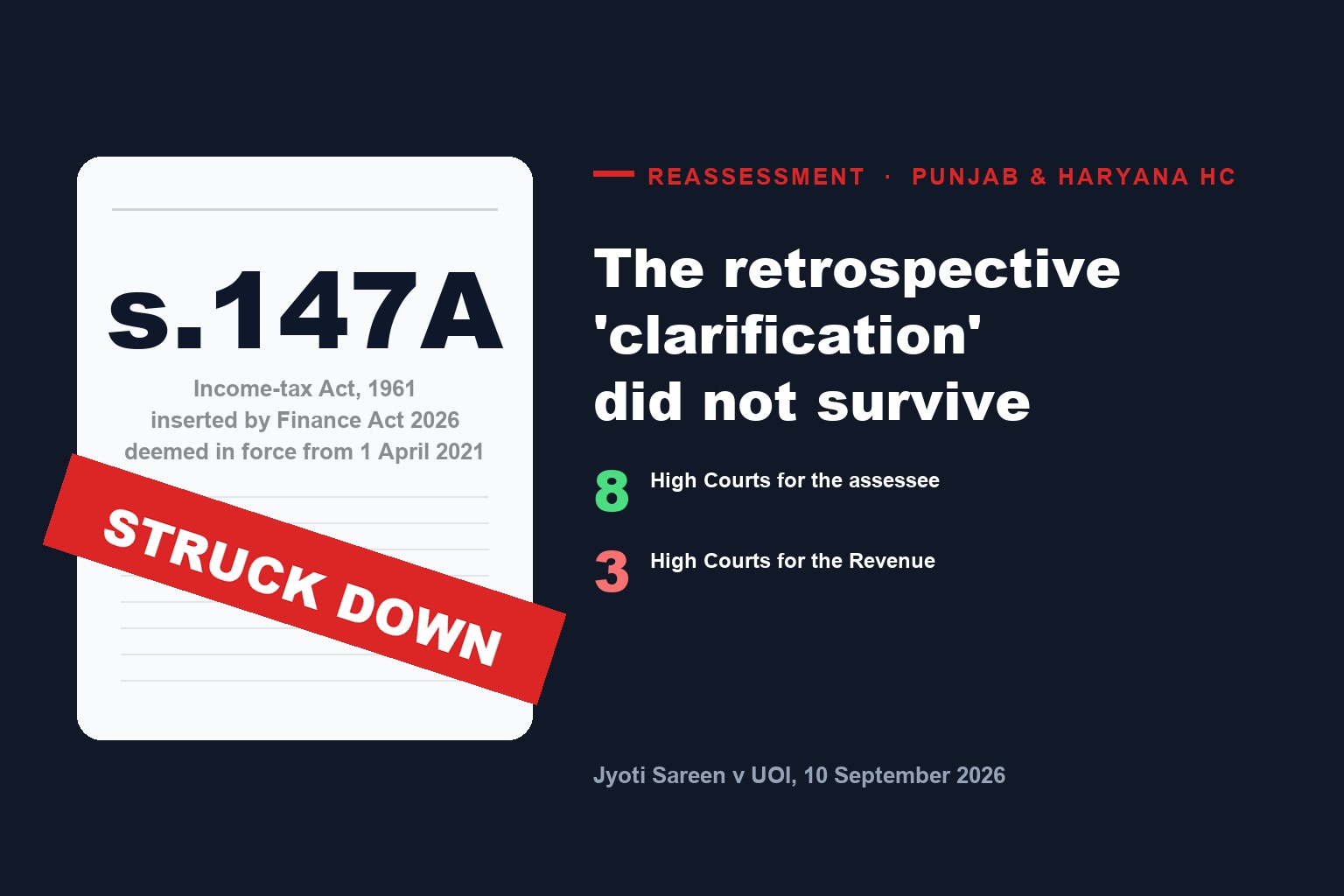

TL;DR: On 10 September 2026 a Division Bench of the Punjab & Haryana High Court (Deepak Sibal and Rupinderjit Chahal JJ) in Jyoti Sareen v Union of India, CWP No. 15791 of 2024 and a few hundred connected petitions, held Section 147A of the Income-tax Act, 1961 unconstitutional and struck it down. Section 147A was inserted by the Finance Act, 2026 with retrospective effect from 1 April 2021 to say that the "Assessing Officer" for Sections 148 and 148A has always meant the jurisdictional officer and not the faceless centre. The court held that Parliament may change the law retrospectively but may not simply declare that court judgments "shall not bind" while leaving untouched the provision those judgments were built on, Section 151A and the faceless scheme notified under it on 29 March 2022. The Section 148 notices before the court, all issued by jurisdictional Assessing Officers, were set aside on two independent grounds. The judgment binds the department in Punjab, Haryana and Chandigarh. Every other High Court has the same question in front of it, remitted by the Supreme Court on 10 April 2026 with a request to decide "preferably by 30 September 2026". If you hold a notice issued by your jurisdictional officer, this is the moment to have your jurisdiction objection on the record.
1. The dispute in one paragraph
Since 1 April 2021, reassessment has run through Section 148A (a show-cause step) and Section 148 (the notice). Section 151A lets the Central Government frame a scheme for these proceedings, and on 29 March 2022 it did: the e-Assessment of Income Escaping Assessment Scheme, 2022 (Notification No. 18/2022, S.O. 1466(E)). Clause 3 of that scheme says that assessment under Section 147 and "issuance of notice under section 148" shall be "through automated allocation, in accordance with risk management strategy formulated by the Board" and "in a faceless manner, to the extent provided in section 144B of the Act with reference to making assessment or reassessment of total income or loss of assessee". Those last words, "to the extent provided in section 144B", are what the Revenue-side judgments leaned on; Jyoti Sareen reads them as qualifying the assessment limb, clause 3(a), and holds that clause 3(b), the notice limb, would add nothing to Section 144B if it did not require the notice itself to go through automated allocation and the faceless route. The department nevertheless kept issuing Section 148 notices through the taxpayer's jurisdictional Assessing Officer (the JAO), relying on notifications under Section 120 that conferred concurrent jurisdiction on the JAO and the faceless units. Taxpayers said a JAO-issued notice is one the scheme does not permit. The Bombay High Court agreed in Hexaware Technologies (2024), and so, by the count the Punjab & Haryana bench itself gives, did the Telangana, Rajasthan, Madras, Karnataka, Andhra Pradesh and Gauhati High Courts and this court in two earlier judgments: eleven judgments across eight High Courts for the assessee. The Calcutta (Triton Overseas), Delhi (T.K.S. Builders) and Gujarat (Snehdham Trust) High Courts went the other way: three for the Revenue. The Revenue carried the assessee-side judgments to the Supreme Court.
2. What Section 147A says, and where it came from
While those appeals were pending, the Finance Act, 2026 (Section 9) inserted Section 147A into the 1961 Act, "deemed to have been inserted with effect from the 1st day of April, 2021":
"147A. Notwithstanding anything contained in any judgment, order or decree of any court or in section 151A or in any scheme framed thereunder, for the removal of doubts, it is hereby clarified that the Assessing Officer for the purposes of sections 148 and 148A shall mean and shall always be deemed to have meant to be an Assessing Officer other than the National Faceless Assessment Centre or any assessment unit referred to in sub-section (3) of section 144B."
The memorandum to the Finance Bill, quoted in the judgment, is candid about the purpose: the matter "is now pending in Hon'ble Supreme Court" and "the present amendment seeks to achieve certainty and clarity and avoid litigation". The same Finance Act (Section 71) inserted a prospective twin into the Income-tax Act, 2025: Section 279(3), under which the "Assessing Officer" for Sections 280 and 281 (the 2025 Act's reassessment provisions) "shall mean to be an Assessing Officer other than the National Faceless Assessment Centre or any assessment unit referred to in section 273(3)". The memorandum says the 1961-Act clarification is retrospective from 1 April 2021 and the 2025-Act amendment takes effect from 1 April 2026.
Two things about the drafting mattered to the court. The section is a non-obstante clause aimed at judgments. And it does not amend Section 151A, does not amend the 2022 scheme, and does not say that a Section 148 notice may be issued otherwise than through automated allocation.
3. What the Supreme Court did on 10 April 2026
The Supreme Court (Surya Kant CJI, B.V. Nagarathna and Joymalya Bagchi JJ) did not decide the merits. Its order of 10 April 2026 records that the High Courts had "primarily quashed the reassessment notices on the ground that the JAOs lacked competence" and that "the very foundation of that view now stands altered by the amending legislation". On that "limited ground" it set aside the assessee-side judgments and sent the matters back to the High Courts, with four directions that shape everything that has happened since:
- assessees could amend their petitions within four weeks to challenge Section 147A "or any other connected or consequential provision"; the Revenue had three weeks after that for its affidavits;
- "we have not expressed any opinion on the merits of the controversy, including the validity, scope, effect, retrospectivity or applicability of the amended provisions, and all such questions are left open to be decided by the High Courts";
- "during the pendency of the writ petitions before the High Courts, there shall be an interim stay of further assessment/reassessment proceedings pursuant to the impugned notices", on such terms as the High Courts impose;
- the High Courts were "requested to decide the matters preferably by 30.09.2026", with no adjournments "on mere asking".
Punjab & Haryana is the first High Court to have answered the remitted question.
4. What the court held
The petitioners asked for two things: a declaration that Section 147A is ultra vires Articles 14, 19(1)(g) and 265 of the Constitution, and, whether or not they got it, the quashing of their JAO-issued notices. They got both.
On the validating law. The bench applied the settled test for retrospective validating legislation, from Shri Prithvi Cotton Mills v Broach Borough Municipality onwards: a legislature may cure the defect a court identified and then validate what was done, but it cannot simply overrule the court. Section 147A, the court found, does the second thing. The judgments it targets rested on Section 151A and the 2022 scheme, and both remain on the statute book exactly as they were. A provision that says court decisions "shall not bind" without touching the law those decisions applied is, in the court's words, an impermissible attempt to reverse a judicial decision by legislative fiat.
On concurrent jurisdiction. The Revenue's fallback was the Section 120 notifications of 20 October 2014, 31 March 2021 and 10 June 2022, under which the JAO's powers were never withdrawn and the faceless units were added alongside. The court rejected it: once a scheme framed under Section 151A, and laid before both Houses of Parliament, requires randomised automated allocation of the officer, "there is no question of conferment of concurrent jurisdiction on faceless AOs and jurisdictional AOs", and where a departmental notification conflicts with the Act read with the scheme, the Act prevails. The bench cited the Constitution Bench in Ratan Melting & Wire Industries for the proposition that circulars contrary to statute "have really no existence in law".
On the scheme itself. The court also rejected the argument that the scheme does not reach Section 148 because it does not mention Section 148A. Clause 3(b) names the issuance of the Section 148 notice in terms; reading it out would make Section 151A a dead letter, since faceless assessment under Section 147 is already covered by Section 144B.
The operative order (paragraphs 79 and 80). Section 147A is held unconstitutional and struck down. Independently, the Section 148 notices are set aside "because such notices have not been issued through the process of randomized allocation of assessing officers and in a faceless manner as is mandated under Section 151A of the Act read with the scheme framed thereunder dated 29.03.2022". The court expressly concurs with Hexaware, Kairos Properties, its own Jatinder Singh Bhangu and Jasjit Singh, the Rajasthan (Shree Cement, Sharda Devi Chhajer), Madras (TVS Credit Services), Karnataka (Ramachandra Reddy Ravi Kumar), Andhra Pradesh (Prameela Pasumarthi) and Gauhati (Ram Narayan Sah) decisions, and "respectfully differ[s]" from T.K.S. Builders, Snehdham Trust and Triton Overseas.
5. Who this binds, and who it does not
| Where your case is | Position on 13 September 2026 |
|---|---|
| Punjab, Haryana, Chandigarh | Binding. Section 147A is struck down and JAO-issued Section 148 notices are set aside for the petitioners. The department's remedy is the Supreme Court; nothing filed had been reported when this was written. |
| Maharashtra, Goa, Telangana, Rajasthan, Tamil Nadu, Karnataka, Andhra Pradesh, Assam and the north-east | Your High Court decided for the assessee before Section 147A existed; those judgments were set aside on the limited ground and remitted. The remitted batch is pending with a 30 September 2026 target. Jyoti Sareen is persuasive, not binding. |
| Delhi, Gujarat, West Bengal | Your High Court decided for the Revenue on the pre-147A law. The Supreme Court's order of 10 April 2026 set aside and remitted only "the impugned judgments in favour of the assessees"; it did not disturb T.K.S. Builders, Snehdham Trust or Triton Overseas. A challenge to Section 147A there has to be raised in a petition that pleads it. Jyoti Sareen is persuasive and directly contrary to your court's earlier view. |
| Everywhere else | Open. Expect the department to keep issuing notices through the JAO until the Supreme Court speaks or your High Court does. |
Two caveats. First, a High Court judgment binds the income-tax authorities within its territory; it does not bind another High Court, and the Supreme Court's 10 April 2026 stay of proceedings operates only in the remitted writ petitions, on the terms each High Court sets. Second, this is a 97-page reasoned judgment, not an interim order, and the Revenue's appeal, when it comes, will be to the Supreme Court, which has already said it wants the High Courts' views first. A stay of the judgment would be reported immediately; check before relying on it in a reply.
6. If you hold a JAO-issued Section 148 notice
- Do not ignore the notice. A jurisdictional objection is a ground to be taken, not a reason to stay silent. The 30-day minimum for filing the return in response to a Section 148 notice, inserted into Section 148(1) by the same Finance Act from 30 March 2026, still runs.
- Put the jurisdiction objection on the record now, in the Section 148A reply if you are at that stage, and in the return and objections if you are past it: that the notice was issued by the jurisdictional Assessing Officer and not through automated allocation and in a faceless manner as Section 151A and the 2022 scheme require, citing Hexaware and, from 10 September 2026, Jyoti Sareen. A jurisdictional defect not raised is a jurisdictional defect the department will say you waived.
- If you are already in a writ petition in a remitted batch, your counsel will already have amended to challenge Section 147A under the liberty the Supreme Court gave; the Punjab & Haryana reasoning is now available to be placed before your court before its 30 September target.
- Answer the merits as well. Reassessment also has to clear Section 149 (time limits), the "information" requirement in Section 148, and the Section 151 sanction. A notice that fails on jurisdiction may be re-issued through the faceless route if Section 149, with its exclusions, still allows it; and Section 150(1), as substituted by the Finance Act, 2026 from 1 February 2026, lets a notice issue "at any time" to give effect to a finding or direction in an appellate, revisional or court order, subject to Section 150(2). Limitation is therefore a case-by-case question, not a guaranteed second defence. Argue both.
- Keep the file that shows how the notice reached you. The officer designation and address on the notice, the portal metadata, the Section 148A(b) show-cause and the Section 148A(d) order. Whether the officer was "chosen randomly through automated allocation" is a fact the record proves or disproves.
7. What this does not decide
The judgment is about Section 147A of the 1961 Act and notices issued under that Act. It does not consider Section 279(3) of the Income-tax Act, 2025, which was not before the court and which, per the memorandum, operates from 1 April 2026 for proceedings under the new Act. Whether the same conflict arises under the 2025 Act depends on what scheme, if any, is framed under it; that question is for another day. Nor does the judgment say the department cannot reassess the petitioners at all: it says the notices it saw were issued by the wrong route. Vijay's note on when an updated return is the wrong answer to a reassessment notice covers the other decision a notice forces, and the transition page on which Act applies to which year explains why a notice for AY 2021-22 to AY 2025-26 is still a 1961-Act notice.
8. Why the judgment matters beyond reassessment
The Finance Act, 2026 used the "shall mean and shall always be deemed to have meant" formula in more than one place. The Punjab & Haryana bench has now held that the formula, on its own, cannot reverse a line of High Court decisions if the statutory provision those decisions applied is left standing. That is a proposition about how tax law may be amended, and it will be read by every taxpayer facing a retrospective "clarification". It is also, on the court's own account, a question that "will ultimately require Supreme Court resolution". Until then, the position in Punjab, Haryana and Chandigarh is that a Section 148 notice issued by a jurisdictional officer after the 2022 scheme came into force on 29 March 2022 was issued without jurisdiction. (Section 147A reaches back to 1 April 2021; the jurisdiction objection itself dates from the scheme, not from the section.)
Sources
- Jyoti Sareen v Union of India and others, CWP No. 15791-2024 (O&M) and connected petitions, Punjab & Haryana High Court, Division Bench (Deepak Sibal and Rupinderjit Chahal JJ), reserved 8 September 2026, pronounced 10 September 2026; paragraphs 1, 41-42, 73-80.
- Finance Act, 2026 (Act 4 of 2026): section 9 (insertion of section 147A, deemed from 1 April 2021), section 10 (section 148(1), thirty days, from 30 March 2026), section 11 (section 150, substituted from 1 February 2026), section 71 (section 279(3) of the Income-tax Act, 2025).
- Supreme Court order of 10 April 2026 in the Revenue's batch of appeals against the JAO/FAO judgments (Surya Kant CJI, B.V. Nagarathna and Joymalya Bagchi JJ), paragraphs 14-28.
- e-Assessment of Income Escaping Assessment Scheme, 2022, Notification No. 18/2022 (S.O. 1466(E)) dated 29 March 2022, clause 3, as reproduced in the Supreme Court's order.
- Income-tax Act, 1961: sections 120, 144B, 147, 148, 148A, 149, 151 and 151A.
- Hexaware Technologies Ltd v ACIT (Bombay High Court, 2024); Triton Overseas Pvt Ltd v Union of India (Calcutta); T.K.S. Builders (P) Ltd v ITO (Delhi, 28 October 2024); Snehdham Trust v ACIT (Gujarat, 17 September 2025); Shri Prithvi Cotton Mills Ltd v Broach Borough Municipality (1970); CCE, Bolpur v Ratan Melting & Wire Industries (2008) 13 SCC 1, all as cited in the judgment.
This article describes a High Court judgment pronounced on 10 September 2026 as reported in its own text, and the law as it stood on 13 September 2026. It is not a prediction of what the Supreme Court or any other High Court will do. A reassessment notice is a fact-specific matter with hard time limits; act on your own notice with a practising professional, not on this page.


Comments (0)
No comments yet. Be the first to comment!