
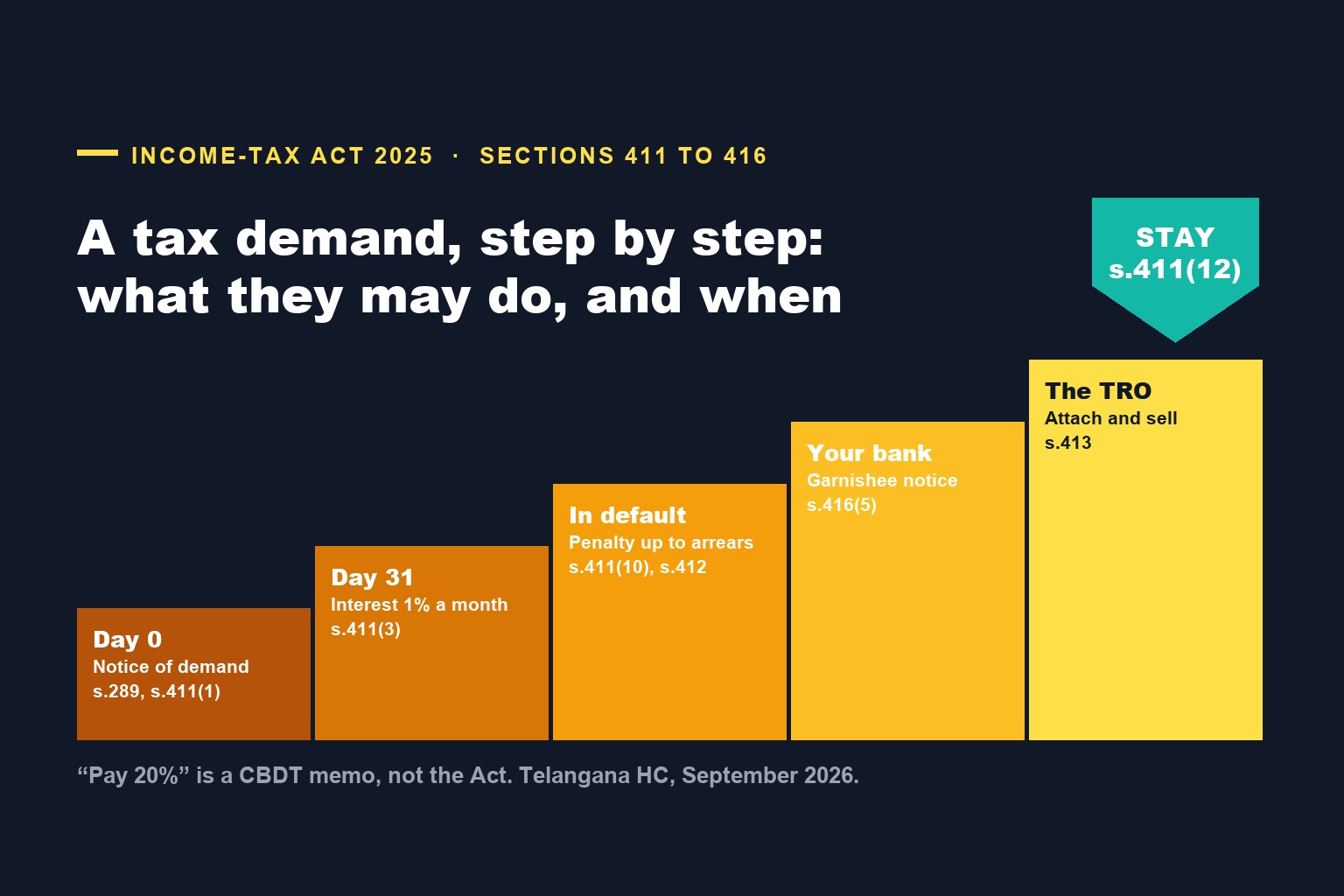

TL;DR: A notice of demand ordinarily gives you 30 days to pay (section 411(1) of the Income-tax Act, 2025). From day 31 the department charges simple interest at 1% for every month or part of a month (411(3)), and you are an "assessee in default" (411(10)). From that point the Assessing Officer, without involving anyone else, may write to your bank, your employer, your tenant or anyone who owes you money and require them to pay the department instead of you (section 416(5), the garnishee notice), and may adjust any refund against the demand after telling you first (section 438). A Tax Recovery Officer's certificate (section 413) adds attachment and sale of movable and immovable property. Filing an appeal changes none of this on its own. What changes it is a stay: section 411(12) lets the Assessing Officer, "in his discretion", treat you as not in default for the amount in dispute while the first appeal is pending. For a decade the department has run that discretion off a CBDT memorandum that says "pay 20% and you get the stay". In an order dated 20 August 2026, reported on 13 September, a Division Bench of the Telangana High Court, in VSAIPPL-SMC (JV) v ITO, set aside two stay orders because the officers had "pre-dominantly" decided them on that memorandum, and sent the applications back to be decided "strictly in accordance with the provisions envisaged under the Income Tax Act ... without being in any manner influenced by the CBDT instructions". The 20% is guidance to the officer, not a condition Parliament imposed on you, and the Supreme Court confirmed in 2018 that an officer may accept less on the facts of a case. The Budget for 2026-27 promised to cut it to 10% of "core tax demand"; as of today, nothing has been issued to do that.
1. The clock starts with the notice
A demand under the 2025 Act, whether from an assessment, a rectification or a penalty order, is served through a notice of demand under section 289; a processing intimation that shows a sum payable is deemed to be one (section 289(2)). Section 411(1) says the amount "shall be paid within (a) thirty days of the service of the notice; or (b) such period being a period less than thirty days, as specified in the notice with the previous approval of the Joint Commissioner, where the Assessing Officer has any reason to believe that it shall be detrimental to revenue if the full period of thirty days is allowed". (One special case sits in section 289(3): the deferred tax on ESOPs of eligible start-up employees carries a 14-day period.) The days run from service; for a notice delivered electronically, section 502 governs when that happens, and the portal's record of delivery is ordinarily the evidence. Note the date; every later step is measured from it.
Filing an appeal does not suspend the notice. Section 411(2) says that where an appeal "or other proceeding" is filed against the amount, "such demand shall be deemed to be valid till the disposal of the appeal by the last appellate authority", with the effect given by the Taxation Laws (Continuation and Validation of Recovery Proceedings) Act, 1964. The demand survives the appeal; it is the recovery that can be paused.
2. What day 31 costs
Section 411(3), as substituted by the Finance Act, 2026 (section 91): if the amount is not paid within the period in sub-section (1), "the assessee shall be liable to pay simple interest at 1% for every month or part of a month comprised in the period", running from the day after the 30 days end to the day of payment. Simple, not compound; a part of a month counts as a month. Two carve-outs. First, section 411(4): no interest under 411(3) for any period for which interest is already charged on the same amount under section 398(3) on a processing intimation, so a demand from an intimation is not charged twice. Second, the 2026 substitution added clause (b): no interest on a demand "raised on account of penalty levied under section 439" up to the date of the first appellate order under section 359 (or the Tribunal's order under section 363 where the assessment followed Dispute Resolution Panel directions). The 1961 Act got the same relief by a new proviso to section 220(2), but only for assessments under section 143 or reassessments under section 147 made on or after 1 April 2027; a 1961-Act penalty demand raised on an assessment made before that date still carries interest through the appeal.
Interest can be waived, but the bar is high. Section 411(7) lets the Principal Chief Commissioner, Chief Commissioner, Principal Commissioner or Commissioner reduce or waive it if satisfied on all three of: genuine hardship, default "due to circumstances beyond the control of the assessee", and co-operation in the assessment and recovery. The order has to come within twelve months of the end of the month the application is received (411(8)), and cannot reject without a hearing (411(9)). If the demand is later reduced on appeal, the interest is recomputed and any excess refunded (411(6)).
3. Asking for time, and what a missed instalment does
Section 411(5): "where an application is made by the assessee before the expiry of the due date under sub-section (1)", the Assessing Officer may extend the time or allow instalments "subject to such conditions as he may think fit to impose". Read the timing condition twice. The application for instalments has to be in before the 30 days run out; an application on day 40 is not one the sub-section contemplates. The Board's own recovery guidelines (Instruction No. 1914) told officers that instalments "may be liberally allowed so as to collect the entire demand within a reasonable period not exceeding 18 months". And section 411(11): default on any one instalment and "the assessee shall be deemed to be in default as to the whole of the amount then outstanding", with every remaining instalment deemed due on the missed date.
4. "Assessee in default", and the penalty on top
Section 411(10): if the amount is not paid within the 30 days, or the extended time, "the assessee shall be deemed to be in default". That phrase is the trigger for everything in sections 412 to 416. Section 412 adds a penalty "in addition to the amount of the arrears and the amount of interest": such amount as the Assessing Officer directs, and further amounts for a continuing default, capped at the tax in arrears (412(2)). It cannot be levied without a hearing, or where you prove "that the default was for good and sufficient reasons" (412(3)); paying the tax before the levy does not by itself end the exposure (412(4)); and if the tax is later "wholly reduced" on appeal the penalty is cancelled and refunded (412(5)).
5. What the Assessing Officer can do on their own: section 416
This is the part most taxpayers meet first, usually as a frozen bank account. Section 416(1) says that where no Tax Recovery Officer's certificate has been drawn up, "the Assessing Officer may recover the tax by any one or more of the modes provided in this section". The modes:
- Salary (416(3)): the officer may require your employer to deduct the arrears from later salary payments, except the part of salary a civil court could not attach under section 60 of the Code of Civil Procedure (416(4)).
- The garnishee notice (416(5)): "by notice in writing require any person (i) from whom money is due or may become due to the assessee; or (ii) who holds or may subsequently hold money for or on account of the assessee, to pay to the Assessing Officer or Tax Recovery Officer ... so much of the money as is sufficient to pay the amount due by the assessee in respect of arrears or the whole of the money when it is equal to or less than that amount". Banks, post offices, insurers, debtors, tenants. The notice can go to a joint account, and "the shares of the joint holders in the account ... shall be presumed, until the contrary is proved, to be equal" (416(5)(b), (c)). A copy must go to you and to every joint holder (416(5)(d)). The bank must comply without waiting for your passbook or deposit receipt (416(5)(e)). The recipient can object "by a statement on oath" that nothing is due or held (416(5)(g)), but a false statement makes them personally liable (416(5)(h)), as does paying you after receiving the notice (416(5)(k)); and a recipient who simply ignores it becomes an assessee in default themselves (416(5)(l)). The officer may amend or revoke the notice or extend time (416(5)(i)).
- Money in court (416(6)): the officer may apply to a court holding money belonging to you.
- Distraint and sale of movables (416(7)): stock, vehicles, machinery, but only "if so authorised by an income-tax authority not below the rank of Commissioner by general or special order".
Land and buildings need the Tax Recovery Officer. Section 413(1) lets the TRO draw up a certificate for the arrears and recover it by "attachment and sale of movable property", "attachment and sale of immovable property", and "appointing a receiver". The section as enacted in 2025 also listed "arrest of the assessee and his detention in prison"; the Finance Act, 2026 (section 92) replaced that pair of clauses with the receiver clause alone, and section 15 of the same Act omitted the matching clause (c) of section 222(1) of the 1961 Act from 30 March 2026. Civil arrest for income-tax arrears is no longer on the statute book. Two other TRO rules to know: you "shall not be entitled to dispute the correctness of any certificate ... on any ground" (413(3)), so the place to fight the demand is the appeal, not the certificate; and property you transferred to a spouse, minor child, son's wife or son's minor child without adequate consideration counts as yours for recovery (413(5)). Section 415 obliges the TRO to stay recovery of any part of the certificate that an appeal or other proceeding has reduced, for as long as the reducing order is itself the subject of a further proceeding under the Act, and to amend or cancel the certificate once it is final.
And the refund. Section 438(1) lets the officer set off a refund "against the sum, if any, remaining payable"; 438(2) says "any action under sub-section (1) shall be taken after giving an intimation in writing to such person of the action proposed to be taken". A set-off without a prior intimation is one you can contest. Separately, 438(3) lets the officer withhold a refund, with the Principal Commissioner's or Commissioner's approval and recorded reasons, for up to 60 days after a pending assessment is completed.
6. The stay: what section 411(12) actually says
"(12) Where an assessee has presented an appeal under section 356 or 357, the Assessing Officer may, in his discretion and subject to such conditions as he may think fit to impose in the circumstances of the case, treat the assessee as not being in default in respect of the amount in dispute in the appeal, even though the time for payment has expired, till the time such appeal remains undisposed of."
Four things in that sentence. It applies only while a first appeal, to the Joint Commissioner (Appeals) or Commissioner (Appeals), is pending; the Tribunal stage has its own rule in section 363 (part 8 below). It is the officer's discretion. It covers "the amount in dispute in the appeal", not the whole demand: tax on income you returned yourself is not in dispute, and section 358(6) will not admit the appeal at all unless that tax is paid (or, where no return was filed, the advance tax that was payable, which the appellate authority can waive for reasons recorded). And it says nothing about a percentage. Every number you have heard comes from the Board, not Parliament.
7. Where 20% came from, and what the courts have done with it
The Board's recovery guidelines, Instruction No. 1914, told officers to dispose of stay petitions within two weeks by a speaking order and listed when a stay was warranted: where the disputed demand "relates to issues that have been decided in assessee's favour by an appellate authority or court earlier", where High Courts had differed, and where the assessment was unreasonably high-pitched or payment would cause genuine hardship. It set no percentage. On 29 February 2016 the Board issued Office Memorandum F.No.404/72/93-ITCC: to "reduce arbitrariness", an officer should ordinarily grant stay "on payment of 15% of the disputed demand", could seek a higher amount (with a reference to the Principal Commissioner or Commissioner) where the addition had been confirmed on the same issue in earlier years or was backed by a High Court or Supreme Court decision, and could accept a lower amount, by the same reference, where the addition had been deleted on the same issue or the courts had gone the assessee's way. On 31 July 2017 a second memorandum of the same number revised "all references to 15% of the disputed demand" to "20% of the disputed demand", leaving the rest unchanged.
The Supreme Court looked at the 20% within a year. In PCIT v LG Electronics India (P) Ltd (Civil Appeal 6850 of 2018, 20 July 2018) it did not disturb the memoranda; it accepted the Revenue's own submission that the officer's power under section 220(6) is quasi-judicial, and made clear that on the facts of a given case the authorities may grant a stay on deposit of less than 20%. Several High Courts have since applied that: the memorandum is a guideline for the officer, and an order that recites it and imposes 20% without engaging with the appeal's merits, the taxpayer's finances or the history of the issue is not an exercise of the discretion the section confers.
The Telangana order (P. Sam Koshy and Vakiti Ramakrishna Reddy JJ, WP Nos. 27454, 27512 and 27534 of 2026, 20 August 2026) is the latest and the clearest. The petitioner held stay orders for three assessment years (2022-23 to 2024-25), each conditioned on 20%. The department's answer was that the officers "have considered the submissions put forth by the petitioner and thereafter, have imposed the condition". The Bench read the orders and disagreed: the first "starts with reference to the instructions both in para No.1 as also para No.2 and only thereafter, the authority proceeded", and the second "heavily relied upon the instructions ... requiring depositing of 20% for granting of stay". Its conclusion, in paragraph 8: section 220(6) "very emphatically makes it clear that the authority concerned has to exercise its discretion by taking into consideration the overall facts and circumstances of the case, decide the stay application, and also decide whether any conditions, if at all, have to be imposed, and, if so, what should be the nature of such conditions and to what extent. This aspect is totally absent from the impugned orders". Both orders were set aside; the applications go back to the first officer to be decided within four weeks "without being in any manner influenced by the CBDT instructions"; no coercive steps meanwhile. The order construes section 220(6) of the 1961 Act because those were 1961-Act years, and section 411(12) of the 2025 Act is the same sentence with new cross-references.
8. The Budget's 10%, and where it stands
Paragraph 113 of the Budget speech of 1 February 2026 said: "Further, quantum of pre-payment is being reduced from 20 percent to 10 percent and will continue to be calculated only on core tax demand." Two things about that sentence are worth knowing. The speech does not define "core tax demand"; the natural reading is the tax component alone, as against the tax plus interest plus penalty that the 2016 memorandum's "disputed demand" captures. If the implementing memorandum reads it that way, then on a Rs 80 lakh demand of which Rs 50 lakh is tax, 10% of core would be Rs 5 lakh against 20% of Rs 80 lakh, Rs 16 lakh; until the memorandum defines the base, treat that arithmetic as an illustration, not a rule. And the sentence describes an administrative benchmark, so the instrument that changes it is a Board memorandum, not the Finance Act. The Finance Act, 2026 left sections 220(6) and 411(12) untouched, and as at 14 September 2026 we have not traced a memorandum replacing the 2017 one. Until it is issued, the officer in front of you is still reading "20% of the disputed demand" from 2017; after the Telangana order, that is not something the officer may simply apply.
The Tribunal stage is different, and there the percentage is in the Act. Section 363(6): the Appellate Tribunal may stay proceedings in an appeal before it for up to 180 days "subject to the condition that the assessee (a) deposits not less than 20% of the amount of tax, interest, fee, penalty or any other sum payable under this Act; or (b) furnishes security of equal amount". Extension needs the same condition and a finding that the delay is not yours, capped at 365 days in all (363(7)), after which the stay stands vacated (363(8)). That is Parliament's 20%, and no memorandum or Budget speech touches it.
9. If the demand notice has just arrived
- Diary day 30 from service. Everything in this note keys off it.
- Check the demand for an apparent mistake first. A demand from a processing intimation that ignores TDS or a paid challan is rectified, not appealed; a rectification application also matters for limitation under section 358(4).
- File the appeal within 30 days (section 358(3)), with the tax on the returned income paid (358(6)). Section 411(12) speaks of an appeal that has been presented; do not hand the officer the answer that yours is not even admissible.
- File the stay application with the Assessing Officer at the same time, and before day 30, so that the instalment option in 411(5) is also open. Argue the merits, not the percentage: covered issues decided in your favour, a high-pitched addition, hardship, the history of the same issue in your own earlier years. Cite section 411(12), LG Electronics and the Telangana order. Ask for a speaking order and, if any payment is to be a condition, that it be reasoned and confined to the tax component.
- If the officer's order simply recites 20%, the 2016 memorandum itself gives you a review to the Principal Commissioner or Commissioner, and the writ route the Telangana petitioner took.
- Expect a section 438(2) intimation before any refund is adjusted, and respond to it; an adjustment against a demand under a valid stay is contestable.
- If a section 416(5) notice has already gone to your bank, the recipient is bound to comply; the way out is a stay or a revocation under 416(5)(i), not an argument with the branch. Ask the officer to revoke on the strength of the stay order or the pending application.
For the appeal itself, our note on the Punjab & Haryana judgment on section 147A covers the jurisdiction point for reassessment demands, and when an updated return is the wrong answer to a notice covers the one thing you should not do in reaction to a demand. The interest that accrues on the underlying tax before the demand is in sections 234A, 234B and 234C explained.
Sources
- Income-tax Act, 2025: sections 356, 358, 363, 411, 412, 413, 415, 416, 438; read on incometaxindia.gov.in on 14 September 2026 (the site's section 413 page still carries the pre-amendment clauses).
- Finance Act, 2026 (Act 4 of 2026): sections 14 (proviso to section 220(2) of the 1961 Act, deemed from 1 March 2026), 15 (omission of section 222(1)(c) of the 1961 Act from 30 March 2026), 91 (substitution of section 411(3)) and 92 (substitution of section 413(1)(c)-(d)).
- Budget speech 2026-27, 1 February 2026, paragraph 113.
- VSAIPPL-SMC (JV) v Income Tax Officer, Telangana High Court, Division Bench (P. Sam Koshy and Vakiti Ramakrishna Reddy JJ), common order dated 20 August 2026 in WP Nos. 27454, 27512 and 27534 of 2026 (AYs 2022-23, 2023-24 and 2024-25), paragraphs 3 to 11, as reported on 13 September 2026.
- PCIT v LG Electronics India (P) Ltd, Supreme Court, 20 July 2018, (2018) 18 SCC 447.
- CBDT: Instruction No. 1914 dated 2 December 1993 (recovery of outstanding demand); Office Memorandum F.No.404/72/93-ITCC dated 29 February 2016; Office Memorandum of the same number dated 31 July 2017.
- Income-tax Act, 1961: sections 156, 220(1), (2), (3) and (6), 221, 222, 226(3), 245 and 254(2A), the provisions the 2025 sections replace. Section 536 of the 2025 Act keeps them in force for proceedings relating to tax years that began before 1 April 2026, which includes FY 2025-26 (AY 2026-27), so a demand for any year up to AY 2026-27 is a 1961-Act demand even if raised after 1 April 2026.
This article describes the recovery provisions as they stood on 14 September 2026 and one High Court order as reported in its own text. The Telangana order binds the department in Telangana and is persuasive elsewhere; a stay is fact-specific and time-bound. Act on your own demand with a practising professional, not on this page.


Comments (0)
No comments yet. Be the first to comment!