
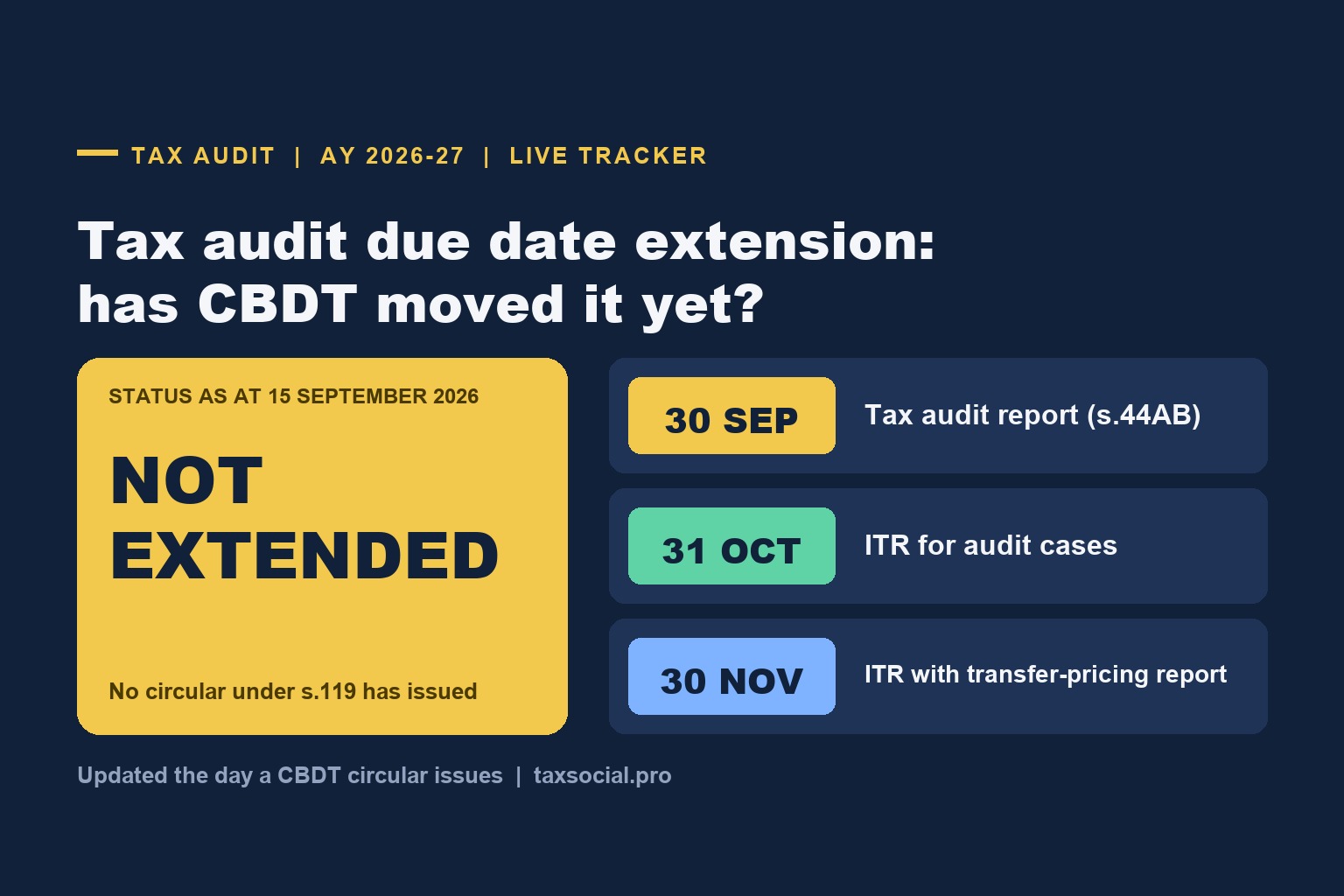

Status as at 17 September 2026, 10 am IST: NOT extended. The tax audit report under Section 44AB for AY 2026-27 (FY 2025-26) is due on 30 September 2026, and the return for audit cases on 31 October 2026. Where a transfer-pricing report under Section 92E is required, the return is due 30 November 2026 and the audit report one month earlier, on 31 October 2026. No CBDT circular under Section 119 extending the specified date has issued. Six associations have written to the Finance Minister or the Board; ICAI has said it will not ask unless there is a compelling reason. This page is re-dated every time we check and rewritten the day a circular issues.
1. The status board
| Item | Position as at 17 September 2026 |
|---|---|
| Tax audit report (Forms 3CA/3CB-3CD), AY 2026-27 | 30 September 2026. Not extended. (Section 92E cases: 31 October 2026, one month before their 30 November return date.) |
| Return of income, audit cases (other than Section 92E) | 31 October 2026. Not extended. |
| Return of income, Section 92E cases | 30 November 2026. Not extended. |
| CBDT circular under Section 119 | None issued. The department’s own help page still reads “30th September, 2026 for cases where the ITR due date is 31st October, 2026”. |
| Representations published so far | Chartered Accountants Association, Jalandhar (6 September, to the Finance Minister); The Punjab Accountants Association (11 September, to the Finance Minister); Tax Bar Association, Bhilwara (14 September, to the CBDT Chairperson); Chandigarh Chartered Accountants Taxation Association (14 September, to the Finance Minister); Maharshi Bharadwaj Chartered Accountants’ Association, Prayagraj (published 16 September, to the Finance Minister); Bikaner Tax Consultants Association (15 September, to the Finance Minister). Details in section 3. The list is what we have found, not necessarily everything sent. |
| ICAI position | Will not seek an extension “unless there are compelling or urgent reasons” (reported 12 September 2026). |
| High Court petitions for AY 2026-27 | None that we have found. |
| Days left to the specified date | 13, including today. |
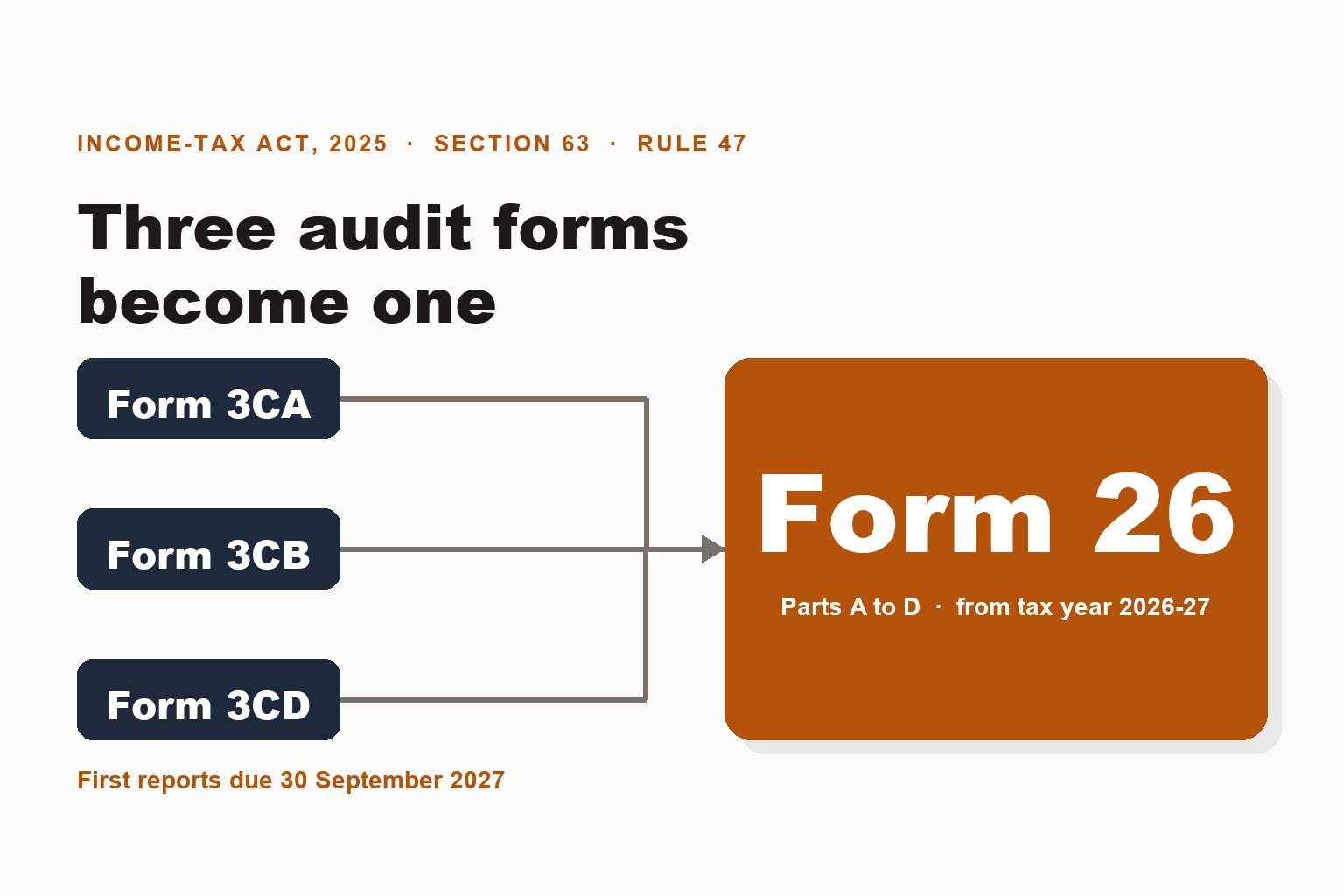
The dates come from Section 44AB of the Income-tax Act, 1961, read with the table the Finance Act 2026 wrote into Explanation 2 to Section 139(1). The “specified date” for the audit report is one month before the return date, so 31 October produces 30 September. Nothing in the Finance Act touched the audit provision itself. AY 2026-27 is the last year under the 1961 Act; the Income-tax Act, 2025 applies from tax year 2026-27. Which Act applies to which year is set out separately.
2. Update log
17 September (Thursday). No circular. Two more letters surfaced: the Bikaner Tax Consultants Association’s representation to the Finance Minister, dated 15 September, was published this morning, a day after the Maharshi Bharadwaj Chartered Accountants’ Association, Prayagraj published its own. Both ask for 31 October (section 3). Six associations have now written. Nothing from the Board.
16 September (Wednesday). No circular. Two more representations, both dated 14 September, were published on 15 September: the Tax Bar Association, Bhilwara wrote to the CBDT Chairperson and the Chandigarh Chartered Accountants Taxation Association wrote to the Finance Minister, each asking for 31 October (section 3). Nothing on the CBDT circulars page, the e-filing portal’s news panel or the department’s X account speaks to the specified date.
15 September (Tuesday). No circular. Second advance-tax instalment fell due, as did the close of the CCFS-2026 window. Search interest in “tax audit date extension” was the highest of the month, which is why this page exists.
14 September (Monday). Ganesh Chaturthi. Offices in Maharashtra, Gujarat, Goa and parts of Karnataka begin the ten-day festival that ends on Anant Chaturdashi, 25 September. The same day, the Tax Bar Association, Bhilwara (about 250 members) writes to the CBDT Chairperson, and the Chandigarh Chartered Accountants Taxation Association writes to the Finance Minister, both asking for 31 October. No circular.
11 September (Friday). The Punjab Accountants Association writes to the Finance Minister asking for the audit report date to move from 30 September to 31 October 2026. Its case: one month between the 31 August non-audit return date and the audit report is not enough, the enhanced financial-statement and disclosure requirements for non-corporate assessees, the staggered release of return forms and utilities, and a reasonable framework needs about two months between the two milestones.
12 September (Saturday). CAClubIndia reports ICAI Central Council member CA Sanjay Agarwal as saying the Institute will not pursue an extension unless there are compelling or urgent reasons, and advising members to plan assignments and manage workloads. The same report carries a poll in which more than 80 per cent of participating chartered accountants said they had completed only 10 to 30 per cent of their tax audit work.
7 September (Monday). The Jalandhar representation is published. TaxSocial runs the argument for moving the date to 31 October.
6 September (Sunday). The Chartered Accountants Association, Jalandhar writes to the Finance Minister asking for the audit report date to move to 31 October 2026.
31 August (Monday). Return date for business and professional assessees not liable to audit. This is the first year that date is 31 August rather than 31 July, which leaves one calendar month, and far fewer working days, before the audit report is due.
3. Who has asked, and for what
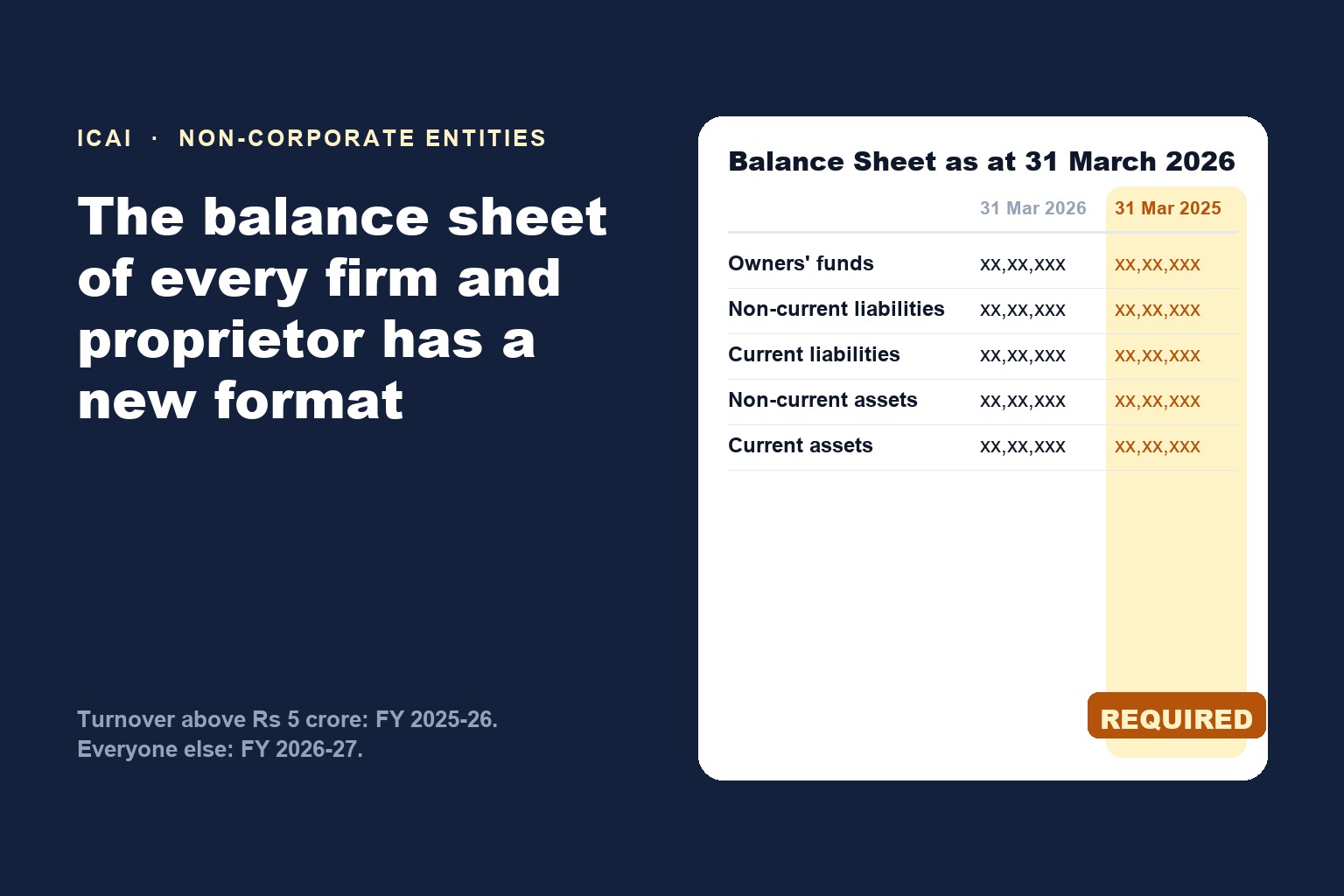
Chartered Accountants Association, Jalandhar, 6 September 2026. Addressed to the Finance Minister. Two alternatives: extend the tax audit report date from 30 September to 31 October 2026, with the same extension for Forms 10B and 10BB and other audit reports; or synchronise the audit report and the audit-case return at 31 October 2026. The reasons: the 31 August date for non-audit business returns now overlaps the audit season; the return utilities came late (ITR-3 on 18 June, ITR-5 on 7 July, ITR-7 on 9 July, ITR-6 on 4 August, with the online utilities 15 to 20 days after each form); and the new mandatory ICAI financial-statement format adds disclosure, compilation and verification work for every non-corporate assessee this year. That format is explained here.
The Punjab Accountants Association, 11 September 2026. Addressed to the Finance Minister. Asks for 31 October 2026 for the tax audit report. The reasons overlap with Jalandhar: the one-month gap after 31 August, the detailed verification and reconciliation work a report needs, the enhanced financial-statement and disclosure requirements for non-corporate assessees this year, and the staggered release of return forms and utilities. It puts the reasonable gap between the two milestones at about two months.
Tax Bar Association, Bhilwara, 14 September 2026. Reference TBA/CBDT/REP/2026-27/01, addressed to the Chairperson, CBDT, invoking Section 119. Asks for 31 October 2026 for the tax audit report and the same for Forms 10B and 10BB. Reasons: the ITR-3 and ITR-5 utilities were updated as late as 1 September, leaving thirty days; the ICAI financial-statement format for non-corporate entities; the 31 August non-audit date concentrating the work; and the verification and reconciliation a report needs across books, GST returns, TDS records and related-party transactions.
Chandigarh Chartered Accountants Taxation Association, 14 September 2026. Addressed to the Finance Minister. Asks for 31 October 2026 for Forms 3CA/3CB-3CD and for Forms 10B and 10BB, with a proportional extension of the audit-case return. Reasons: utilities released progressively with several updated on 1 September; difficulty accessing AIS, TIS and Form 26AS; overlapping GST, TDS/TCS and MCA deadlines; the new ICAI reporting guidance. It makes the structural point this page also makes: relief was granted in six of the last seven years outside the Covid years, so the difficulty is recurring, not exceptional.
Maharshi Bharadwaj Chartered Accountants’ Association, Prayagraj, published 16 September 2026. Addressed to the Finance Minister. Asks for 31 October 2026 and, beyond this year, for a permanent two-month interval between the non-audit and audit return dates. Reasons: the utilities (ITR-3 on 18 June, ITR-5 and ITR-7 on 7 July, ITR-6 on 4 August), the reconciliation a report now needs across GST records, Form 26AS, TDS and TCS data, related-party transactions and cash flows, and the ICAI financial-statement format for non-corporate entities.
Bikaner Tax Consultants Association, 15 September 2026. Addressed to the Finance Minister, published 17 September. Asks for 31 October 2026 for Forms 3CA/3CB-3CD and Forms 10B/10BB, with the audit-case return moved to match and relief from the interest and penalties that a compressed window produces. Adds two reasons the others do not: utility and schema changes running into early September, and the Rajasthan municipal and panchayat elections spread across September, which take working days out of the month.
ICAI. No 2026 representation from the Institute has been located by this tracker as at 17 September. Its public position, through a Central Council member on 12 September, is that members should plan for 30 September and that the Institute will act only if there is a compelling reason. That is a change of posture from 2025, when the Institute did make a representation, and it matters, because the Board’s circulars have historically cited representations from professional bodies as the ground for extension.
Nobody else that we have found. Several pieces circulating this week quoting the Bombay Chartered Accountants’ Society, the Advocates Tax Bar Association and the Nagpur Chamber are from September 2025 and concern AY 2025-26. We have not cited them. If a 2026 representation from any of them surfaces, it will be logged above.
4. The extension record, 2022 to 2025
The expectation of an extension is not superstition. It is a pattern, and the pattern has a shape: the circular comes in the last week, sometimes on the last day, and it moves the report date first and the return date, if at all, later.
| AY | Circular | Dated | What it did | Days before the deadline |
|---|---|---|---|---|
| 2022-23 | No. 19/2022 | 30 September 2022 | Audit reports 30 September to 7 October 2022 | 0 |
| 2023-24 | None | — | The general date stayed at 30 September 2023 | — |
| 2024-25 | No. 10/2024 | 29 September 2024 | Specified date 30 September to 7 October 2024, citing difficulties in electronic filing of audit reports | 1 |
| 2025-26 | No. 14/2025 | 25 September 2025 | Specified date 30 September to 31 October 2025, under Section 119, for “report of audit under any provisions of the Act” | 5 |
| 2025-26 | No. 15/2025 | 29 October 2025 | Audit report to 10 November 2025; audit-case return to 10 December 2025 | 2 |
Three things to read off that table. First, in three of the last four years the date moved, and in 2023 it did not, so a firm that plans on an extension is betting on form and not on law. Second, the 2022 and 2024 extensions were a week; only 2025 gave a month, and 2025 had floods, a return season that had itself been pushed to 16 September, and High Court petitions. Third, the circular that moved the report date in 2025 did not, on its face, move the return date. Explanation (ii) to Section 44AB defines the specified date as one month before the return date, so the Income Tax Bar Association went to the Gujarat High Court, which on 13 October 2025 (Income Tax Bar Association v. Union of India, SCA 13533 of 2025, Bhargav D. Karia and Pranav Trivedi JJ) held that the Board ought to have extended the return date as a consequence of extending the specified date, and directed it to issue a circular under Section 119 taking the audit-case return to 30 November 2025. Circular 15/2025 followed on 29 October. The law, then, is that the two dates are linked; the practice is that you still wait for the circular that says so, and for the circular to say whether interest under Section 234A is affected.
5. Where an extension would appear first
An extension is an order of the Board under Section 119 of the 1961 Act. It is not a press statement, a tweet from a professional body, or a screenshot. In the order in which they usually appear:
- The department’s X account, @IncomeTaxIndia. In 2025 the post went up the same evening as the circular, with the circular’s wording.
- The circular itself, on the Circulars page of incometaxindia.gov.in, with a number and an F. No. The 2024 circular was F. No. 225/205/2024/ITA-II.
- A PIB press release, usually within the hour.
- The e-filing portal’s “Latest updates” panel and, a day or so later, the utilities.
Anything that does not carry a circular number and a date is a rumour. Every extension season produces forwards that look like circulars. Check the number against the department’s own Circulars page before you tell a client.
6. If no extension comes
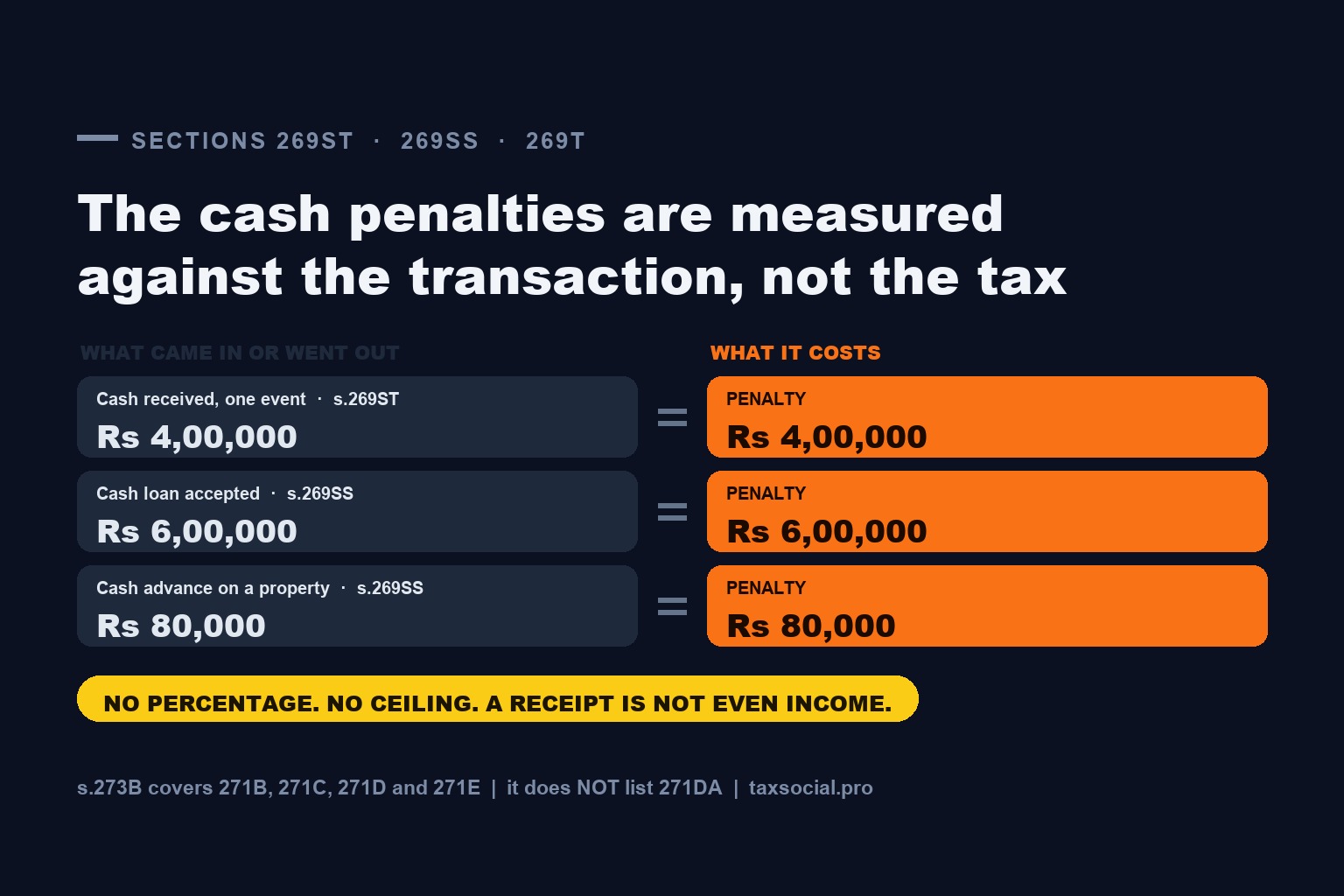
Work to 30 September. Upload, do not merely sign: a report signed on 28 September and uploaded on 3 October is a late report. If a report is late, Section 271B allows a penalty of one-half per cent of turnover or gross receipts, capped at Rs 1,50,000, at the Assessing Officer’s discretion, and Section 273B bars it where the assessee shows reasonable cause. The penalty, with worked figures, is here. The return for audit cases other than Section 92E cases stays due on 31 October regardless of the report; Section 92E cases stay at 30 November. A documented reason for delay is a defence; a hoped-for extension is not. The fifteen-document list and the AY 2026-27 Form 3CD checklist are the two pages to work from.
From tax year 2026-27 the calculus changes: the Income-tax Act, 2025 replaces the discretionary penalty with a fixed fee under Section 428(c), Rs 75,000 for a delay of up to a month and Rs 1,50,000 after. That is next year’s problem, but it is the reason the profession is asking Parliament, not just the Board, to fix the calendar.
7. If an extension comes
Read the circular for four things. Which date it moves (the specified date for the report, the return date, or both). Whom it covers (the 2025 circular was limited to assessees in clause (a) of Explanation 2 to Section 139(1), and covered every audit report under the Act, which is why Forms 10B and 10BB moved with it). Whether it says anything about Section 234A. And whether the return date is moved in the same circular; the Gujarat High Court held in 2025 that an extended specified date carries the return date with it under Explanation (ii) to Section 44AB, but the Board had to be directed to say so, and until it does the portal will not know. This page will carry the answers to all four the day it issues.
FAQ
Has the tax audit due date for AY 2026-27 been extended? No, as at 17 September 2026. The report is due 30 September 2026.
Is there any news of an extension? Six published representations (Jalandhar, 6 September; Punjab Accountants Association, 11 September; Tax Bar Association Bhilwara and the Chandigarh CA taxation association, both 14 September; Prayagraj, published 16 September; Bikaner, 15 September) and a public statement from ICAI that it will not ask without a compelling reason. No circular.
What is the ITR due date for audit cases? 31 October 2026; 30 November 2026 where a Section 92E report is required. Neither has been extended.
When did CBDT extend last year? On 25 September 2025 (Circular 14/2025, to 31 October) and again on 29 October 2025 (Circular 15/2025, to 10 November, with the return to 10 December).
Did it extend every year? No. 2022 and 2024 saw a week, 2025 a month and then more, 2023 nothing.
Will an extension of the report date also extend the return date? In law it should: the specified date is defined as one month before the return date, and the Gujarat High Court said so in October 2025. In practice the 2025 return extension came in a second circular five weeks after the first, and only after the Court directed it. Wait for the circular.
Where do I check? The Circulars page on incometaxindia.gov.in and the @IncomeTaxIndia account. A circular has a number and a date; a forward does not.
What if I miss 30 September? Section 271B, one-half per cent of turnover up to Rs 1,50,000, discretionary, with reasonable cause a defence under Section 273B.
Sources
- Income-tax Act, 1961, s.44AB Explanation (ii); s.139(1) Explanation 2 as substituted by the Finance Act, 2026, s.5; s.119; s.271B; s.273B.
- Income-tax Act, 2025, s.63 and s.428(c) as substituted by the Finance Act, 2026, s.96.
- Income Tax Department e-filing portal, help page “Income Tax Returns” and “Latest updates”, as read on 15 September 2026.
- CBDT Circular No. 19/2022 dated 30 September 2022; Circular No. 10/2024 dated 29 September 2024; Circular No. 14/2025 dated 25 September 2025; Circular No. 15/2025 dated 29 October 2025.
- Chartered Accountants Association, Jalandhar, representation dated 6 September 2026 (published 7 September); The Punjab Accountants Association, 11 September 2026; Tax Bar Association, Bhilwara, TBA/CBDT/REP/2026-27/01 dated 14 September 2026; Chandigarh Chartered Accountants Taxation Association, 14 September 2026 (the last two published 15 September); Maharshi Bharadwaj Chartered Accountants’ Association, Prayagraj (published 16 September 2026); Bikaner Tax Consultants Association, 15 September 2026 (published 17 September).
- CAClubIndia, “CAs under tax audit pressure as Sept 30 deadline approaches: no CBDT extension yet”, 12 September 2026.


Comments (0)
No comments yet. Be the first to comment!