
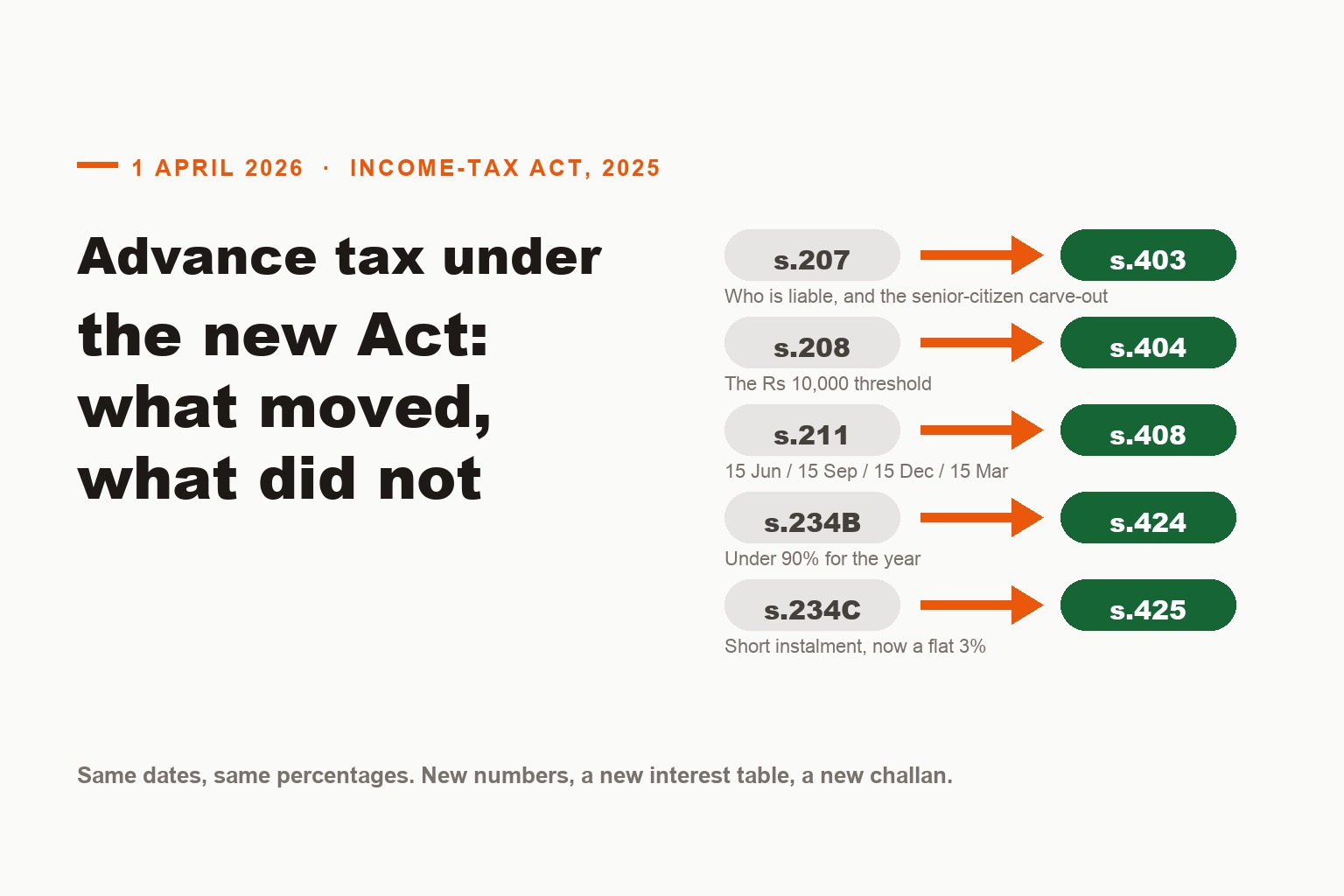

TL;DR: Tax year 2026-27 is the first year in which advance tax is paid under the Income-tax Act, 2025, which commenced on 1 April 2026. The substance is almost entirely carried over from the 1961 Act: the same four dates, the same 15/45/75/100 per cent, the same Rs 10,000 threshold, the same senior-citizen exclusion, the same 12 and 36 per cent tolerances, the same single March instalment for presumptive business and profession declarants (Section 58(2) Sl. No. 1 and 3). What changed is the map (Sections 207 to 211 are now 403 to 408, 234B is 424, 234C is 425), the drafting of the interest table (a flat 3 per cent instead of “1 per cent a month for three months”, the same money), the vocabulary (“tax year” instead of previous year and assessment year) and the challan (ITNS 280N, after selecting the Act on the portal). The Finance Act, 2026 made one targeted change to the interest provisions, a cross-reference, in two places.
1. The map
| What it does | Income-tax Act, 1961 | Income-tax Act, 2025 |
|---|---|---|
| Liability to pay advance tax on current income; exclusion for a resident individual aged 60 or more with no business or professional income | Section 207 | Section 403 |
| Advance tax payable only where it is Rs 10,000 or more | Section 208 | Section 404 |
| Computation: tax on estimated income less TDS and TCS | Section 209 | Section 405 |
| Payment on the assessee’s own estimate; revising later instalments | Section 210 (part) | Section 406 |
| Payment on the Assessing Officer’s order; the assessee’s lower estimate | Section 210 (part) | Section 407 |
| Instalments and due dates; presumptive single instalment; 31 March rule | Section 211 | Section 408 |
| Interest for paying less than 90 per cent for the year | Section 234B | Section 424 |
| Interest for a short or missed instalment | Section 234C | Section 425 |
The mapping is the whole reason to keep the old numbers in your head for one more year: FY 2025-26, whose return is being filed now, is still the 1961 Act, so the belated-return, self-assessment and interest computations for that year cite 234B and 234C. Anything you do about the year running 1 April 2026 to 31 March 2027 cites 424 and 425. Deep’s explainer on AY 2026-27 versus tax year 2026-27 is the one to send to anyone confusing the two.
2. What did not change
- The dates and the percentages. Section 408(1): not less than 15 per cent by 15 June, 45 per cent by 15 September, 75 per cent by 15 December and the whole by 15 March, each reduced by what was paid earlier. Identical to Section 211(1).
- The Rs 10,000 threshold. Section 404 carries Section 208 over word for word in substance.
- The senior-citizen exclusion. Section 403(3): an individual resident in India, 60 or more at any time in the tax year, with no income under the head profits and gains of business or profession, is outside advance tax entirely. This was Section 207(2).
- The presumptive single instalment. Section 408(2): an assessee declaring profits under Sl. No. 1 or 3 of the Section 58(2) table pays the whole amount by 15 March. This was Section 211(1)(b) for Sections 44AD and 44ADA. The goods-carriage row, old Section 44AE, is not covered, exactly as before.
- The 31 March rule. Section 408(3): anything paid on or before 31 March is advance tax for the year. This was the proviso to Section 211(1).
- The 12 and 36 per cent tolerances. Section 425(2): no interest for June if 12 per cent was paid, none for September if 36 per cent was paid. This was the first proviso to Section 234C(1).
- The exception for unpredictable income. Section 425(4): no interest on a shortfall from under-estimating capital gains, winnings within Section 2(49)(n), business or professional income arising for the first time, or dividend income, provided the tax on it is paid in the remaining instalments or by 31 March; Section 425(6) defines dividend for this purpose so as to exclude deemed dividend under Section 2(40)(e). Same list as the second proviso to Section 234C(1).
- The 90 per cent test and the 1 per cent a month. Section 424(1): simple interest at 1 per cent for every month or part of a month from 1 April following the tax year, on the assessed tax if nothing was paid or, where less than 90 per cent was paid, on the amount by which the advance tax paid falls short of the assessed tax. Same as Section 234B(1).
- The rates. The slabs and the Section 156 rebate for tax year 2026-27 are the Finance Act, 2025 rates; Budget 2026 left them alone.
3. What changed
3.1 The interest table is now flat
Section 234C charged “simple interest at the rate of one per cent per month for a period of three months” on each of the June, September and December shortfalls, and 1 per cent on the March shortfall. Section 425(1) is written as a table: 3 per cent on the shortfall at each of the first three dates, 1 per cent for March. Three times 1 per cent is 3 per cent; the amount is the same. What the redraft removes is the illusion that the interest is a running clock. It never was, under either Act, but the old wording made people think a payment on day 5 cost less than a payment on day 85. It does not. Deep’s piece on what a missed 15 June instalment actually costs prices it out.
3.2 The base definitions are spelled out in the section
Section 425(5) defines “tax due on returned income” and Section 424(2) defines “assessed tax” with an explicit list of what comes off: TDS and TCS on income included in the total, relief under Section 157, foreign tax relief under Sections 159(1), 159(2) and 160, and the credit set-off under Section 206. The 1961 Act reached the same list through Explanations and cross-references to Sections 90, 90A, 91 and 115JAA / 115JD. Same reductions, easier to read.
3.3 Section 406 and 407 split the old Section 210
Section 210 of the 1961 Act carried both the assessee’s own-estimate payment and the Assessing Officer’s power to order payment. The 2025 Act separates them. Section 406 is the taxpayer’s side: pay on your own estimate at the appropriate percentage by each date, and revise the remaining instalments up or down as the estimate changes. Section 407 is the officer’s side: where you have been assessed before, an order in writing, not later than the last day of February, to pay advance tax on the higher of the latest assessed income and any later returned income, followed by a demand notice under Section 289; the assessee may send an intimation in the prescribed form and pay on a lower estimate. Nothing new in substance; a cleaner split.
3.4 Vocabulary
“Previous year” and “assessment year” are gone. The 2025 Act uses tax year, the twelve months from 1 April in which the income is earned and the advance tax is paid. Section 424 accordingly runs “from the 1st April following such tax year”. The interest FAQs and every form under the new Act use the same word, so “advance tax for AY 2027-28” is now simply “advance tax for tax year 2026-27”.
3.5 The challan
The e-Pay Tax service on the income-tax portal now asks you to select the Act before anything else. Payments for tax year 2026-27 go under the Income-tax Act, 2025 and generate challan ITNS 280N, the successor of ITNS 280, with the familiar minor head 100 for advance tax. ITNS 280 stays for 1961-Act years. A payment booked against the wrong Act is a payment for a different year; check the Act on every challan receipt, and take up any wrong selection through the portal’s challan-correction request. Najma’s step-by-step on paying advance tax online has the screens.
3.6 The one Finance Act, 2026 change
The Finance Act, 2026 amended the 2025 Act in over a hundred places before it commenced, but in the advance-tax interest provisions it made one targeted change, in two places: sections 94 and 95 of the Finance Act substitute clause (f) in Sections 424(2) and 425(5), so that the credit set-off now cross-refers to Sections 206(2)(e) to (h), 206(3) and (4). This is the successor of the MAT and AMT credit references. No rate, date, threshold or percentage was altered.
4. What this means in September 2026
- The 15 September instalment is 45 per cent, exactly as last year, computed under Section 405 as A = B minus C. Deep’s 15 September 2026 instalment guide has the worked examples.
- The applicability tests are unchanged: the Rs 10,000 floor, the senior-citizen exclusion, the presumptive single instalment. Vijay’s who-pays page works through them person by person.
- Cite the new numbers. A reply to a notice, a working paper or a client note for tax year 2026-27 that says “234C” is citing a section of a different Act. The FY 2025-26 file, being finalised this month for the return, still says 234C, correctly.
- Two challans on the same portal. September is the month when both are in use: ITNS 280 for self-assessment tax on the FY 2025-26 return, ITNS 280N for the tax year 2026-27 instalment. Check the Act on every challan receipt.
5. Quick answers
Is the interest rate higher under the new Act? No. 3 per cent flat per missed instalment is 1 per cent a month for three months; 1 per cent a month under Section 424 is the Section 234B rate.
Did the dates move? No. 15 June, 15 September, 15 December, 15 March.
Did the Rs 10,000 threshold change? No. Section 404.
I am a senior citizen with pension and interest only. Anything new? No. If you are resident in India, 60 or more at any time in the tax year, and have no business or professional income, Section 403(3) excludes you as Section 207(2) did.
I declare under Section 58. Still one instalment? Yes, by 15 March, for the business (Sl. No. 1) and profession (Sl. No. 3) rows. The goods-carriage row pays four instalments, as under the old Act.
Which challan? ITNS 280N for tax year 2026-27 after selecting the Income-tax Act, 2025 on e-Pay Tax.
Sources
- Income-tax Act, 2025 — Sections 403 to 408, 424, 425, 58(2), 156, 206, 2(40), 2(49)(n), 289.
- Finance Act, 2026 (Gazette of India, Extraordinary, 30 March 2026) — sections 94, 95 and 96.
- Income-tax Act, 1961 — Sections 207 to 211, 234B, 234C.
- Income Tax Department e-filing portal — e-Pay Tax help and FAQs (challan ITNS 280N under the Income-tax Act, 2025).
Written as at 10 September 2026 for tax year 2026-27 under the Income-tax Act, 2025. Take advice from a Chartered Accountant on a specific computation.



Comments (0)
No comments yet. Be the first to comment!