
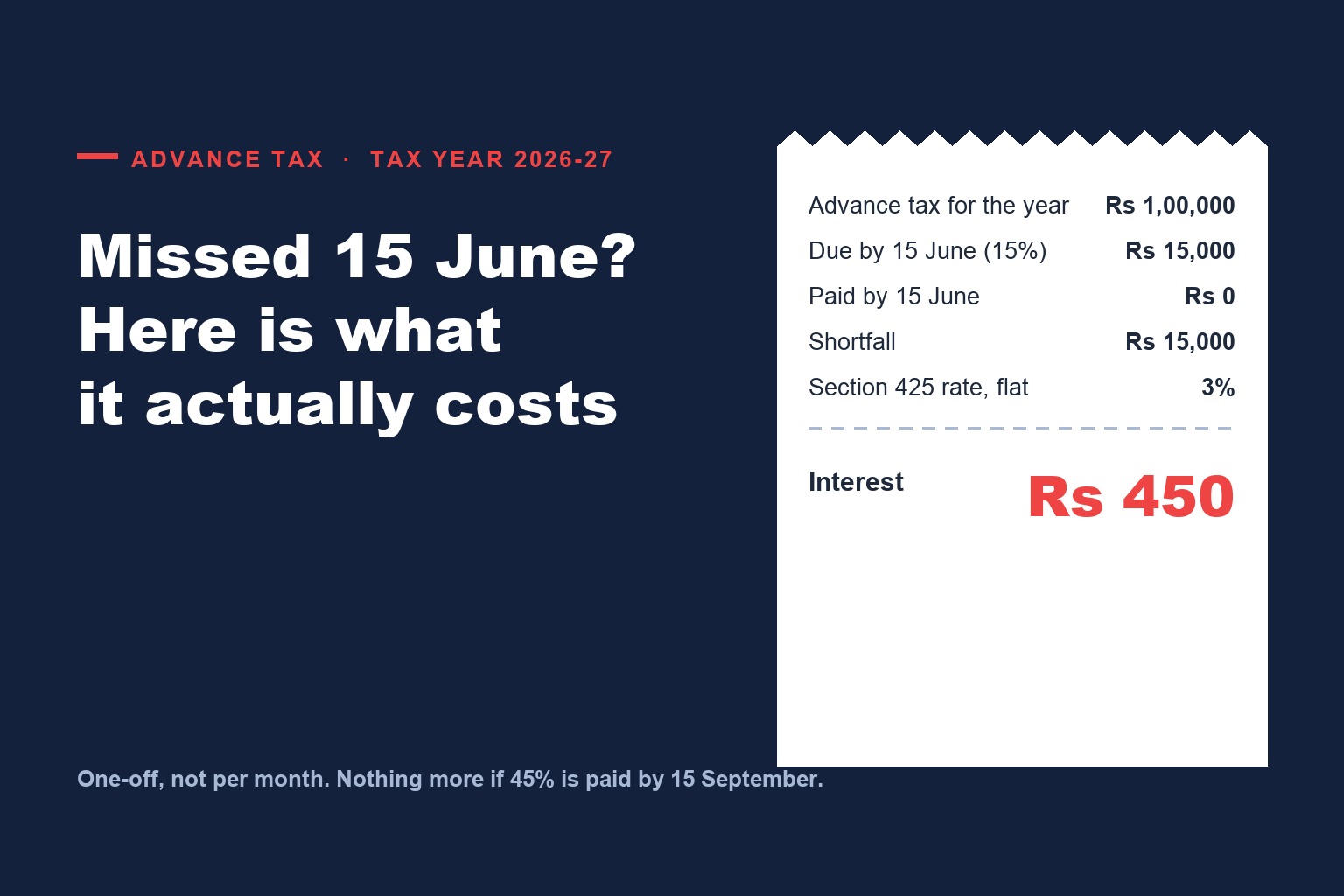

TL;DR: If you were liable for advance tax and paid nothing by 15 June 2026, the Income-tax Act, 2025 charges you 3 per cent of the June shortfall, once, under Section 425. On a year’s advance tax of Rs 1,00,000 that is Rs 450. It does not grow by the day, and nothing more arises for June or September if you pay 45 per cent of the year’s tax by 15 September 2026 (December and March then have their own tests). Miss September too and another 3 per cent lands on the September shortfall, so as far as the June and September charges go, paying on 16 September costs exactly what paying on 14 December costs. The interest people actually fear, Section 424 at 1 per cent a month, does not start until 1 April 2027, and only if you end the year having paid less than 90 per cent. Sections 424 and 425 are the 2025-Act successors of Sections 234B and 234C.
1. First, were you even liable on 15 June?
Section 425 interest is charged only on someone who was liable to pay advance tax under Section 404. That means the tax on your estimated income for tax year 2026-27, after the TDS and TCS you will suffer on it, is Rs 10,000 or more (Section 405: A = B minus C). It also means you are not a resident individual aged 60 or more with no business or professional income, because Section 403(3) takes that person out of advance tax altogether. If either of those lets you out, there was no 15 June instalment to miss and nothing in this article applies. Vijay’s piece on who has to pay advance tax on 15 September and who does not works through the tests.
Everyone else was due 15 per cent of the year’s advance tax on or before 15 June 2026 under Section 408(1). Presumptive declarants under Sl. No. 1 or 3 of the Section 58(2) table are a special case: Section 408(2) gives them a single instalment on 15 March, so they had no June date either.
2. The price list: Section 425 is flat, not monthly
Section 425(1) sets out a table. For each of the first three instalments, the “shortfall” is the cumulative percentage due by that date less what you had actually paid by that date, and the interest is 3 per cent of that shortfall. For the March instalment it is 1 per cent.
| Due date | Cumulative due (of tax due on returned income) | Interest on the shortfall at that date |
|---|---|---|
| 15 June | 15% | 3% |
| 15 September | 45% | 3% |
| 15 December | 75% | 3% |
| 15 March | 100% | 1% |
Two things about this table matter more than the numbers.
It is a flat charge, not a running clock. The 1961 Act expressed the same thing as “one per cent per month for a period of three months”; the 2025 Act simply writes 3 per cent. Same money, but the new drafting makes the consequence obvious: the interest on the June shortfall is the same whether you pay on 16 June or on 14 September. There is no reward for paying on day 2 rather than day 90, and no extra cost for it either.
The base is the tax due on the returned income. Section 425(5) defines it as the tax on the total income you declare in your return for the year, less TDS and TCS, less the reliefs under Sections 157, 159 and 160 and the credit set-off under Section 206. So the shortfall is measured against what you eventually return, not against your June guess. If your June guess was low because your income turned out higher, the interest is computed on the higher figure.
3. Worked example: what the June miss costs
Take someone whose advance tax for tax year 2026-27, after TDS, works out to Rs 1,00,000. Fifteen per cent, or Rs 15,000, was due by 15 June 2026. They paid nothing.
| What happens next | Section 425 interest | Running total |
|---|---|---|
| Pays Rs 45,000 (45%) on or before 15 September | June shortfall Rs 15,000 × 3% = Rs 450. September shortfall nil. | Rs 450 |
| Pays nothing in September either, pays Rs 75,000 by 15 December | June Rs 450 + September shortfall Rs 45,000 × 3% = Rs 1,350 | Rs 1,800 |
| Pays nothing until 15 March, then pays Rs 1,00,000 | Rs 450 + Rs 1,350 + December shortfall Rs 75,000 × 3% = Rs 2,250 | Rs 4,050 |
| Pays nothing at all during the year | Rs 4,050 + March shortfall Rs 1,00,000 × 1% = Rs 1,000 | Rs 5,050 |
Read the first row again. The whole cost of missing 15 June, if you make the September instalment good, is Rs 450 on a lakh, under half a per cent of the tax. That is the fear-versus-fact gap this article exists to close. The second row is the one to avoid: missing September as well adds Rs 1,350, three times the June cost, because the shortfall is now measured against 45 per cent rather than 15.
Notice also what the last row does not say. Rs 5,050 is the entire Section 425 cost of ignoring advance tax for a whole year on Rs 1 lakh of tax. Section 425 is capped by its own arithmetic. What is not capped is what follows.
4. The 12 per cent and 36 per cent tolerances
Section 425(2) switches the June and September charges off entirely if you paid 12 per cent of the tax due on returned income by 15 June, or 36 per cent by 15 September. In the example, Rs 12,000 paid by 15 June would have meant no June interest at all, and Rs 36,000 by 15 September means no September interest even though the table says 45 per cent.
The tolerance applies to the June and September instalments only. December must reach 75 per cent and March must reach 100 per cent to escape the charge. It is a tolerance for estimation error in the first half of the year, when income is hardest to predict, not a discount.
5. Paying now: what 16 September costs versus 14 December
This is the part worth forwarding. Suppose you have missed June and are reading this on 16 September, one day after the second instalment. You pay Rs 45,000 today.
- June shortfall: Rs 15,000 × 3% = Rs 450.
- September shortfall: on 15 September you had paid nothing against Rs 45,000 due, so Rs 45,000 × 3% = Rs 1,350. Your payment on the 16th does not undo that; the test is what had been paid on or before the 15th.
- December: you have now paid Rs 45,000 against Rs 75,000 due, so pay the further Rs 30,000 by 15 December and nothing more arises.
Total Rs 1,800. If instead you had paid the same Rs 45,000 on 14 December, the June and September charges would be identical, Rs 1,800, because both are flat; you would then need the further Rs 30,000 by 15 December to avoid a third charge of Rs 900. The only thing that changes the bill is whether you cross each 15th. So the useful rule is not “pay as soon as possible” but “be at the cumulative percentage on each 15th”. On 10 September, with the deadline five days away, that means: get to 45 per cent by the 15th and the June miss ends at Rs 450. Deep’s 15 September instalment guide has the schedule and the slab arithmetic for the estimate itself.
6. Section 424: the clock that actually hurts
Section 424 is the successor of Section 234B and it has nothing to do with instalment dates. It asks one question on 31 March 2027: did the advance tax you paid during the year reach 90 per cent of the assessed tax? Section 424(2) defines assessed tax as the tax on the total income determined under Section 270(1), or on regular assessment, less TDS and TCS, the Section 157, 159 and 160 reliefs and the Section 206 credit. If you paid nothing, or paid less than 90 per cent, Section 424(1) charges simple interest at 1 per cent for every month or part of a month, starting on 1 April following the tax year, on the whole assessed tax if you paid nothing and, if you paid something but less than 90 per cent, on the amount by which what you paid falls short of the assessed tax (the full shortfall, not the gap to 90 per cent).
It runs until the date the total income is determined under Section 270(1), or the regular assessment is completed. Section 424(4) deals with the common case where you pay the balance with your return before that: interest is computed up to the date you pay, and thereafter only on any amount still short.
Back to the Rs 1,00,000 example, worst case. Nothing paid during the year, Section 425 total Rs 5,050. The person files on 31 July 2027 and pays the Rs 1,00,000 with the return. April, May, June and July are four months, or parts of months, so Section 424 adds Rs 4,000. Total interest for ignoring advance tax on Rs 1 lakh: Rs 9,050. File in December instead and Section 424 alone is Rs 9,000. That is the number to fear, and it is entirely avoidable by being at 90 per cent by 31 March, which Section 408(3) allows: anything paid on or before 31 March counts as advance tax for the year.
One more thing the 90 per cent test does not do. It does not switch off Section 425. Paying 100 per cent on 30 March satisfies Section 424 and still leaves the Rs 450 + Rs 1,350 + Rs 2,250 + Rs 1,000 that accrued at each 15th.
7. When the June miss carries no interest at all
Section 425(4) removes the charge where the shortfall came from under-estimating, or failing to estimate, four kinds of income: capital gains, income of the kind in Section 2(49)(n) (lottery and similar winnings), business or professional income arising for the first time, and dividend income (Section 2(40), excluding deemed dividend under sub-clause (e)). The condition is that you pay the full tax on that income in the remaining instalments, or by 31 March.
The shortfall at each date is measured against the tax on the income you eventually return, so a gain made in July or a dividend received in August is, on the arithmetic, part of what should have been 15 per cent paid by 15 June. Section 425(4) is the answer to that: if the June shortfall is attributable only to that gain or dividend, there is nothing to pay in interest on it provided the tax on it goes into the September instalment. The exception is income-specific: it does not rescue a shortfall on your salary, rent or interest income. Deep’s companion piece on advance tax on capital gains takes this exception through examples.
8. Common mistakes on the way to fixing it
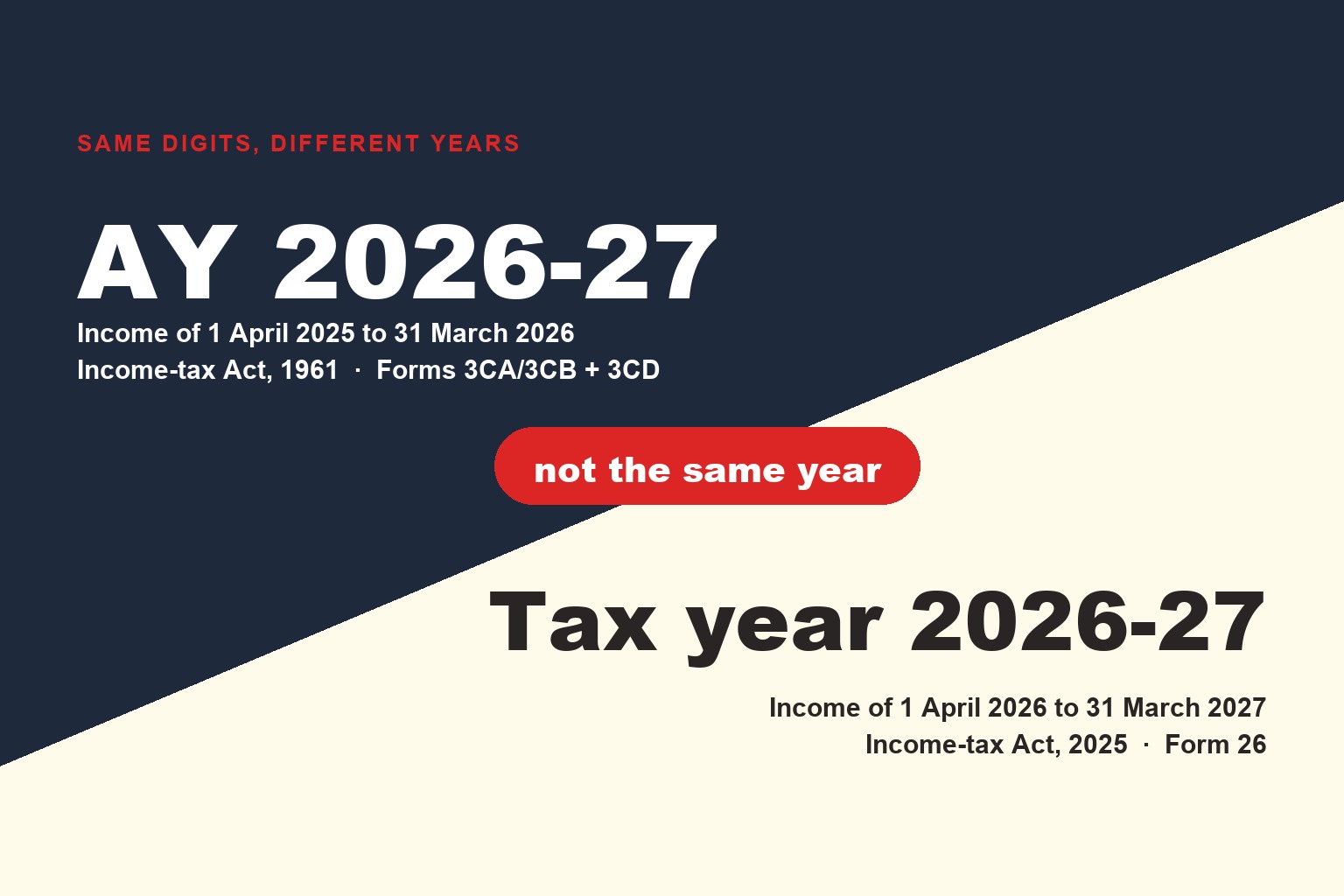
- Paying against the wrong Act. On the portal, e-Pay Tax now asks which Act the payment is for. Tax year 2026-27 is the Income-tax Act, 2025, challan ITNS 280N, minor head 100. A payment booked against the 1961 Act and AY 2026-27 is a payment for a different year and does nothing for Section 425 until it is corrected. Najma’s step-by-step on paying advance tax online shows the screens.
- Waiting until the estimate is exact. The 36 per cent tolerance exists for imprecise estimates. Pay 36 to 45 per cent of a reasonable estimate by 15 September; refine in December.
- Counting employer TDS twice. C in A = B minus C is the TDS and TCS you will actually suffer. Salary TDS already covers the tax on salary; the advance tax is on the income the employer does not know about.
- Assuming interest is a penalty you can argue. Sections 424 and 425 are interest computed by formula. The sections themselves carry no reasonable-cause defence and give the officer no discretion, unlike penalty provisions; only a general relaxation order from the Board could waive them.
9. Quick answers
I missed 15 June by three weeks and paid in July. Interest? 3 per cent of the June shortfall, the same as if you had paid on 14 September. Your July payment counts towards the 45 per cent due on 15 September.
I paid 13 per cent by 15 June. Interest? None for June, because 12 per cent or more was paid (Section 425(2)).
My advance tax is Rs 9,000. I paid nothing in June. Below Rs 10,000, so you were never liable; no interest.
I am 63, retired, resident in India, no business income, and my capital gains tax is large. Section 403(3) excludes you from advance tax; neither Section 424 nor 425 applies.
I declare 50 per cent of receipts under Section 58. One instalment on 15 March 2027 (Section 408(2)); a June miss does not exist for you. Najma’s piece on presumptive taxpayers paying advance tax once covers the March rules.
Does Section 424 stop if I pay everything with the return? Interest runs to the date you pay (Section 424(4)); a payment in July costs four months at 1 per cent on the shortfall.
Sources
- Income-tax Act, 2025 — Section 403(1) and (3), Section 404, Section 405, Section 408(1) to (3), Section 424(1), (2) and (4), Section 425(1) to (6), Section 58(2), Section 2(40), Section 2(49)(n), Section 206, Section 266, Section 270(1).
- Finance Act, 2026 — sections 94 and 95 (substitution of clause (f) in Sections 424(2) and 425(5); no change to rates or dates).
- Income-tax Act, 1961 — Section 234C (rate expressed as 1 per cent per month for three months), for the comparison only.
Written as at 10 September 2026 for tax year 2026-27 under the Income-tax Act, 2025. Figures are shown before rounding and assume the person is liable under Section 404. Take advice from a Chartered Accountant on a specific computation.


Comments (0)
No comments yet. Be the first to comment!