
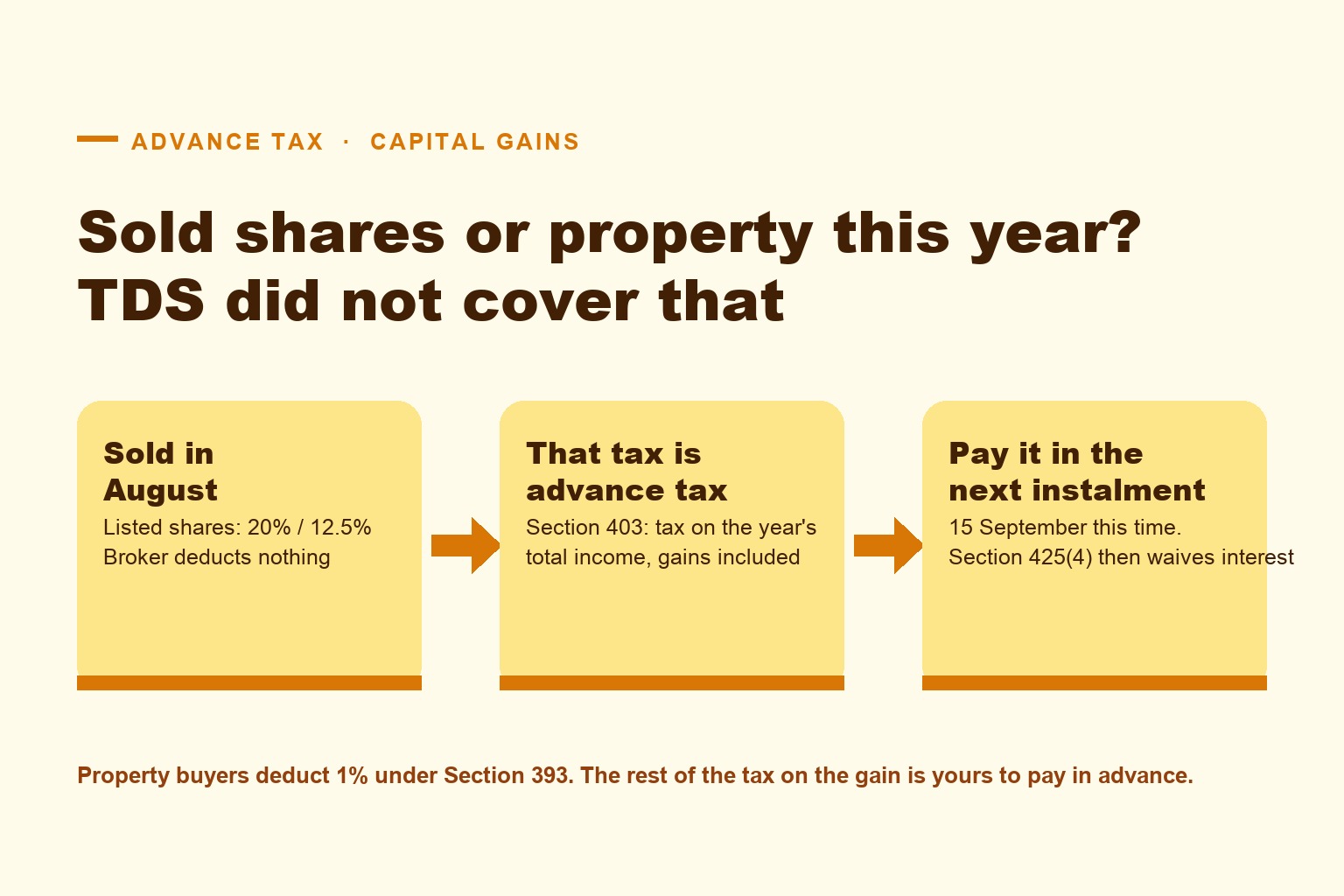

TL;DR: If you sold listed shares, equity mutual funds or a house in tax year 2026-27 (1 April 2026 to 31 March 2027), the tax on that gain is advance tax. Section 403 of the Income-tax Act, 2025 charges advance tax on the whole of your estimated total income for the year, and capital gains are part of it. Your employer’s TDS covers salary only; a broker or a fund house deducts nothing on a resident’s gains; a property buyer deducts 1 per cent, which is a fraction of the 12.5 per cent you owe. The good news is Section 425(4): you owe no instalment interest on a gain you could not have estimated earlier, provided you pay the tax on it in full in any of the remaining instalments after the sale, or by 31 March. Sold in July? Put the tax into the 15 September instalment, or a later one. Sold in March? By 31 March. Do that and the instalment dates that fell before the sale cost nothing. The examples below assume a salaried investor whose salary already uses up the basic exemption, so the gain is taxed at the special rate in full.
1. Why TDS does not cover it
Advance tax under Section 405 is A = B minus C: B is the tax on your estimated total income for the year, C is the tax that will be deducted or collected at source on income included in that estimate. For a salaried investor, C is usually just the employer’s TDS on salary, which is computed on salary alone unless you have declared other income to the employer. The gain adds to B and adds nothing to C. If the result is Rs 10,000 or more (Section 404), advance tax is payable, and the rest of this article applies.
| What you sold | Tax on the gain (resident, tax year 2026-27) | TDS on the sale |
|---|---|---|
| Listed equity shares or equity-oriented mutual fund units held 12 months or less (STT paid on the sale) | 20 per cent under Section 196, plus cess | None for a resident |
| Listed equity shares or equity-oriented mutual fund units held more than 12 months (STT paid on acquisition and sale for shares, subject to the notified exceptions) | 12.5 per cent under Section 198 on the gain above Rs 1.25 lakh for the year, plus cess | None for a resident |
| House, flat or land held more than 24 months | 12.5 per cent under Section 197, plus cess (no indexation; a resident individual or HUF gets the lower-of-two computation under Section 197(3) for property bought before 23 July 2024) | Buyer deducts 1 per cent under Section 393 of the consideration or the stamp-duty value, whichever is higher, where either is Rs 50 lakh or more |
| House, flat or land held 24 months or less | Slab rate on the gain | Buyer deducts 1 per cent, same test |
The gap on property is the one that surprises people: 1 per cent withheld against 12.5 per cent owed on a gain that is often most of the price. On shares the gap is the whole tax. Deep’s explainer on capital gains on shares and mutual funds covers the classification and rates in depth; that page is written for AY 2026-27 under the 1961 Act, and the rates carried over unchanged into Sections 196 to 198 of the new Act. Two exclusions before you go further: a resident individual aged 60 or more with no business or professional income is outside advance tax altogether under Section 403(3), gains included; and the Section 156 rebate for total income up to Rs 12 lakh does not reach tax on these special-rate gains: for Section 198 long-term gains, Section 198(7) allows the rebate only from the tax on total income as reduced by the tax on such gains, and the rebate is in any case measured against slab-rate tax. One more point for a resident individual or HUF whose other income is below the basic exemption: Sections 196, 197 and 198 first set the unused exemption against the gain, so the tax is lower than the headline rate suggests; the examples below assume the exemption is already used up by salary.
2. When the tax on a gain is due: Section 425(4)
Section 408(1) makes advance tax due in four cumulative instalments, 15, 45, 75 and 100 per cent by 15 June, 15 September, 15 December and 15 March. Read literally, a gain in November was part of the year’s tax that should have been 15 per cent paid in June, which is absurd, and the Act says so.
Section 425(4) provides that no instalment interest is payable under Section 425(1) or (3) on a shortfall that arises from under-estimating, or failing to estimate, four kinds of income: capital gains; winnings within Section 2(49)(n); business or professional income arising for the first time; and dividend income (Section 2(40), excluding deemed dividend under sub-clause (e)). The condition is that you have paid in full the tax on that income “in any of the remaining instalments of advance tax, if any, or by the 31st day of March of the tax year”.
So the rule for a gain is: pay the full tax on it in any instalment that falls after the sale, or by 31 March, and the instalments that fell before the sale are treated as if the gain did not exist. The simplest discipline is to put it into the next instalment, so that nothing is left to remember; the law does not require that.
| Date of sale | Pay the full tax on the gain in | Instalments that carry no interest for this gain |
|---|---|---|
| 1 April to 15 June 2026 | The ordinary schedule: 15 per cent by 15 June, and so on | None; the gain is known before the first date |
| 16 June to 15 September 2026 | Any of the September, December or March instalments, or by 31 March | June |
| 16 September to 15 December 2026 | The December or March instalment, or by 31 March | June, September |
| 16 December 2026 to 15 March 2027 | The March instalment, or by 31 March | June, September, December |
| 16 to 31 March 2027 | By 31 March 2027 | All four; Section 408(3) counts a payment by 31 March as advance tax |
Two limits. First, the exception is income-specific. It removes interest on the shortfall attributable to the gain; it does nothing for a shortfall on salary, rent or interest income you could have estimated. Second, it needs the tax on the gain to be paid in full in a remaining instalment or by 31 March. Pay half of it in September and the rest in July next year and the condition fails for the whole of it, and Section 425(1) charges 3 per cent on the shortfall at each date from the sale onward. Deep’s piece on what a missed instalment actually costs has the price list.
3. Worked examples
Figures with 4 per cent cess and no surcharge, before rounding.
A. Salaried investor, listed shares, July 2026. Sells shares held three years for a gain of Rs 8,00,000. Long-term, Section 198: Rs 1,25,000 exempt, Rs 6,75,000 at 12.5 per cent = Rs 84,375, plus cess = Rs 87,750. Employer TDS covers salary; the broker deducts nothing. Advance tax on the gain is Rs 87,750 and the remaining instalments after a July sale are September, December and March. Pay Rs 87,750 in full by 15 September 2026, or by 15 December, or by 15 March, or by 31 March, and Section 425(4) removes any instalment interest on it, including for the June date that fell before the sale. What does not work is paying it in July 2027 with the return: Section 425 then charges 3 per cent on the shortfall at each of the September and December dates and 1 per cent for March, and Section 424 runs from 1 April.
B. Same person, short-term. Shares held five months, gain Rs 3,00,000. Section 196: 20 per cent = Rs 60,000, plus cess = Rs 62,400, to be paid in full in any instalment after the sale, or by 31 March, on the same logic.
C. Flat sold in November 2026. Consideration Rs 1,20,00,000, indexed-free long-term gain Rs 40,00,000. Section 197: 12.5 per cent = Rs 5,00,000, plus cess = Rs 5,20,000. The buyer deducts 1 per cent under Section 393 of the consideration or the stamp-duty value, whichever is higher; taking the two as equal, Rs 1,20,000, which is C in the formula. Advance tax on the gain = Rs 5,20,000 minus Rs 1,20,000 = Rs 4,00,000, to be paid in full by 15 December 2026 or 15 March 2027 (or by 31 March). Paid then, no interest arises for June, September or December on account of the gain. If the seller plans to reinvest in another house and claim the exemption, the amount that will be exempt is not part of the estimate, but the exemption conditions and the capital-gains account scheme deadline have to be met; Deep’s house-property capital-gains exemptions page covers those.
D. Small gain, no advance tax at all. Gain Rs 60,000 short-term, tax Rs 12,480, but the person also has a Rs 5,000 refund position on salary TDS after declarations. A = Rs 7,480, below the Rs 10,000 floor in Section 404. No advance tax, no interest; the tax goes with the return.
4. The year-end test: Section 424 has no capital-gains exception
Section 425 is about instalments. Section 424 is about the year: if the advance tax paid by 31 March is less than 90 per cent of the assessed tax, simple interest at 1 per cent for every month or part of a month runs from 1 April 2027 on the amount by which what you paid falls short of the assessed tax, until you pay. There is no Section 425(4)-style carve-out in Section 424. A gain in February whose tax you decide to “pay with the return” in July costs four months at 1 per cent on that shortfall. Section 408(3) is the safety valve: anything paid by 31 March is advance tax for the year, so a March gain is handled by paying the tax on it before the year ends.
5. Losses, set-off and the estimate
The estimate under Section 406 is yours, and you may revise the remaining instalments up or down as the year unfolds. A short-term loss in October can be set off against a short-term gain in July when you estimate the December instalment; if the loss wipes out the gain, the advance tax on it falls away. Paying in September on the July gain and then making a loss is not wasted; the excess comes back with the return, with interest on refund under the Act’s refund provisions. What you cannot do is run a loss you have not yet made against a gain you already have.
6. Paying it
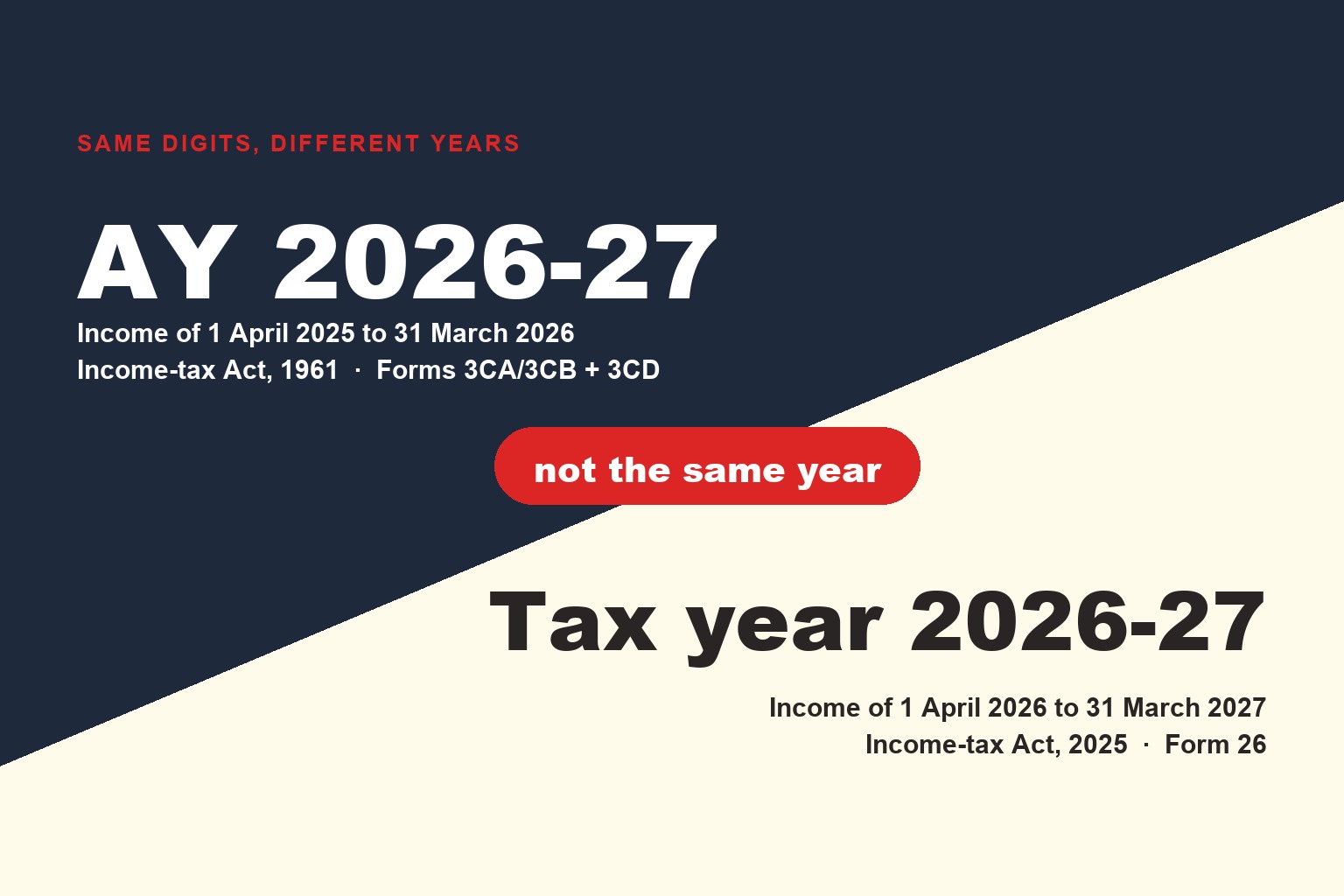
On the e-Pay Tax service, select the Income-tax Act, 2025, the year ending 31 March 2027, and minor head 100, Advance Tax; the challan is ITNS 280N. There is no separate challan or minor head for capital gains; it is simply the advance-tax instalment amount, which you have computed to include the gain. Najma’s step-by-step guide to paying advance tax online shows the screens. And if this is a gain being reported in the ITR you are filing this month, that is FY 2025-26 under the 1961 Act, with its own advance-tax rules on the FY 2025-26 advance-tax page; the 2025 Act starts with sales on or after 1 April 2026.
7. Quick answers
I sold equity mutual funds in August; my only other income is salary with full TDS. Do I pay on 15 September? If the tax on the gain, after TDS, is Rs 10,000 or more, it is advance tax; Section 425(4) lets you pay it in full in the September, December or March instalment, or by 31 March, without interest, and covers the June instalment you did not pay. Paying it in September is simplest.
I sold shares in May and paid nothing in June. The gain was known before 15 June, so the exception does not apply to the June shortfall; 3 per cent on 15 per cent of the year’s tax. Pay 45 per cent by 15 September to stop it there.
The buyer deducted 1 per cent on my flat. Is that my advance tax? It is part of C. The balance of the 12.5 per cent (plus cess) on the gain is advance tax, to be paid in full in a remaining instalment or by 31 March.
I am 64, retired, and sold a flat. Section 403(3) excludes you if you have no business or professional income; pay with the return, no advance-tax interest.
Does the Rs 12 lakh rebate cover my share gains? Not the tax on gains taxed at the special rates under Sections 196 or 198; for Section 198 gains, Section 198(7) says so expressly.
I sold in March. Which instalment? By 31 March 2027, which Section 408(3) treats as advance tax; nothing then arises under Section 425 or 424 for that gain.
Sources
- Income-tax Act, 2025 — Section 403(1) to (3), Section 404, Section 405, Section 406, Section 408(1) to (3), Section 424, Section 425(1), (4), (5) and (6), Sections 196, 197, 198 and 198(7), Section 393, Section 156, Section 2(40), Section 2(49)(n).
- Finance Act, 2025 — rates in force for tax year 2026-27 (Budget 2026 made no change to the capital-gains rates or the individual slabs).
Written as at 10 September 2026 for tax year 2026-27 under the Income-tax Act, 2025. Examples use 4 per cent cess, no surcharge, before rounding. Take advice from a Chartered Accountant on a specific computation.


Comments (0)
No comments yet. Be the first to comment!