
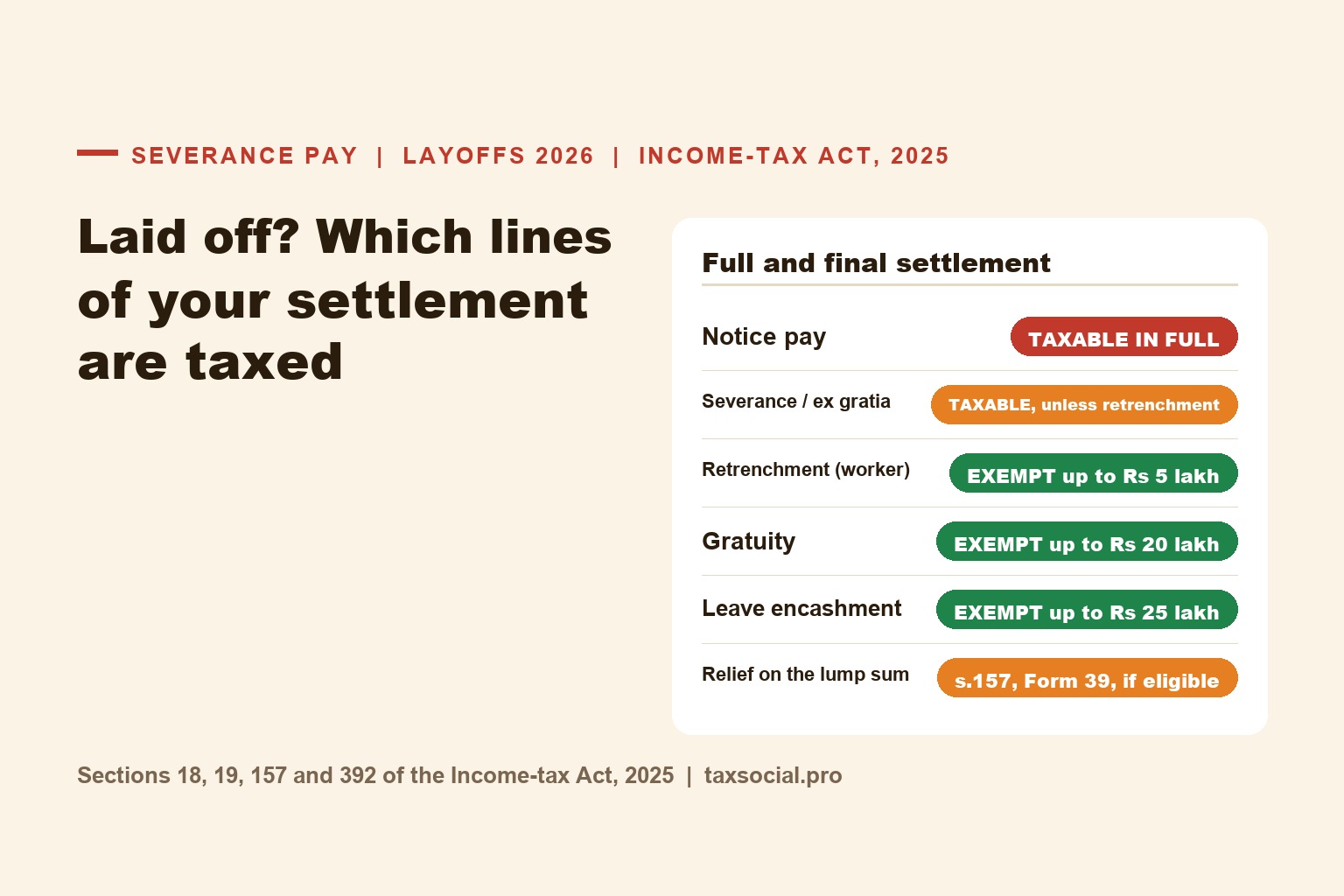

Most of a layoff package is taxable, and it is taxed as salary. If you were let go this month, the money lands in tax year 2026-27, which means the Income-tax Act, 2025 applies, not the 1961 Act your last return was filed under. Under the new Act: pay in lieu of notice is salary and taxed in full; a severance or ex gratia payment is “profits in lieu of salary” under Section 18 and taxed in full unless it qualifies for one of the deductions in the Section 19 table; retrenchment compensation to a worker is deductible up to the lower of fifteen days’ average pay per completed year or the notified ceiling of Rs 5 lakh; gratuity under the Payment of Gratuity Act is deductible up to Rs 20 lakh; leave encashment up to Rs 25 lakh; a genuine voluntary-retirement payment up to Rs 5 lakh. Your employer deducts TDS under Section 392 on the taxable part of the settlement, after the deductions it accepts, at the average rate for the year. Relief under Section 157, claimed on Form 39, can spread the tax on a large lump sum, but only if you meet the conditions in Rule 73.
1. Which Act, and why it matters this time
The Income-tax Act, 2025 came into force on 1 April 2026. Income earned from that date falls in tax year 2026-27 and is computed under the new Act, with its own section numbers, forms and rules. A settlement paid in September 2026 is therefore the first big test of the new salary provisions for a lot of people at once. The substance has not changed much; the citations have. Section 17(3) has become Section 18. The exemptions that used to sit in Section 10(10), 10(10AA), 10(10B) and 10(10C) now sit in a single table in Section 19. Section 89 relief is Section 157, Form 10E is Form 39, Rule 21A is Rule 73, and the Form 16 your employer will issue next year is Form 130. If you search an old article and it cites Section 10(10B), the number is stale but the arithmetic is the same.
2. The settlement, line by line
A full and final settlement after a layoff usually has five or six lines. Each has its own tax answer.
Salary to the last working day, bonus, unpaid incentives
Salary. Taxed in full at your slab, with TDS.
Pay in lieu of notice
Salary. Taxed in full. Nothing in the Section 19 table covers it, and the courts have consistently treated notice pay as salary for the period it replaces. If, instead, you had to pay the employer for an unserved notice period, there is no express deduction for it. One Ahmedabad Tribunal decision (Nandinho Rebello, 2017) held on its facts that where the former employer recovered notice pay from salary under the contract, only the net salary actually received was taxable; it is fact-specific, not a general rule, and needs the contract and the full and final statement to support it.
Severance, ex gratia, “separation pay”
This is the line people ask about. Section 18(1)(a) of the 2025 Act says that profits in lieu of salary include the amount of any compensation due to or received from an employer or former employer at or in connection with the termination of employment, or the modification of its terms. Profits in lieu of salary are salary. So a severance payment is taxable as salary in full, at your slab, unless a deduction in the Section 19 table applies: Sl. No. 10 for retrenchment compensation to a worker, Sl. No. 11 for compensation under a scheme the Central Government has approved for the protection of workers, or Sl. No. 12 for a qualifying voluntary retirement or separation scheme.
Deduction one: retrenchment compensation (Table, Sl. No. 10). Compensation received by a workman at the time of retrenchment under the Industrial Disputes Act, 1947, or under any other Act, rule, order or notification, is deductible to the extent of the lowest of three figures: the amount actually received; the amount computed under Section 25F(b) of that Act, which is fifteen days’ average pay for every completed year of continuous service or any part of a year exceeding six months; and the amount notified by the Central Government, which is Rs 5,00,000 (the table itself fixes only a floor of Rs 50,000 for any notification; the 1999 notification of Rs 5 lakh continues under the 2025 Act’s saving provision). Two things decide whether you can use this. First, you must be a workman: the term is defined by reference to the labour statute, and it excludes anyone employed mainly in a managerial or administrative capacity, and supervisors above a pay threshold. The Industrial Disputes Act was repealed from 21 November 2025 by the Industrial Relations Code, 2020, whose corresponding term is “worker”, whose retrenchment-compensation rule is in Section 70(b) in the same fifteen-days-per-year form, and whose supervisory pay threshold is Rs 18,000 a month. The 2025 Act still names the 1947 Act and has not been amended to name the Code; Section 8 of the General Clauses Act gives a strong basis for reading the reference as one to the corresponding Code provisions, but that is a transitional interpretation, not express tax wording, and a claim should say so. The test turns on what you actually did, not your designation: a software engineer with no one reporting to them is, on the statutory words, capable of being a worker; a team lead who appraises people is not. Second, the payment has to be compensation for retrenchment. The Code defines retrenchment as the employer’s termination of a worker’s service otherwise than as punishment, and excludes voluntary retirement, superannuation, termination on non-renewal or under a term of the contract, completion of a fixed term, and continued ill-health; a temporary lay-off is a different concept altogether. A redundancy label does not make a payment retrenchment compensation, and the absence of the label does not stop it being one; the settlement letter and the facts decide.
Deduction two: voluntary retirement or separation (Table, Sl. No. 12). Up to Rs 5,00,000 of an amount received on voluntary retirement, or on termination under a scheme of voluntary separation, is deductible, but only if the scheme is framed in accordance with the guidelines the Central Government has laid down, now Rule 20 of the Income-tax Rules, 2026: ten years’ service or age forty, a scheme drawn up to reduce overall strength that applies to all employees other than directors, the vacancy not to be filled, no re-employment in the same group, and the amount not to exceed the lower of three months’ salary for each completed year of service and salary for the months left to superannuation. It is open only to the employer categories listed in Section 19(2), which include companies, public-sector undertakings, statutory and local authorities, co-operatives, universities and governments. A layoff is not a voluntary separation, and a package designed by the employer alone is not a scheme under the guidelines unless it was built to be one. The deduction is available once in a lifetime, and Section 19(2) bars Section 157 relief on any amount that has taken it.
Gratuity
Section 19, Table, Sl. No. 5: gratuity received under the Payment of Gratuity Act, 1972 is deductible to the extent of what Section 4(2) and 4(3) of that Act provide: fifteen days’ wages for every completed year of service or part exceeding six months, at 15/26 of the last drawn wages for a monthly-rated employee, subject to the ceiling of Rs 20 lakh. One transition point to know: the 1972 Act was repealed from 21 November 2025 by the Code on Social Security, 2020, whose Section 53 now governs the entitlement in the same form, with “wages” defined by the Code (basic, dearness allowance and retaining allowance, with an add-back where excluded allowances exceed half of the total). The tax table still names the 1972 Act; the same General Clauses Act reading applies, and the Rs 20 lakh notification is carried forward by the Code’s own saving clause. You need five years of continuous service to be entitled to gratuity at all, except on death or disablement; an employer that pays gratuity to someone with less than five years’ service is paying ex gratia, and that line goes back into the severance analysis above. Gratuity outside the Act (Sl. No. 6) is deductible to the lowest of the amount, half a month’s salary per completed year, and the notified limit. Both limits are lifetime aggregates across employers.
Leave encashment
Section 19, Table, Sl. No. 14, for non-government employees: the lowest of the cash equivalent of unavailed leave, counted at not more than thirty days for every year of service; ten months’ average salary; and the notified limit, which was raised to Rs 25 lakh from 1 April 2023 and is a lifetime aggregate. “Salary” here means basic plus dearness allowance if your terms count it, and nothing else. Encashment paid on termination qualifies; the provision speaks of retirement “whether on superannuation or otherwise”.
Provident fund
Your PF balance is not part of the settlement; it stays with EPFO until you withdraw it. Withdrawal on unemployment is governed by the EPF Scheme, 2026, and the tax on a withdrawal depends on length of membership. The 2026 withdrawal rules are set out here.
3. A worked example
An engineer with six years and eight months’ service, no supervisory duties, is laid off in September 2026. Assume Rs 1,20,000 a month is both the last drawn basic plus dearness allowance and the average wages of the three months before the termination (the retrenchment formula uses average pay, and gratuity uses last drawn wages as the Code defines them; if your allowances make those figures differ, recompute from the payroll records). The settlement: two months’ pay in lieu of notice; severance of Rs 9,00,000; gratuity under the Act; and 45 days of unavailed leave encashed.
| Line | Received | Section 19 deduction | Taxable |
|---|---|---|---|
| Pay in lieu of notice (2 months) | Rs 2,40,000 | None | Rs 2,40,000 |
| Severance, treated as retrenchment compensation to a worker | Rs 9,00,000 | Lowest of Rs 9,00,000; 15/30 × 1,20,000 × 7 years = Rs 4,20,000; Rs 5,00,000 → Rs 4,20,000 | Rs 4,80,000 |
| Gratuity (Payment of Gratuity Act) | Rs 4,84,615 | 15/26 × 1,20,000 × 7 = Rs 4,84,615, within Rs 20 lakh | Nil |
| Leave encashment (45 days) | Rs 1,80,000 | Lowest of Rs 1,80,000; 45 days at Rs 4,000 a day = Rs 1,80,000; 10 months = Rs 12,00,000; Rs 25 lakh → Rs 1,80,000 | Nil |
| Total | Rs 18,04,615 | Rs 7,20,000 |
Six years and eight months counts as seven years for both the retrenchment formula and gratuity, because a part of a year exceeding six months rounds up. If the same engineer were a team lead with reports, and therefore not a worker, the severance line would be taxable in full and the taxable total would be Rs 11,40,000. That is the single largest swing in the whole computation, and it turns on a labour-law definition, not on anything in the tax Act.
4. TDS, Form 130 and what to get from HR
Your employer deducts tax on the settlement under Section 392 of the 2025 Act at the average rate for the year, on the taxable part after the Section 19 deductions it is satisfied apply. The annual certificate is Form 130 (the old Form 16); it will show the gross settlement and the deductions the employer allowed. Three things to ask for in writing before you sign anything: a break-up of the settlement by line, with the words “retrenchment compensation” used if that is what the payment is; a statement of your last drawn basic and dearness allowance and your completed years of service, which drive two of the formulas; and the leave balance encashed, in days. An employer that lumps everything into “ex gratia” makes the Section 19 deductions harder to defend, and the department has been known to disallow them where the settlement letter does not support the claim.
5. Section 157 relief: spreading a lump sum
Section 157(1) gives relief where salary is received in arrears or in advance, or where the income for a year includes gratuity for past service, compensation on termination, or commuted pension, and the total is taxed at a higher rate than it would otherwise have been. The mechanics are in Rule 73 of the 2026 Rules and the claim is on Form 39, to be furnished by the return due date under Section 263(1)(c), or handed to the employer under sub-rule (4) so that the TDS reflects it.
For compensation on termination, the rule carries a condition that trips most private-sector claims: the compensation must be received after continuous service of not less than three years, and where the unexpired portion of the term of employment is also not less than three years. The second limb was written for fixed-term contracts and government service. For an open-ended employment, practitioners differ on whether it can ever be satisfied; the safe reading is that it cannot, and a claim should be made only with advice and a basis. Where it does apply, the relief is the compensation multiplied by the difference between this year’s average rate of tax and the average of the three preceding years’ rates, each recomputed with one-third of the compensation added. Gratuity for past service has its own limbs in the same rule, and a Section 19 deduction and Section 157 relief cannot be taken on the same rupee.
6. Old regime or new regime
The Section 19 deductions for gratuity, leave encashment, retrenchment compensation and voluntary retirement sit in the computation of salary itself, and are available under the default regime of Section 202 as they were under Section 115BAC. The regimes differ on the standard deduction (Rs 75,000 under the default regime, Rs 50,000 otherwise) and on the Chapter VIII deductions. A layoff year is a year to run both computations, because a large taxable severance can push you into a bracket where the old regime’s deductions are worth more than the new regime’s lower rates.
7. What Oracle’s package looks like, for context
Reports on 15 September 2026 describe termination emails sent that morning and a package of four weeks’ base pay for the first year of service plus one week for each further year, capped at 26 weeks; the March 2026 round in India was reported as “N+2” months of pay plus notice pay, leave encashment and gratuity. None of that changes the analysis above. Whatever the formula, the tax question for each rupee is which line it sits on: notice, severance, gratuity, or leave.
FAQ
Is severance pay taxable in India? Yes, as salary, under Section 18 of the Income-tax Act, 2025, unless a Section 19 deduction applies.
Which deductions can apply? Retrenchment compensation to a worker (lowest of the amount, fifteen days’ average pay per year of service, Rs 5 lakh); compensation under a Central Government-approved scheme (in full); voluntary separation under a Rule 20 scheme (Rs 5 lakh); gratuity (Rs 20 lakh); leave encashment (Rs 25 lakh).
Am I a “worker”? If you were not employed mainly in a managerial or administrative capacity and were not a supervisor drawing more than Rs 18,000 a month. Function, not title.
Is notice pay taxable? In full.
Will TDS be deducted? Yes, under Section 392, at the average rate on your estimated taxable salary for the year, including the taxable part of the settlement.
Can I spread the tax? Section 157 relief on Form 39, if Rule 73’s conditions are met; the “unexpired term” limb is the obstacle for open-ended employment.
Which Act applies to a September 2026 layoff? The Income-tax Act, 2025 (tax year 2026-27). The return is filed in 2027.
Does the new regime take away these deductions? No. They are part of the salary computation under both regimes.
Sources
- Income-tax Act, 2025, ss.15-19 (in particular s.18(1)(a) and the s.19 Table, Sl. Nos. 5, 6, 10, 11, 12 and 14, and s.19(2)), s.157, s.202, s.263(1), s.392.
- Income-tax Rules, 2026, Rule 20 (voluntary retirement guidelines), Rule 73 (relief under s.157(1)), Form 39, Form 130.
- Industrial Relations Code, 2020, ss.2(zr), 70 and 104; Ministry of Labour notification S.O. 5320(E) bringing the Code into force on 21 November 2025; Industrial Disputes Act, 1947, ss.2(s) and 25F.
- Payment of Gratuity Act, 1972, s.4; Code on Social Security, 2020, ss.2(y), 53 and 164 (in force from 21 November 2025).
- General Clauses Act, 1897, s.8; Income-tax Act, 2025, s.536(2)(j).
- Nandinho Rebello v. DCIT, ITAT Ahmedabad, ITA No. 3492/Ahd/2015 (2017).
- CBDT Notification No. 31/2023 dated 24 May 2023 (leave encashment limit Rs 25 lakh).
- Reports of 15 September 2026 (The Week) and 6 April 2026 (Business Today) on Oracle’s severance terms.


Comments (0)
No comments yet. Be the first to comment!