
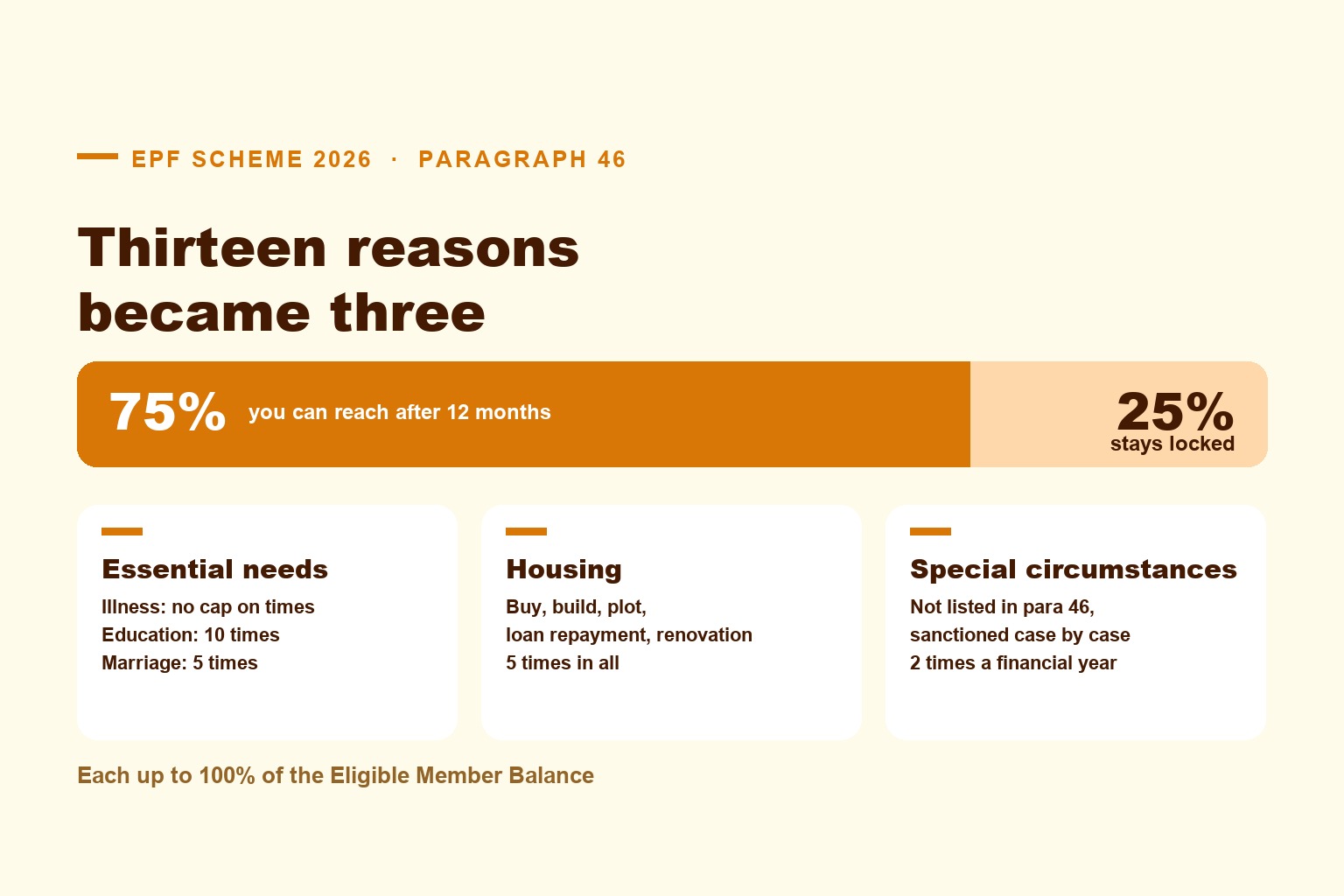

TL;DR: The Employees' Provident Funds Scheme, 2026, notified on 29 June 2026 and in force from that date, rewrote how you take money out of EPF while still working. Paragraph 46 replaces the thirteen separate advance provisions of the 1952 Scheme with three categories: essential needs (illness, education, marriage), housing, and special circumstances. Every category allows a withdrawal of up to 100 per cent of your "Eligible Member Balance", which is your balance after setting aside a Minimum Balance of 25 per cent of everything ever credited to you, so on a first withdrawal you can reach three-quarters of what is in the account. Every category needs twelve months of membership first, with one exception: a member leaving employment before twelve months can still draw up to the Eligible Member Balance under paragraph 46(5). The number of times is capped for education (ten in a lifetime), marriage (five), housing (five) and special circumstances (two a year), and uncapped for illness. Under the special-circumstances head, the Central Board's decision is that a member applies without assigning a reason. EPFO's explainer on the new rules made the rounds this week; this page gives you the paragraph it is based on, a worked example, and the tax answer.
1. Where the rules now live
The 1952 Scheme was made under the Employees' Provident Funds and Miscellaneous Provisions Act. The 2026 Scheme is made under Section 15(1)(a) of the Code on Social Security, 2020, and paragraph 1(2) brings it into force on the date of its publication in the Gazette, 29 June 2026. It supersedes the 1952 Scheme. The withdrawal rules sit in Chapter VIII: paragraph 46 (partial withdrawals), paragraph 47 (how membership is counted), paragraph 48 (how the money is paid), and paragraph 49 (when the whole balance can be taken). If you are used to citing paragraph 68B for housing or 68K for a wedding, those numbers no longer exist.
2. Paragraph 46, in the Scheme's own words
The three definitions are the whole story, so here they are as drafted.
"46. Partial withdrawals from Fund. (1) The Commissioner may, on an application from a member on the designated portal sanction from the amount standing to the credit of the member in the Fund, a partial withdrawal not less than rupees one thousand for the purposes and subject to the eligibility and frequency specified in sub-paragraphs (2), (3) and (4) and subject to the requirement of maintaining in the member's account, the Minimum Balance."
"Explanation: ... 'minimum balance' means an amount equivalent to twenty-five per cent of the aggregate of the total contributions made to the Fund to the credit of the member (inclusive of both the employee's and the employer's share and interest thereon) up to the date of such withdrawal, which shall remain to the credit of the member after giving effect to any partial withdrawal under this paragraph."
"Explanation. For the purpose of this paragraph, 'Eligible Member Balance' means the amount standing to the credit of the member in the Fund after deducting the Minimum Balance required to be maintained."
Then the three categories:
| Category (sub-paragraph) | Purpose | How much | Membership needed | How many times |
|---|---|---|---|---|
| Essential needs, 46(2)(a) | Illness of self or family members | Up to 100% of the Eligible Member Balance | Twelve months' total membership | No limit stated |
| Essential needs, 46(2)(b) | Education of self or family members | Up to 100% of the Eligible Member Balance | Twelve months | Not more than ten times during membership |
| Essential needs, 46(2)(c) | Marriage of self or family members | Up to 100% of the Eligible Member Balance | Twelve months | Not more than five times during membership |
| Housing, 46(3) | Purchase of a flat or house; a site for construction; construction; repayment of a home loan taken for any of those; additions, alterations, renovations or improvements to an existing house or flat | Up to 100% of the Eligible Member Balance | Twelve months | Not more than five times during membership, across all housing purposes together |
| Special circumstances, 46(4) | Not listed in the paragraph; per the 238th CBT decision the member applies "without assigning any reasons" | Up to 100% of the Eligible Member Balance | Twelve months | Not more than two times in a financial year |
Three smaller provisions round it off. Under 46(5), a member who leaves employment before completing twelve months can still take a partial withdrawal, capped at the Eligible Member Balance on that date. Under 46(6), the counts above are "calculated afresh in respect of each member on and from the date of commencement of this Scheme": whatever you took under the 1952 Scheme does not count against the new limits. And the minimum application is Rs 1,000.
3. A worked example
Suppose your passbook on the day you apply shows:
| Component | Amount |
|---|---|
| Your contributions | Rs 3,50,000 |
| Employer's contributions (the EPF share, not the pension share) | Rs 3,50,000 |
| Interest credited on both | Rs 1,00,000 |
| Balance | Rs 8,00,000 |
| Minimum Balance (25% of Rs 8,00,000) | Rs 2,00,000 |
| Eligible Member Balance | Rs 6,00,000 |
For a daughter's wedding you could apply for anything from Rs 1,000 to Rs 6,00,000 under 46(2)(c), and that would be one of your five marriage withdrawals. Suppose you took Rs 4,00,000. The account now stands at Rs 4,00,000, but the Minimum Balance does not fall with it: the Explanation defines it as 25 per cent of "the aggregate of the total contributions made to the Fund to the credit of the member ... up to the date of such withdrawal", which is everything ever credited, not what is left after you drew on it. On the day of a second application, for a home-loan repayment under 46(3) say, the Minimum Balance is still Rs 2,00,000 plus 25 per cent of whatever has been credited since, so the Eligible Member Balance is the Rs 4,00,000 in the account less that floor: about Rs 2,00,000 if nothing new has come in. Three things the example shows. The floor is a share of the whole credited amount, employer's share and interest included, not of your own contributions alone. It only rises over time, as new contributions and interest are credited; a withdrawal never lowers it. And the employer's contribution to the pension fund is a separate account and does not enter this calculation at all.
4. What changed from the 1952 Scheme
The 2026 paragraph is the enactment of a decision the Central Board of Trustees took at its 238th meeting on 13 October 2025: merge thirteen provisions into three, allow the employer's share to be withdrawn, hold back 25 per cent so the account keeps compounding, and cut the qualifying service to twelve months across the board. The practical differences a member notices:
- One membership test. Housing used to need five years' membership (paragraph 68B) and marriage or education seven years (paragraph 68K). Now everything needs twelve months.
- One limit. The old rules measured each purpose differently: months of wages for illness (68J) and housing (68B), fifty per cent of the member's own share for marriage or education (68K). Now every purpose is measured against the same Eligible Member Balance, which includes the employer's share.
- Frequency, not formula. Marriage or education under 68K was three times in a lifetime combined. Now education is ten, marriage five, housing five, special circumstances two a year, illness uncapped, and the counters started at zero on 29 June 2026.
- A floor you cannot go below. There was no general minimum balance before. Now 25 per cent stays, however many times you draw.
What has not changed is that a partial withdrawal is sanctioned, not automatic: paragraph 46(1) says the Commissioner "may" sanction it on an application through the portal, "for the purposes" listed. For the essential-needs and housing heads the purpose has to be one the paragraph names. For special circumstances the paragraph names none, and the Board's stated intention at its 238th meeting was that the member "can apply without assigning any reasons under this category", where the 1952 Scheme had required a reason such as a natural calamity, a lockout or continuous unemployment and rejected claims that did not fit.
5. Partial withdrawal or final settlement: which one are you doing?
Paragraph 46 is for a member who stays a member. Taking the whole balance is paragraph 49, and its conditions are different: retirement after fifty-five, permanent incapacity, migration abroad for settlement or employment, retrenchment, or a voluntary retirement scheme, and, with a two-month waiting condition, closure or transfer of the establishment to one outside the Code and discharge with retrenchment compensation, all under 49(1); and otherwise, under 49(2), on ceasing employment in a covered establishment, but only after "a continuous period of not less than twelve months" without employment in any covered establishment, a waiting period the proviso waives for a woman resigning to marry. The two routes differ in three ways that matter:
| Partial withdrawal (para 46) | Final settlement (para 49) | |
|---|---|---|
| Membership | Continues; contributions and interest carry on | Ends; a member who withdrew under 49(2) and is re-employed has to qualify again and is "treated as a fresh member" (49(3)) |
| How much | Up to the Eligible Member Balance (75% of the account) | The full amount |
| Income tax | Not taxed on the recognised-fund rules (see section 6) | Taxable, with 10% TDS, if you have under five years' continuous service and no exception applies |
6. The tax position
EPF is a recognised provident fund for income-tax purposes, and the tax rules for it are in Schedule XI, Part A of the Income-tax Act, 2025 (the successor to the Fourth Schedule of the 1961 Act). Paragraph 8 excludes the "accumulated balance due and payable to an employee" from total income if the employee has five years' continuous service (counting service with previous employers whose balances were transferred in), or the service ended for ill-health, closure of the employer's business or another cause beyond the employee's control, or the balance is transferred to another recognised fund or a notified pension scheme. Where paragraph 8 does not apply, paragraph 9 taxes the balance as if the fund had never been recognised, and Section 392(7) requires the EPFO trustees to deduct tax at 10 per cent at the time of payment where the amount is Rs 50,000 or more.
The phrase that matters is "accumulated balance due", which paragraph 2(g) of the Schedule defines as the balance claimable "on the day he ceases to be an employee of the employer maintaining the fund". A partial withdrawal under paragraph 46 is taken while you remain an employee and a member; it is not an accumulated balance due, so paragraph 9 and the 10 per cent deduction are not attracted. That is the basis on which advances from EPF have always been paid without deduction. The tax risk is in paragraph 49: a member with three years' service who takes a final settlement rather than transferring the balance to a new employer's account is the person Section 392(7) is written for.
One drafting point to know. The Income-tax Act, 2025 still speaks of the 1952 Act and the 1952 Scheme: Section 392(7) names "the trustees of the Employees' Provident Funds Scheme, 1952", and the recognised-fund definition and Schedule XI paragraph 4(f) refer to the Employees' Provident Funds and Miscellaneous Provisions Act, 1952. The 2026 Scheme is made under the Code on Social Security, 2020, which replaces that Act. The ordinary rule is that a reference to a repealed and re-enacted law is read as a reference to the law that replaced it, and nothing in the Code or the 2026 Scheme suggests EPF has stopped being a recognised fund; but as at 13 September 2026 there is no CBDT circular saying so in terms, and EPFO's deduction practice under the new Scheme is the thing to watch. Until the cross-reference is tidied up, treat the tax position above as the settled understanding rather than a provision you can quote by number.
7. Before you apply
- Check the passbook date. The Eligible Member Balance is computed on the balance at the date of withdrawal. Interest for the year is credited later; an application in July is measured on a balance without that year's interest.
- Pick the category deliberately. Education and marriage each have a lifetime count. If an expense fits "illness", that route has no count. If it fits nothing in 46(2) or 46(3), the special-circumstances route is two a year and, on the Board's decision, needs no reason to be assigned.
- Do the sum for the floor. If you need Rs 5 lakh, the account holds Rs 6 lakh and you have never withdrawn before, the most you can take is Rs 4.5 lakh. If you have withdrawn before, the floor is 25 per cent of everything ever credited, so the room is smaller still. Paragraph 46 will not let you empty the account.
- Weigh it against the compounding you give up. Mrunmai's page on PPF withdrawal and loan rules covers the other locked account in the same household; the emergency-fund piece is about why the retirement account should be the last pocket you reach for, not the first.
- Keep the purpose evidence. The Scheme sanctions withdrawals "for the purposes" it names. What the portal asks for is EPFO's to set, but a withdrawal for a home-loan repayment is a withdrawal against a loan that exists.
Sources
- Employees' Provident Funds Scheme, 2026, Ministry of Labour and Employment, G.S.R. 525(E) dated 29 June 2026, Gazette of India Extraordinary Part II Section 3(i) No. 473: paragraphs 1, 46, 47, 48 and 49.
- Code on Social Security, 2020, section 15(1)(a).
- Press brief of the 238th meeting of the Central Board of Trustees, EPF, 13 October 2025 (Ministry of Labour and Employment / PIB).
- Income-tax Act, 2025: section 392(7); Schedule XI, Part A, paragraphs 2(g), 8, 9 and 10.
- Employees' Provident Funds Scheme, 1952, paragraphs 68B, 68H, 68J and 68K, as superseded.
- Press reports of 8 September 2026 on EPFO's simplified guidelines for EPF advances.
This article states the Employees' Provident Funds Scheme, 2026 and the Income-tax Act, 2025 as in force on 13 September 2026. The amount actually sanctioned on any application depends on your passbook balance on that date and on the purpose you declare; the portal's document requirements are EPFO's and can change without a Scheme amendment. Nothing here is investment advice.


Comments (0)
No comments yet. Be the first to comment!