
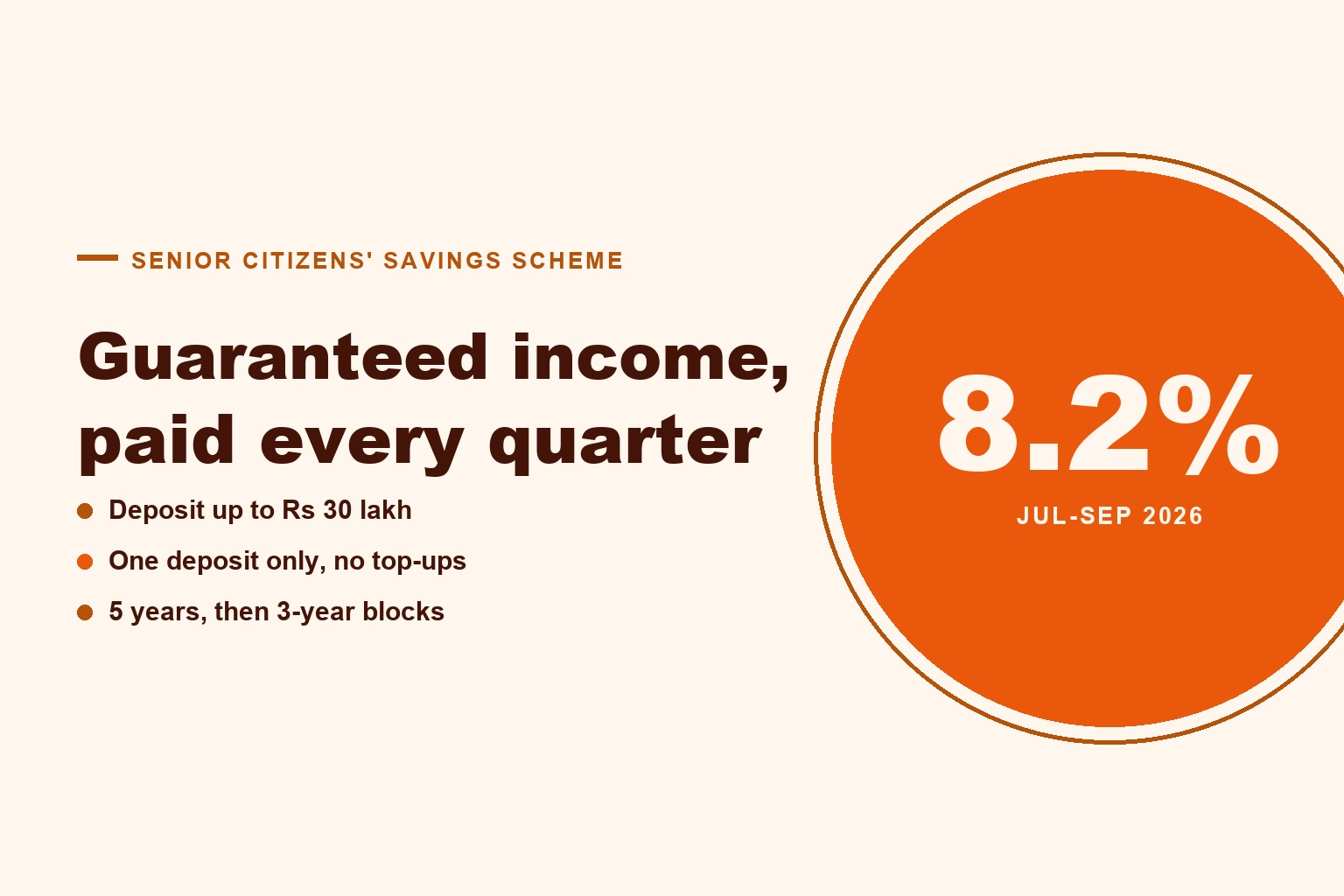

TL;DR: The Senior Citizens' Savings Scheme (SCSS) pays 8.2% per annum for the July-September 2026 quarter, which makes it one of the highest-paying government-backed products available to anyone over 60. You can put in up to Rs 30 lakh, interest lands in your bank account every quarter rather than compounding, and the rate you get on the day you open the account is locked for the full five years regardless of what happens to rates afterwards. But the scheme has sharp edges: you get exactly one deposit and can never add to it, unclaimed interest earns you nothing at all, and closing early costs real money. This guide works through the Senior Citizens' Savings Scheme, 2019 as it now stands after amendment.
1. SCSS at a glance
| Feature | Rule |
|---|---|
| Interest rate | 8.2% p.a. for the July-September 2026 quarter. Reset quarterly by the Finance Ministry. |
| Rate lock | The rate on your opening date applies for the whole five-year term. |
| Minimum deposit | Rs 1,000, in multiples of Rs 1,000 |
| Maximum deposit | Rs 30 lakh across all your SCSS accounts taken together |
| Number of deposits | One. You cannot add to the account later. |
| Tenure | 5 years, extendable in blocks of 3 years |
| Interest payout | Quarterly, not compounded |
| Tax | Deposit qualifies for Section 80C (old regime). Interest is fully taxable. |
2. Who can open an account
Paragraph 3 of the Scheme sets four doors in, and the second one is the one people miss.
- Age 60 or above on the date of opening. The straightforward route.
- Age 55 to 59, if you have retired on superannuation or otherwise. But there is a deadline: the account must be opened within three months of receiving your retirement benefits, and you must attach proof of the disbursal date plus a certificate from your employer. This window was widened from one month to three by the 2023 amendment, which helps, but it is still easy to miss while sorting out a retirement.
- Retired defence personnel at age 50 (excluding civilian defence employees), subject to the other conditions.
- The spouse of a government employee who had attained the age of 50 and died in harness — added by the 2023 amendment. Read that carefully: the age-50 test attaches to the deceased employee, not to the surviving spouse. That is the entire point of the change, which was made because spouses of employees who died in service were otherwise stuck waiting until they themselves turned 60.
If you are in the 55-59 band, one more limit applies: your deposit is capped at the retirement benefits you actually received, or the ceiling, whichever is lower. You cannot use this early door to park money that did not come from your retirement.
Joint accounts
You may open an account alone or jointly with your spouse only. Three points follow from the Scheme text and they surprise people:
- The age of the first account holder decides eligibility. There is no age limit on the second holder — so a 62-year-old can open a joint account with a 54-year-old spouse.
- The entire deposit is attributed to the first holder — but for the purposes of the Scheme and its ceiling. It does not settle the income-tax position: who is taxed on the interest turns on whose money it actually was, under the Income-tax Act, not on whose name appears first on the form.
- Both spouses can hold their own single accounts and joint accounts with each other, provided each is independently eligible — which is how a couple gets to Rs 60 lakh between them rather than Rs 30 lakh.
3. The one-deposit rule
Paragraph 4(2) is one line long and it shapes the whole decision: "There shall be only one deposit in the account."
SCSS is not a recurring product. Whatever you put in on day one is what earns for five years. If you open with Rs 5 lakh in September and come into another Rs 10 lakh in December, you cannot top up — you open a second account, at whatever rate is current in December, subject to the Rs 30 lakh combined ceiling across all your accounts.
That has a practical consequence worth thinking about. Because the rate is fixed at opening and reset quarterly, opening several accounts at different times spreads your rate risk, the same way a fixed-deposit ladder does. Whether that is worth doing depends on where you think rates are heading, but the option exists and most people do not realise it.
Deposit more than the ceiling by mistake and the excess is refunded immediately, earning only Post Office Savings Account rates for the days it sat there.
4. How the interest actually reaches you
This is where SCSS differs most sharply from PPF, and where the money is either used or quietly wasted.
Interest is calculated to 31 March, 30 June, 30 September and 31 December, and paid on the first working day of April, July, October and January. It is a payout, not a compounding accrual — which is exactly what a retiree living off the corpus wants, and exactly what someone hoping to grow the corpus does not.
The trap is paragraph 5(4): if you do not claim the quarterly interest, it earns no additional interest. It simply sits there. Leave four quarters unclaimed on a Rs 30 lakh deposit and you have roughly Rs 2.46 lakh sitting completely idle for a year. The fix is trivial — authorise the accounts office to credit interest straight to your savings account, which paragraph 5(3) expressly allows — but it has to be done.
Rounding is to the nearest rupee, with 50 paise and above rounded up.
5. Closing early, and what it costs
You can close at any time, but paragraph 6 prices it by how long you have held the account:
| When you close | What happens |
|---|---|
| Before 1 year | All interest already paid to you is recovered from the deposit |
| After 1 year, before 2 years | 1.5% of the deposit is deducted |
| On or after 2 years | 1% of the deposit is deducted |
| After extension, more than 1 year from the extension date | No deduction at all |
| After extension, within 1 year of the extension date | 1% of the deposit is deducted |
Note the first row properly. Closing inside twelve months is not a penalty on top of your interest — the interest is taken back. On a Rs 30 lakh deposit at 8.2%, three quarters of paid interest is about Rs 1.84 lakh, and it goes back.
And paragraph 6(4) closes the obvious workaround: partial withdrawals are not permitted. You cannot take out Rs 5 lakh and leave the rest running. It is the whole account or nothing, which is the strongest argument for splitting a large corpus across several accounts rather than one.
6. Maturity and the extension blocks
The account matures at five years. From there, paragraph 8 as amended in 2023 gives you something better than it used to:
- You may extend for a further block of three years by applying within one year of maturity.
- Extension is no longer once-only. The 2023 amendment replaced "only once" with repeating three-year blocks, so an account can now run 5 years, then 8, then 11, and onward.
- The extension is deemed effective from the date of maturity (or the end of each block), whatever date you actually applied.
- An extended account earns the rate applicable on the date of maturity or extended maturity — so each extension re-prices to the then-current rate. That cuts both ways.
- Once extended, you can close any time after one year from the extension date with no deduction.
Miss the one-year application window and you lose the right to extend — but the account is not closed for you. It simply sits there, and under paragraph 5(8) a deposit that is neither extended nor closed earns only the Post Office Savings Account rate until you get round to closing it. That is a fall from 8.2% to roughly 4%, quietly, for as long as you leave it. Diarise the maturity date the day you open the account.
7. The tax position
- Deposit: qualifies for Section 80C, up to Rs 1.5 lakh, and only under the old regime. If you are on the new regime — the default — the deduction is unavailable, which materially changes the comparison against a bank FD.
- Interest: fully taxable as income from other sources. SCSS is not tax-free; it is a high-rate taxable product.
- TDS: deducted under Section 194A once the interest paid or credited by a given payer — the post office or bank holding the account — crosses Rs 1,00,000 in the financial year for a senior citizen. That threshold was doubled from Rs 50,000 with effect from 1 April 2025. Note it is tested payer by payer, not across everything you hold everywhere. At 8.2%, Rs 1 lakh of interest is roughly a Rs 12.2 lakh deposit, so most full-limit investors will see TDS.
- Section 80TTB separately allows senior citizens a deduction of up to Rs 50,000 on interest income under the old regime. Worth checking against your total interest before assuming tax is due on all of it.
8. SCSS or PPF?
They are not competitors so much as different tools, and the honest answer depends on whether you need the money to arrive or to grow.
| SCSS | PPF | |
|---|---|---|
| Who can open | Broadly 60+ (55+ on retirement) | Any resident individual |
| Ceiling | Rs 30 lakh | Rs 1.5 lakh per year |
| Interest | Paid out quarterly | Compounded annually |
| Tax on interest | Fully taxable | Tax-free |
| Term | 5 years, +3-year blocks | 15 years, +5-year blocks |
If you need quarterly income now, SCSS does a job PPF cannot, at a far higher ceiling. If you are still accumulating and taxed at a high rate, PPF's tax-free compounding usually wins despite the lower headline rate. Many retirees sensibly run both.
9. Before you open one
- Check the current quarter's rate. It resets every quarter and locks on your opening date. A few weeks either side of a revision can matter for five years.
- Authorise auto-credit of interest at the time of opening. Unclaimed interest earns nothing.
- Consider splitting the corpus across accounts opened at different times — no partial withdrawal is allowed, so one large account is all-or-nothing.
- Diarise the maturity date and the one-year extension window.
- If you are 55-59, count the three months from receipt of retirement benefits carefully.
- Consider Form 15H if you qualify — the test is that your estimated tax liability for the year is nil, not merely that income looks low. Declaring wrongly has consequences; where you do not qualify, the TDS is recovered through your return instead.
Sources
- Senior Citizens' Savings Scheme, 2019 — notified vide G.S.R. 916(E) dated 12 December 2019 under sections 3A and 15 of the Government Savings Promotion Act, 1873. Paragraphs 3 to 8 govern opening, deposits, interest, premature closure, closure and extension.
- Senior Citizens' Savings (Fourth Amendment) Scheme, 2023 — G.S.R. 829(E) dated 7 November 2023: three-month window for retirees aged 55-59, eligibility for the spouse of a government employee who died in harness, and extension in repeating three-year blocks.
- Deposit ceiling — raised from Rs 15 lakh to Rs 30 lakh, announced in the Union Budget 2023 and effective from 1 April 2023.
- Interest rate — set quarterly by the Ministry of Finance, Department of Economic Affairs; 8.2% p.a. for the July-September 2026 quarter.
- Income-tax Act, 1961 — Section 80C (deposit, old regime), Section 80TTB (senior citizen interest deduction) and Section 194A (TDS, threshold Rs 1,00,000 for senior citizens from 1 April 2025).
This guide reflects the position for the July-September 2026 quarter. Small-savings rates are revised every quarter and scheme rules can be amended by notification; confirm the current rate and any recent amendment on the India Post or National Savings Institute portal, or with your bank, before acting. Nothing here is individual financial advice — for decisions tied to your own retirement corpus and tax position, consult a SEBI-registered investment adviser or a qualified financial planner.


Comments (0)
No comments yet. Be the first to comment!