
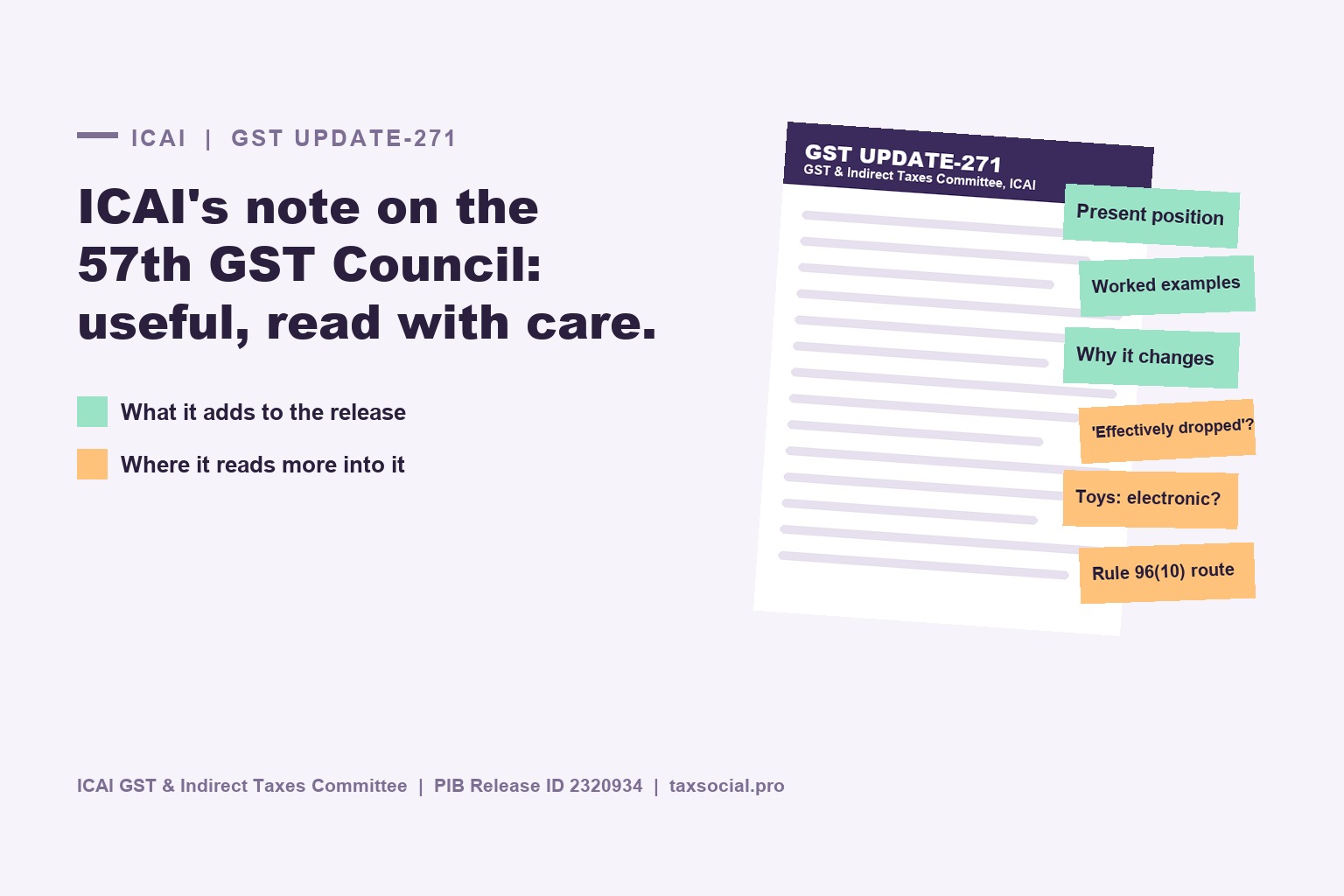

ICAI's GST & Indirect Taxes Committee has issued GST Update-271, a 15-page note on the recommendations of the 57th GST Council meeting of 8 October 2026. It follows the Council's press release item by item. For each it adds a "present position", the "recommended change" and its "impact", with worked examples. That makes it the most useful single reading of the meeting for a practitioner. But in a few places it reads more into the release than the release says, and those are the places to be careful. This article summarises what the update adds and flags those points. ICAI's update is attached to this article.
1. What GST Update-271 is
The Institute of Chartered Accountants of India publishes numbered GST updates through its GST & Indirect Taxes Committee to keep members current. Update-271 covers one subject: "Recommendations made in the 57th GST Council Meeting". It is organised in five parts: process reforms (registration, returns, refunds, dispute resolution), other major reforms (blocked credit, exports), ease of living and doing business (arrest, e-way bills, IPR, rule 86A, late fee, ARQP and compliance items), goods, and services.
It is an explanatory note, not law, and it does not claim to be. Like the press release it summarises, it describes recommendations that take effect only when the circulars, notifications and Act amendments are issued.
2. What it adds that the press release does not
The release is a list of decisions. Update-271 explains each against the current position, which is where most readers need the help. The most useful additions:
- Registration amendments. It explains that today core particulars, such as legal name and address of places of business, need the officer's approval. After the change only a principal place of business change will (and not even that for rule 14A registrants).
- Cancellation. It sets out today's route: officer examination, notice, order, then GSTR-10 within three months of the date of cancellation or of the order, whichever is later. That shows what automatic acceptance removes.
- Portal facilities given legal backing. It explains that the RCM liability/ITC statement (new rule 86D), the credit reversal and reclaim statement (new rule 86C) and IMS (new rule 60(6A)) run today on GSTN advisories, not on the Rules. It sets out what each records in GSTR-3B.
- GSTR-3B corrections. It explains that a wrong GSTR-3B entry cannot be revised today, and that the new sub-rules 61(1A) and 61(1B) would give an alternate correction route, which the Council recommended "may be brought into force from the return of April, 2027", after public consultation.
- Refunds. A worked example: on a Rs 10 lakh export refund, Rs 9 lakh would be sanctioned provisionally in phase 1, and in phase 2 the full Rs 10 lakh, less dues, in each case only for claims the system clears on its risk evaluation. For capital goods spread over 60 months, Rs 6 lakh of credit works out to Rs 10,000 a month; the actual refund mechanics will be in the amended rules.
- Interest on pre-deposit refunds. It explains why section 115 is being made standalone: it now refers to the rate "under section 56", which has two rates (6% and 9%) and has caused confusion. It notes that the new rate is not yet disclosed.
- Penalties. It states today's non-fraud penalty as the higher of 10% of tax or Rs 10,000 (under section 73 for periods up to 2023-24 and section 74A from 2024-25), against which the new 5% early-payment penalty and the removal of the Rs 10,000 minimum can be read.
- Exports. It explains in plain terms why services to a foreign branch are not exports today (the distinct-person condition in section 2(6)(v)) and why work on a foreign client's goods in India is not export (section 13(3)(a) places the supply in India).
- Waste and scrap. It reminds readers that the reverse charge plus 2% TDS mechanism already applies to metal scrap from 10 October 2024, and sets out the extension to plastics, e-waste, tyres and used cooking oil as a supplier-recipient table.
- Late fee. A worked example: a return due 20 November filed on 28 November carries no late fee; filed on 3 December, the late fee applies. It also says interest on tax paid late still applies.
3. Where to read it carefully
Five statements in Update-271 go beyond, or put differently from, the Council's release. None is necessarily wrong as a forecast, but none is in the release itself.
| Topic | The release says | Update-271 says | Our reading |
|---|---|---|---|
| Pending notices below Rs 10,000 | Pending notices and appeals below Rs 10,000 "will be decided as if the said threshold of Rs. 10,000/- had been in force when the notice was issued" | "so they will effectively be dropped" | That is the likely result, but the release describes a statutory rule for deciding them. How each is closed will depend on the amendment's wording, and nothing happens until it is in force. |
| Prosecution | Threshold raised from Rs 1 crore to Rs 5 crore, offences narrowed, punishments rationalised | Present position: "prosecution applies when tax involved exceeds Rs 1 crore"; punishments "to be rationalized with upcoming notifications" | Today Rs 1 crore is the floor only for the fake-invoice offence in section 132(1)(b). And section 132 is in the Act, so the punishments change by Act amendment, not by notification. |
| Toys | The toy entries cover "all other categories of toys (such as dolls, puzzles and other toys) mentioned in heading 9503" | "Entries cover all toys in heading 9503 (other than electronic toys)" | The words "other than electronic toys" are not in the release. Wait for the clarifying notification before applying the entry to electronic toys either way. |
| Rule 96(10) | Listed among issues for clarification by circular: "Omission of rule 96 (10) ... to be effective from 23.10.2017, in accordance with the Hon'ble Supreme Court decision" | "A circular may clarify that the omission of Rule 96(10) shall be effective from 23.10.2017"; proceedings for the period "would lose their legal basis" | Both describe the intent. Whether a circular alone can give the omission retrospective effect, or a notification amending the rules will follow, is open. Exporters with pending rule 96(10) demands should wait for the instrument before treating them as closed. |
| Re-treaded tractor tyres | Rate to be aligned "with that applicable on new tractor tyres" | Gives the current rates as 18% for re-treaded and 5% for new | The release gives no rates. Check the rate notification. |
4. Where Update-271 and the release agree, and what that confirms
- Arrest: section 69 to be omitted.
- Transit checks: interception only on specific intelligence with Joint Commissioner authorisation; only where the supplier or recipient is in the State; no confiscation in transit. All of this by amending sections 68, 129 and 130.
- Notice floor: Rs 10,000 counted across CGST, SGST, IGST and cess.
- Pre-deposit cap: Rs 40 crore (Rs 20 crore CGST plus Rs 20 crore SGST/UTGST) for penalty-only orders.
- Blocked credit: outdoor catering, health and life insurance, telecom towers and pipelines outside the factory, free samples, and goods destroyed or written off on expiry as required by law.
- Refunds: input services for inverted duty from credit availed on 1 November 2026; capital goods for inverted duty and zero-rated supplies from 1 April 2027, over 60 months.
- Same-line credit: restaurants and outdoor catering, hotels up to Rs 7,500 per unit per day, and gyms, as already allowed for passenger transport, tour operators and vehicle renting.
- ARQP: only a concept note, approved in principle, for turnover up to Rs 5 crore and B2C supplies only.
5. How to use it
- As a briefing note for clients. The "present position / recommended change / impact" format makes it easy to explain each change.
- Not as the law. Cite the notification or the amended section once it issues, not the update. Where the update and the release differ, go by the release and then by the notification.
- Alongside the Finance Ministry's FAQs. The Ministry published 12 sets of FAQs on 9 October covering registration, cancellation, the e-commerce scheme, refunds, litigation, arrest and prosecution, e-way bills, exports, goods and services. Where they go into more detail than both the release and the update, the FAQs are useful administrative guidance on how the department intends to apply the changes, though, like the update, they are not law; the amendment, notification or circular controls. We have covered two: cancellation of registration and registration for e-commerce sellers under rule 14B.
Our own article-by-article coverage of the meeting starts with the 57th GST Council roundup, built from the official release.
Source: "Goods & Services Tax Update-271: Recommendations made in the 57th GST Council Meeting", GST & Indirect Taxes Committee, The Institute of Chartered Accountants of India (October 2026), attached; Recommendations of the 57th Meeting of the GST Council, PIB, 8 October 2026 (Release ID 2320934); CGST Act section 132.



Comments (0)
No comments yet. Be the first to comment!