
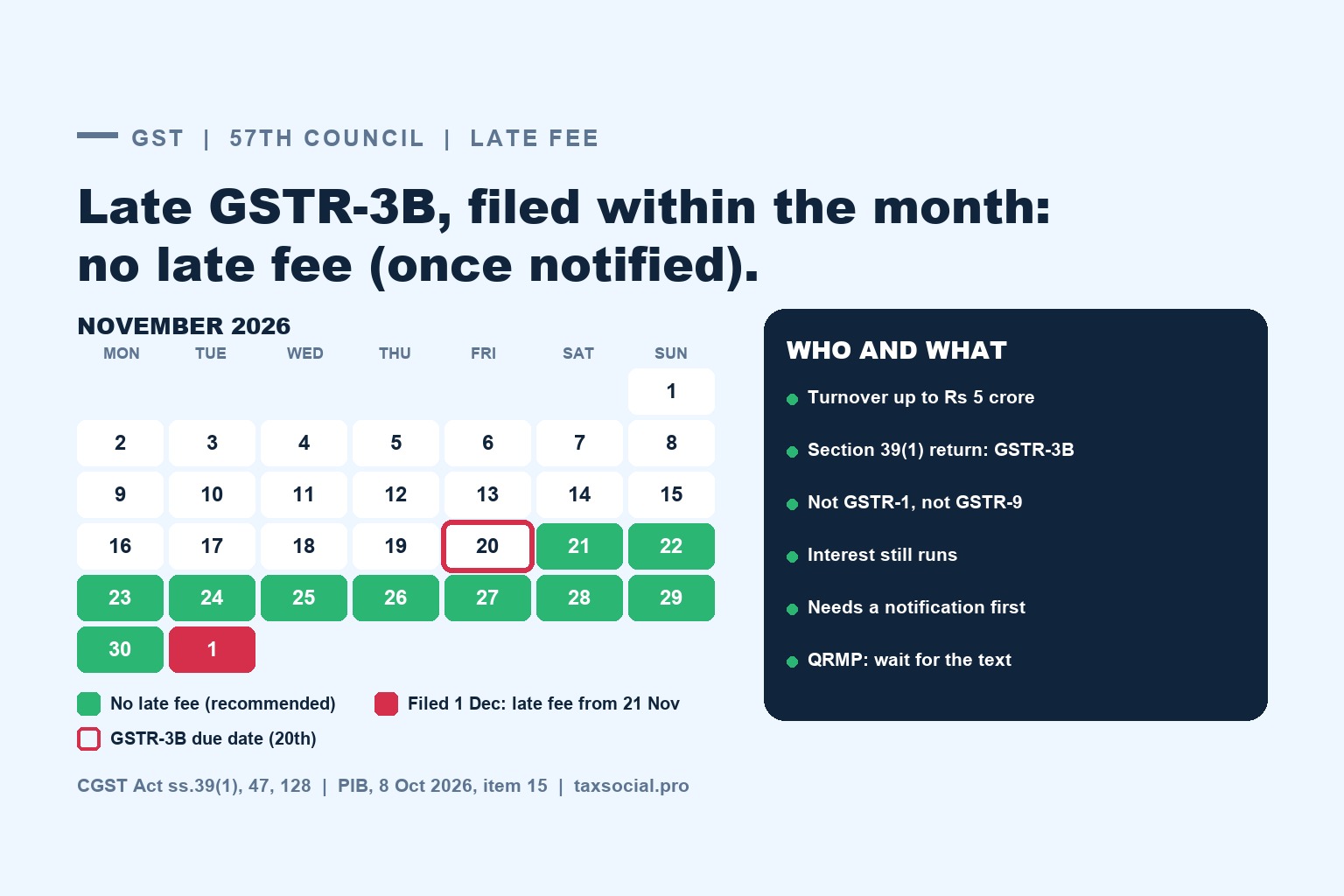

Yes, it is true, and it is official. Item 15 of the Council's press release of 8 October 2026 says the GST Council "recommended waiver of late fee on delayed filing of return under section 39(1) of the CGST Act, 2017, for taxpayers with an annual turnover up to Rs. 5 crore in the preceding financial year, if the said delayed return is filed by the end of the month in which it was due." For a monthly filer, the section 39(1) return is GSTR-3B, due on the 20th. So a GSTR-3B for October, due on 20 November, would carry no late fee if filed by 30 November. Three things the viral posts leave out: it is a recommendation, so the late fee still applies until a notification is issued; it covers the late fee only, not interest on tax paid late; and it does not cover GSTR-1 or the annual return.
1. What the Council actually said
The full text of item 15 of "Recommendations of the 57th Meeting of the GST Council" (PIB, 8 October 2026):
"Extending relief for small taxpayers on late fees: The GST Council recommended waiver of late fee on delayed filing of return under section 39(1) of the CGST Act, 2017, for taxpayers with an annual turnover up to Rs. 5 crore in the preceding financial year, if the said delayed return is filed by the end of the month in which it was due."
Each phrase sets a condition:
- "return under section 39(1)": the monthly return of a regular taxpayer, which is GSTR-3B. Not GSTR-1, which is a statement under section 37. Not GSTR-9, which is the annual return under section 44.
- "annual turnover up to Rs. 5 crore in the preceding financial year": measured on the previous year. Note the wording: item 15 says "annual turnover", while item 17 of the same release, on the ARQP scheme, says "aggregate turnover". The existing late fee caps use aggregate turnover, which is computed on a PAN basis across all States. Whether the waiver will use the same measure, and so whether a business with several registrations is tested on all of them together, is for the implementing notification to say.
- "filed by the end of the month in which it was due": a return due on 20 November must be filed by 30 November. File it on 1 December and the waiver does not apply, so the late fee runs from 21 November.
2. What a late GSTR-3B costs today
Section 47(1) of the CGST Act sets a late fee of Rs 100 a day under CGST, up to Rs 5,000, for a return under section 39 not filed by the due date. An equal amount applies under the SGST Act. Notifications under section 128 have cut this a long way, and the position since June 2021 is:
| Taxpayer | Late fee per day (CGST + SGST) | Maximum per return (CGST + SGST) |
|---|---|---|
| Nil return (no tax payable) | Rs 20 | Rs 500 |
| Aggregate turnover up to Rs 1.5 crore | Rs 50 | Rs 2,000 |
| Aggregate turnover above Rs 1.5 crore up to Rs 5 crore | Rs 50 | Rs 5,000 |
| Aggregate turnover above Rs 5 crore | Rs 50 | Rs 10,000 |
The caps come from Notification No. 19/2021-Central Tax dated 1 June 2021, which amended Notification No. 76/2018-Central Tax. Under CGST alone the caps are Rs 250 for a nil return, Rs 1,000 for aggregate turnover up to Rs 1.5 crore, and Rs 2,500 for more than Rs 1.5 crore and up to Rs 5 crore, matched under SGST. Above Rs 5 crore, the ordinary section 47 ceiling of Rs 5,000 applies. Our GST penalties and late fees quick reference sets out the other returns.
3. What the waiver would save
A GSTR-3B is due on the 20th, so the window between the due date and the end of the month is ten or eleven days (eight in February, nine in a leap year). At Rs 50 a day, the most a regular filer saves on one return is about Rs 550; a nil filer, about Rs 220.
That is small per return, but it is the most common late fee there is. A business that habitually files GSTR-3B a few days late, because the accountant closes the books after the 20th or because its suppliers' GSTR-1 data arrives late, pays it twelve times a year. For a practice filing hundreds of returns, it is a recurring cost to explain to clients.
It also shows what the waiver is not. It does not move the due date. After the end of the month, the full late fee applies from the day after the due date, not from the first of the next month.
4. What it does not cover
- Interest. Section 50(1) charges interest, currently 18% a year, from the day after the due date on tax paid late. Under the proviso to section 50(1), for a return filed late (other than after proceedings start), interest is levied on the part of the tax paid through the electronic cash ledger. A GSTR-3B filed on the 28th still carries eight days' interest on the cash portion. Nothing in item 15 touches that.
- GSTR-1. GSTR-1 is furnished under section 37, not section 39, so the recommendation as worded does not cover it. GSTR-1 for a monthly filer is due on the 11th, and its late fee runs separately.
- The annual return. GSTR-9 is under section 44 and has its own late fee under section 47(2).
- Turnover above Rs 5 crore. Larger taxpayers get nothing from this.
- Returns already filed. A recommendation operates from the date of the notification that implements it. Do not assume late fees already paid will be refunded unless the notification says so.
5. The question the notification has to answer: QRMP filers
Taxpayers with aggregate turnover up to Rs 5 crore can opt for the QRMP scheme (Notification 84/2020-Central Tax) and file GSTR-3B quarterly, on the 22nd or 24th of the month after the quarter depending on the State, under rule 61. That quarterly return is furnished under the proviso to section 39(1).
The release says "return under section 39(1)". Whether that includes returns under the proviso is not stated. Notification 19/2021, the last major late fee notification, treated the two separately, with one row for taxpayers "liable to furnish the return as specified under sub-section (1) of section 39" and another for those under "proviso to sub-section (1) of section 39". So it is possible the implementing notification covers monthly filers only, or treats QRMP filers differently. Until it is out, a QRMP filer should not assume the waiver applies to a quarterly GSTR-3B filed on, say, the 28th.
6. When does it start?
No Act amendment is needed. Section 128 lets the Government, on the Council's recommendation, waive late fee wholly or partly for a class of taxpayers, by notification. That is how every late fee reduction since 2017 has been done. So this can come quickly, and it is one of the few recommendations from this meeting that does not have to wait for Parliament.
But until the notification is issued, the late fee applies in full from the day after the due date. Watch for a Central Tax notification under section 128, probably amending Notification 76/2018 as earlier waivers did, and for its effective date, including how it defines turnover: the tax period from which it applies will decide which of your returns benefit.
7. What to do
- Keep filing GSTR-3B by the 20th. The waiver is a safety net, not a new due date, and interest runs regardless.
- Check your turnover for the preceding year against Rs 5 crore on an aggregate, all-State basis.
- If you are on QRMP, read the notification before relying on the waiver for a quarterly return.
- Do not treat it as covering GSTR-1. File GSTR-1 by the 11th as before.
- Practices: once the notification is out, check the late fee shown on the portal for returns filed between the 21st and the month end. If it is still charged for a qualifying return, it should be raised with the GST helpdesk.
The rest of the meeting's decisions for small businesses, including the proposed annual return (ARQP) and the e-commerce registration route, are in our small business article, and the full list is in our 57th GST Council roundup.
Source: Recommendations of the 57th Meeting of the GST Council, Press Information Bureau, 8 October 2026 (Release ID 2320934), item 15; CGST Act sections 37, 39, 44, 47, 50 and 128; Notification No. 19/2021-Central Tax dated 1 June 2021.




Comments (0)
No comments yet. Be the first to comment!