
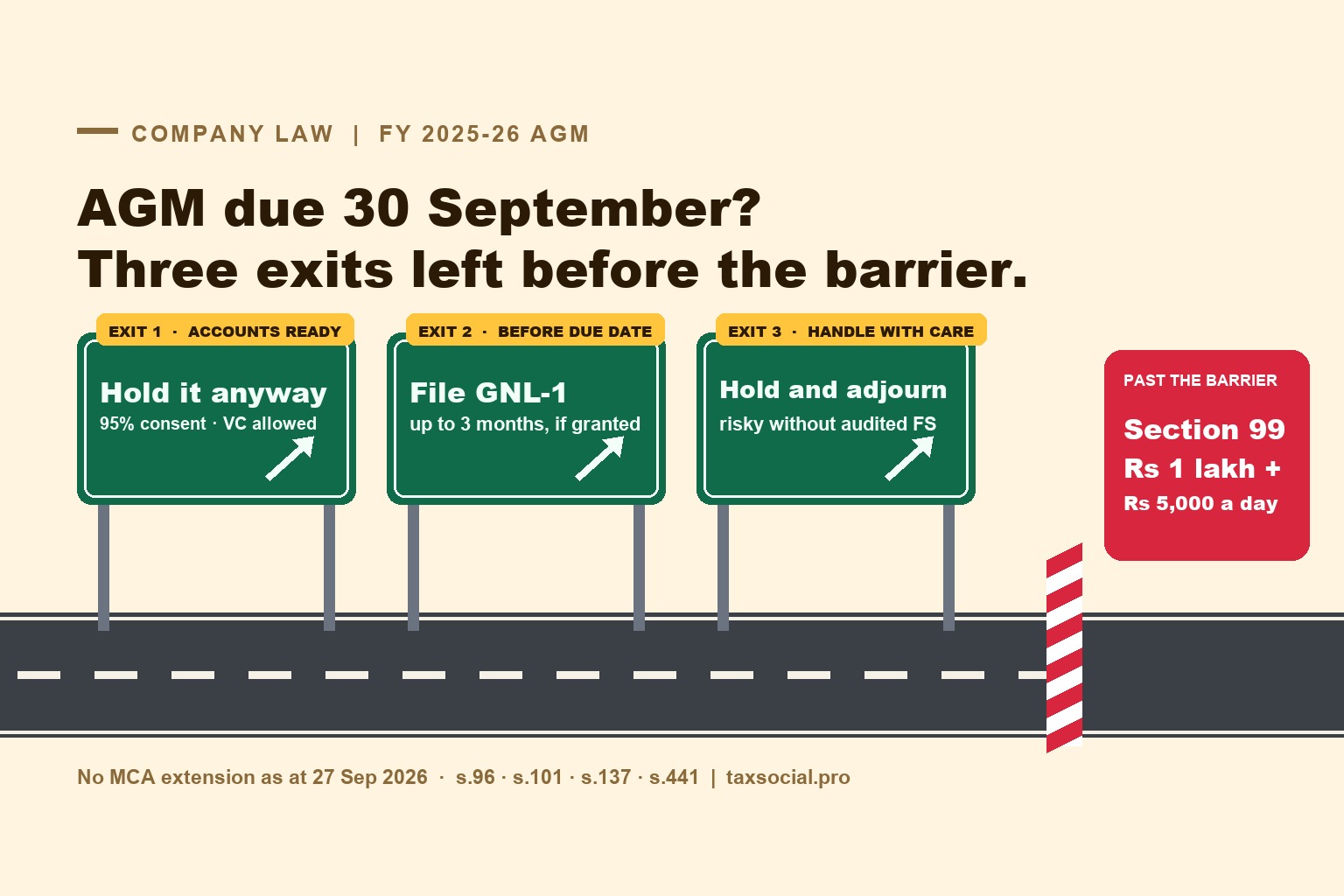

As at 27 September 2026, nothing has moved the date. MCA has issued no general extension of the AGM for FY 2025-26 and no direction to Registrars to grant one. The last General Circular is GC 04/2026 of 31 August, which was about CCFS-2026. If your due date is 30 September (and it may be earlier), three routes are still open for a few more days. If the audited accounts are ready, hold the meeting. Shorter notice needs the written consent of at least 95% of members entitled to vote, and a video-conference AGM is still allowed under GC 03/2025. If they are not ready, apply for an extension in Form GNL-1 before the due date passes. After that there is nothing left to extend. The third route, holding the AGM and adjourning it for the accounts, is less safe than it is often made to sound. If the date does pass, the company and each officer in default face a section 99 fine with an uncapped daily limb. Separately, the filing clocks for AOC-4 and MGT-7 start anyway, and a member can go to the Tribunal. Compounding under section 441 is the usual way to close the offence, but it is an option the company applies for, not an automatic step.
1. Where things stand on 27 September 2026
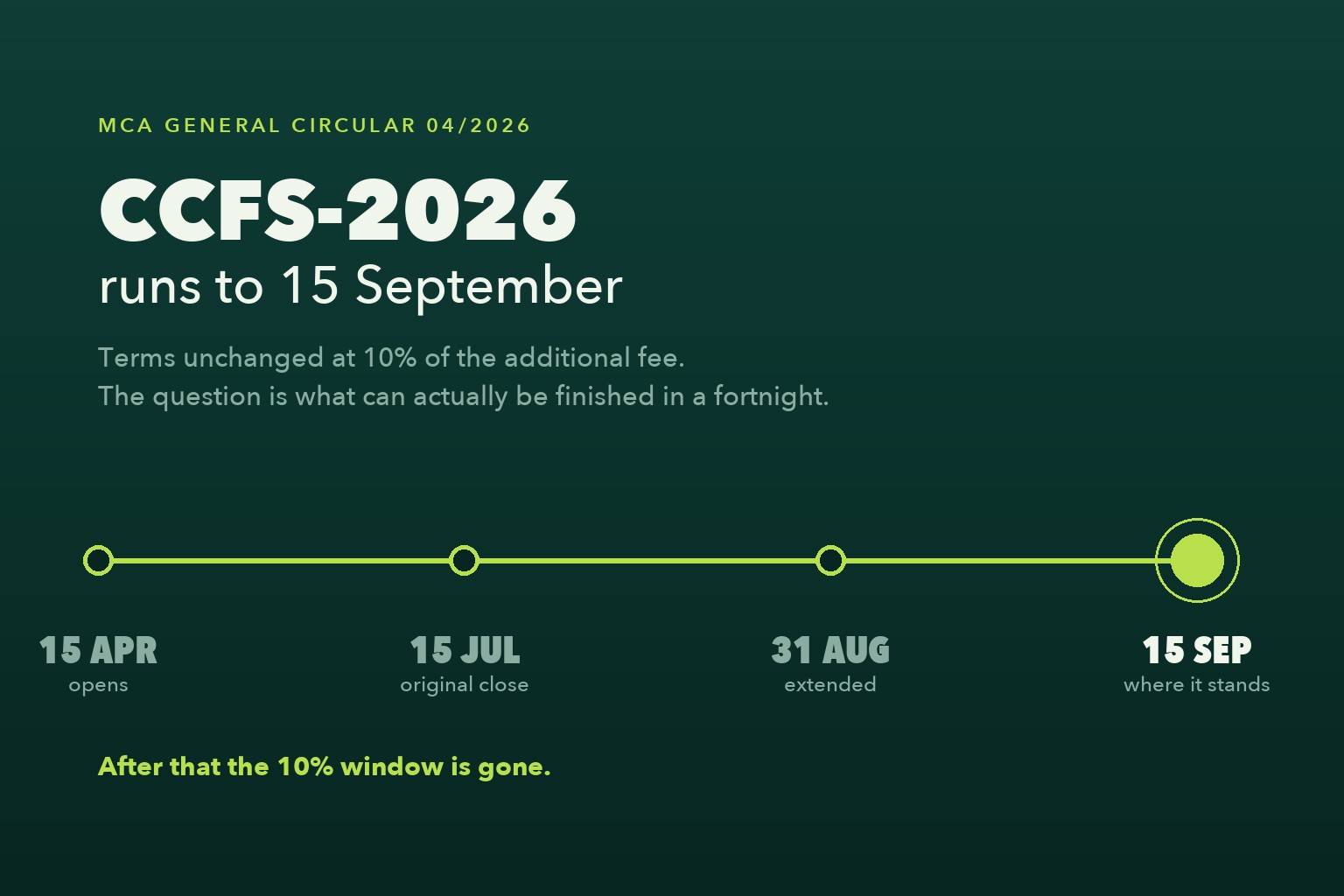
We checked MCA's circulars page this weekend. The 2026 General Circulars run from GC 01/2026 to GC 04/2026, and none of them touches the AGM:
| Circular | Date | Subject |
|---|---|---|
| GC 01/2026 | 24.02.2026 | CCFS-2026 opens |
| GC 02/2026 | 19.06.2026 | DPT-3 for the year ended 31.03.2026 without additional fee, to 31.07.2026 |
| GC 03/2026 | 08.07.2026 | CCFS-2026 extended to 31.08.2026 |
| GC 04/2026 | 31.08.2026 | CCFS-2026 extended to 15.09.2026 |
So the position is the statutory one. For a 31 March company, the FY 2025-26 AGM is due within six months of the year end and within fifteen months of the last AGM, whichever comes first. Our companion piece on the extension works that arithmetic through. Do it before reading on, because a company whose FY 2024-25 AGM was held before 30 June 2025 is already past the dates below.
A circular could still issue in the last days. In 2020 the ministry directed a blanket extension through the Registrars. But nothing like that has happened this year, and it is not a plan.
2. Route one: hold the meeting anyway
If the audited financial statements are signed, the cleanest answer is to hold the AGM by the due date, even at short notice. Two provisions make that possible in three days.
Shorter notice. The ordinary notice for a general meeting is twenty-one clear days. The proviso to section 101(1) allows an AGM on shorter notice if consent is given, in writing or by electronic mode, by not less than ninety-five per cent of the members entitled to vote at it. For most private companies and closely held unlisted companies that is a phone round, not an obstacle, though the consents themselves must still come in writing or by e-mail. Collect them before the meeting and keep them with the minutes.
By video conference. General Circular 03/2025 of 22 September 2025 allows companies to hold AGMs through video conferencing or other audio-visual means "till further orders", following paras 3 and 4 of General Circular 20/2020. We found nothing withdrawing it. The same circular says, in its second paragraph, that it does not extend the statutory time for holding an AGM. VC solves the problem of getting people into a room. It doesn't move the date.
Time and place. Section 96(2) requires the meeting to be called during business hours, between 9 a.m. and 6 p.m., on a day that is not a National Holiday. It must be held at the registered office or elsewhere in the same city, town or village. An unlisted company can hold it anywhere in India if all members consent in advance, in writing or by electronic mode. 30 September 2026 is a Wednesday and not a National Holiday, so it is available. The national holiday to watch is 2 October, which falls after the date anyway.
What this route can't fix is accounts that aren't ready. Section 129(2) requires the financial statements to be laid before the company at every AGM. A meeting called on short notice with no audited accounts to lay leads straight to the question in section 4 below.
3. Route two: apply for the extension, today or tomorrow
If the accounts cannot be ready in time, the lawful route is an extension of up to three months under the third proviso to section 96(1). The application goes in Form GNL-1, backed by a Board resolution and a specific reason. The companion piece covers what to file, what counts as a special reason and what does not. Three points matter most this week:
- It has to reach the Registrar before the due date. The power is to extend a period that is still running. An application after the date has nothing to act on.
- Filing is not the same as being granted. The extension exists when the Registrar's order says so, and the order may allow less than three months. If an application is refused, the company is where it would have been without it. Hold the meeting as soon as you can and don't rely on the pending application.
- The first AGM cannot be extended. The proviso excludes it in terms. A company whose first AGM is due has route one, and nothing else.
File early in the day and keep the acknowledgement. MCA's portal has had a difficult year, and a GNL-1 that fails to upload at 11:50 p.m. on the due date is a missed application, not a pending one.
4. Route three, with a warning: hold it and adjourn it
A route that circulates every September is to hold the AGM on time, open it, and adjourn it to a later date for adoption of the accounts. The idea is that a meeting was "held" within section 96 even though the accounts were dealt with later.
There is statutory language that gets pointed to. The first two provisos to section 137(1) deal with financial statements that "are not adopted at annual general meeting or adjourned annual general meeting". In that case the unadopted financial statements, with the required documents, are to be filed within thirty days of the AGM. The Registrar keeps them on record as provisional. The adopted statements are then filed within thirty days of the adjourned meeting.
The provisos say "not adopted". They do not say why, and they do not in terms require that audited statements were laid. But they do require the unadopted statements, with the required documents, to be filed within thirty days of the AGM. That sits naturally with a company whose accounts are audited and before the meeting but not adopted. It sits badly with a company that has no audited accounts at all, and section 129(2) requires the financial statements to be laid at every AGM. A meeting held only to be adjourned, with nothing to lay, is exposed to the argument that it was not the AGM section 96 requires.
The Act doesn't resolve that question, and we found no MCA, ICSI, ROC or Tribunal authority endorsing an AGM convened only to be adjourned because the accounts are not available. We would not rely on it where a GNL-1 can still be filed. It is on firmer ground where the audited statements exist and are laid, and adoption is deferred for a genuine reason, such as a query from members.
5. If the date passes: what it actually costs
The fine under section 99
Section 99 provides that if a default is made in holding a meeting in accordance with section 96, 97 or 98, the company and every officer in default "shall be punishable with fine which may extend to one lakh rupees". On a continuing default there is a further fine of up to five thousand rupees for every day it continues.
Two features make this different from most company-law defaults. First, it is still a fine, imposed by a court on prosecution. It is not a penalty the Registrar adjudicates under section 454. Section 99 has not been amended since 2013. Second, the continuing-default limb has no cap, so the potential exposure keeps growing as long as the meeting is not held.
The filing clocks start anyway
Not holding the AGM doesn't pause the annual filings. Section 137(2) requires the financial statements to be filed within thirty days of the last date before which the AGM should have been held, with a statement of the facts and the reasons for not holding it. Section 92(4) runs the annual return from the same notional date. Miss those as well and a second set of consequences follows. Section 137(3) is a penalty of ₹10,000 plus ₹100 a day, capped at ₹2 lakh for the company. It also reaches named individuals rather than "officers in default" generally: the managing director and the CFO, or failing them the director the Board has charged with the filing, or failing that every director, each capped at ₹50,000. MCA's additional fees apply on top. And for directors, the real long-term risk is section 164(2)(a). It disqualifies the directors of a company that has not filed its financial statements or annual returns for any continuous period of three financial years. A missed AGM does not trigger that on its own. Missed filings year after year do.
A member can take it to the Tribunal
Under section 97, where a company defaults in holding its AGM, the Tribunal may, on the application of any member, call the meeting or direct that it be called, and give consequential directions. In a company with a minority shareholder in dispute with the Board, this is often how a missed AGM gets used.
Closing it out: compounding under section 441
Because section 99 is punishable with fine only, the offence can be compounded under section 441, before or after a prosecution is launched. Compounding is discretionary and has to be applied for. A company that doesn't apply remains exposed to prosecution. Offences punishable with imprisonment, alone or with a fine, cannot be. The Regional Director compounds where the maximum fine that can be imposed does not exceed ₹25 lakh. Above that, the Tribunal does. Two limits apply:
- The three-year bar. Section 441(2) says compounding is not available for an offence committed within three years of a similar offence by the same company or officer being compounded. A company that compounded a missed AGM in 2024 can't compound another one now.
- A pending investigation. An offence cannot be compounded if an investigation against the company under the Act has been initiated or is pending.
Note what the uncapped daily fine does to the first threshold. At ₹1 lakh plus ₹5,000 a day, the statutory maximum reaches exactly ₹25 lakh after 480 days of continuing default and exceeds it from day 481. Beyond that, depending on how the maximum is computed on the facts, the application may belong before the Tribunal, not the Regional Director. It is one more reason not to let a missed AGM sit.
The practical sequence is short. Hold the meeting as soon as you can, because each day adds to the continuing default. File AOC-4 and MGT-7 on the section 137(2) and 92(4) basis if the meeting is still some way off. Then consider applying to compound, with the default already brought to an end.
6. The Bill that would change this, and why it doesn't help yet
The Corporate Laws (Amendment) Bill, 2026 (Bill No. 85 of 2026) was introduced in the Lok Sabha on 23 March 2026. A Joint Parliamentary Committee reported on it on 3 August 2026. Three of its clauses bear on this subject:
- clause 33 would turn section 99 into a penalty of ₹1 lakh, plus ₹5,000 a day for a continuing default, capped at ₹2 lakh for a company and ₹50,000 for an officer. It would also narrow the section to defaults under section 96 alone, dropping sections 97 and 98 and Tribunal directions;
- clause 97 would raise the Regional Director's compounding limit from ₹25 lakh to ₹1 crore;
- a new section 96(3) would allow AGMs wholly or partly by video conference, with a physical AGM at least once every three years.
As far as we can find, the Bill has not been passed by either House. Until it is enacted and notified, section 99 is a criminal fine with an uncapped daily limb, and a default in September 2026 is judged under the law as it stands. Don't plan a missed AGM around a Bill.
7. The next three days, as a checklist
- Confirm your real due date from the date of last year's AGM. If it is before 30 September and has passed, skip to step 7.
- Are the audited financial statements signed? If yes: convene the AGM, collect 95% consent for shorter notice, and use VC under GC 03/2025 if people cannot gather.
- If no: identify the specific reason, pass the Board resolution, and file GNL-1 no later than the day before the due date.
- Don't hold a meeting just to adjourn it as a substitute for step 3.
- If the extension is granted, read the date the order actually gives, and hold the AGM by then.
- If it is refused, or never filed, hold the AGM as soon as possible anyway.
- Past the date without an extension: file AOC-4 within thirty days and MGT-7 within sixty days of the last permissible date, each with the statement of reasons. Once the meeting has been held, take advice on applying to compound under section 441.
Quick answers
Can we hold the AGM on a Sunday?
Section 96(2) excludes only a day that is a National Holiday, which the section's Explanation defines as a day declared as such by the Central Government. A Sunday is not, by itself, a National Holiday. The meeting still has to be within business hours.
We are a One Person Company. Does any of this apply?
No. Section 96(1) excludes a One Person Company, so there is no AGM to miss.
Is the video-conference circular an extension?
No, and it says so. GC 03/2025 allows the mode of the meeting. Its second paragraph states that it does not extend the statutory time for holding AGMs, and that companies that miss the timelines remain liable to action.
Will MCA waive the additional fee on late AOC-4 and MGT-7 this year?
Nothing has been issued for FY 2025-26. Even when MCA has waived additional fees in past years, the waiver applied to the forms, not to the AGM. A fee waiver never cures a missed meeting.
Sources
- Companies Act, 2013: sections 92(4), 96(1) and (2), 97, 99, 101(1) proviso, 129(2), 137(1) first and second provisos, 137(2) and (3), 164(2)(a) and 441, as published in MCA's e-book of the Act.
- MCA General Circular 03/2025 dated 22.09.2025 (AGMs through VC/OAVM till further orders), read with paras 3 and 4 of General Circular 20/2020 dated 05.05.2020.
- MCA General Circulars 01/2026 to 04/2026; GC 04/2026 dated 31.08.2026.
- Corporate Laws (Amendment) Bill, 2026, Bill No. 85 of 2026, clauses 33 and 97 and the proposed section 96(3) (text via PRS Legislative Research).
This article states the position under the Companies Act, 2013 as at 27 September 2026, for a company with a 31 March financial year end whose last AGM set a due date of 30 September 2026. A circular issued after that date is not reflected here, so check MCA's site before you act. Nothing here is advice on your company's facts. If your accounts will not be ready, the GNL-1 and its reason are worth putting in front of a practising company secretary today.


Comments (0)
No comments yet. Be the first to comment!