
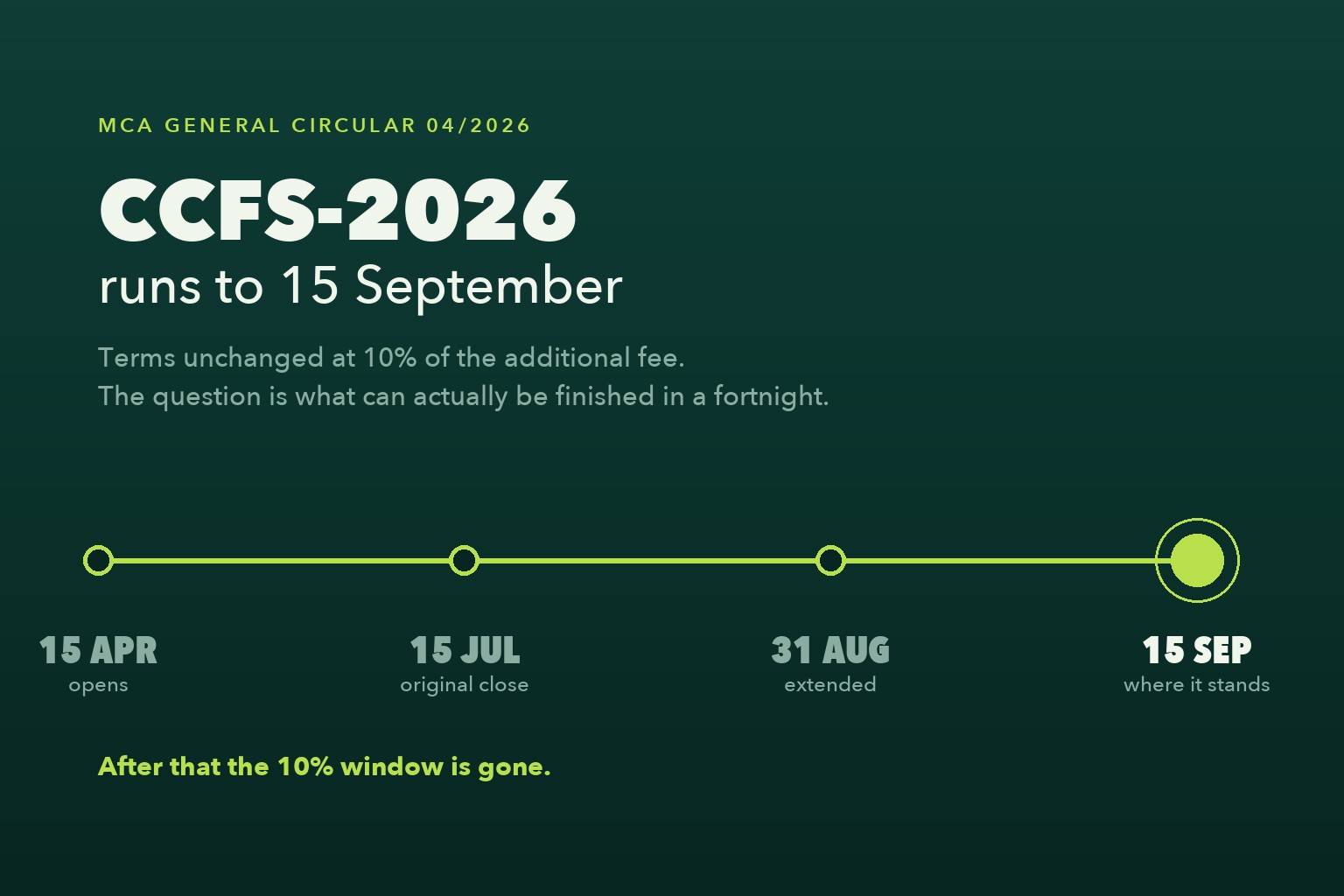

TL;DR: The Ministry of Corporate Affairs has extended the Companies Compliance Facilitation Scheme, 2026 to 15 September 2026 through General Circular No. 04/2026 dated 31 August 2026. This is the second extension. Nothing else about the scheme has changed — the 90% additional-fee concession, the dormant-status and strike-off routes, the Section 92 and 137 immunity and the exclusions are all exactly as notified in February. So the useful question is not what CCFS offers. It is what a company can realistically finish in fourteen days. A strike-off or a dormant application can be done from a standing start. A single overdue year with signed financials already in hand can be done. A three-year backlog where the back-year audits have not begun cannot, and pretending otherwise is how firms end up filing at full fee on 16 September.
1. What the circular actually does
General Circular No. 04/2026, issued under file number Policy-02/02/2020-CL-V-MCA, does one thing: it moves the last date of CCFS-2026 from 31 August 2026 to 15 September 2026. The stated basis is representations received from stakeholders. The circular then confirms that all other terms and conditions of the scheme remain unchanged.
That last sentence is the one worth reading twice. An extension circular that leaves terms untouched means every calculation you did in April or July still holds. There is no new concession to reassess, no fresh eligibility carve-out, and no reason to redo fee workings you have already prepared. If you built a CCFS plan for a client in June and then ran out of runway, the plan is still valid — it simply has a new deadline attached to it.
2. The trail: how a 92-day scheme became a five-month one
It is worth setting out the sequence, because a company that heard about CCFS once in the spring may reasonably believe the window shut long ago.
| Circular | Date | Effect |
|---|---|---|
| General Circular No. 01/2026 | 24 February 2026 | Notifies CCFS-2026. Window: 15 April 2026 to 15 July 2026. |
| General Circular No. 03/2026 | 8 July 2026 | Extends the last date to 31 August 2026, citing capacity enhancement and restoration work at the MCA data centre following a fire on 5 June 2026. |
| General Circular No. 04/2026 | 31 August 2026 | Extends the last date to 15 September 2026, in view of representations received from stakeholders. All other terms unchanged. |
The July extension is the more interesting of the two, and it explains a lot about how this season has gone. A fire at the data centre on 5 June knocked out capacity in the middle of the scheme's busiest stretch, at precisely the point when the portfolio work planned in April was supposed to be converting into filed forms. Practitioners who spent June fighting the portal rather than filing on it were not imagining the problem. The Ministry extended the window because the infrastructure could not carry the load, not because demand was soft.
The August extension reads differently. There is no infrastructure reason given — only representations from stakeholders, which is the standard formula for "a lot of people asked". That is a meaningful distinction when you are deciding how much weight to put on the possibility of a third extension. An outage is a reason the Ministry has to fix. A backlog of firms asking for more time is a reason it can decline at any point.
3. What fourteen days is enough for
Sort the portfolio by whether signed audited financials already exist, not by how many years are pending. That single question decides almost everything, because the audit is the one input that cannot be compressed by working harder in the last week.
| Where the entity stands | Realistic call |
|---|---|
| Directors have decided the company is finished | Strike-off, at 25% of the STK-2 fee. Lowest preparation overhead of the three routes and no dependency on back-year audit. Check the Rule 4 prerequisites first — they are what will stop this, not time. |
| Company is idle but the directors want to keep it alive | Dormant status, at 50% of the MSC-1 fee. Needs board and shareholder approvals and the statutory declarations. All achievable inside a fortnight if the meetings are convened now. |
| One or two overdue years, financials already audited and signed | File under the scheme. AOC-4, then MGT-7, then ADT-1. The UDINs already exist, so this is form preparation, not accounting work. |
| Multi-year backlog, back-year audits not started | Partial recovery only. File the years whose audits can genuinely be signed in time and accept full fee on the rest. A partial clean-up is still worth doing. |
| An adjudication notice is outstanding | Top of the list, whatever the route. The 30-day immunity window runs from the date of the notice and has nothing to do with the scheme's closing date. Track those dates separately. |
4. The constraint everybody underestimates
For the route that most companies actually want — bringing overdue annual filings current — the binding constraint is not the MCA portal and it is not the fee. It is that AOC-4 cannot be filed without audited financial statements, and the form requires the UDIN generated against the auditor's signed report.
That means the sequence is: complete the back-year audit, hold the AGM, sign the financials, generate the UDIN, and only then file. A company that walks in on 8 September with three unaudited years is not going to finish. This is not pessimism about anyone's capacity; it is that the intervening steps involve people other than you, several of whom need to sign things in a particular order.
The practical response is to stop treating the backlog as one job. Take the most recent year, where the records are freshest and the opening balances least contested, and get that one audited and filed. Each year you clear reduces the additional fee you will pay later and narrows the exposure under Sections 92 and 137 on that year permanently.
5. What has not changed, and still catches people
Because the circular leaves terms untouched, every limitation that applied in April applies now:
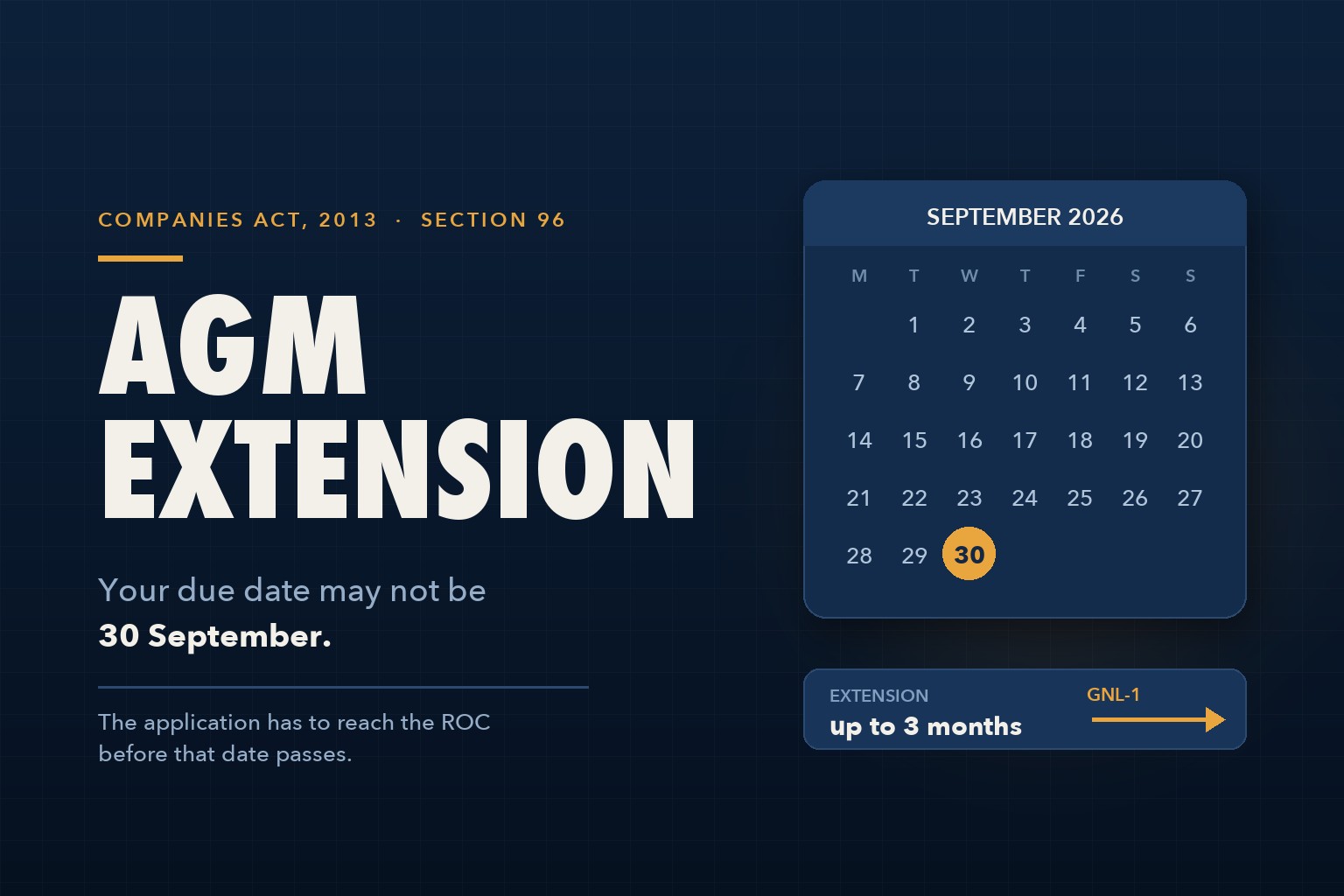
- Section 96 is not covered. The scheme addresses the failure to file, not the failure to hold the annual general meeting. A company that never held its AGM has a Section 96 default that survives the scheme entirely, and filing MGT-7 does not cure it. This is the single most common misreading of CCFS.
- LLPs are outside the scheme. It is a Companies Act facility. An LLP with overdue Form 8 or Form 11 gets nothing from it.
- Immunity has conditions. Protection for Section 92 and 137 defaults depends on filing before an adjudication notice is issued, or within 30 days of one. It is not automatic on filing.
- Strike-off has prerequisites. Rule 4 of the 2016 Removal of Names Rules governs what a company must have done before STK-2 is available. The fee concession does not waive those.
- Disqualification is not addressed by the scheme at all. Section 164(2)(a) disqualifies directors of a company that has not filed for three consecutive financial years. CCFS neither unwinds a disqualification that has already attached nor states that filing under it retrospectively negates a completed three-year default. Filing ends the ongoing non-compliance, which matters; it is not an answer to the disqualification question, and that one turns on the facts.
6. Do not plan around a third extension
Two extensions have happened, and the temptation to assume a third is obvious. Three reasons not to build a plan on it:
First, the reasons given have weakened. The July extension answered a concrete failure on the Ministry's own side. The August one answered requests. A Ministry that has already granted the requested relief once has less reason to grant it again.
Second, the cost of being wrong is asymmetric. If you assume no extension and one arrives, you have filed early and paid the concessional fee. If you assume an extension and none arrives, you pay the full additional fee on every year in the backlog, and the enforcement track — strike-off action under Section 248(1), adjudication with running penalties, fresh disqualification exposure — resumes against a company you have told the directors was being sorted out.
Third, the fourteen days are not really fourteen. Allow working days for a form to come back for resubmission, and a filing lodged on 15 September that is sent back for correction on 17 September is not a filing made under the scheme. Treat 11 or 12 September as the real internal deadline for anything on Route A.
7. What resumes on 16 September
- Full additional fee. The 90% concession goes, and subsequent late filings are charged at the normal slabs under the Registration of Offices and Fees Rules.
- Registrar-initiated strike-off. Action under Section 248(1) resumes against companies still in default. Once a company is struck off, getting it back means an NCLT application under Section 252, which costs materially more in both money and months than the filing would have.
- Adjudication. Proceedings under Sections 92 and 137 restart, with penalties that continue to run.
- Fresh disqualification. Section 164(2)(a) continues to bite on three consecutive years of non-filing.
8. A two-week checklist
- Today: list every entity in default, and against each mark the years pending, whether the AGM was held, whether signed financials exist, whether any STK-1 or adjudication notice has been received and on what date, and what the directors want the company to be in twelve months.
- Day 1–2: assign each entity a route — file, dormant, or strike off. Take the ones with an adjudication notice out of the queue and handle them first against their own 30-day clocks.
- Day 2–3: convene the board and shareholder meetings needed for the dormant and strike-off applications. These need notice periods; starting them late is what kills otherwise easy filings.
- Day 3–9: file everything that does not wait on an audit. Get the signed-and-ready Route A years in as well — do not batch them to the end.
- Day 9–12: back-year audits that can genuinely close, and the filings that follow them. Anything still open at day 12 should be reclassified as a full-fee filing for after the window, and the client told so plainly.
- Day 13–14: resubmissions, DSC problems, and nothing new.
9. Sources
- Ministry of Corporate Affairs — General Circular No. 04/2026 dated 31 August 2026, F. No. Policy-02/02/2020-CL-V-MCA, extending CCFS-2026 to 15 September 2026.
- Ministry of Corporate Affairs — General Circular No. 03/2026 dated 8 July 2026, extending the scheme to 31 August 2026 following the data centre fire of 5 June 2026.
- Ministry of Corporate Affairs — General Circular No. 01/2026 dated 24 February 2026, notifying the Companies Compliance Facilitation Scheme, 2026.
- Companies Act, 2013 — Sections 92, 96, 137, 164(2), 248(1) and 252.
- Companies (Removal of Names of Companies from the Register of Companies) Rules, 2016 — Rule 4.
- Companies (Registration of Offices and Fees) Rules, 2014 — base fee and additional-fee slabs.
Confirm the current position on the MCA portal before relying on a closing date, and check the additional-fee slab that applies to the specific company and form. Corporate compliance is fact-specific — take advice from a practising Company Secretary, Chartered Accountant or Advocate on a particular entity before acting.


Comments (0)
No comments yet. Be the first to comment!