
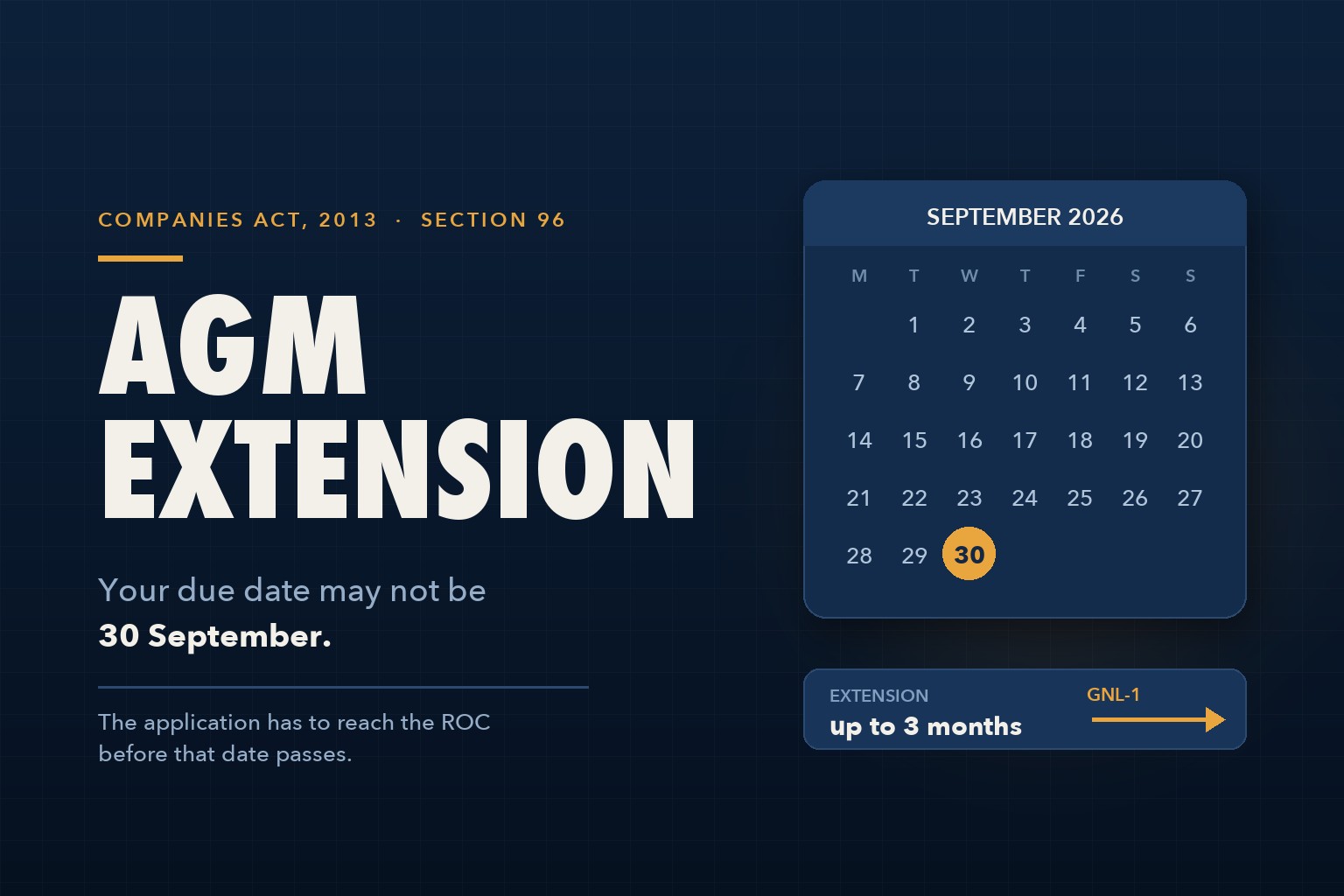

TL;DR: For a company with a 31 March year end, the annual general meeting for FY 2025-26 is due by 30 September 2026 — but only if your last AGM was held on or after 30 June 2025. Section 96(1) has two limbs and the due date is whichever falls earlier. If you cannot hold the meeting in time, the Registrar can extend it by up to three months under the third proviso, but the application in Form GNL-1 has to reach the ROC before the due date passes. There is nothing to extend afterwards. And an MCA circular waiving additional fees on AOC-4 or MGT-7 is not an AGM extension — those are two different things, and companies conflate them every year.
1. Where things stand as at 2 September 2026
There is no general extension of the AGM date for FY 2025-26. Nothing has been notified that moves the statutory date for companies at large, and nothing should be assumed.
This is worth stating plainly because there is recent precedent pulling the other way. In 2020, the ministry directed the Registrars to grant a blanket three-month extension and twenty-five ROCs issued orders on the same day — no application required from anyone. Companies that lived through that year tend to expect a repeat. It has not happened for FY 2025-26.
The General Circulars issued in 2026 so far, and what each of them actually did:
| Circular | Subject | Does it move the AGM date? |
|---|---|---|
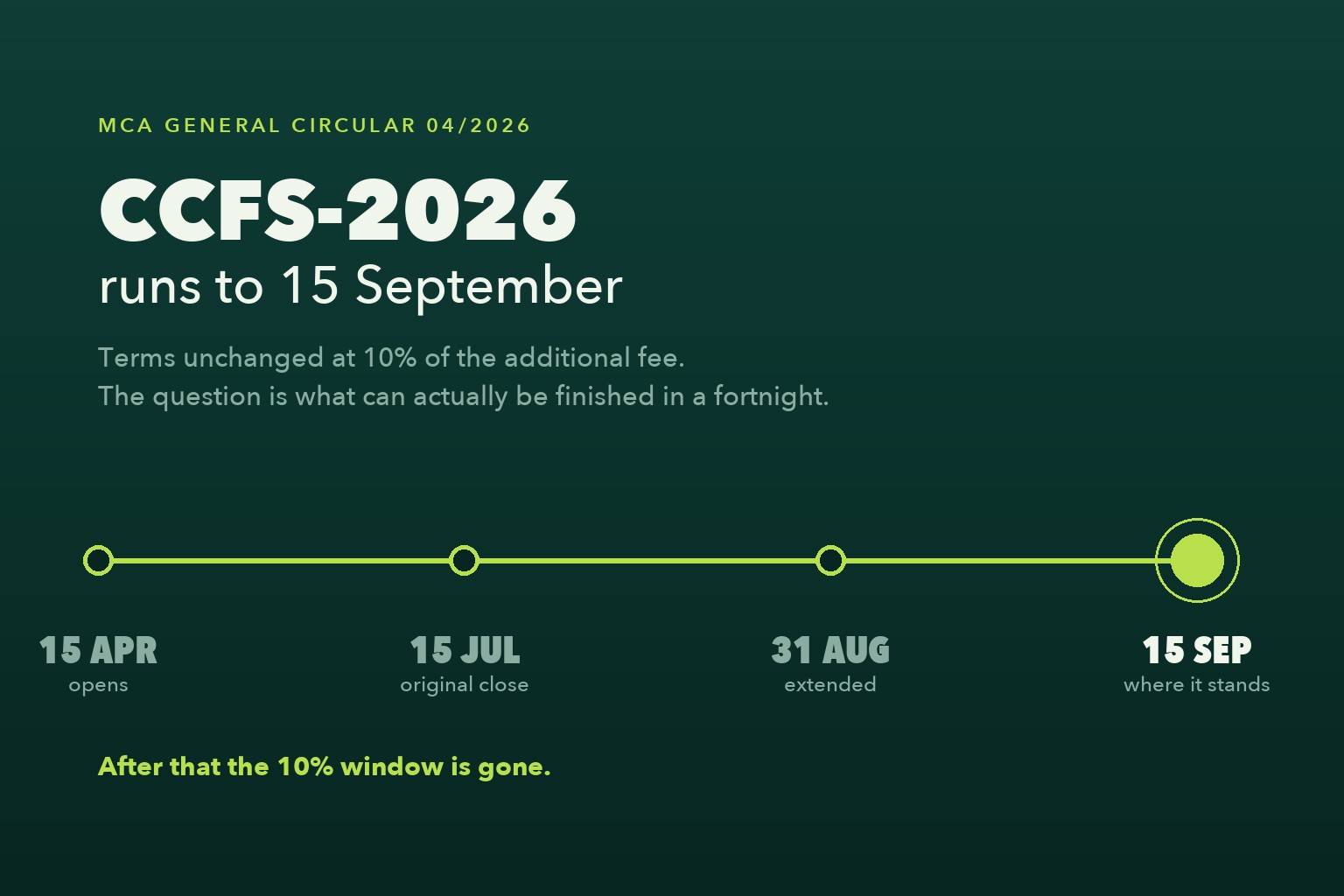
| GC 01/2026 | Opens the CCFS-2026 compliance window | No |
| GC 02/2026 (19.06.2026) | DPT-3 for FY ended 31.03.2026 without additional fee to 31.07.2026, after the MCA data-centre fire of 5 June 2026 | No |
| GC 03/2026 | CCFS-2026 extended to 31.08.2026 | No |
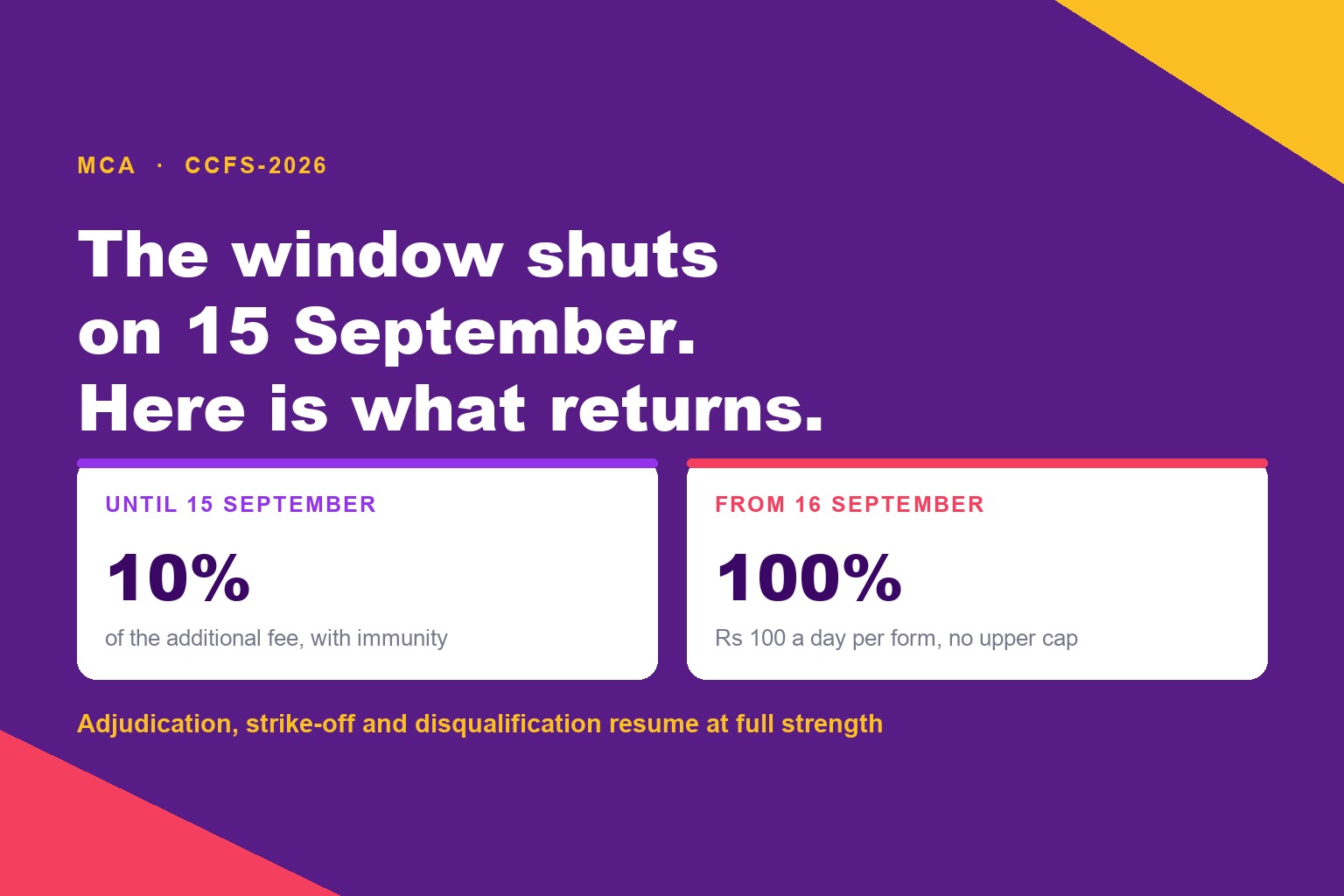
| GC 04/2026 | CCFS-2026 extended to 15.09.2026 | No |
Check the MCA site before you rely on this. A circular issued after the date on this article will not be reflected here, and the position can change quickly — it did four times this year on CCFS alone.
2. What section 96 actually says
Section 96(1) applies to every company other than a One Person Company. An OPC is outside the AGM requirement altogether, so nothing in this article applies to one.
For everyone else, the section imposes two independent time limits:
- the AGM must be held within six months from the close of the financial year; and
- not more than fifteen months may elapse between one AGM and the next.
A newly incorporated company is on a different clock: its first AGM must be held within nine months from the close of its first financial year, and if it holds that first AGM it need not hold another one in the year of incorporation.
The extension power sits in the third proviso, and it is short enough to read in full:
"the Registrar may, for any special reason, extend the time within which any annual general meeting, other than the first annual general meeting, shall be held, by a period not exceeding three months."
Three things follow from that sentence, and each of them catches somebody out every year.
3. Your due date is the earlier of the two limbs
This is the point the posters and infographics leave out, and it is the one most likely to cost a company its extension.
The two limbs in section 96(1) both bind. Your due date is whichever comes first — six months from the year end, or fifteen months from the date of your last AGM. For FY 2025-26 with a 31 March year end, the six-month limb lands on 30 September 2026. Whether that is your real due date depends entirely on when you held your previous AGM.
| Your FY 2024-25 AGM was held on | Fifteen-month limb falls on | Your due date for FY 2025-26 | Latest date with a full three-month extension |
|---|---|---|---|
| 25 September 2025 | 25 December 2026 | 30 September 2026 (six-month limb binds) | 31 December 2026 |
| 30 June 2025 | 30 September 2026 | 30 September 2026 (the two limbs meet) | 31 December 2026 |
| 20 June 2025 | 20 September 2026 | 20 September 2026 (fifteen-month limb binds) | 20 December 2026 |
| 10 May 2025 | 10 August 2026 | 10 August 2026 — already gone | 10 November 2026, but only if the application went in before 10 August |
The pivot is 30 June 2025. If your last AGM was on or after that date, the six-month limb binds and 30 September 2026 is your date. If it was before, your date is earlier than 30 September and every deadline in this article moves with it.
Two practical consequences. First, a company that ran an efficient FY 2024-25 cycle and held its AGM in June or July 2025 is penalised for it by a tighter FY 2025-26 window — which is counter-intuitive and is exactly why it gets missed. Second, if your last AGM was itself held late under an extension, that late date becomes the start of the fifteen-month clock, which usually helps you rather than hurting you.
Work out your own date before you do anything else. Everything below runs off it.
4. The extension runs from your due date, not from 30 September
The proviso lets the Registrar extend "the time within which any annual general meeting ... shall be held" by up to three months. That is three months from your due date as computed above, not three months from a calendar date that applies to everybody.
So a company whose due date is 20 September 2026 can be extended to 20 December 2026 at the outside — not to 31 December. Assuming the year-end date and asking for, or acting on, an extension to 31 December is a straightforward way to be in default while believing you are compliant.
Note also that the Registrar may grant less than three months. The proviso sets a ceiling, not an entitlement, and the order will specify the date actually allowed. Read the order rather than assuming you got the full period.
5. The application must reach the ROC before the due date
This is the hard edge of the whole subject.
The Registrar's power is to extend a period. Once the due date has gone by, there is no live period left to extend, and the settled practice is that an application made afterwards cannot be entertained. The company is not late in applying — it is in default in holding the meeting, which is a different and worse position. There is no condonation route back.
What the application involves:
- A Board resolution approving the application, recording the reason, and authorising a director or the company secretary to file it. Pass this at a properly convened Board meeting; the resolution is an attachment.
- Form GNL-1, filed with the Registrar under the Companies (Registration Offices and Fees) Rules, 2014. No separate format is prescribed for an AGM extension application — GNL-1 is the vehicle, with the reasons set out in the attachment. MCA has been migrating forms to the V3 portal, so confirm which portal GNL-1 is live on before you sit down to file.
- A statement of the special reason, with documents backing it where documents exist.
- The prescribed fee, which is slabbed by authorised share capital. Check the current Table of Fees rather than a figure quoted in an article.
Then wait for the order. The extension is not effective because you applied; it is effective because the Registrar granted it. File early enough that an order can realistically issue, and keep the order with your minutes — it is what you will produce if the AGM date is ever questioned.
6. What counts as a "special reason"
The section does not define the term and no list has been prescribed, which means the Registrar exercises discretion on the facts. What can be said from how the power is used in practice is that reasons carrying weight tend to be ones outside the management's control and specific to the company. Reasons that read as ordinary internal slippage tend not to.
Reasons commonly advanced, and generally treated as substantive:
- a merger, amalgamation or scheme pending before the Tribunal that affects the accounts being laid;
- the auditor's resignation, death or incapacity, or a casual vacancy that has delayed the audit through no fault of the company;
- seizure of the books by the income-tax department, a serious-fraud agency or any other authority;
- loss of accounting data through fire, flood or system failure, with the incident evidenced;
- natural calamity affecting the registered office or the operating location;
- a change in the financial year;
- the death of a director taking the Board below the statutory minimum, or an inability to constitute a quorum that is genuinely outside the company's hands.
"The accounts are not ready" on its own is a weak application. It describes the problem the section is aimed at rather than a reason for it. Say why they are not ready, and attach whatever evidences it.
7. A fee waiver is not an AGM extension
This one causes more confusion than anything else on this page, so it deserves its own heading.
MCA periodically issues circulars allowing companies to file annual forms — AOC-4, MGT-7, MGT-7A and their variants — without additional fee up to a stated date. General Circular 08/2025, dated 30 December 2025, did precisely this for FY 2024-25, allowing those filings up to 31 January 2026 without additional fee.
A circular of that kind does not move the AGM date. The circulars generally say so in terms. What they relieve is the additional fee on a late filing. The statutory obligation to hold the AGM within the section 96 period is untouched, the default under section 99 still arises if the meeting is not held, and the company is still exposed even though the forms went in without a rupee of additional fee.
In short: a fee circular buys time on the form. Only an order under the third proviso to section 96(1) buys time on the meeting.
8. What an extension does and does not shift
The annual filing deadlines are pegged to the AGM, so an extension moves them with it:
| Filing | Due | Where the section 96 date matters |
|---|---|---|
| ADT-1 | Within 15 days of the AGM at which the auditor is appointed | Runs from the actual AGM date |
| AOC-4 | Within 30 days of the AGM | Runs from the actual AGM date — but see section 137(2) below |
| MGT-7 / MGT-7A | Within 60 days of the AGM | Runs from the actual AGM date — but see section 92(4) below |
Now the part that makes postponement useless as a strategy. Section 137(2) provides that where the AGM is not held, the financial statements are to be filed within thirty days of the last date before which the annual general meeting should have been held, together with a statement of the reasons for not holding it. Section 92(4) does the same for the annual return in its own terms: where no AGM is held, the sixty days run from the date on which it should have been held, again with a statement of the reasons.
So not holding the meeting does not stop the filing clocks. It starts them from a notional date and adds a default under section 99 on top. A company cannot buy time on AOC-4 by quietly letting the AGM slide — the only mechanism that legitimately moves both is an extension granted before the due date.
9. If the date has already gone
If your due date has passed without the meeting and without an extension, the position is what it is. What is left is damage control, and it is better done early:
- Hold the AGM anyway, as soon as you can. The default is in not holding it on time; continuing not to hold it makes the position worse day by day, because section 99 contemplates a continuing default.
- File AOC-4 and MGT-7 on the section 137(2) / section 92(4) footing, with the statement of reasons, rather than waiting for a meeting that has not been convened.
- Understand the exposure. Section 99 provides that on a default in holding a meeting in accordance with section 96, the company and every officer in default are punishable with a fine which may extend to one lakh rupees, and on a continuing default a further fine which may extend to five thousand rupees for every day the default continues.
- Know that a member can force the issue. Under section 97, where a company defaults in holding an AGM, the Tribunal may on the application of any member call the meeting or direct that it be called, and may give consequential directions. In a company with a dissenting shareholder this is a live route, not a theoretical one.
10. A short checklist
- Look up the date of your last AGM. Not the year — the date.
- Add fifteen months. Compare with 30 September 2026. The earlier one is your due date.
- If you can hold the meeting by then, do that and stop reading.
- If you cannot, identify the special reason and gather what evidences it.
- Pass a Board resolution approving the application and authorising the filing.
- File GNL-1 with the reason and attachments, well before the due date — not on it.
- Wait for the order and read the date it actually grants.
- Hold the AGM by that date, then run ADT-1, AOC-4 and MGT-7 off the actual meeting date.
Frequently asked
Can the first AGM be extended?
No. The third proviso excludes the first annual general meeting in terms. A newly incorporated company gets nine months from the close of its first financial year instead of six, and that is the whole of its concession — there is no application that adds to it.
Does an extension apply to the company or to the meeting?
To the meeting for that year. It is not a standing arrangement. The following year's AGM runs off the ordinary section 96 limbs again, with the fifteen-month clock starting from the date the extended AGM was actually held.
We are a One Person Company. Do we need any of this?
No. Section 96(1) applies to every company other than a One Person Company. An OPC does not hold an AGM, and its AOC-4 due date is pegged to the financial year end rather than to a meeting.
Can we apply for an extension of more than three months?
No. Three months is the statutory ceiling on the Registrar's power. If the company needs longer than that, the extension route does not solve the problem and the company should take advice on where that leaves it.
If we get an extension, does the fifteen-month gap rule still apply?
The extension operates on the section 96 time limit, so where the fifteen-month limb set your due date, the permitted gap moves out to the extent of the extension granted. The safe way to think about it is not in terms of a fixed outer number of months but as: your due date, plus whatever period the Registrar's order actually allows.
The MCA portal was down. Is that a special reason?
Portal availability is a reason directed at a filing, not at holding a meeting, and the two are separate. An AGM is a meeting of members; it does not require the portal. Where MCA has considered portal or system disruption worth relieving, it has done so by circular against specific forms — as with DPT-3 in June 2026 — rather than by moving section 96 dates.
Sources
- Companies Act, 2013 — section 96, including the first proviso (nine months for the first AGM, six months otherwise) and the third proviso (Registrar's power to extend by up to three months, first AGM excluded).
- Section 92(4) — annual return within sixty days of the AGM, or, where no AGM is held, of the date on which it should have been held.
- Section 97 — power of the Tribunal to call an AGM on a member's application.
- Section 99 — punishment for default in complying with sections 96 to 98.
- Section 137(1) and (2) — filing of financial statements, and the position where no AGM is held.
- Companies (Registration Offices and Fees) Rules, 2014 — Form GNL-1 and the Table of Fees.
- MCA General Circular 08/2025 dated 30 December 2025 — FY 2024-25 annual filings without additional fee to 31 January 2026, and the clarification that it does not extend the AGM date.
- MCA General Circular 02/2026 dated 19 June 2026 — DPT-3 relief following the data-centre fire of 5 June 2026.
This article states the position under the Companies Act, 2013 as in force on 2 September 2026, and the AGM dates worked through above assume a financial year ending 31 March. A company with a different financial year end, a first AGM, or a previous AGM held under an extension should redo the arithmetic on its own dates. Ministry circulars issued after this date are not reflected here — check the MCA site before you rely on any date in this piece. Nothing here is advice on your particular facts; an extension application turns on the reason you can actually evidence, and that is worth putting in front of a practising professional before you file.



Comments (0)
No comments yet. Be the first to comment!