
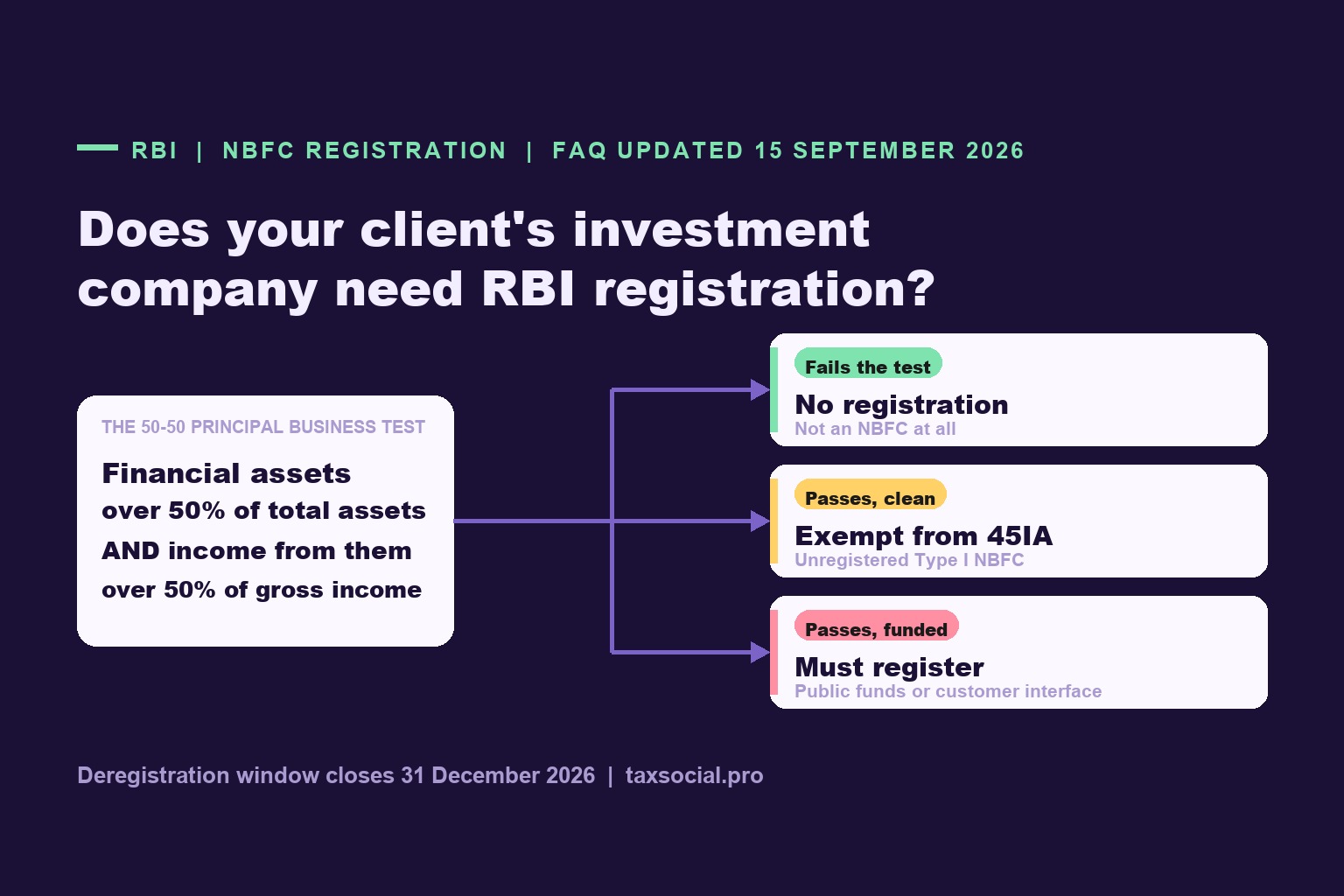

The Reserve Bank updated its NBFC FAQs on 15 September 2026, and buried under a Tata Sons news cycle is something far more useful to an ordinary practice. A company is an NBFC if it passes the 50-50 test — financial assets above 50% of total assets, and income from those assets above 50% of gross income. Pass both and Section 45-IA obliges you to register. A great many family holding companies and promoter investment vehicles have quietly passed that test for years without registering. Since 1 July 2026 there is a lawful home for them: the Unregistered Type I NBFC, exempt from registration altogether if it uses no public funds, has no customer interface, holds under ₹1,000 crore of assets, and keeps up the continuing conditions in paragraph 65A — an annual board resolution and a Notes to Accounts disclosure. If your client is already registered and now qualifies, the deregistration window runs to 31 December 2026. Two traps decide most cases, and both are counter-intuitive: a loan from a director or shareholder is public funds, and lending or giving a guarantee to a group company is customer interface. Get either wrong and the exemption evaporates.
1. Why this is suddenly in the news, and why your client is not Tata Sons
The headlines came from a different direction. Tata Sons was classified as an upper-layer NBFC in September 2022, a classification that carries a requirement to list on a stock exchange within three years. It did not list. Having repaid its debt, it applied in 2024 to surrender its registration as a Core Investment Company — the theory being that a company with no borrowings no longer meets the definition. On 11 September 2026, according to reports of an RBI letter that has not been published, the request was refused. Four days later the Reserve Bank updated its NBFC FAQs.
It is worth being careful here. Sequence is not causation, and the RBI has not said the two are connected. The reasons in the Tata Sons letter are not public, so anyone explaining them to you is inferring. What is public, and what almost nobody has read, is the update itself — and it contains a new Section H addressing a separate exemption framework — one with a great deal to do with the companies an ordinary practice actually sees.
Because the real question for most readers is not whether a ₹15 lakh crore group must list. It is this: the client with a private limited company that holds the family's shares, funded entirely by the promoters' own money, filing its returns quietly for fifteen years — was that company always supposed to be registered with the Reserve Bank? For a surprising number, the honest answer is yes. And the position has just improved.
2. The 50-50 test, and where it comes from
The statutory formulation sits in Section 45-I(c) of the Reserve Bank of India Act, 1934, which defines a financial institution, read with Section 45-I(f), which defines a non-banking financial company by reference to its principal business. What the Act never does is define "principal business". The Reserve Bank filled the gap itself, by Press Release 1998-99/1269 dated 8 April 1999, and the FAQ restates the test in terms worth quoting exactly:
"Financial activity as principal business is when a company's financial assets constitute more than 50 per cent of the total assets (netted off by intangible assets) and income from financial assets constitute more than 50 per cent of the gross income. A company which fulfils both these criteria needs to get registered as NBFC with the Reserve Bank."
Four things in that sentence do real work.
- Both limbs, not either. The word is "and". A company stuffed with shares that earns nothing from them fails the income limb and is not an NBFC. A company with modest investments throwing off most of its income fails the asset limb. You need both.
- Assets are netted off by intangible assets. Goodwill and the like come out of the denominator, which pushes the financial-asset ratio up. That matters for a company carrying a large intangible.
- Gross income, not net. The income limb runs on gross income, so it is not softened by expenses.
- It is self-executing. Nothing happens to tell you that you have crossed the line. There is no notice, no trigger and no filing that flags it. The obligation in Section 45-IA arises by operation of law the moment the balance sheet says so.
The FAQ notes drily that the test "is popularly known as 50-50 test". The purpose, it explains, is to ensure "that only companies predominantly engaged in financial activity get registered", so that a manufacturer "doing some financial business in a small way" is left alone.
3. Branch one: most holding companies fail the test, and that is a complete answer
Before reaching for any exemption, run the test. A great many holding companies fail it, and failing it is the cleanest possible outcome — not an exemption from registration, but no obligation to register in the first place.
The FAQ deals with this squarely. Asked about a holding company that owns 60% of a group company, does not qualify as a Core Investment Company, and earns less than half its income from financial assets, the Reserve Bank's answer is unambiguous:
"No, since the Company is not fulfilling the Principal Business Criteria (asset-income pattern) of an NBFC ... it is not required to register as an NBFC under Section 45 IA of the RBI Act, 1934. However, it should register itself as an NBFC as soon as it fulfils the criteria of an NBFC and comply with the NBFC norms."
Note the sting in the tail. The position is tested year on year, against the latest audited balance sheet. A company that fails the test today and passes it in three years' time — because it sold its operating undertaking, or because a dividend stream grew — acquires the obligation then, without anyone telling it so. This is the single most common way a perfectly well-run company drifts into non-compliance: the composition of its balance sheet changed and nobody re-ran the test.
Practical step. Add the 50-50 computation to the year-end file for every investment or holding company on your books. Two lines: financial assets over total assets net of intangibles, and income from financial assets over gross income. It takes a minute, and it is the only thing standing between your client and an obligation that arrives silently.
4. Branch two: it passes the test — the new Unregistered Type I NBFC
If the company passes both limbs, it is an NBFC in substance. Until this year that meant registration under Section 45-IA, with net owned funds of ₹10 crore, or continuing non-compliance.
The RBI (Non-Banking Financial Companies – Registration, Exemptions and Framework for Scale Based Regulation) Amendment Directions, 2026, notified on 29 April 2026 and in force from 1 July 2026, create a third possibility. A new paragraph 65A exempts a class of company from Sections 45-IA and 45-IC of the RBI Act altogether. The Reserve Bank's own explanation of why is refreshingly plain: these companies "operate without accessing public funds and without having customer interface and their asset size is less than ₹1,000 crore, due to which the regulatory concerns on systemic risk and customer protection issues are not relevant". They "normally undertake investments out of their owned funds and hence, their potential to pose systemic risk is very low".
That is a precise description of the family investment company.
The conditions in paragraph 65A are four, and all must hold:
- It operates without public funds and without customer interface as a conscious and long-term business model — not as this year's accident.
- Its asset size is less than ₹1,000 crore per the latest audited balance sheet.
- It passes a Board Resolution at the beginning of each financial year recording that it will not avail public funds or have customer interface during the year.
- It discloses in the Notes to Accounts that it is an Unregistered Type I NBFC, along with the status of public funds and customer interface.
Conditions 3 and 4 are recurring obligations, not one-time steps, and they are the ones a practice will actually have to remember. The Reserve Bank says the resolution must be passed "at the beginning of the financial year" without fixing a date, so calendar it conservatively with the other April board business rather than leaving it to be picked up at the year-end audit.
Note also what the exemption covers. Section 45-IA is registration. Section 45-IC is the statutory reserve fund — the obligation to transfer 20% of net profit each year before any dividend. Losing that obligation is a genuine benefit for a company that wants to pay dividends up to its shareholders.
5. The two traps, and they will decide most of your cases
Everything turns on two defined terms, and the FAQ's treatment of both is far wider than instinct suggests. This is where a comfortable assumption becomes an incorrect filing.
Trap one: a loan from a director or shareholder is public funds
Most practitioners hear "public funds" and think of deposits from the public, or at least a bank. It is very much broader. Asked directly whether loans from directors or shareholders are public funds, the Reserve Bank answers:
"Any funds received from outside sources and which constitute outside liability are treated as public funds for 'Type I NBFCs'. As such, loans from directors and/ or shareholders will be classified as public funds. Further, money availed through margin trading facility shall also be classified as public funds."
Read that against the balance sheet of a typical promoter investment company and the problem is obvious. An unsecured loan from a director — the most ordinary item in the world, often sitting there for a decade because it was easier than issuing shares — is public funds. So is a margin facility against the share portfolio, which is precisely how such a company often funds a purchase.
The Amendment Directions add a further reach. A new explanation to paragraph 6(18) provides that "Indirect receipt of public funds means funds received not directly but through associates and Group entities which have access to public funds." So money routed in from a group company that itself borrows from a bank is public funds in the recipient's hands. Structuring around the test by taking the money one step sideways does not work.
The remedy, where there is one, is capital rather than debt: convert the director's loan to equity, or repay it, and do it in a year that will be reflected in the audited balance sheet the Reserve Bank looks at.
Trap two: lending to your own group is customer interface
The second term is wider still. "Customer interface" sounds like a retail concept. The FAQ says:
"Any customer-oriented activity like lending or providing guarantee, or placing inter-corporate deposits, including to 'entities in the Group', its shareholders, its directors, or providing any other product or service to these entities would constitute 'customer interface'."
An investment company that lends to a sister concern has customer interface. One that guarantees a group company's bank facility has customer interface. One that parks surplus in an inter-corporate deposit has customer interface. None of these feels like having customers, and all of them disqualify.
There is exactly one concession: loans to employees "as per terms of employment condition/ contract and not on commercial terms" are not customer interface. A commercial loan to an employee is.
The Reserve Bank also shuts the side door. Type I and Unregistered Type I NBFCs may not distribute mutual funds, issue credit cards, act as a Point of Presence for the National Pension System, or run an insurance agency, because each involves dealing with customers. And under Section H Q10, a company that wants to take on either public funds or customer interface must obtain prior approval and a Type II registration first — not register afterwards.
6. The group aggregation rule
One provision is easy to miss and catches exactly the structures our readers advise. Explanation II to paragraph 38A(1) provides that where there are multiple Unregistered Type I NBFCs in a group, their asset sizes are aggregated. If the aggregate reaches ₹1,000 crore or more, every one of them must register as a Type I NBFC.
So the ₹1,000 crore ceiling is not a per-company allowance. A family that holds its investments through five companies of ₹250 crore each is at ₹1,250 crore in aggregate, and all five must register. Splitting the holding across entities makes the position worse, not better, because each company must now register while none of them individually looks large.
Section H Q13 adds a nuance worth knowing, because it cuts the other way. For the separate exercise of consolidating group assets to decide Middle Layer classification under the scale-based framework, the assets of Unregistered Type I NBFCs are not counted, while those of registered Type I NBFCs are. And a Type I NBFC "shall always be classified in Base Layer regardless of such aggregation". So the aggregation that matters to an exempt company is the ₹1,000 crore test among its exempt siblings — not the group-wide consolidation that determines layering for everyone else.
7. Already registered? The deregistration route, and the date
For a client that took a certificate of registration and now qualifies for the exemption, paragraph 38A(1) opens a window. In the Reserve Bank's words, existing eligible NBFCs "may apply to the Reserve Bank, for deregistration, within a period of six months i.e., by December 31, 2026".
A caution on that date. Several professional notes circulating since April give the deadline as 30 September 2026, apparently by counting six months from the notification date or from 1 April. The Amendment Directions commenced on 1 July 2026 and the RBI spells the resulting date out in the text: 31 December 2026. If a note on your desk says September, check it against the notification before acting on it.
Do not, however, treat the date as soft. The Reserve Bank's own provision for later applications is addressed to a different company: one "currently not fulfilling the prescribed criteria for exemption but fulfilling the same in future" may apply at that point. That is the client who cleans up its balance sheet in 2027, not the client who was eligible throughout 2026 and simply let the window pass. Nothing in the Directions promises the second client a route after 31 December, so a client who is eligible now should apply now.
The application goes through PRAVAAH, on the company's letterhead, with six things:
- The original certificate of registration — which must be sent to the Reserve Bank physically, so retrieve it before you start.
- Audited financial statements for the last three financial years.
- A statement on the status of public funds and of customer interface across those three years.
- A statutory auditor's certificate that the company has neither public funds nor customer interface as on date.
- A board resolution recording the current position, the intention not to change it, an undertaking to register as a Type II NBFC if the company ever wants public funds or customer interface, and an undertaking to register as a Type I NBFC if assets reach ₹1,000 crore.
- An undertaking from the board to make the Notes to Accounts disclosure.
Item 3 is the one to prepare carefully, and it is retrospective. Be precise about what it requires: a three-year statement of status, not three years free of public funds and customer interface. The Directions prescribe no three-clean-year eligibility rule, and the auditor's certificate at item 4 speaks only "as on date". But the history is disclosed, and it feeds the discretionary judgement at the next step — a director's loan repaid eighteen months ago is inside the three-year window and will appear in the statement. Approval is not automatic either: under paragraph 38A(3) the Reserve Bank must be satisfied that the company "is functioning with a conscious and long-term business model to operate without availing public funds and without having customer interface".
8. What the exemption does not do
It would be a mistake to read deregistration as leaving the regulatory perimeter. Paragraph 38A(10) is explicit, and worth reading to any client who thinks otherwise: the exemption is only from Sections 45-IA and 45-IC. The company continues to conduct the business of a non-banking financial institution, so Chapter III-B of the RBI Act continues to apply, the Reserve Bank may issue instructions specifically to Unregistered Type I NBFCs if it sees risk, and it "retains the power to take action against 'Unregistered Type I NBFCs' under Chapter V of the RBI Act, 1934". Violations "shall be viewed seriously and shall invite penal action".
There is also a live reporting line into the Reserve Bank that does not depend on the company. Under paragraph 38A(4), the statutory auditor must submit an Exception Report to the Reserve Bank on a breach of the public funds or customer interface conditions "or any other condition for the exemption" — which reaches the asset threshold, the annual resolution and the disclosure as well. The auditor is the reporting channel, which changes the conversation: this is not a status a client can quietly let slip.
And one absolute bar. Under paragraph 38A(9), an Unregistered Type I NBFC that wants to make an overseas investment in the financial services sector must register; and it may not make overseas investment in the non-financial sector at all. For a family office with any international ambition, that alone may decide against the exemption.
9. Core Investment Companies: a different track entirely
A CIC is a category of NBFC, not an alternative to one, and it has its own definition. The FAQ lists six conditions, and a company is a CIC only if it meets all of them: at least 90% of net assets in equity, preference shares, debt or loans of group companies; at least 60% of net assets in group equity (including instruments compulsorily convertible into equity within ten years) and InvIT units held as sponsor; no trading in those investments except block sales for dilution or disinvestment; no other financial activity beyond bank deposits, money market instruments, government securities, group bonds, group loans and group guarantees; asset size of ₹100 crore or above; and — the condition that matters most — "(f) It accepts public funds".
That last one is the hinge of the whole Tata Sons argument, and you can see the shape of it without knowing what the RBI's letter said. If accepting public funds is a constituent condition of being a CIC, a company that has repaid everything and accepts no public funds appears to fall outside the definition. The FAQ reinforces the point in its group examples: where a parent holds several CICs and only one has accessed public funds, "only C will be registered, provided C is not funding any of the other CICs either directly or indirectly". Access to public funds — direct or indirect — is what pulls an entity in.
Why that reasoning did not carry the day for Tata Sons is not something anyone outside the Reserve Bank can currently answer, and a practitioner should be wary of the confident explanations circulating. What can be said is that ceasing to meet the CIC conditions is not the same thing as being released from an upper-layer classification and the listing requirement attached to it, and the two questions have been run together in a good deal of the commentary.
10. The year-end checklist
- Run the 50-50 test on the latest audited balance sheet for every investment and holding company. Both limbs. Document it.
- Fails it? Nothing to do — but diarise it for next year, because the obligation arrives the year it passes.
- Passes it? Check assets against ₹1,000 crore, and aggregate across every such company in the group.
- Scan the balance sheet for public funds — director loans, shareholder loans, inter-corporate borrowings, bank facilities, margin funding, and anything received from a group entity that itself borrows.
- Scan for customer interface — loans out, guarantees given, ICDs placed, to anyone at all including group companies, shareholders and directors.
- Clean on both, under the ceiling, and already registered? The deregistration window runs to 31 December 2026. Retrieve the original CoR and start assembling three years of evidence now.
- Clean on both and never registered? The exemption applies from 1 July 2026 — but put the annual board resolution and the Notes to Accounts disclosure into the compliance calendar, because they are conditions, not formalities.
- Not clean? Either fix the position in a year that will show in the audited accounts, or register. Do not assume nobody is looking: the statutory auditor is a reporting channel to the Reserve Bank.
FAQ
Does a family holding company have to register with the RBI? Only if it passes the 50-50 test — financial assets above half of total assets net of intangibles, and income from them above half of gross income. Many fail, and those have no obligation at all.
What changed on 15 September 2026? The RBI's NBFC FAQs were updated and now carry a new Section H on companies that use no public funds and have no customer interface, explaining the exemption created by the Amendment Directions of 29 April 2026.
What is an Unregistered Type I NBFC? A company that meets the principal business criteria but uses no public funds, has no customer interface and holds under ₹1,000 crore of assets. It is exempt from Sections 45-IA and 45-IC of the RBI Act from 1 July 2026.
Is a director's loan public funds? Yes. The RBI says funds from outside sources constituting an outside liability are public funds, and names loans from directors and shareholders specifically. Margin trading facilities too.
Does lending to a group company count as customer interface? Yes — as does giving a guarantee or placing an inter-corporate deposit, even entirely within the group. Only employee loans on employment terms are carved out.
When does the deregistration window close? 31 December 2026 — six months from the 1 July 2026 commencement. Notes giving 30 September 2026 have counted from the wrong date.
Can five companies of ₹250 crore each use the exemption? No. Asset sizes of all Unregistered Type I NBFCs in a group are aggregated; at ₹1,250 crore all five must register as Type I.
Does the exemption take the company outside RBI regulation? No. It is an exemption from registration and the reserve fund only. Chapter III-B still applies and the RBI retains its powers of action.
Sources
- Reserve Bank of India, "All you wanted to know about NBFCs", Frequently Asked Questions, updated as on 15 September 2026 — Q2 (principal business and the 50-50 test), Q4 (Section 45-IA and net owned funds), the Core Investment Company definition, Q48 and Q49 (CICs within a group), Q51 (holding company failing the asset-income pattern), and Section H, questions 1 to 13, on "NBFCs not availing public funds and not having any customer interface".
- Reserve Bank of India Act, 1934 — Sections 45-I(c), 45-IA, 45-IC, Chapter III-B and Chapter V; Section 45NC (power to exempt).
- RBI Press Release 1998-99/1269 dated 8 April 1999, defining "principal business".
- Reserve Bank of India (Non-Banking Financial Companies – Registration, Exemptions and Framework for Scale Based Regulation) Amendment Directions, 2026, RBI/2026-27/43, DOR.FIN.REC.No.67/03.10.001/2026-27 dated 29 April 2026, in force from 1 July 2026 — paragraphs 6(14A), 6(18) explanation, 6(22) to 6(24), 38A and 65A; amending the Directions of 28 November 2025.
- Reports of the Tata Sons Core Investment Company de-registration refusal of 11 September 2026 and the upper-layer classification (Business Today, Business Standard, September 2026). The Reserve Bank's letter has not been published and its reasons are not on the record.


Comments (0)
No comments yet. Be the first to comment!