
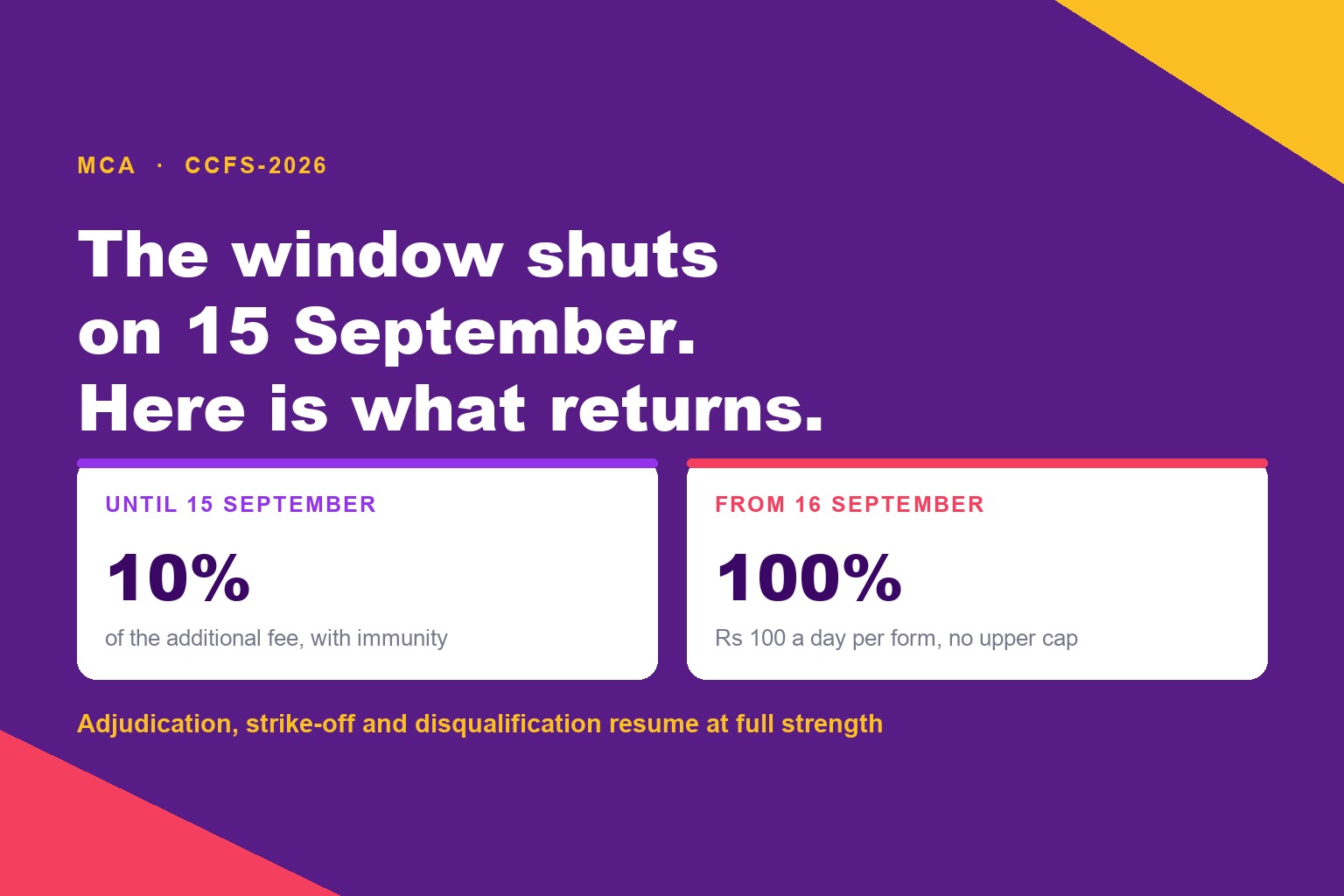

TL;DR: The Companies Compliance Facilitation Scheme, 2026 closes on Tuesday, 15 September 2026. Nothing in the circulars says what happens next, because nothing needs to: on 16 September the ordinary law of the Companies Act, 2013 simply applies again. That means three things come back at full strength — the Rs 100 a day, per form, uncapped additional fee on overdue AOC-4 and MGT-7; penalty adjudication under Section 454 for the Section 92 and 137 defaults; and Registrar-initiated strike-off under Section 248. One thing does not go away, and most coverage misses it: the statute itself says that if you file the overdue annual return or financial statements before, or within 30 days of, an adjudication notice, no penalty is imposed. That protection lives in the proviso to Section 454(3), not in CCFS. What CCFS uniquely gave you — and what is genuinely lost on the 16th — is the 90% cut in additional fee, the immunity on forms other than AOC-4 and MGT-7, and the cheap dormant and strike-off routes. If you did not finish, the answer is still to file, and to file the most recent year first.
1. Where the scheme stands, in one paragraph
CCFS-2026 was notified by MCA General Circular No. 01/2026 dated 24 February 2026 for a window of 15 April to 15 July 2026. General Circular No. 03/2026 dated 8 July 2026 pushed the close to 31 August after the 5 June fire at the MCA data centre, and General Circular No. 04/2026 dated 31 August 2026 pushed it again to 15 September, on representations from stakeholders and with every other term unchanged. Our practitioner guide covers the three routes and the fee mathematics while the window is open, and the note on the second extension covers what a fortnight was realistically good for. This article is about the day after.
Whether there will be a third extension is not something this article predicts. Two have happened. The July one answered a failure on the Ministry’s own side; the August one answered requests. Plan on the 15th being the last day, and treat anything else as a bonus.
2. What ends on 15 September, and what was never the scheme’s to give
It helps to separate the concessions that CCFS created from the protections that exist in the Act regardless. The scheme did four things:
| What CCFS gave | From 16 September |
|---|---|
| Additional fee at 10% of the normal amount on covered forms | Gone. Full additional fee under the Registration Offices and Fees Rules. |
| Immunity from penalty for Section 92 / 137 defaults, if filed before or within 30 days of the adjudicating officer’s notice | Survives in substance — the same 30-day rule is the proviso to Section 454(3) of the Act itself. See section 4. |
| Prospective immunity on other covered forms (ADT-1, FC-3, FC-4, legacy 1956-Act forms), if no show-cause notice had issued | Gone. Those defaults are back on ordinary footing. |
| Dormant status at 50% of the MSC-1 fee; strike-off at 25% of the STK-2 fee | Gone. Both routes remain available at full fee, subject to their ordinary conditions. |
Read across that table and the picture is clearer than the phrase “the amnesty is over” suggests. For the core annual-filing default, the thing that genuinely gets more expensive on the 16th is the fee. The penalty remains avoidable by anyone who files promptly once the Registrar writes. The scheme’s real, irreplaceable value was in the fee cut and in the cheap exit routes.
3. The fee that comes back: Rs 100 a day, per form, no ceiling
Under the Companies (Registration Offices and Fees) Rules, 2014, the additional fee for filing an annual return or financial statements whose due date fell after 30 June 2018 is a flat Rs 100 for every day of delay, with no upper limit. It does not scale with share capital and it does not taper. Other forms — ADT-1 is the one most often in the same backlog — use the ordinary slab: one times the normal fee for delay up to 15 days, then two, four, six, ten and twelve times as the delay crosses 30, 60, 90 and 180 days.
Here is the same two-year backlog costed three ways. Take a company that has not filed for FY 2023-24 or FY 2024-25. Its AGMs were due by 30 September 2024 and 30 September 2025, so AOC-4 fell due 30 days later (30 October) and MGT-7 60 days later (29 November) in each year. Days are counted from each form’s own due date.
| Form | Filed 15 Sep 2026 under CCFS | Filed 31 Oct 2026, no scheme | Filed 31 Dec 2026, no scheme |
|---|---|---|---|
| AOC-4, FY 2023-24 | 685 days → Rs 68,500 | 731 days → Rs 73,100 | 792 days → Rs 79,200 |
| MGT-7, FY 2023-24 | 655 days → Rs 65,500 | 701 days → Rs 70,100 | 762 days → Rs 76,200 |
| AOC-4, FY 2024-25 | 320 days → Rs 32,000 | 366 days → Rs 36,600 | 427 days → Rs 42,700 |
| MGT-7, FY 2024-25 | 290 days → Rs 29,000 | 336 days → Rs 33,600 | 397 days → Rs 39,700 |
| Additional fee, gross | Rs 1,95,000 | Rs 2,13,400 | Rs 2,37,800 |
| Payable | Rs 19,500 (10%) | Rs 2,13,400 | Rs 2,37,800 |
Normal filing fees are payable in every column and are left out because the scheme never touched them. Two things stand out. First, the scheme was worth about Rs 1.9 lakh on a modest two-year backlog — that is the size of what was lost. Second, and this is the point for anyone who missed it, waiting costs Rs 400 a day on this backlog, roughly Rs 12,000 a month, and a five-year backlog runs at Rs 1,000 a day. The full-fee column is not a fixed price for having missed the window. It is a meter, and it is running.
4. Adjudication: how the penalty machinery works, and the 30-day rule that survives
The additional fee is a charge for late filing. The penalty is a separate thing, imposed by an adjudicating officer (the Registrar, in practice) under Section 454. The Companies (Amendment) Act, 2019 turned both annual-filing defaults from criminal fines into civil penalties, and the Companies (Amendment) Act, 2020, in force from 21 December 2020, set the amounts that apply today:
- Section 92(5) — annual return not filed within the 60 days: the company and every officer in default are each liable to Rs 10,000, plus Rs 100 for each day the failure continues, capped at Rs 2 lakh for the company and Rs 50,000 per officer.
- Section 137(3) — financial statements not filed within the 30 days: the company is liable to Rs 10,000 plus Rs 100 a day, capped at Rs 2 lakh; the managing director and CFO (or the director charged with compliance, or failing that every director) are each liable to Rs 10,000 plus Rs 100 a day, capped at Rs 50,000.
For a One Person Company, a small company, a recognised start-up or a Producer Company, Section 446B halves whatever penalty a section prescribes and caps it at Rs 2 lakh for the company and Rs 1 lakh for an officer. Many private companies with a filing backlog will qualify as small companies, but check the statutory definition and its exclusions — a holding or subsidiary company, for instance, is never a small company however small its numbers — before assuming the halved exposure. And Section 454A doubles the penalty for a repeat of the same default within three years of an earlier adjudication order — worth knowing for a company that has been through this once.
Now the part that matters most. The proviso to Section 454(3) reads, in substance: where the default is a failure to file under Section 92(4) or Section 137(1) or (2), and it has been rectified either before, or within thirty days of, the adjudicating officer’s notice, no penalty shall be imposed and the proceedings are deemed concluded. This was inserted by the 2019 amendment and it is permanent law. The “Tier 1 immunity” that CCFS advertised for Sections 92 and 137 was, for the most part, a restatement of this proviso. It did not leave on 15 September and it will not leave on the 16th.
What that means in practice: a company that files its overdue AOC-4 and MGT-7 at full fee in October has ended the default before any notice, and no Section 92(5) or 137(3) penalty can be adjudicated on it. A company that sits on the backlog until the Registrar’s notice arrives still has 30 days from that notice to file and reach the same result — but only if the forms can actually be filed in 30 days, which brings back the audit-and-UDIN constraint that runs through every CCFS discussion. An unaudited back year cannot be filed in 30 days, and the proviso does not help a company that cannot get the form in.
If a penalty is adjudicated, the procedure under the Companies (Adjudication of Penalties) Rules, 2014 is: a written notice stating the alleged default and allowing 15 to 30 days to reply (extendable by up to 15 more days for reasons recorded); a hearing where the officer requires the company to appear, or where the company asks in its reply to be heard orally; and an order within 30 days of the reply period, or 90 days of the notice where a hearing is held. The proceedings run electronically. The officer weighs the size and nature of the company, the nature and repetition of the default and any disproportionate gain, but cannot go below a statutory minimum. An appeal lies to the Regional Director within 60 days of receiving the order. Failing to comply with the order — in practice, not paying the penalty — within 90 days of receiving it becomes an offence in its own right under Section 454(8): a fine of Rs 25,000 to Rs 5 lakh for the company, and for an officer imprisonment of up to six months or a fine of Rs 25,000 to Rs 1 lakh or both.
5. Strike-off: what the Registrar can do, and how long it takes to undo
The enforcement track that CCFS paused is Registrar-initiated removal under Section 248(1). The ground that catches a filing defaulter is clause (c): the company is not carrying on any business or operation for the two immediately preceding financial years and has not applied for dormant status under Section 455. A long run of unfiled returns is how the Registrar forms that view.
The sequence under the Companies (Removal of Names of Companies from the Register of Companies) Rules, 2016 is fixed:
- Form STK-1 — notice to the company and every director, by registered or speed post, stating the grounds and inviting representations within 30 days.
- Form STK-5 — public notice on the MCA website and in the Official Gazette, with the newspaper notices (one English, one vernacular, both circulating in the State of the registered office) in Form STK-5A for Section 248(1) cases, again inviting objections within 30 days. The income-tax, central excise and service-tax authorities are written to in parallel and are deemed to have no objection if they do not answer within 30 days.
- Form STK-7 — the Gazette notice striking the name off and dissolving the company under Section 248(5).
Two consequences deserve to be said plainly. Under Section 248(7) the liability of every director, manager and officer who was managing the company, and of every member, continues after dissolution as if the company had not been dissolved — strike-off is not a discharge. And restoration is not a form: it is an application to the National Company Law Tribunal. Under Section 252(3) the company, or a member, creditor or workman, may apply within 20 years of the STK-7 notice and must persuade the Tribunal that the company was carrying on business when struck off or that restoration is otherwise just; under Section 252(1) a person aggrieved by the Registrar’s order may appeal within three years. Either way the Tribunal will ordinarily require the pending filings to be made as a condition, so the fee meter in section 3 is still paid — plus counsel, plus months.
If STK-1 lands after 15 September, it is not the end of the road: it is the 30-day window in which to file the pending returns and represent that the company is in operation. That is precisely the situation in which the full-fee filing described in section 3 is cheap relative to the alternative.
6. Directors: the three-year rule and what it does to their other boards
Section 164(2)(a) disqualifies a person who is or has been a director of a company that has not filed financial statements or annual returns for any continuous period of three financial years; the disqualification bars re-appointment in that company and appointment in any other company for five years. Under Section 167(1)(a) the office of a director who incurs a Section 164 disqualification becomes vacant — and the proviso to that clause says that for a Section 164(2) disqualification, the office is vacated in every company other than the one in default. A single dormant subsidiary that nobody filed for can therefore remove its directors from the boards of every operating company they sit on. MCA has in past drives flagged and deactivated the DINs of directors it identified as disqualified; that is administrative practice rather than something written into the section, but it is what the experience looks like on the ground.
Two cautions, consistent with what we said in the earlier articles. First, CCFS never contained a provision on disqualification in either direction, so nothing about it changes on the 16th. Second, whether a late filing retrospectively negates a completed three-year default is a question the Act does not answer in terms and on which specific advice is needed. What filing certainly does is stop the clock on a default that is still running. For a company on two unfiled years, filing before the third year’s due date passes is the single most valuable thing the directors can do for themselves, and it is more valuable than any fee saving.
7. Do not add FY 2025-26 to the pile
The quickest way to turn a two-year backlog into a three-year one — and to bring Section 164(2)(a) into play — is to let the current year slip while dealing with the old ones. For FY 2025-26 the ordinary dates are:
- AGM by 30 September 2026 (Section 96: within six months of the financial year end). If it cannot be held, the extension application is in Form GNL-1 and has its own timing rules — see our note on AGM extension for FY 2025-26, and in particular the fifteen-month limb that can make the due date earlier than 30 September.
- AOC-4 within 30 days of the AGM — 30 October 2026 for an AGM held on the last day.
- MGT-7 or MGT-7A within 60 days of the AGM — 29 November 2026 for an AGM held on the last day.
The full MCA filing calendar for 2026-27 has the rest of the year’s forms. The current year’s filings do not need a back-year audit, so they can and should be done on time whatever state the backlog is in.
8. One open point: forms lodged on the 15th and returned afterwards
The circulars say nothing about a form uploaded on the last day of the scheme and sent back for resubmission on the 17th. The scheme’s terms attach to a filing made within the window, and a resubmitted form is ordinarily treated as filed when it is finally accepted. We are not aware of a clarification either way. If this is your position, keep the original SRN and challan and the date-stamped acknowledgement, and be ready to represent that the filing was made in time. Do not assume the concession carries over.
9. What to do, in order
- Stop the three-year clock. For any company with two unfiled years, get the most recent year audited and filed before the third year’s due date passes. Section 164(2)(a) is the exposure that cannot be bought back with a fee.
- File the current year on time. AGM by 30 September, AOC-4 by 30 October, MGT-7 by 29 November. It needs no back-year work.
- Work the backlog newest-first. Opening balances are freshest and the audit is quickest; each year filed stops Rs 200 a day (Rs 100 on each of AOC-4 and MGT-7) and, once filed before any notice, takes the Section 92(5) and 137(3) penalty off the table under the Section 454(3) proviso.
- Treat any notice as a 30-day deadline. Whether it is an adjudication notice (file within 30 days and no penalty is imposed) or STK-1 (file and represent within 30 days), the calendar entry is the date on the notice plus 30 days.
- Decide honestly whether the company should exist. If it should not, strike-off at full fee is still available and still cheaper than being struck off by the Registrar and restored by the Tribunal. Rule 4 of the Removal of Names Rules still requires filings up to the year operations ceased before STK-2 will be accepted.
- Tell the directors the true position. The scheme saved fee; it never settled disqualification; the penalty is avoidable by filing; the fee is not. Set the expectation now rather than at the third year.
10. Sources
- Ministry of Corporate Affairs — General Circular No. 01/2026 dated 24 February 2026 (notifying CCFS-2026), No. 03/2026 dated 8 July 2026 and No. 04/2026 dated 31 August 2026 (extensions). Circulars are published at mca.gov.in.
- Companies Act, 2013 — Sections 92(4) and 92(5), 96, 137(1) and 137(3), 164(2), 167(1), 248, 252, 446B, 454 and 454A, as amended by the Companies (Amendment) Acts of 2019 and 2020.
- Companies (Adjudication of Penalties) Rules, 2014, Rule 3.
- Companies (Removal of Names of Companies from the Register of Companies) Rules, 2016, Rules 3, 4, 7 and 9 and Forms STK-1, STK-2, STK-5, STK-5A and STK-7.
- Companies (Registration Offices and Fees) Rules, 2014, Table of additional fees as amended with effect from 1 July 2022.
The figures above are computed on the stated assumptions and rounded to the rupee; verify the company’s own due dates, capital bracket and form-by-form position on the MCA portal before quoting a number. Corporate compliance is fact-specific — take advice from a practising Company Secretary, Chartered Accountant or Advocate on a particular entity before acting.


Comments (0)
No comments yet. Be the first to comment!