
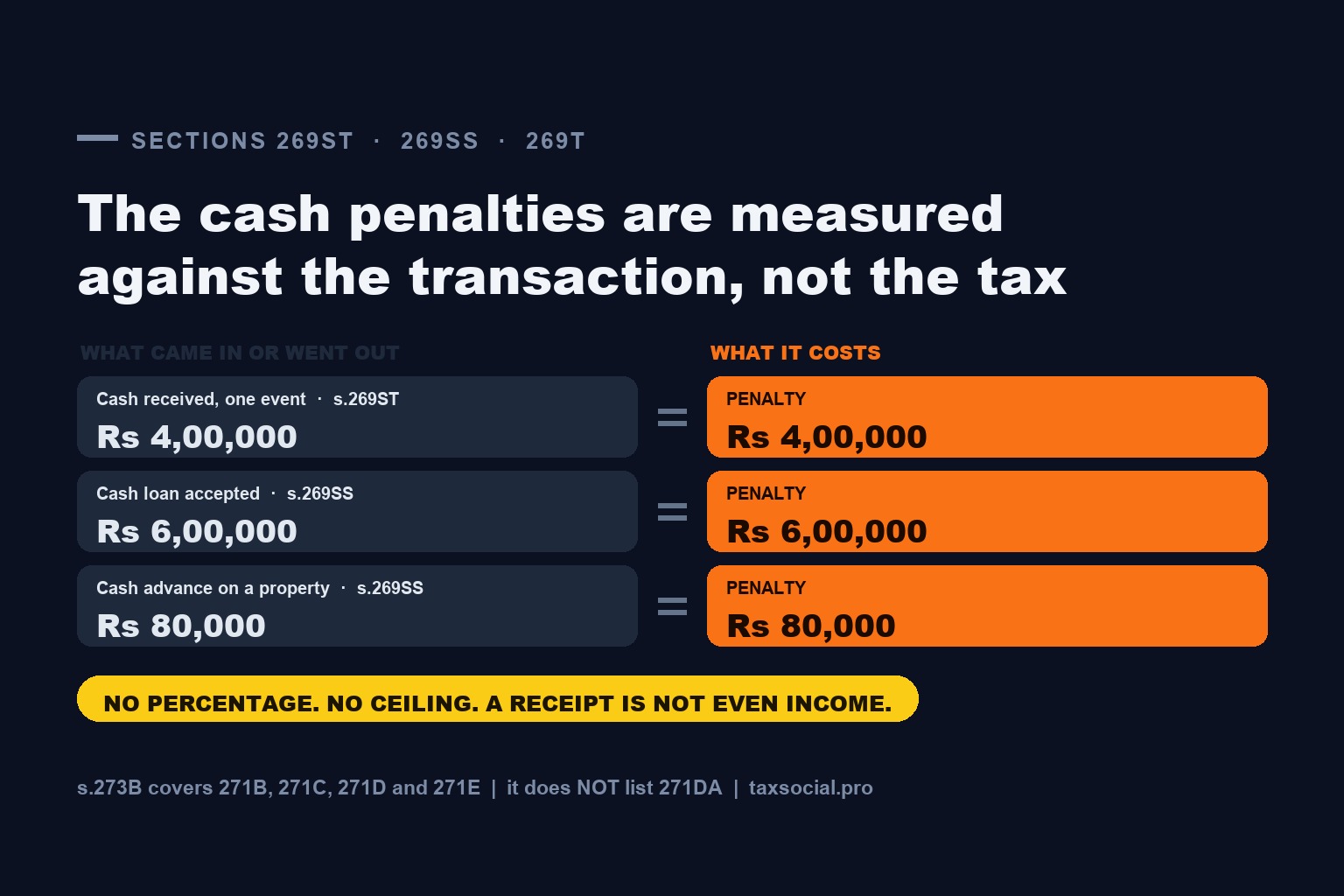

Most tax penalties are proportionate to the tax. The cash penalties are not — they are proportionate to the transaction. Section 271DA charges "a sum equal to the amount of such receipt" for a breach of Section 269ST. Sections 271D and 271E do the same for Sections 269SS and 269T. A ₹4 lakh cash receipt is a ₹4 lakh penalty, and since a receipt is not income, the penalty can arrive on a transaction that produced no profit whatsoever. Section 40A(3) works differently but bites just as hard: a cash payment over ₹10,000 to one person in one day is disallowed in full, not at 20% as the older law provided. Five mistakes recur: reading Section 269ST as a test on a single bill when it has three independent limbs; assuming Section 273B rescues you from Section 271DA, which it does not, because 271DA is not in its list; testing Section 40A(3) voucher by voucher instead of per person per day; treating "business expediency" as a defence when the statute makes it a factor for the rule-maker; and forgetting that Section 269SS reaches an advance for an immovable property at just ₹20,000. All five are visible in the books the auditor is already reading.
1. Why these penalties behave differently
It is worth being precise about what makes this group of provisions unusual, because the instinct built up on other penalties misleads here.
A penalty under Section 270A is 50% of the tax on under-reported income, rising to 200% where the under-reporting is in consequence of misreporting. A penalty under Section 271B is half a per cent of total sales, turnover or gross receipts, capped at ₹1.5 lakh. Both are anchored to something that scales with the default — tax in the first case, turnover in the second — and the second carries an express rupee ceiling.
The cash penalties have neither feature. Section 271DA provides that a person who receives a sum in contravention of Section 269ST "shall be liable to pay, by way of penalty, a sum equal to the amount of such receipt". There is no percentage and no cap. Sections 271D and 271E use the same construction for loans and deposits. And because these provisions regulate the mode of a transaction rather than the taxability of a receipt, the amount can be entirely capital, entirely exempt, or entirely someone else's money, and the penalty is computed on it all the same.
That is why a tax audit matters here beyond the report itself. The auditor is going through the cash book, the loan ledgers and the vendor payments anyway. Anything found now can at least be documented while the facts are fresh, and in some cases corrected. Found later, it is a penalty proceeding.
2. Mistake one: reading Section 269ST as a single-bill test
Section 269ST is short, and almost everyone remembers one third of it. The section reads:
"No person shall receive an amount of two lakh rupees or more—
(a) in aggregate from a person in a day; or
(b) in respect of a single transaction; or
(c) in respect of transactions relating to one event or occasion from a person,
otherwise than by an account payee cheque or an account payee bank draft or use of electronic clearing system through a bank account or through such other electronic mode as may be prescribed"
Four points, each of which is routinely lost.
- There are three limbs and they are joined by "or". A receipt need only offend one of them, which is what makes the section hard to engineer around. Splitting a ₹3 lakh bill into two invoices does not necessarily take it outside limb (b) — whether there is one transaction is a question of substance, not of how many documents were raised — and in any event the receipts can fall independently within limb (a) if collected the same day, or limb (c) if they relate to one event, whichever day they are collected on.
- Limb (c) has no time boundary at all. "Transactions relating to one event or occasion from a person" catches a wedding, a contract, a function, a project, collected in instalments across weeks. This is the limb that catches banquet halls, caterers, decorators, tour operators and clinics running a course of treatment.
- It is "or more", not "exceeds". Exactly ₹2 lakh is caught. Compare Section 44AB, which uses "exceeds", and Section 40A(3), which also uses "exceeds". The drafting is not uniform across these provisions and the boundary case genuinely differs.
- It restricts the person who RECEIVES. Section 269ST does not penalise the payer. Your client's exposure arises when money comes in. When money goes out, a different provision applies — Section 40A(3), below — and the consequence is a disallowance rather than a penalty.
The statutory exclusions are narrow: receipts by the Government, by a banking company, post office savings bank or co-operative bank; transactions of the nature referred to in Section 269SS, which are dealt with by their own provisions; and such other persons, classes of persons or receipts as the Central Government may notify. That notification power has been used more than once, so check whether a notification covers your facts rather than assuming either way.
3. Mistake two: assuming Section 273B saves you
This one is worth reading carefully, because the reflex is strong and the reflex is wrong.
Section 273B is the general reasonable-cause shield. It provides that notwithstanding the provisions listed in it, no penalty shall be imposable if the assessee proves there was reasonable cause for the failure. Practitioners reach for it almost automatically, and for most of this family of penalties they are right to: the list expressly includes Section 271B (failure to get accounts audited), Section 271C (failure to deduct tax), Section 271D (Section 269SS breaches) and Section 271E (Section 269T breaches).
It does not include Section 271DA. The provision that penalises a Section 269ST breach is simply absent from the Section 273B list.
That does not leave a breach undefendable. Section 271DA carries its own proviso:
"Provided that no penalty shall be imposable if such person proves that there were good and sufficient reasons for the contravention."
So the defence exists — but it lives inside Section 271DA, in different words, and it has to be built there. The practical consequence is about where you look and what you cite, and it is the sort of thing that matters when a reply is being drafted under time pressure. Do not cite Section 273B against a Section 271DA notice.
One change worth noting alongside it, because it applies across this whole group. Sections 271DA, 271D and 271E each originally provided that the penalty was to be imposed by the Joint Commissioner. A proviso inserted into all three with effect from 1 April 2025 now provides that a penalty imposed on or after that date is imposed by the Assessing Officer. For the year under audit, that is the position for a Section 269ST breach and for a Section 269SS or 269T breach alike.
4. Mistake three: testing Section 40A(3) voucher by voucher
Section 40A(3) is the payment-side rule, and the unit of measurement is the thing people get wrong:
"Where the assessee incurs any expenditure in respect of which a payment or aggregate of payments made to a person in a day, otherwise than by an account payee cheque drawn on a bank or account payee bank draft, or use of electronic clearing system through a bank account or through such other electronic mode as may be prescribed, exceeds ten thousand rupees, no deduction shall be allowed in respect of such expenditure."
Three things follow.
- The test is per person per day, not per bill or per voucher. Four payments of ₹4,000 to the same supplier on the same day aggregate to ₹16,000 and the whole ₹16,000 is disallowed. Splitting vouchers does nothing; splitting across days is a different transaction pattern that the assessing officer will read for what it is.
- The disallowance is 100%. The pre-2017 law disallowed 20%, and that figure is still repeated in a great deal of circulating material. The current words are "no deduction shall be allowed".
- There is a higher limit for goods carriages. The second proviso substitutes ₹35,000 for "ten thousand rupees" in the case of payments made for plying, hiring or leasing goods carriages. It is specific to that activity and does not generalise to transport costs at large.
Then there is Section 40A(3A), which is the provision people forget entirely. Where a deduction was allowed in an earlier year for a liability incurred, and the assessee later pays it in cash above the same threshold, the payment "shall be deemed to be the profits and gains of business or profession" and is chargeable as income of the year of payment. So the exposure is not closed by the year end. A liability that was properly accrued and properly allowed can still generate an addition years later purely because of how it was eventually settled.
5. Mistake four: treating "business expediency" as the exception
Ask why a particular cash payment is acceptable and the answer very often comes back as "business expediency" — the supplier insisted, the payment was made at a site, the bank was closed. It is worth seeing exactly where that phrase sits in the statute, because it is not where people think.
The first proviso to Section 40A(3) and (3A) reads that no disallowance shall be made:
"...in such cases and under such circumstances as may be prescribed, having regard to the nature and extent of banking facilities available, considerations of business expediency and other relevant factors"
Read the grammar. "Business expediency" is one of the matters the rule-making authority was directed to have regard to when prescribing the cases. It is not, standing alone, a free-standing exception an assessee can invoke. The exceptions are the prescribed ones, and they live in Rule 6DD.
That is not the same as saying the commercial circumstances are irrelevant. Section 40A(3) has long been read together with Rule 6DD, and the surrounding facts — the nature and extent of banking facilities available, the genuineness of the payment and the identity of the payee, the practical compulsions of the trade — can matter a great deal in establishing that a prescribed case is made out. The distinction is between using those facts to establish an exception and offering them instead of one.
So a file that records only "paid in cash for business expediency" has not documented a position. A file that identifies the Rule 6DD case relied on, and sets out the facts that bring the payment within it, has. And if no prescribed case applies, the honest conclusion is that the amount is disallowed — better reached in September than in an assessment.
6. Mistake five: forgetting what Section 269SS actually covers
Section 269SS is usually filed mentally under "cash loans", and the threshold is remembered as low. Both are right as far as they go, and both are incomplete.
The section prohibits taking or accepting a loan, deposit or specified sum otherwise than by account payee cheque, account payee bank draft, electronic clearing system or a prescribed electronic mode, where the amount is ₹20,000 or more. The threshold is tested not only on the transaction itself but, under the second and third limbs, on amounts already outstanding from the same depositor — so a series of unremarkable receipts from one person can cross it without any single one looking like anything.
The part that gets missed is the definition of "specified sum" in the Explanation:
"'specified sum' means any sum of money receivable, whether as advance or otherwise, in relation to transfer of an immovable property, whether or not the transfer takes place."
So an advance taken against a proposed sale of property is inside Section 269SS — at ₹20,000, in cash — and the closing words make it clear that the section does not care whether the sale ever happens. Subject to the section's own exceptions, token money on a property deal, taken in cash because that is how token money has always been taken, contravenes Section 269SS and can attract a Section 271D penalty equal to the amount. Note also Explanation (iii): "loan or deposit" means loan or deposit of money, which is why the analysis turns on money movements rather than on how an account is labelled.
Where these transactions surface in the audit is clause 31 of Form 3CD, and the reporting there has its own traps — chiefly that loans get created and settled by journal entry and never touch a bank account. We work that through in five Form 3CD entries that come back as a notice.
7. The other place cash changes the answer
One connection worth making explicitly, because it runs in the opposite direction from everything above. Cash does not only create penalties; it also decides whether the audit is required at all.
The ₹1 crore threshold in Section 44AB becomes ₹10 crore only where cash receipts are within 5% of all amounts received and cash payments are within 5% of all payments. Both limbs, on separate denominators. And the second proviso deems a cheque or bank draft "which is not account payee" to be cash for that test — so an instrument that looks like banking in every ledger counts against you. That computation, and the four other ways the turnover figure goes wrong, are in five ways turnover gets computed wrong.
8. What to do with this before the report is signed
- Run the cash book for receipts of ₹2 lakh or more on all three Section 269ST limbs — per person per day, per transaction, and per event or occasion. The third needs a question asked of the client, because no ledger groups by event.
- Aggregate cash payments by party and by date, not by voucher, and test against ₹10,000 — ₹35,000 only for plying, hiring or leasing goods carriages.
- For every cash payment above the limit that is being treated as allowable, record the prescribed case in Rule 6DD relied on, and the facts. "Business expediency" on its own is not an answer.
- Scan for property advances, earnest money and token amounts received otherwise than by banking channel, however small — ₹20,000 is the line, and it applies whether or not the deal completed.
- Look for loans and repayments created by journal entry, including director and partner current accounts and set-offs between group concerns.
- Where a breach has happened, document the circumstances now — under Section 273B for a 271D or 271E exposure, and under the proviso to Section 271DA for a 269ST one. Contemporaneous facts are what make either defence work.
None of this removes a breach that has already occurred. What it does is convert an unpleasant surprise into a known position with a file behind it, which is a materially better place to be when a notice arrives.
Sources
- Income-tax Act, 1961, Section 269ST — the three limbs, the "two lakh rupees or more" threshold, the prescribed modes, and the proviso excluding receipts by the Government, banking companies, post office savings banks and co-operative banks, transactions of the nature referred to in Section 269SS, and notified persons or receipts.
- Income-tax Act, 1961, Section 271DA — penalty of a sum equal to the amount of the receipt; the proviso providing a defence where "good and sufficient reasons" are proved; sub-section (2), under which the penalty was to be imposed by the Joint Commissioner, as amended with effect from 1 April 2025 so that a penalty imposed on or after that date is imposed by the Assessing Officer.
- Income-tax Act, 1961, Section 273B — the list of penalties against which reasonable cause is available. It includes Sections 271B, 271C, 271D and 271E, and does not include Section 271DA.
- Income-tax Act, 1961, Section 40A(3) and 40A(3A) — the per person per day test, the ₹10,000 limit and the full disallowance; the deeming of a later cash payment as profits and gains; the first proviso (exceptions as prescribed, Rule 6DD) and the second proviso (₹35,000 for plying, hiring or leasing goods carriages).
- Income-tax Act, 1961, Sections 269SS and 269T, including the Explanation defining "loan or deposit" and "specified sum" (a sum receivable in relation to transfer of an immovable property, whether or not the transfer takes place), and Sections 271D and 271E, each as amended with effect from 1 April 2025 so that the penalty is imposed by the Assessing Officer.
- Income-tax Act, 1961, Section 44AB, first and second provisos to clause (a) — the two-limb 5% cash test and the deeming of a non-account-payee cheque or draft as cash.


Comments (0)
No comments yet. Be the first to comment!