
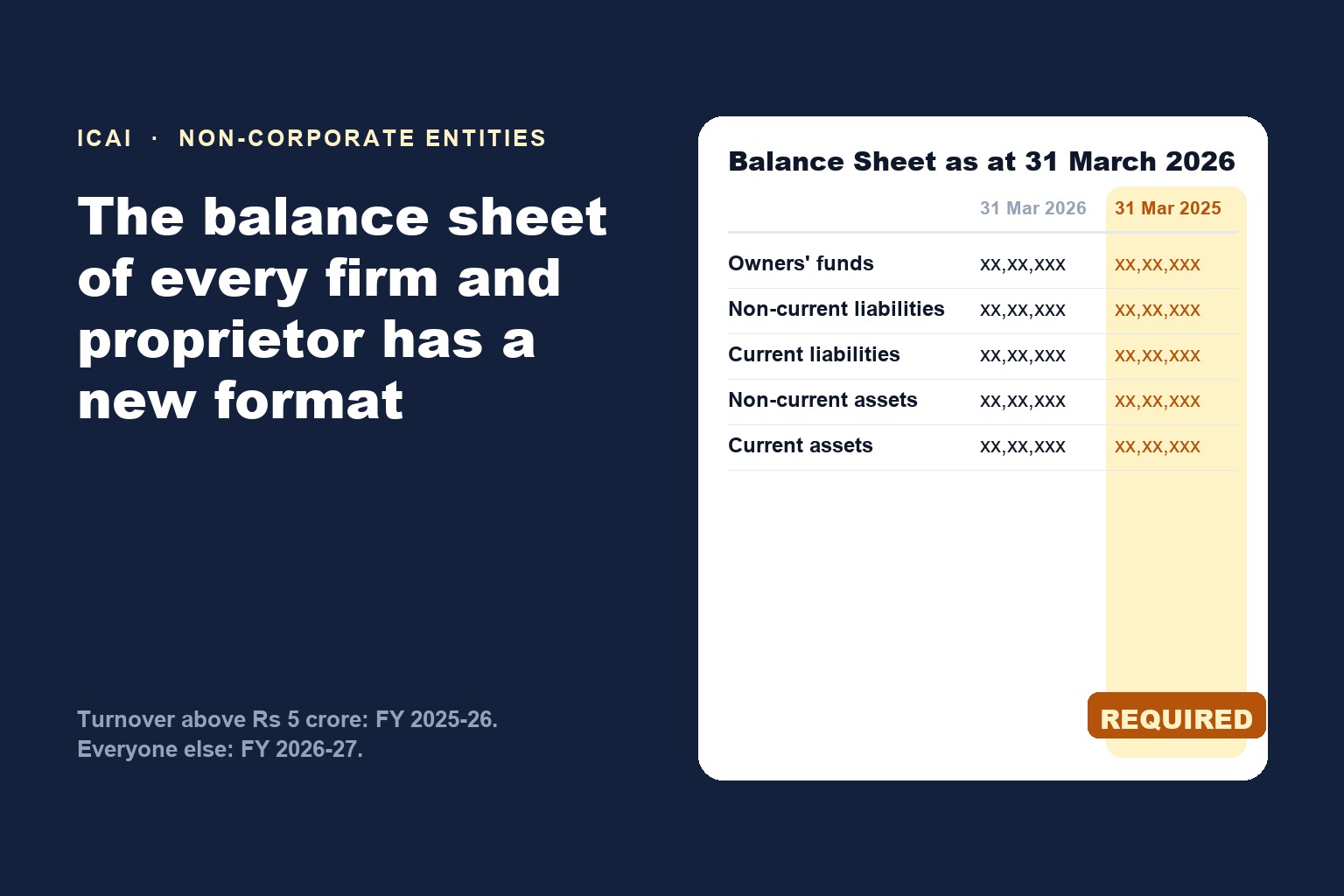

TL;DR: The ICAI’s Guidance Note on Financial Statements of Non-Corporate Entities (August 2023) gives every proprietorship, partnership firm, HUF, AOP, society and trust that carries on business or profession a prescribed set of financial statements: a vertical Balance Sheet, a Statement of Profit and Loss in which partners’ remuneration sits below operating profit, and a fixed list of notes. It was meant to start on 1 April 2024, was made voluntary for FY 2024-25 on 19 September 2025, and on 31 March 2026 the Council fixed the real timetable: turnover above Rs 5 crore from FY 2025-26, everyone from FY 2026-27. For the entities above that threshold which are also under tax audit, those are the FY 2025-26 accounts being signed for the 30 September 2026 deadline right now; whether the Note applies and whether Section 44AB applies are separate questions, and the Note applies to both audited and unaudited entities. The part that catches people is not the format. It is paragraph 5: the previous year’s figures, for every line and every note, must be recast into the same format. Below: who is covered, what the format is, how the comparatives work in the first year, every note the format asks for, which Accounting Standards apply, and what an auditor has to write if the client does not comply.
1. How we got here: 2022, 2023, 2024, 2025, and the 31 March 2026 announcement
| Date | What ICAI did |
|---|---|
| June 2022 | Accounting Standards Board issues a Technical Guide on Financial Statements of Non-Corporate Entities with recommended formats. Recommendatory. |
| August 2023 | The Technical Guide is upgraded into a Guidance Note, “to prescribe more authoritative guidance for the members”. A separate Guidance Note is issued for LLPs. Effective for periods beginning on or after 1 April 2024; the Technical Guide stands superseded. |
| 13-15 August 2024 | Council (433rd meeting) replaces the four-level classification of non-company entities with two categories, MSME and Large, for periods from 1 April 2024. |
| July-August 2025 | ASB and AASB jointly issue FAQs on the Guidance Note (the text was hosted in July 2025; the printed ICAI edition is dated August 2025): who is covered, whether comparatives are needed in the new format (yes), what the auditor does if the client does not comply. |
| 19 September 2025 | Council announces relaxation: both Guidance Notes “can be applied voluntarily for annual reporting period 2024-25”. Accounting Standards and the Framework continue to apply as before. |
| 31 March 2026 | Council (451st meeting, 30-31 March 2026) announces phased applicability of both Guidance Notes: Phase I, accounting periods beginning on or after 1 April 2025, “entities whose turnover exceeds Rs 5 crores”; Phase II, periods beginning on or after 1 April 2026, “all entities”. |
So the position on 8 September 2026 is this. A partnership firm or proprietorship with turnover above Rs 5 crore prepares its FY 2025-26 financial statements in the Guidance Note format. Everyone else does so from FY 2026-27. The 31 March announcement does not say which year’s turnover the Rs 5 crore is tested on, or how turnover is measured. ICAI has not clarified that as at 8 September 2026, so any reading is an interpretation, and the working paper should say which one was taken and why. The defensible course for the FY 2025-26 accounts: if turnover exceeds Rs 5 crore in either FY 2025-26 or FY 2024-25, apply the format. Adopting it a year early costs nothing; being on the wrong side of a later clarification does.
2. Who is covered, and who is not
The Guidance Note defines a non-corporate entity as any business or professional entity other than a company under the Companies Act and an LLP under the LLP Act. Its own list of the common structures:
- Sole proprietorship firms
- Hindu Undivided Families
- Partnership firms, registered and unregistered
- Associations of Persons, including partnership firms not covered above, Bodies of Individuals and resident welfare associations
- Societies registered under any law
- Trusts, private or public, registered or unregistered
- Statutory corporations, autonomous bodies and authorities
- Any form of organisation engaged fully or partially in business or professional activities
Three carve-outs. The format does not apply where a statute or regulator prescribes its own: the Note’s own example is trusts under the Maharashtra Public Trust Rules, 1951. It does not apply to autonomous bodies compiling accounts in the Ministry of Finance’s uniform format. And it does not apply where ICAI has given separate guidance, which the FAQs illustrate with a children’s-rights foundation: a not-for-profit organisation follows the Technical Guide on Accounting for Not-for-Profit Organisations, not this Note. LLPs are scoped out because they are a corporate form; they have their own Guidance Note, phased on the same two dates.
One practical consequence is worth saying plainly. A professional practice, a doctor’s clinic, a CA firm, a trading proprietorship, a family HUF business: all of these are inside. “Non-corporate” is not a synonym for “small”.
3. Is it actually mandatory? What a Guidance Note can and cannot do
A Guidance Note is not a statute, and the Note itself does not pretend otherwise. The FAQs quote ICAI’s standing clarification on the authority of its documents: Guidance Notes are “recommendatory in nature”, but a member who does not apply one must document the rationale for the alternative, and while discharging an attest function “a member should examine whether the recommendations in a Guidance Note relating to an accounting matter have been followed or not” and consider whether a disclosure in the report is necessary.
Then FAQ 5 draws the conclusion: where the client does not furnish the financial statements in the prescribed format, “the auditor is required to disclose the same in his / her report”, and the auditor exercises professional judgment on whether the non-adherence results in a modified opinion under the Standards on Auditing.
That is the whole mechanism. The Guidance Note and the FAQs prescribe no monetary penalty and no fee on the entity; they speak to the member’s reporting duty. Whether a lender, a regulator or an engagement letter attaches its own consequence to the format is a separate question for each entity. The professional pressure sits on the Chartered Accountant who signs. For a tax audit, the Note says the auditor conducts an audit of the financial statements to give a true and fair view in Form 3CB and reports the particulars in Form 3CD, taking the Guidance Note on Tax Audit into consideration. A Form 3CB that says the accounts are true and fair, and then says in the same breath that they are not in the format the Institute prescribes for members, is an uncomfortable document. That is why the format will spread faster than any statute could make it: no signing auditor wants to write that paragraph. For FY 2025-26 (AY 2026-27) the report is still Form 3CB and Form 3CD under the 1961 Act. From tax year 2026-27, Form 26 under the Income-tax Rules, 2026 replaces Forms 3CA, 3CB and 3CD, and nothing about the format question changes.
4. The format: what changes on the face of the statements
The Note prescribes two faces and a set of notes. Chapter VI says the financial statements “shall be in the form as provided hereafter”. The formats are the minimum; line items, sub-items and sub-totals can be added or substituted where relevant to an understanding of the entity (FAQ 7), and a line that is nil in both years can be dropped where its omission does not affect the true and fair view (FAQ 8).
The Balance Sheet
Vertical, not the horizontal “T” that most Tally-generated firm accounts still print. Two halves, each with current and non-current splits:
| I. Owners’ Funds and Liabilities | II. Assets |
|---|---|
| (1) Owners’ Fund: (a) Owners’/Partners’ Capital Account and Current Account; (b) Reserves and Surplus | (1) Non-current assets: PPE and intangibles (with CWIP and intangibles under development), non-current investments, deferred tax assets, long-term loans and advances, other non-current assets |
| (2) Non-current liabilities: long-term borrowings, deferred tax liabilities, other long-term liabilities, long-term provisions | (2) Current assets: current investments, inventories, trade receivables, cash and bank balances, short-term loans and advances, other current assets |
| (3) Current liabilities: short-term borrowings, trade payables, other current liabilities, short-term provisions |
The Note uses “owners’ funds” rather than “equity” because some items in a firm’s owners’ funds do not strictly meet the Framework’s definition of equity, and it allows an AOP to write “members’ funds” instead. The current/non-current test is the Schedule III test: an asset is current if it is expected to be realised in the normal operating cycle, is held for trading, is expected to be realised within twelve months of the reporting date, or is unrestricted cash. A liability is current if it is expected to be settled in the operating cycle, is due within twelve months, or the entity has no unconditional right to defer it for twelve months. Where the operating cycle cannot be identified, it is twelve months. Every firm now has to make that call for each loan, each advance and each deposit, and the current maturities of long-term borrowings must be shown separately under short-term borrowings.
The Statement of Profit and Loss
Revenue from operations, other income, total income; then expenses in the Schedule III order (cost of materials, purchases of stock-in-trade, changes in inventories, employee benefits, depreciation and amortisation, finance cost, other expenses). Then the part that is specific to firms:
| Line | Description |
|---|---|
| V | Profit before exceptional and extraordinary items, partners’ remuneration and tax |
| VI | Exceptional items |
| VII | Profit before extraordinary items, partners’ remuneration and tax (V - VI) |
| VIII | Extraordinary items |
| IX | Profit before partners’ remuneration and tax (VII - VIII) |
| X | Partners’ remuneration (wherever applicable) |
| XI | Profit before tax |
| XII-XVII | Current and deferred tax; continuing and discontinuing operations; profit or loss for the period |
So partners’ remuneration comes out of the expense block and appears as its own line after operating profit. Interest on partners’ capital stays inside finance costs, but the instructions require finance costs to be split between interest on partners’/members’ capital and interest to everyone else. Both numbers now sit in plain view, which is exactly where a Section 40(b) computation, a bank’s credit appraisal and a partner reading the accounts want them.
Cash flow statement
Not mandatory for an MSME (see section 7); AS 3 is one of the standards MSMEs are exempt from in full, and the Note says they “may not include cash flow statements” while encouraging them to. A Large entity prepares one.
5. The comparatives trap: paragraph 5 and the first year
Paragraph 5 of the General Instructions is one sentence: “Except in the case of the first Financial Statements prepared by the Non-Corporate entity (after its incorporation) the corresponding amounts (comparatives) for the immediately preceding reporting period for all items shown in the Financial Statements including notes shall also be given.”
FAQ 9 removes any doubt about what that means in the first year. The Framework’s comparability principle requires corresponding information for the preceding period, and therefore the formats “[are] to be applied in preparation and presentation of financial statements of non-corporate entities including comparative year figures”, the only exception being an entity preparing its first financial statements after incorporation.
In practice, for a firm above Rs 5 crore preparing FY 2025-26 accounts, this means the FY 2024-25 figures, which were finalised, audited and filed in the old horizontal format, must be regrouped into the new format: split into current and non-current, partners’ remuneration lifted out of expenses and shown at line X, interest on capital pulled out of interest into its own sub-line, every note re-cut with a previous-year column. The same thing happens for every other firm a year later with its FY 2025-26 figures. Some points that save time:
- Regrouping is not restatement. The previous year’s profit does not change. The figures are reclassified, not re-measured. A note saying “previous year figures have been regrouped or reclassified wherever necessary to conform to the current year’s presentation” is the honest and sufficient disclosure, and it belongs in Note 2 or as the last note.
- Do the split at the ledger level once. Tag every loan, deposit, advance and provision as current or non-current in the books, with the maturity date, so the split does not have to be reconstructed for the next year’s comparatives as well.
- The partner-wise capital grid needs an opening balance per partner and a “Previous Year” row. Pull the FY 2024-25 partner accounts now; that is the row.
- A line that is nil in both years can be omitted, provided the omission does not affect the true and fair view (FAQ 8). Do not print an empty “Intangible assets under development” row for a wholesaler.
- Newly constituted entities preparing their first statements after incorporation give no comparatives. A firm reconstituted on a change of partners is not a new entity for this purpose unless it is actually a new firm; treat that as a judgment to document, not a loophole.
- Rounding is permitted, keyed to total income: below Rs 100 crore, to the nearest hundreds, thousands, lakhs or millions; Rs 100 crore and above, to the nearest lakhs, millions or crores. Once chosen, use the unit uniformly, in both columns.
6. The notes the format demands (what practitioners still call “schedules”)
The Note does not use the word “schedule”. It requires notes, and it requires that every item on the face of the Balance Sheet and Statement of Profit and Loss be cross-referenced to a note (General Instructions para 3). The disclosures in the format are in addition to, not in place of, the disclosures the Accounting Standards require (para 2). The illustrative set in Appendix B numbers them like this:
| Note | What it contains |
|---|---|
| 1 | Brief about the entity: constitution, business, place |
| 2 | Significant accounting policies (AS 1), including the depreciation method, the capital-account policy, the operating cycle adopted |
| 3a / 3b | Owners’/Partners’ Capital Account and Current Account, partner by partner, eight columns: name, share of profit (%), opening balance, capital introduced during the year, remuneration for the year, interest for the year, withdrawals during the year, share of profit or loss (% and amount), closing balance; plus a Previous Year row |
| 4 | Reserves and surplus: capital reserve, revaluation reserve, other reserves with their nature and purpose, undistributed surplus (a debit balance shown as a negative) |
| 5 | Long-term and short-term borrowings: term loans from banks and others, deferred payment liabilities, loans from related parties, finance lease maturities; each secured or unsecured with the nature of security; loans guaranteed by partners or the proprietor, in aggregate; terms of repayment; current maturities shown separately |
| 6 | Deferred tax (net) |
| 7, 8 | Other long-term liabilities; provisions, split employee benefits and others |
| 9 | Trade payables, with the full MSMED Act disclosure: principal and interest unpaid to micro and small suppliers at year-end, interest paid under Section 16, interest due for the period of delay, interest accrued and unpaid, and further interest due until actually paid, for the Section 23 disallowance |
| 10 | Other current liabilities: interest accrued but not due, interest accrued and due, income received in advance, other payables |
| 11 | PPE and intangibles: class-wise (land, buildings, plant, furniture, vehicles, office equipment) with a reconciliation of gross and net carrying amounts, additions, disposals, revaluation and depreciation; assets under lease shown separately |
| 12 | Investments, current and non-current, by class; for an investment in another partnership firm, the name of the firm, the names of all its partners, its total capital and each partner’s share; quoted versus unquoted with market value |
| 13, 14 | Loans and advances (capital advances, related parties, others; secured / unsecured / doubtful) and other non-current assets (security deposits, bank deposits over 12 months) |
| 15 | Inventories by class, goods in transit under the relevant class |
| 16 | Trade receivables: outstanding more than six months from the due date stated separately; secured / unsecured / doubtful; allowance for doubtful debts |
| 17 | Cash and bank balances: balances with banks, cheques on hand, cash on hand; earmarked balances, margin money, deposits of 3 to 12 months |
| 18 | Other current assets |
| 19-22 | Revenue from operations split into sale of products, sale of services and other operating revenue; other income (interest, dividend, gain on investments, other); cost of materials; changes in inventories |
| Expense notes | Employee benefits split into salaries, contribution to funds and staff welfare; finance costs split as above; any item of income or expense above 1 per cent of revenue from operations or Rs 1,00,000, whichever is higher, shown separately; stores consumed, power and fuel, rent, repairs to buildings, repairs to machinery, insurance, rates and taxes, miscellaneous expenses, each separately; auditor’s remuneration |
| Contingent liabilities | Claims not acknowledged as debt, guarantees, other contingent liabilities, to the extent not provided for |
Two of these are new work for most firm files. The MSMED disclosure in Note 9 requires the entity to know which of its suppliers are registered micro or small enterprises and to track payment beyond the appointed day, which is the same data Section 43B(h) has needed since FY 2023-24, so the tax computation and the accounts finally use one schedule. The partner-wise capital grid in Note 3a replaces the single “Partners’ Capital” figure with a movement table per partner: introduced, remuneration, interest, drawings, share of profit. A partnership deed that allows remuneration to working partners under Section 40(b) will now have the arithmetic printed on the face of the note.
7. Which Accounting Standards apply: MSME or Large
The Guidance Note’s own Appendix A still prints the four-level scheme (Level I to Level IV) from the March 2021 announcement, because the Note was published in August 2023. That scheme has been superseded. FAQ 10 reproduces the Revised Criteria from the 433rd Council meeting of 13-15 August 2024, effective for periods commencing on or after 1 April 2024, and that is what applies to the FY 2025-26 accounts:
| Category | Test (all conditions, as at the end of the accounting period) | Consequence |
|---|---|---|
| MSME | Equity or debt not listed or in the process of listing; not a bank, financial institution or insurance company; turnover (excluding other income) up to Rs 250 crore in the immediately preceding accounting year; borrowings up to Rs 50 crore at any time during that year; not a holding or subsidiary of a non-MSME | Exempt in full from AS 3 (cash flow), AS 17 (segments), AS 20 (EPS), AS 24 (discontinuing operations); AS 14 and AS 27 generally not relevant; partial relaxations under AS 10, 11, 15, 19, 22, 26, 28, 29 |
| MSME below Rs 50 crore turnover and Rs 10 crore borrowings | As above, with the lower thresholds, and not a holding or subsidiary of an MSME above them | Additionally exempt in full from AS 18 (related parties) and AS 28 (impairment) |
| Large | Any non-company entity that is not an MSME | All Accounting Standards in full |
Three consequences follow. An MSME that uses the exemptions must say so in a note: that it is an MSME and has complied with the Accounting Standards to the extent applicable to an MSME. An entity that stops being an MSME applies the newly applicable standards from the current period and need not revise the previous year’s figures merely for that reason, but it must disclose two things in the notes: that it was an MSME in the previous period and availed of the exemptions, and that the previous-period figures have not been revised. And an entity that becomes an MSME does not get the exemptions until it has been one for two consecutive years. For almost every partnership firm and proprietorship in the country, the answer is MSME, and for most of them the sub-Rs-50-crore MSME, which is why AS 18 related-party disclosures are not on the list above. The format’s own disclosures of loans to and from related parties and partners still are.
8. A September checklist for the FY 2025-26 files
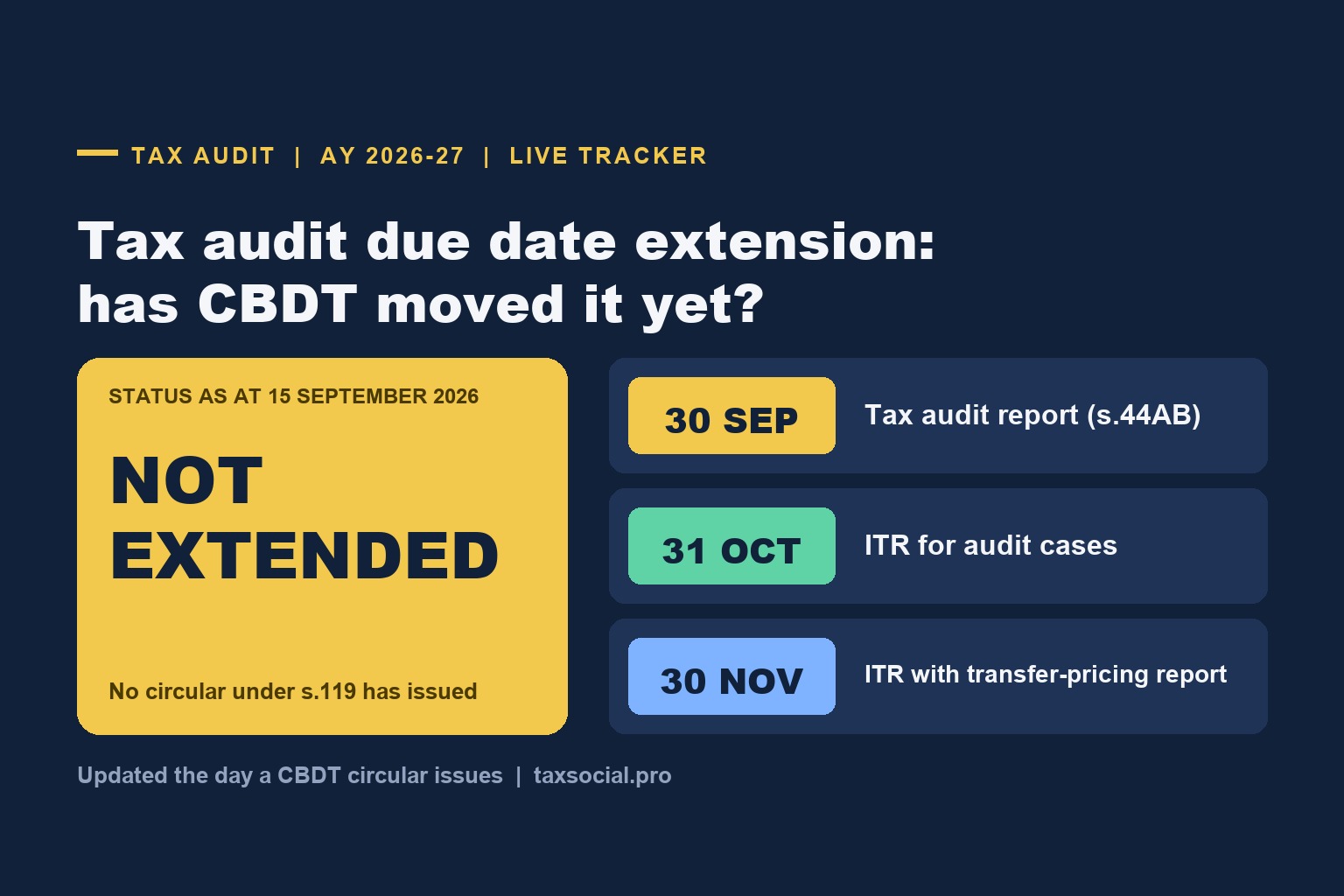
For a firm or proprietorship above Rs 5 crore whose tax audit report is due on 30 September 2026 (no extension as at 8 September):
- Confirm the entity is inside the Note. Not a company, not an LLP, not a trust with a statutory format, not an NPO. Then confirm turnover above Rs 5 crore.
- Classify every balance current or non-current for both 31 March 2026 and 31 March 2025, with the operating cycle written into Note 2.
- Rebuild FY 2024-25 in the new format as the comparative column. Tie the regrouped previous-year totals back to the signed FY 2024-25 accounts and keep the working.
- Lift partners’ remuneration to line X and split interest on partners’ capital out of finance costs, both years. Reconcile to the Section 40(b) computation in Form 3CD.
- Prepare Note 3a per partner, eight columns, with the Previous Year row.
- Build the MSMED schedule for Note 9 from the same supplier data used for Section 43B(h).
- Pick the MSME category and say so in the notes; drop the cash flow statement if exempt, or prepare it if Large.
- Cross-reference every face item to a note, choose a rounding unit, and put the regrouping disclosure in.
- Get the client’s sign-off on the format. Preparation of the financial statements is management’s responsibility; if the client refuses the format, the auditor’s report has to say so (section 3).
The AY 2026-27 Form 3CD checklist covers the audit-report side of the same file. Firms below Rs 5 crore can do all of this at leisure for FY 2026-27, but the ledger tagging in step 2 is worth doing now, because the FY 2025-26 figures become their comparatives next year.
FAQ
Does the ICAI non-corporate format apply for FY 2025-26? For entities whose turnover exceeds Rs 5 crore, yes, for accounting periods beginning on or after 1 April 2025 (Council announcement of 31 March 2026). For all other non-corporate entities it applies from periods beginning on or after 1 April 2026. It remains a Guidance Note: the consequence of not following it is that the auditor must disclose the non-adherence in the report and consider whether the opinion is modified (FAQ 5).
Did it apply for FY 2024-25? No. The 19 September 2025 announcement made both Guidance Notes voluntary for the annual reporting period 2024-25.
Does a proprietorship have to follow it? Yes. Sole proprietorship firms are the first item on the Note’s list of covered entities.
Do LLPs follow this Guidance Note? No. LLPs have a separate Guidance Note on Financial Statements of Limited Liability Partnerships, phased on the same dates.
Do I have to give previous-year figures in the new format in the first year? Yes. Paragraph 5 of the General Instructions and FAQ 9: comparatives for all items including notes, in the same format. Only an entity preparing its first financial statements after incorporation is exempt.
Where does partners’ remuneration go? Line X of the Statement of Profit and Loss, after profit before partners’ remuneration and tax. Interest on partners’ capital stays in finance costs as a separately disclosed sub-line.
Is a cash flow statement required? Not for an MSME (turnover up to Rs 250 crore and borrowings up to Rs 50 crore in the preceding year, plus the other conditions). Required for a Large entity.
Which classification applies, Level I-IV or MSME/Large? MSME/Large, from periods commencing on or after 1 April 2024. The four levels in the Note’s Appendix A were superseded by the August 2024 Council decision.
What happens if the client will not adopt the format? The Guidance Note prescribes no penalty on the entity. The auditor is required to disclose the non-compliance in the report and decides, under the Standards on Auditing, whether the opinion is modified.
Sources
- ICAI, Guidance Note on Financial Statements of Non-Corporate Entities, Accounting Standards Board, August 2023: Chapter I (scope, effective date), Chapter V, Chapter VI General Instructions paras 1-6, Part I and Part II formats and notes, Appendix A, Appendix B illustrative formats.
- ICAI, Frequently Asked Questions on the Guidance Note on Financial Statements of Non-Corporate Entities, issued jointly by the Accounting Standards Board and the Auditing and Assurance Standards Board, hosted July 2025, printed edition August 2025 (foreword dated 22 August 2025), Q1-Q10.
- ICAI, Revised Criteria for classification of Non-company entities for applicability of Accounting Standards, Council decision at the 433rd meeting, 13-15 August 2024, effective for periods commencing on or after 1 April 2024 (reproduced in FAQ 10).
- ICAI announcement dated 19 September 2025 providing relaxation in compliance with the two Guidance Notes for the annual reporting period 2024-25.
- ICAI announcement dated 31 March 2026 regarding applicability of the two Guidance Notes for annual reporting periods 2025-26 onwards (451st Council meeting, 30-31 March 2026).
- ICAI, Clarification Regarding Authority Attached to Documents Issued by the Institute.
This article describes the ICAI pronouncements as they stand on 8 September 2026. It is a guide to the format, not a substitute for reading the Guidance Note against a specific set of accounts. Take advice from a Chartered Accountant on a specific engagement.



Comments (0)
No comments yet. Be the first to comment!